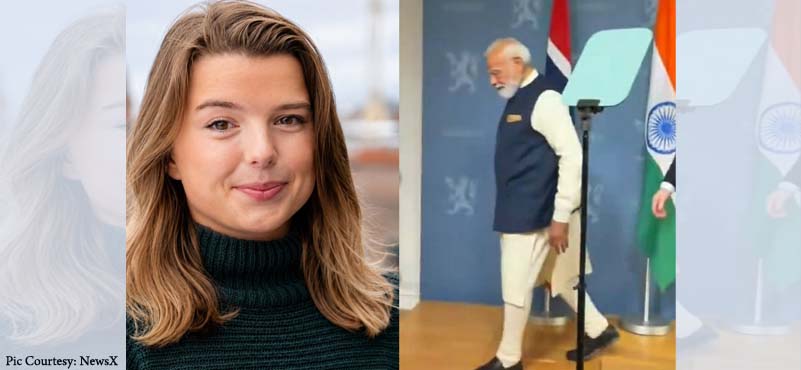
The sharp exchange between an Indian diplomat and a Norwegian journalist during Prime Minister Narendra Modi’s visit to Oslo has travelled far beyond the room where it occurred. What might otherwise have remained a routine media interaction quickly became a global debate about trust, democracy, media freedom and India’s international image.
The journalist’s questions were pointed. Why should the world trust India? Why does the Indian Prime Minister rarely hold open press conferences? The diplomat’s response was equally direct and, to many, visibly irritated.
Predictably, social media split into familiar camps. Some saw the exchange as proof that India is becoming intolerant of scrutiny. Others viewed it as yet another example of Western media speaking to non-Western countries in a tone of inherited superiority.
But the real issue runs deeper than a few uncomfortable minutes before television cameras. The controversy exposed something larger that has been building quietly for years: a growing disconnect between how parts of the West continue to judge India and how India increasingly sees itself.
The West and its long-standing sense of self-righteousness
For a long time, Western democracies held a unique moral position in global politics. Their institutions, media networks and universities shaped the language in which democracy, legitimacy and human rights were discussed internationally. Much of the world accepted that arrangement after the Cold War, as the West appeared politically stable, economically dominant and institutionally confident.
That certainty no longer exists in the same way.
The Iraq War damaged Western claims of moral consistency more than many policymakers initially realised. Libya deepened scepticism. Afghanistan exposed the limits of exporting political models through military intervention. Even within Europe and North America, democracies now face intense internal polarisation, declining trust in institutions, disinformation, and rising political extremism.
Across much of Asia, Africa and Latin America, there is a growing feeling that the so-called “rules-based order” often changes shape depending on who is violating the rules.
This frustration is not always spoken openly, but it exists.
Countries are sanctioned selectively. Military interventions are justified differently depending on the actor. Human rights concerns are loudly amplified in some places and cautiously addressed in others. For many in the Global South, the message increasingly seems inconsistent: principles matter, but geopolitics matters more.
India’s rise while the West’s illusions are getting shattered
India’s rise has unfolded against this changing backdrop. The country is no longer seen internationally as merely a developing economy grappling with poverty and bureaucracy. It is now central to major conversations on technology, manufacturing, digital infrastructure, energy transition and Indo-Pacific security. India matters strategically in ways that were not fully acknowledged even a decade ago. With that rise has come a more confident political mood inside the country.
India does not see itself today as a fragile post-colonial state awaiting external approval. It sees itself as an ancient civilisation operating within a modern democratic framework, marked by enormous internal complexity yet still holding together through elections, institutions and constitutional processes. That reality deserves recognition, even from critics.
India conducts elections on a scale unmatched anywhere in the world. Governments lose power peacefully. Regional parties dominate state politics. Courts regularly intervene in political disputes. Television debates are chaotic, noisy and often exhausting, but they are hardly silent. Opposition leaders campaign freely across the country, often launching fierce attacks on the government.
India has her problems and issues; the narrative is complex!
None of this means India is beyond criticism. No democracy is. Questions about media access, political centralisation, or the tone of public discourse are legitimate topics for debate. Democracies grow stronger when uncomfortable questions are asked. But many Indians today are less frustrated by criticism itself than by what they see as selective framing.
There is often a tendency in parts of the Western conversation to reduce India to a simplified narrative. Complex realities are compressed into binaries. Every social tension becomes evidence of democratic decline, and every political disagreement is interpreted as institutional collapse. Nuance disappears quickly.
Meanwhile, equally serious tensions within Western societies are discussed with greater historical sympathy and contextual depth. When political divisions emerge in Europe or America, analysts speak of economic stress, migration, class anxiety or digital fragmentation. When tensions arise in India, they are often presented as proof of civilisational intolerance. The difference in tone is difficult to miss.
India’s internal reality is far more complex than many external narratives suggest. Take welfare and social mobility. Over the past decade, state welfare delivery has expanded dramatically through digital governance, direct benefit transfers, housing programmes, sanitation schemes and food support systems. These benefits are not distributed on the basis of religion. They reach citizens across caste, regional and faith lines.
This does not erase inequality or discrimination. India continues to struggle with both. But the existence of social challenges is not the same as institutional exclusion. The same complexity is evident in culture.
Then there is the Indian diaspora. From Silicon Valley boardrooms to British politics, and from global academia to medicine and finance, Indians have successfully integrated into some of the world’s most advanced liberal democracies. Their success is not accidental. It reflects educational aspiration, adaptability and a comfort with diversity developed within India itself.
The importance of the Norway incident
A deeply closed society does not produce communities that flourish as naturally as they do in open democratic systems. This is where the Norway episode became symbolically important.
For many Western observers, the exchange was about accountability. For many Indians, however, it reflected something else: fatigue with being constantly examined through a moral lens rarely applied with equal intensity elsewhere.
That frustration should not be mistaken for hostility towards democratic values. India remains emotionally invested in democracy because it is woven into its national experience. It emerged from a freedom movement rooted not in a military revolution but in political mobilisation, constitutional negotiation and mass participation. What has changed is India’s willingness to accept external certification as the final measure of democratic legitimacy.
The world itself is becoming more multipolar, politically and intellectually. Different societies are increasingly asserting the right to develop through their own historical experiences rather than conform entirely to Western political expectations. This does not mean universal values no longer matter. It means no country today possesses unquestioned moral authority.
Not the United States after Iraq. Not Europe after years of selective strategic morality. Not rising powers either. Every major nation now carries contradictions between what it says and what it does. India is no exception. That is precisely why humility matters in international discourse.
Trust is the Future Foundation of Relationships
Trust between nations cannot emerge from televised lectures or moral grandstanding. Nor can it survive through defensive nationalism alone. It grows slowly through consistency, reciprocity, and a willingness to examine one’s own failures before magnifying others’.
The Oslo exchange will eventually fade from headlines. Another controversy will replace it soon enough. But the discomfort it exposed is likely to remain.
India seeks engagement with the West, not estrangement. It values democratic partnerships, economic cooperation and strategic alignment. But it increasingly seeks those relationships on equal terms rather than on the basis of instruction.
That is the larger story beneath the headlines. And perhaps that is what made the conversation in Norway feel so unusually tense.
ABOUT THE AUTHOR
 Lieutenant General A B Shivane, is the former Strike Corps Commander and Director General of Mechanised Forces. As a scholar warrior, he has authored over 200 publications on national security and matters defence, besides four books and is an internationally renowned keynote speaker. The General was a Consultant to the Ministry of Defence (Ordnance Factory Board) post-superannuation. He was the Distinguished Fellow and held COAS Chair of Excellence at the Centre for Land Warfare Studies 2021 2022. He is also the Senior Advisor Board Member to several organisations and Think Tanks.