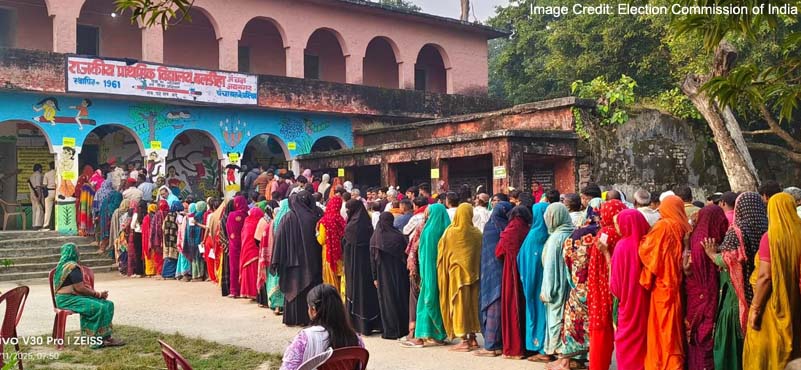
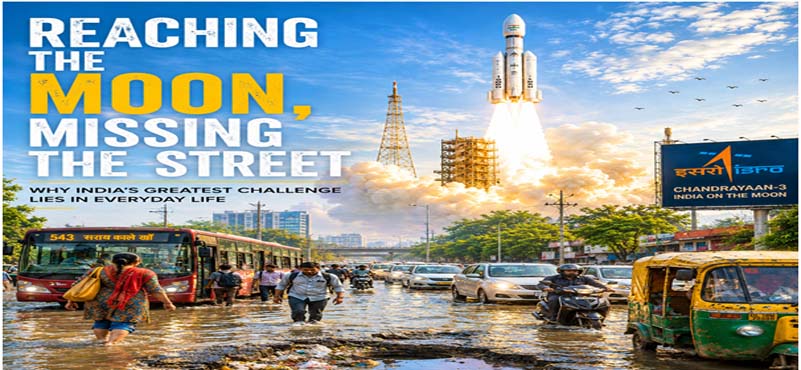
In today’s India, the morning newspaper can simultaneously celebrate a successful Chandrayaan mission, report crores recovered from a judge’s residence, expose examination papers leaked by the system itself, describe horrific violence against women, and count the dead from fires, stampedes, collapsing infrastructure or preventable road accidents. India’s rise is real — but so is the widening gap between national achievement and everyday life.
A Civilisation That Once Led the World
For much of recorded history, India was not merely a geographical expression but one of the world’s great civilisational centres. Long before the rise of modern Europe, India contributed significantly to mathematics, astronomy, metallurgy, medicine, philosophy, spirituality and trade. Ancient universities such as Nalanda Mahavihara attracted scholars from across Asia. Indian textiles, steel, spices and knowledge systems travelled across continents. For centuries, India remained among the world’s largest economies and one of humanity’s most culturally sophisticated societies.
Equally important was the social architecture that sustained this civilisation. India’s strength did not lie only in wealth, but in resilient family structures, local community systems, spiritual pluralism, respect for learning and deeply rooted ethical traditions. Society functioned through networks of trust, duty and continuity.
Then came nearly two centuries of colonial rule under the British Raj. India was systematically deindustrialised, economically drained and psychologically weakened. Traditional education systems declined. Indigenous industries collapsed. Famines ravaged populations. Most damagingly, a civilisation that once possessed confidence in itself gradually lost faith in its own institutions and character.
At Independence, India inherited poverty, illiteracy, partition trauma and fractured infrastructure. Yet against enormous odds, the Republic survived, stabilised and eventually rose again. Over the last decade or so especially, India has entered a phase of visible national resurgence.
But history also presents a warning. Civilizations are not judged only by moments of glory. They are judged by the quality of life experienced daily by ordinary citizens. And that remains India’s unfinished challenge.
The India That Makes Us Proud
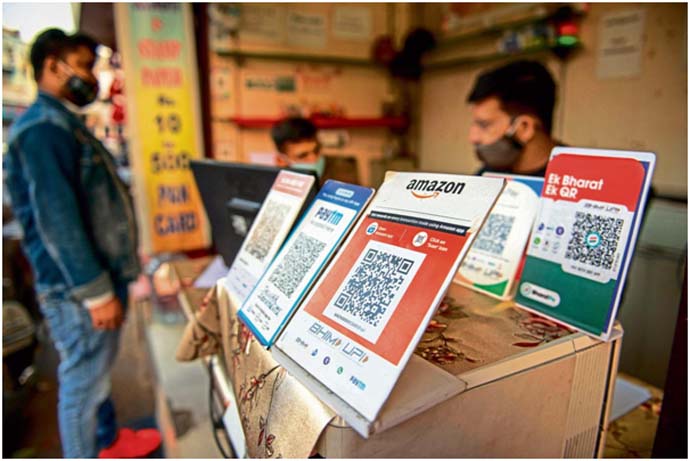
Over the last few years, India has achieved transformations that would once have appeared unimaginable.
- Unified Payments Interface revolutionised digital payments at population scale.
- Chandrayaan-3 Mission made India the first nation to land near the Moon’s South polar region.
- Massive highway, tunnel and border-road construction transformed connectivity.
- India emerged as one of the world’s fastest-growing major economies.
- Indian Space Research Organisation became globally respected for low-cost innovation.
- India demonstrated vaccine and pharmaceutical capacity during the pandemic.
- Defence modernisation accelerated through indigenous missiles, drones and aerospace systems.
- India’s diplomacy expanded its influence across the Indo-Pacific and Global South.
- The start-up ecosystem created global-scale innovation and entrepreneurship.
- A renewed civilisational confidence reconnected modern India with its cultural identity.
These achievements are real. They deserve recognition and national pride.
For the first time in generations, India appears ambitious, assertive and globally consequential.
Yet an uncomfortable question remains: Has the daily life of the average Indian citizen improved with equal speed?
The India That Continues to Exhaust Its Citizens
Despite technological and geopolitical rise, millions still confront structural problems that diminish everyday dignity and quality of life.
- Weak public education and rote-learning systems.
- Educated unemployment and limited high-quality jobs.
- Brain drain of top talent.
- Corruption at multiple administrative levels.
- Judicial delays and weak police reforms.
- Urban flooding, sewage collapse and poor waste management.
- Severe pollution and declining public health.
- Traffic indiscipline and collapsing civic behaviour.
- Vote-bank politics deepening caste and communal fault lines.
- Erosion of meritocracy and institutional excellence.
Beyond these lie deeper social concerns:
- Unsafe public spaces for women.
- Deteriorating public transport.
- Noise pollution.
- Encroachments.
- Collapsing pedestrian culture.
- Disregard for public property.
- Weakening societal value systems.
- Online toxicity.
- Rising emotional stress in urban life.
India today often resembles two nations moving simultaneously:
One reaching for the stars,
The other struggling to cross a flooded street after rainfall.
No number of summits, satellites or slogans can permanently compensate for broken everyday systems.
The next phase of India’s rise must therefore move from visible achievement to lived civilization. And that correction must begin at the ground level.
Great Indian Reforms for a Stronger Everyday India
India’s next transformation will not come from another expressway, summit or moon mission alone. It will come when governance, civic behaviour, education, justice and public morality improve at ground level. A nation is judged not only by the height of its rockets, but by the dignity of ordinary life.
Singapore under Lee Kuan Yew showed that honest leadership, institutional discipline and civic order can transform a nation. India’s scale is far larger, but the principle remains valid: reform begins at the top.
India now needs a Great Indian Correction — not of ambition, but of priorities.
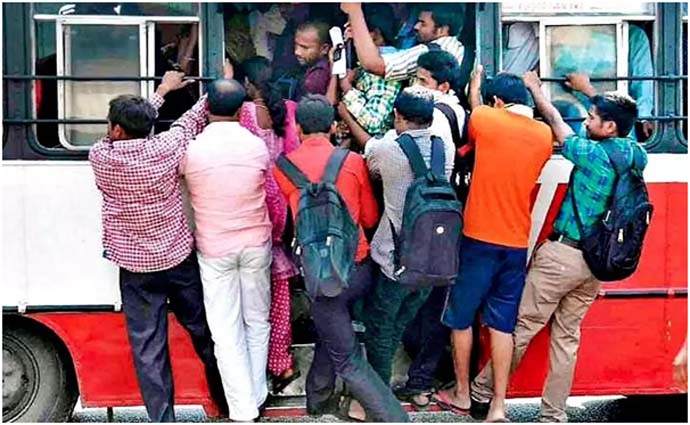
1. Governance Must Become Ruthlessly Accountable. Citizens experience the nation through municipal offices, police stations and district administrations, not speeches. India needs time-bound public services, digital transparency, strict anti-corruption enforcement and performance-based bureaucracy. Every ministry should function through measurable outcomes rather than ceremonial announcements. Governance must become responsive instead of intimidating.
Inefficiency becomes dangerous when it becomes normal.
2. Judicial Reform Can No Longer Wait. A superpower cannot function with a justice system where cases outlive generations. India urgently needs more judges, modern courts, police reform, fast-track trials and judicial transparency. Swift and predictable justice is essential for both citizens and economic growth. Without judicial credibility, development eventually loses moral legitimacy.
Justice delayed eventually becomes national decay.
3. Education Must Create Capability. India produces elite achievers while millions remain trapped in weak schooling. The system rewards memorisation over thinking and degrees over skills. Reform must focus on foundational learning, critical thinking, vocational education, research culture and civic values.
Education should create responsible citizens, not merely examination survivors.
4. Meritocracy and Social Justice Must Coexist. Historical inequality is real, but national strength also depends on excellence. Long-term reform should focus on equal preparation through better schools, scholarships and rural opportunity rather than endless political expansion of quotas. Critical sectors such as science, medicine, judiciary, research and strategic institutions must preserve the highest standards of competence. Sustainable justice empowers the weak without weakening competence.
When merit lose legitimacy, talent quietly leaves.
5. India’s Cities Need Emergency Reform. India’s future will be decided in its cities — many of which are becoming physically and psychologically exhausting. Flooded roads, sewage failures, traffic paralysis and poor public transport cannot coexist with superpower ambitions. Urban reform requires scientific planning, drainage modernisation, walkable spaces and professional municipal governance. Municipal governance must become professional rather than political. No nation appears modern when daily urban life feels chaotic.

Indian cities should be designed for human dignity, not merely vehicle movement.
6. Civic Sense Must Become National Mission. Littering, spitting, vandalism, honking and traffic indiscipline have become socially tolerated. No government alone can solve this. Civic discipline must be taught in schools, reinforced through strict penalties and normalised through social behaviour.
The quality of a civilization is visible in how it treats shared spaces.
7. Growth Must Generate Dignified Jobs. Economic growth without employment creates frustration, not stability. India must aggressively expand manufacturing, MSMEs, labour-intensive industries, apprenticeships and rural enterprise clusters. Government jobs alone cannot absorb national aspirations. India must become a producer nation, not merely a consumption market.
Employment is not merely economics; it is dignity, stability and social confidence.
8. India Must Retain Its Best Minds. Many of India’s brightest minds leave for cleaner systems, stronger research ecosystems and merit-based opportunities abroad. Patriotism alone cannot retain talent. India must build world-class universities, research institutions and innovation ecosystems worthy of return.
A civilization rises when its finest minds choose to build within it.
9. Politics Must Stop Deepening Divisions. Short-term vote-bank politics has sharpened caste, communal and regional fault lines. Democracy requires competition, but not permanent polarization. India needs constitutional nationalism, civic unity and leadership that rewards shared identity over manufactured division. Civilisational confidence must unite, not divide.
Elections may be won through division; nations are not built that way.
10. Moral Renewal Matters as Much as Economic Reform. The deepest crises of societies are moral before they become political. Corruption, dishonesty, disrespect for women, glorification of shortcuts and erosion of public ethics weaken nations silently. Development without character eventually becomes hollow.
India does not merely need economic growth. It needs a correction in behaviour, governance, priorities and national character.
India has already shown that it can build highways, digital systems and lunar missions. The harder challenge now is building clean cities, fair institutions, disciplined public behaviour and dignified everyday life. The next phase of India’s rise must therefore move from spectacle to society, from projection to participation, and from ambition to national character.
Conclusion — The Real Meaning of Amrit Kaal
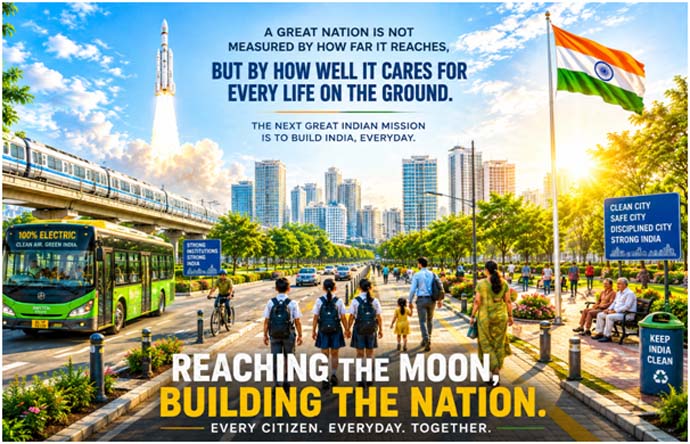
India stands today at a rare moment in its civilisational journey. The nation possesses demographic strength, technological capability, strategic relevance and renewed cultural confidence. Few periods in modern Indian history have carried such possibility. But history also teaches that nations do not decline only because they are attacked from outside. They decline when internal disorder becomes acceptable.
The coming decades of Amrit Kaal cannot merely be about becoming bigger, richer or louder. They must be about becoming more disciplined, more just, more capable and more humane. India has already shown that it can build missiles, digital systems, highways and lunar missions. The harder challenge now is to build:
- Cleaner cities.
- Trustworthy institutions.
- Better schools.
- Safer public spaces.
- Fairer systems.
- Responsible citizens.
- Dignified everyday life.
The next great Indian mission is therefore not technological alone. It is civilisational.
For a nation becomes truly great not when it reaches the Moon, but when ordinary citizens can live with dignity beneath the same sky.
ABOUT THE AUTHOR

Lt Gen Rajeev Chaudhry (Retd) is a social observer and writes on contemporary national and international issues, strategic implications of infrastructure development towards national power, geo-moral dimension of international relations and leadership nuances in changing social construct.