
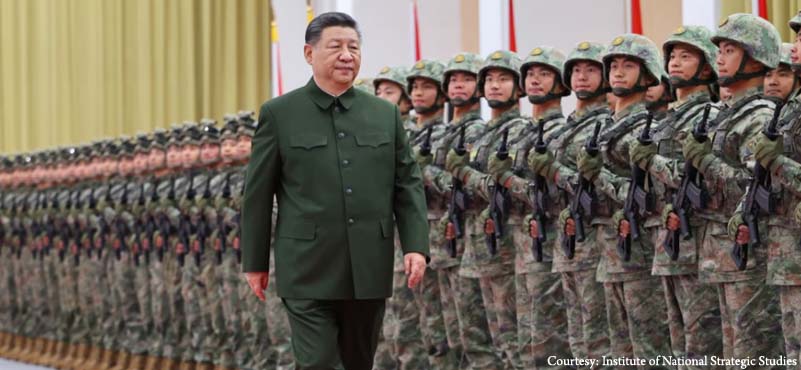
For years, China carefully cultivated the image of a rising military giant. Every parade in Beijing conveyed the same message. New missiles rolled across Tiananmen Square, stealth fighters flew overhead, and warships entered service at a pace few countries could match. Under Xi Jinping, the People’s Liberation Army was portrayed as modern, disciplined, and ready for long-term competition with the West.
That image still exists, but cracks are beginning to show underneath it.
Over the last two years, the discussion around China’s military has shifted quietly from capability to control. Senior officers have disappeared from public life. Defence ministers have been removed. Rocket Force commanders have come under investigation. Officials once considered politically secure suddenly vanished from the system without explanation. In China, such developments are never routine.
At first, Beijing described these moves as part of another anti-corruption drive. Corruption inside the PLA is hardly a new story. Promotions, procurement contracts, and personal networks have influenced military careers for years. Yet what is happening now feels different in scale and tone. The campaign no longer looks limited to corruption alone. It increasingly reflects a leadership worried about loyalty inside its own military establishment.
That concern sits at the heart of the Chinese political system. Since the time of Mao Zedong, the Communist Party has treated the military not simply as a fighting force but as the ultimate guarantee of political survival. The Party does not just command the army. It depends on it. Chinese leaders have always feared losing control over the armed forces, even as they rely on them to project power abroad.
Xi Jinping understood this from the beginning. When he took office in 2012, the PLA was widely seen as powerful but internally compromised. Several senior officers had built extensive patronage networks. Corruption allegations were common. Loyalty to factions often appeared stronger than loyalty to institutions. Xi moved aggressively to break those centres of influence. High-ranking generals were arrested or sidelined. The military was reorganised into theatre commands. Decision-making became more centralised under the Central Military Commission.
At the same time, military modernisation accelerated rapidly. China expanded naval production, improved missile systems, strengthened cyber capability, and invested heavily in space and artificial intelligence programmes. The PLA transformed into a far more capable force than the one Xi inherited.
But another process unfolded alongside military reform. Political supervision inside the armed forces intensified steadily. Officers were repeatedly reminded that absolute loyalty to the Communist Party was essential. Political education regained importance. Ideological conformity returned to military culture. Xi placed increasing emphasis on personal loyalty within the command structure.
This created a difficult balance. Professional militaries need officers who can think independently during crises, identify weaknesses honestly, and adapt under pressure. Excessive political oversight tends to foster caution rather than initiative. Officers become more concerned about avoiding mistakes than confronting problems directly. Over time, fear begins replacing professional confidence.
The recent purge within the PLA appears to be connected to exactly this problem. The investigations involving China’s Rocket Force attracted particular attention because the Rocket Force controls some of Beijing’s most sensitive missile and nuclear assets. Leadership changes inside such organisations rarely happen casually. They usually indicate serious concern at the political level.
Corruption may certainly exist. Rapid military expansion creates enormous procurement systems where abuse can flourish. Yet corruption alone does not explain why figures once considered close to Xi himself also came under scrutiny.
That detail matters. In highly centralised systems, the removal of trusted insiders often reveals rising insecurity at the top. Leaders begin questioning not only opponents but also allies within their own circle. The atmosphere gradually takes on a suspicious tone.
Such conditions affect military effectiveness in ways that are not immediately visible. An officer corps operating under constant political pressure rarely encourages frank discussion. Commanders avoid taking risks. Weaknesses remain unspoken. Decision-making narrows because few people want to deliver unwelcome assessments upward through the system. The institution may continue appearing strong externally while becoming internally rigid.
History shows this repeatedly. Militaries shaped too heavily by political fear often struggle during moments of uncertainty. Discipline alone cannot replace professional confidence. Weapons and technology matter, but trust inside the chain of command matters as well.
China now faces a contradiction of its own making. Externally, Beijing confronts a far more demanding strategic environment than it did a decade ago. Competition with the United States has intensified sharply. Taiwan remains a major flashpoint. Military activity across the Indo-Pacific continues to grow. Under such conditions, China requires commanders capable of flexibility, speed, and independent judgment.
Yet Xi Jinping appears more determined than ever to tighten political discipline inside the PLA. Official speeches increasingly stress ideological loyalty and political rectification. Internal supervision remains strong. The Party’s instinct during periods of uncertainty has always been the same: tighten control further.
The problem is that constant purges create consequences over time. They disrupt continuity inside the officer corps. They create hesitation within command structures. Officers begin studying political signals more carefully than operational realities. Initiative weakens quietly, not dramatically. The damage is often gradual and difficult to measure until a crisis exposes it.
None of this means China’s military strength should be dismissed. The PLA today remains vastly more capable than it was fifteen years ago. China still possesses major advantages in industrial output, missile production, infrastructure development, and military technology. Its capacity to sustain pressure along contested borders or within the Indo-Pacific remains substantial.
But military power is not only about equipment. The real test comes when institutions face stress, uncertainty, and conflict. At those moments, cohesion and confidence become critical.
This is what makes the current developments inside the PLA strategically important. Xi Jinping wanted a military that was modern, centralised, and completely loyal. What is becoming clear now is how difficult it is to sustain those goals together over long periods. Systems built heavily around personal authority often become vulnerable to distrust from within.
For India, these developments require careful interpretation. Assuming that internal turbulence automatically weakens China would be a mistake. Beijing retains significant military capability and long-term strategic ambition. At the same time, political insecurity inside centralised systems can sometimes create unpredictability in external behaviour.
History offers many examples of governments projecting strength abroad during periods of internal unease. Nationalism often becomes a tool for reinforcing political authority at home. That possibility cannot be ignored in China’s case.
India’s response, therefore, must remain grounded in preparedness rather than in optimism about Chinese instability. Military modernisation, infrastructure along the Line of Actual Control, surveillance capability, theatre integration, and technological self-reliance remain essential regardless of temporary turbulence within the Chinese system.
In the end, the current military purge inside China says something larger about the nature of power under Xi Jinping. The Chinese leadership succeeded in concentrating authority to an extraordinary degree. Yet systems centred heavily around personal loyalty eventually create their own insecurities. The more leadership depends on trust, the more damaging distrust becomes when it begins spreading through the structure itself.
ABOUT THE AUTHOR
 Lieutenant General A B Shivane, is the former Strike Corps Commander and Director General of Mechanised Forces. As a scholar warrior, he has authored over 200 publications on national security and matters defence, besides four books and is an internationally renowned keynote speaker. The General was a Consultant to the Ministry of Defence (Ordnance Factory Board) post-superannuation. He was the Distinguished Fellow and held COAS Chair of Excellence at the Centre for Land Warfare Studies 2021 2022. He is also the Senior Advisor Board Member to several organisations and Think Tanks.


