
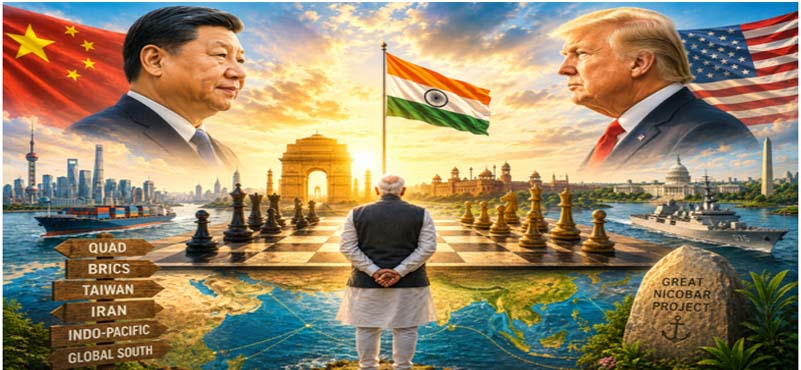
As alliances shift and great powers recalibrate, India attempts something far more difficult – balancing strategic realism with civilisational purpose.
Summit of Rivals
American and Chinese leaders now meet with smiles while warships shadow each other across the Indo-Pacific and sanctions quietly tighten behind closed doors. This image captures the central tension of our century: rivalry without rupture. Washington and Beijing compete in technology, trade, maritime power and influence, yet both understand that uncontrolled confrontation would damage the global economy and destabilize the international order they still depend upon.
The world therefore witnesses a strange age where adversaries negotiate continuously even while preparing for prolonged competition. For India, this changing landscape demands strategic clarity rather than emotional reaction. Every summit is not a betrayal, every disagreement is not war, and every diplomatic thaw is not permanent peace. Great powers often cooperate selectively while competing elsewhere because modern geopolitics has become transactional, layered and deeply interconnected.
This transition creates an extraordinary opportunity for India. For the first time in centuries, India is not merely reacting to world events but increasingly shaping them. The emerging order is no longer purely Western, yet it is not fully Chinese either. It is becoming fluid, uncertain and multipolar.
In such a world, nations rooted in deep civilisational confidence may endure longer than powers dependent only upon military dominance or economic scale.
Strategic Autonomy in a Multipolar World
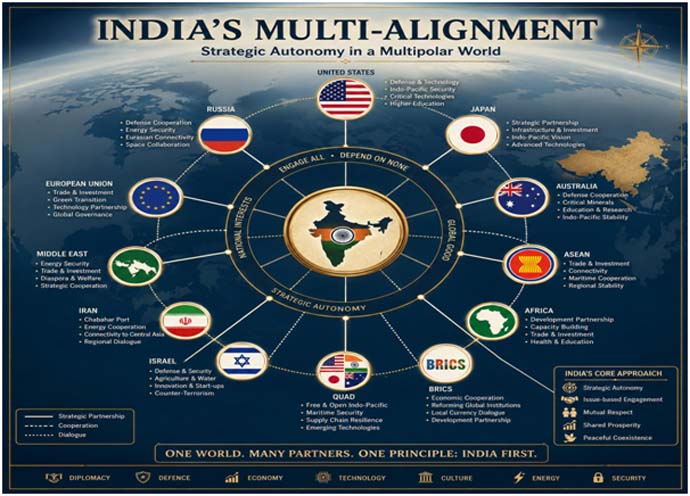
The twentieth century trained nations to think in rigid camps. The twenty-first century is dismantling that model. America competes with China yet remains economically intertwined with it. Europe criticizes Beijing but depends heavily on Chinese trade. Gulf nations host American military infrastructure while expanding ties with China. Russia and China cooperate strategically even while competing quietly in parts of Asia.
Permanent alliances are fading. In their place emerge issue-based partnerships shaped by energy, technology, supply chains, maritime access and strategic necessity. Nations increasingly cooperate in one sphere while competing in another. The world has become simultaneously connected and fragmented.
India understands this transformation better than most because Indian strategic thought has long accepted complexity. From the Mahabharata to Kautilya, Indian statecraft recognised that relationships evolve according to circumstance and interest. But unlike modern cynical realism, Indian civilisation traditionally pursued balance rather than domination.
This explains why India can engage the United States, Russia, Iran, Israel, the Gulf states and BRICS at the same time without fully surrendering strategic autonomy. To outsiders this appears contradictory. In reality it reflects maturity. India understands that the future world order will not resemble the disciplined blocs of the Cold War. It will remain unstable, competitive and constantly shifting.
India’s challenge therefore is not choosing sides between America and China. Its challenge is ensuring that no partnership limits India’s long-term strategic space. That requires patience, confidence and freedom from diplomatic insecurity.
Quad, Taiwan and Theatre of Ambiguity
The Quad is often misunderstood because observers expect it to resemble NATO. It does not. The Quadrilateral Security Dialogue exists not as a rigid military alliance but as a framework designed to shape calculations across the Indo-Pacific. Its purpose is maritime coordination, supply-chain resilience, technology cooperation and strategic signalling.
All four members — India, the United States, Japan and Australia — understand that China’s growing naval presence is altering the Indo-Pacific balance. Yet none seek uncontrolled escalation. Strategic ambiguity itself has become an instrument of deterrence. America avoids complete clarity on Taiwan, China avoids fixed timelines, and the Quad avoids treaty obligations while steadily deepening cooperation.
India’s approach remains especially cautious. New Delhi does not seek military confrontation over Taiwan, yet it also does not wish to see unchecked Chinese dominance across Asian waters. India therefore strengthens maritime partnerships quietly while preserving diplomatic flexibility.
This ambiguity reflects a larger reality of modern geopolitics: wars are increasingly prevented not merely through military superiority but through uncertainty. Nations seek enough preparedness to discourage aggression without locking themselves into irreversible commitments. The Indian Ocean consequently becomes central to the future balance of power. Energy routes, digital cables, shipping lanes and military logistics increasingly converge across these waters.
Whoever shapes this maritime geography will influence the rhythm of the century itself.
Iran, West Asia and Silent Bargains of Power
Modern powers frequently speak the language of morality while acting according to strategic interests. Human rights, sovereignty and democracy remain important principles, yet major nations often interpret them selectively depending upon circumstance. West Asia demonstrates this contradiction clearly.
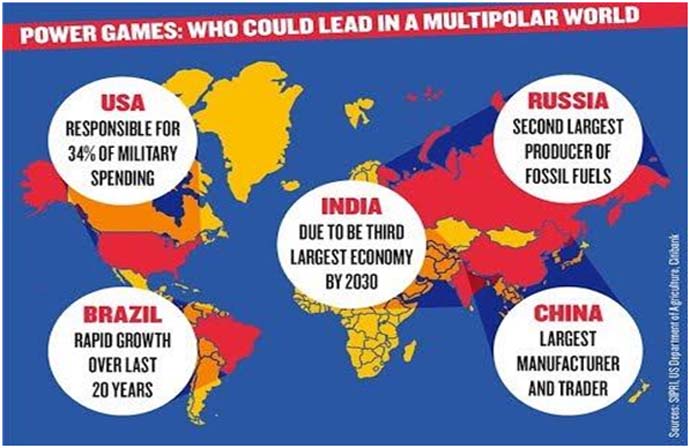
The United States seeks regional stability without endless military entanglement. China wants uninterrupted energy access. Russia seeks influence and leverage. Regional powers pursue their own security ambitions. Amid this complexity emerges an uncomfortable question: do major powers silently tolerate each other’s strategic priorities in different regions to avoid simultaneous escalation?
No formal arrangement may exist, yet history shows that powerful nations often compartmentalise tensions according to necessity. America prioritizes the Indo-Pacific. China prioritises Taiwan and energy security. Both understand the risks of uncontrolled global confrontation.
For India, these changing equations require careful balance. India maintains relations with Iran, Israel, the Gulf monarchies, Russia and the United States simultaneously because its interests demand flexibility. Yet India’s diplomacy also carries a distinct civilisational quality. Unlike many powers, India historically expanded influence more through culture, trade and intellectual exchange than through military conquest abroad.
This gives India unusual credibility. Many countries engage India without fearing ideological domination. Yet moral legitimacy alone is insufficient in a turbulent century. Nations unable to defend economic and strategic interests materially eventually lose influence.
Dharma without capability becomes vulnerability. Capability without restraint becomes domination. India’s challenge is to balance both.
Dharma and Statecraft
Indian civilisation has never separated morality and strategy completely. The Mahabharata itself explores power, duty, deception, restraint and responsibility with extraordinary depth. Krishna represents neither passive idealism nor cynical realism. He represents disciplined balance.
This civilisational memory matters in the emerging world order. Western geopolitical traditions often evolved around expansion and balance of power. Chinese political thought emphasised centrality and hierarchy. Indian strategic philosophy traditionally sought equilibrium.
Dharma therefore is not weakness. It is responsible power operating under ethical restraint. Indian statecraft understood espionage, alliances and hard power thoroughly, yet stability remained the larger objective.
This is one reason India’s rise evokes less fear globally than many historical powers. Nations may compete with India economically or strategically, but few fear civilisational domination from India. Its influence has historically spread through attraction more than coercion.
Yoga, Buddhism, democratic continuity and technological innovation have expanded India’s global presence beyond military reach alone. In a fractured century exhausted by coercive ideologies, civilisational credibility becomes a form of power.
But credibility survives only when supported by capability. India must therefore combine spiritual confidence with technological depth, military modernisation and institutional strength. A civilisation loses relevance not merely when defeated externally, but when it loses belief in itself internally.
India’s quiet recovery of civilisational confidence may therefore become one of the defining geopolitical developments of the century.
Great Nicobar and Quiet Preparation of India
The Great Nicobar project represents far more than infrastructure development. It reflects India’s recognition that the twenty-first century will be profoundly maritime. Located near the Malacca Strait, Great Nicobar sits close to one of the world’s most critical trade chokepoints connecting Asian manufacturing with global markets and energy routes.
China understands the vulnerability of these sea lanes. America understands their importance. India increasingly recognises its own geographic advantage. For centuries India remained strategically preoccupied with continental threats. Today it is gradually rediscovering the importance of maritime power. Ports, logistics corridors, naval reach, submarine networks and island infrastructure will shape the future balance of influence as much as land borders.
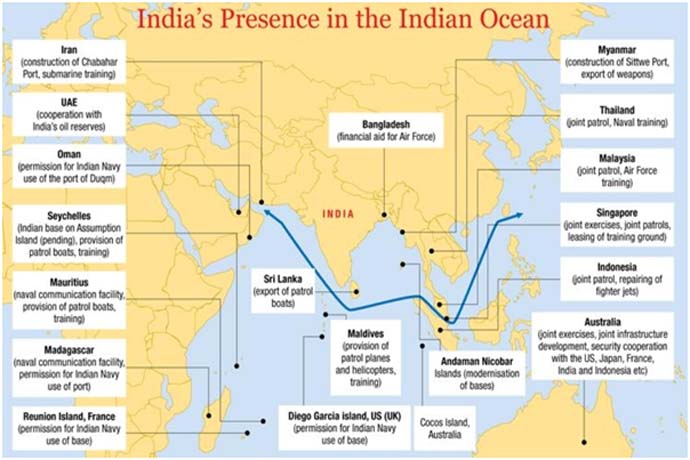
Great Nicobar therefore symbolises a larger strategic lesson: partnerships are useful, but no external power permanently secures another nation’s interests. India cannot rely entirely upon Quad, BRICS or any bilateral understanding. It must build indigenous capability steadily and quietly.
This includes naval modernisation, supply-chain resilience, semiconductor manufacturing, digital infrastructure and economic depth. The world respects nations that prepare consistently rather than proclaim loudly.
India’s growing maritime consciousness indicates that New Delhi increasingly thinks in decades rather than headlines. Civilisations that understand geography early often shape history later.
BRICS and Battle for the Global South
The rise of the Global South is reshaping geopolitics. Many developing countries seek greater influence within international systems historically dominated by Western institutions. BRICS has therefore evolved beyond an economic grouping into a platform for discussing financial reform, trade diversification and strategic autonomy.
Yet BRICS contains competing ambitions. China seeks influence within it. Russia views it partly as a counterweight to Western pressure. Smaller nations seek economic opportunity. India sees potential for Global South coordination without complete anti-Western alignment.
This distinction is important. India does not seek to replace one hegemonic order with another. It seeks a more balanced structure where multiple centres of influence coexist. India’s diplomatic advantage lies in trust. Unlike colonial powers or expansionist states, India is generally viewed as a country that engages without demanding ideological submission. Its developmental journey resonates with many postcolonial societies across Africa, Asia and Latin America.
But leadership of the Global South cannot rest upon speeches alone. It requires infrastructure, trade access, technological cooperation, educational partnerships and development financing. India must convert goodwill into sustained capability.
The coming decades may reveal that influence depends not merely upon fear or economic scale, but upon credibility. And credibility cannot be manufactured quickly.
Is the World Ready for an Indian Century?
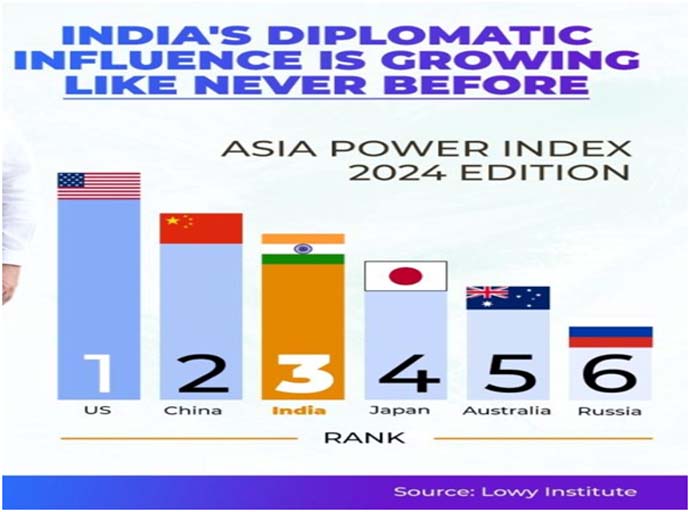
The phrase “Indian Century” inspires confidence, but history punishes complacency. Civilisations rise not because greatness is owed to them, but because they organize themselves effectively during moments of opportunity.
India unquestionably possesses such an opportunity today. Its economy is expanding, its technological profile is strengthening and its geopolitical importance is growing amid intensifying US-China rivalry. Yet opportunity alone never guarantees destiny. India must still modernise manufacturing, improve education, strengthen institutions, accelerate innovation and maintain social cohesion. These are civilisational questions, not merely policy debates.
The country must avoid two dangers simultaneously: inferiority and arrogance. Excessive dependence upon foreign validation weakens strategic confidence. But assuming history automatically guarantees Indian greatness creates complacency.
India’s philosophical inheritance may offer an advantage here. Indian civilisation traditionally viewed time through continuity rather than impatience. Such long-term thinking can become strategic strength in an unstable century dominated by rapid reactions and information warfare. But patience must not become inertia. The coming decades will reward nations capable of combining cultural confidence with technological excellence, economic resilience and military preparedness.
If India succeeds in harmonising these elements, the world may witness not merely the rise of another state, but the return of a civilisation capable of shaping global discourse differently.
The Civilisation That Refused to Choose Sides
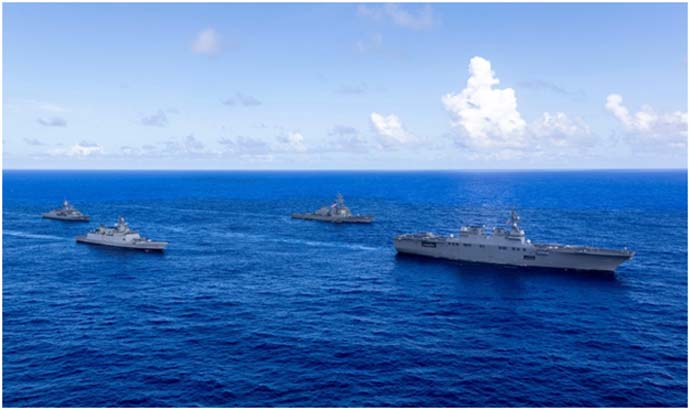
The future world order will not be neatly bipolar or permanently multipolar. It will remain fluid, transactional and uncertain. Nations will cooperate selectively, compete simultaneously and constantly recalibrate. In such a world, survival may depend less upon rigid alliances and more upon civilisational steadiness.
India occupies a unique position within this transition. It engages Washington without becoming fully Western, works with Russia without becoming revisionist and participates in BRICS without becoming anti-American. India maintains relations with Iran, Israel and the Gulf simultaneously while preserving strategic autonomy. This is not confusion. It reflects an ancient instinct: remain anchored while navigating turbulence.
India does not need to dominate every confrontation to shape outcomes. It must instead strengthen itself sufficiently that all major powers recognise the value of stable engagement with India.
The coming century may therefore belong not to the loudest power, but to the civilisation most capable of balancing strength with wisdom. India has survived invasions, colonisation and fragmentation because its continuity emerged from cultural depth as much as military resilience. Today that continuity intersects with geopolitical opportunity.
As America and China negotiate, compete and recalibrate, India’s greatest strategic advantage may lie in an ancient realisation: power matters, but civilisations endure only when power remains anchored to purpose.
If India preserves confidence, discipline and balance, the emerging century may eventually carry an unmistakably Indian civilisational imprint across humanity.
ABOUT THE AUTHOR

Lt Gen Rajeev Chaudhry (Retd) is a social observer and writes on contemporary national and international issues, strategic implications of infrastructure development towards national power, geo-moral dimension of international relations and leadership nuances in changing social construct.