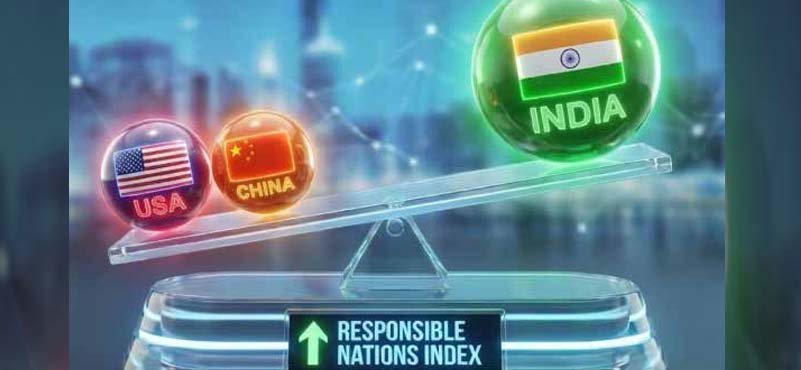
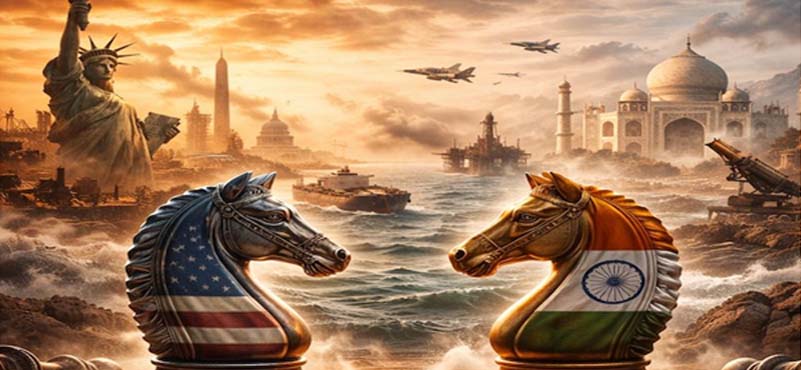
Not every agreement marks a strategic pivot. Some exist to stabilise pressure and foster detente. The US–India trade deal announced on 3 Feb 2026 belongs in that category. Yet, in international relations, strategic space without strategic autonomy remains a pause rather than progress. Cooperation must expand options, not convert leverage into dependency.
This agreement reduces US tariffs on Indian exports to 18 per cent and restores access to key manufacturing sectors. It is paired with Indian commitments to increase imports from the United States, ease non-tariff barriers, and gradually reduce purchases of Russian oil. The relief is welcome, but the obligations are not risk-free. The pause reflects tactical detente, but it does not assure strategic autonomy. Viksit Bharat must be built on strategic autonomy. Any conditional arrangement or dependency remains transactional.
For India, the gain is space rather than certainty. Export momentum returns, but strategic choice narrows when economics becomes conditional. The industries that were affected by the sudden increase in tariffs have a breathing space include textiles, engineering goods, gems and jewellery and marine exports. What remains unchanged are scale limitations, logistics costs, and productivity gaps that continue to restrain export competitiveness.
The concessions India has made may, over time, outweigh the benefits currently visible. The promise to increase imports to the United States, to relax non-tariff barriers and gradually sever its dependency on Russian energy supplies must be weighed through a long term perspective and behavioural predictability of nations. They are not non-partisan trade adjustments. They strike home-grown political faults and strategic linkages, which cannot be recalibrated without expense. Cooperation with Washington is necessary, yet dependence must remain optional, not presumed.
The most understandable would be energy. Russian crude, which was bought at a discount, cushioned India against the global price volatility and inflationary pressure. Abandoning it will increase the import expense and decrease flexibility in a period when energy markets are still volatile. It also complicates the strategic logic of an armed forces structure still heavily reliant on Russian-origin platforms and sustainment chains. The process of diversification is unavoidable, yet speeding up through external pressure and pitting one against the other can be a strategic blunder.
For the United States, trade once again serves as leverage. It works quickly, but credibility accumulates slowly. From Washington’s perspective, the accord reinforces a broader policy that treats economics as an extension of strategy. Leverage is market access and financial conditionality. This method is fast in terms of results, though it has long-term risks. Alliances formed under pressure are not strong, but temporary. In contrast to tariffs, as a concept of credibility cannot be turned on and off.
This reaction is typical of India, which has a sense of balance, but not of alignment. New Delhi has not forsaken its broader diplomatic hedging, which includes its continued involvement in BRICS, engagement with the Global South, G20 leadership and further involvement in Europe and the Indo-Pacific despite closer engagement with the United States. This is not indecision; it is an awareness that excessive reliance, even with amiable powers, limits choice.
The home aspect of the transaction should not be underrated. Experience in agriculture and dairy shows that such commitments, once politicised, are difficult to reverse or quietly implement. Historical experience shows that rapid dilution of regulatory safeguards often collides with public interest, federal politics, and social resistance. Such frictions are not solved by diplomatic communiqués. Until they can no longer be ignored, they build up and demand renegotiation. The spirit of protectionism has not died; only the words have been changed. To India, this drives home a bitter fact: dependency on external goodwill cannot be used at the cost of internal competitiveness.
All this does not detract from the tactical worth of the agreement. It is better to use de-escalation as an alternative to confrontation. Stability brings room for cooperation in high-level manufacturing, technology and defence manufacturing. But that space must be deliberately used. In case temporary relief is made the aim itself, strategic autonomy is destroyed by default instead of design.
Whether the deal is good or bad is, therefore, not the central question. The real test is whether India is able to transform short-term accommodation into long-term capability. That is much more of a domestic reform, supply-chain resilience, and energy diversification than countries negotiating tariff margins overseas.
This accord is a suspension of pressure. The imbalance is not resolved. It presents access, but not security. In the age of the economy-geopolitics complexification, India does not need to evade interaction, but ensure that the interaction will increase options and not reduce them.
As economics and power entwine more tightly, tactical pauses will not suffice. Progress demands autonomy within partnerships, not space that slowly narrows into constraint.
ABOUT THE AUTHOR
 Lieutenant General A B Shivane, is the former Strike Corps Commander and Director General of Mechanised Forces. As a scholar warrior, he has authored over 200 publications on national security and matters defence, besides four books and is an internationally renowned keynote speaker. The General was a Consultant to the Ministry of Defence (Ordnance Factory Board) post-superannuation. He was the Distinguished Fellow and held COAS Chair of Excellence at the Centre for Land Warfare Studies 2021 2022. He is also the Senior Advisor Board Member to several organisations and Think Tanks.