
Introduction
History rarely repeats itself in identical form, but it often reveals familiar patterns. Major powers tend to respond forcefully when they perceive strategic threats to their core interests, particularly in regions they regard as vital to their influence. The United States has long followed this logic of deterrence and dominance, especially in the Western Hemisphere. What distinguishes the January 2026 U.S. military operation against Venezuela, however, is not merely its intent but its scale, speed, and directness.
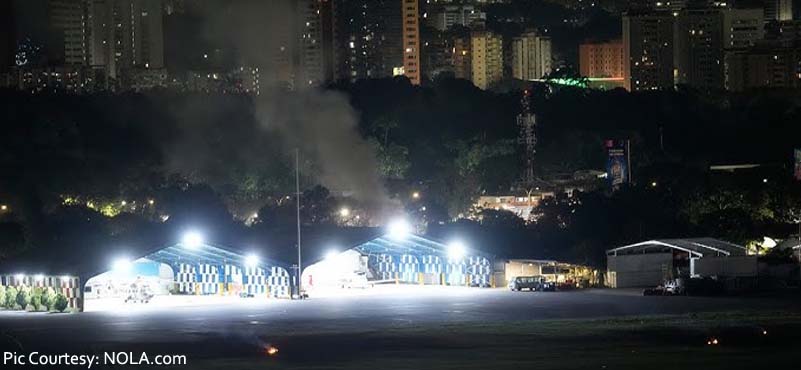
On 3 January 2026, the United States launched coordinated air and special-forces strikes against targets in Caracas, resulting in the capture of Venezuelan President Nicolás Maduro and his wife, Cilia Flores. They were transferred to the United States to face long-standing criminal charges related to narcotics trafficking. President Donald Trump described the operation as a decisive success and signalled Washington’s intention to oversee Venezuela’s stabilisation and open its energy sector to U.S. and allied firms.
This intervention represents the most direct U.S. military action in Latin America since the 1989 invasion of Panama. It has fundamentally altered regional geopolitics and reignited global debates on sovereignty, international law, and the future of the international order.
Historical Background: A Long and Contentious Relationship
U.S.–Venezuela relations have deteriorated steadily since the rise of Hugo Chávez in 1999. Chávez pursued a nationalist, socialist agenda that explicitly challenged U.S. influence and restricted foreign access to Venezuela’s oil sector. His policies reoriented Venezuela’s foreign relations toward ideological allies and state-led economic models, unsettling Washington and international energy markets.
After Chávez’s death, Nicolás Maduro inherited an already strained relationship with the United States, which worsened amid economic collapse, hyperinflation, institutional decay, and a deepening humanitarian crisis. Washington increasingly portrayed the Maduro government as authoritarian, corrupt, and entangled in transnational criminal networks. U.S. sanctions, diplomatic isolation, and legal actions against senior Venezuelan officials became central tools of pressure. This history of antagonism forms the backdrop against which the January 2026 operation must be understood.
Immediate Triggers of the 2026 Intervention
The U.S. military action did not emerge suddenly. Several developments in late 2025 heightened tensions and set the stage for escalation.
First, U.S. naval operations intensified in the Caribbean, including interdictions of vessels allegedly linked to narcotics trafficking and seizures of Venezuelan-associated oil tankers. These actions were justified by Washington as law-enforcement measures but were widely criticised as violations of Venezuelan sovereignty.
Second, the Trump administration tightened restrictions on Venezuelan oil exports, effectively choking the country’s principal source of revenue. The blockade deepened Venezuela’s economic paralysis and reinforced Washington’s leverage.
Third, the long-standing U.S. indictment of Maduro on narco-terrorism charges reframed him not merely as a hostile leader but as an alleged criminal figure. This legal framing provided political justification for a direct operation, echoing the U.S. capture of Panama’s Manuel Noriega in 1989.
Finally, ideological and strategic concerns played a role. Venezuela’s alignment with China, Russia, and Cuba reinforced Washington’s perception of Caracas as a hostile outpost of rival powers in the Western Hemisphere.
Deeper Strategic Drivers
Beyond immediate triggers, several structural factors shaped Washington’s decision.
Oil and Energy Strategy
Venezuela possesses the world’s largest proven oil reserves. Although production has declined sharply due to mismanagement, sanctions, and infrastructure decay, the underlying resource base remains strategically significant. Influence over Venezuelan oil is not merely about supply; it affects global energy markets, refinery systems, price stability, and geopolitical leverage.
From a U.S. perspective, limiting Venezuela’s ability to export oil independently weakens its economic autonomy and constrains the influence of external partners, particularly China and Russia. Energy revenues also underpin domestic political power. Restricting access to those revenues becomes a tool of political pressure.
U.S. Domestic and Financial Pressures
The U.S. economy in the mid-2020s faced rising public debt, inflationary pressures, and political polarisation. Historically, external interventions have often served to project strength and rally domestic support.
At the same time, growing discussions around de-dollarisation, particularly among sanctioned or energy-exporting states, have heightened U.S. sensitivity to challenges against the dollar-centric financial system. Venezuela’s experimentation with alternative currencies and its deepening ties with non-Western financial networks were perceived as part of this broader challenge.
Great Power Competition
The intervention must also be viewed through the lens of intensifying rivalry with China and Russia. Venezuela had become a node in this competition through energy trade, financing, and diplomatic alignment. The U.S. operation sent a clear signal that Washington remains willing to use force to prevent rival powers from consolidating influence in its perceived sphere of influence.
Legality, Legitimacy, and International Fallout
The intervention was conducted without explicit authorisation from the UN Security Council. Many international legal scholars have characterised it as a violation of the UN Charter’s prohibition on the use of force against sovereign states, except in cases of self-defence or collective approval.
This episode risks further weakening already fragile international norms. If major powers act unilaterally when strategic interests are deemed critical, the authority of multilateral institutions, particularly the United Nations, will continue to erode.
For U.S. allies, the message is mixed. The operation demonstrates American resolve and capacity, but it also raises concerns about unilateralism, predictability, and adherence to international law. For adversaries, it reinforces perceptions of U.S. dominance while encouraging strategic hedging and counter-balancing behaviour.
Implications for India
Although geographically distant, the crisis has significant implications for India.
- Energy and Economic Impact
Any prolonged instability in Venezuela would disrupt global energy markets, raising oil prices and worsening India’s import bill, inflation, and current account balance. Supply-chain disruptions could extend beyond oil to petrochemicals and critical industrial inputs.
India would need to strengthen strategic petroleum reserves, diversify energy sources, and accelerate investments in renewables, nuclear power, and alternative fuels.
- Diplomatic Positioning
India’s foreign policy tradition emphasises strategic autonomy, non-intervention, and respect for sovereignty. New Delhi is unlikely to endorse unilateral regime-change operations, instead advocating dialogue and peaceful resolution through multilateral mechanisms.
At the same time, India would seek to manage its relationship with Washington carefully, given the importance of U.S. cooperation in defence, technology, and trade.
- Strategic Autonomy in a Fragmented Order
The Venezuela episode underscores the importance of a multipolar global system in which no single power can unilaterally dictate outcomes. India may deepen engagement within forums such as BRICS, the G20, and the Non-Aligned Movement to hedge against instability and promote reform of global governance institutions.
Conclusion
The U.S. intervention in Venezuela represents a defining moment in contemporary geopolitics. While it has abruptly dismantled a long-standing adversarial regime, it has also raised profound questions about international law, sovereignty, and the future of multilateralism.
At a deeper level, the episode reinforces a long-standing truth: political conflicts are rarely separable from economic interests. I have held this conviction consistently for more than four decades. In my paper titled “The North–South Dialogue,” published in an international journal in 1982, I argued that what are commonly framed as political conflicts, whether between states, regions, or social groups, are, at their core, contests over resources, production, distribution, and economic power. Political ideologies, diplomatic tensions, and even ideological confrontations frequently mask deeper struggles rooted in inequality, access, and material interests.
Over time, this thesis has not only endured but has gained greater clarity and urgency. In today’s globalised world marked by widening economic disparities, financial interdependence, technological asymmetries, and recurring crises, the economic foundations of political decision-making are more visible than ever. Trade wars, migration debates, geopolitical rivalries, and domestic political polarisation increasingly reflect structural economic pressures rather than purely ideological disagreements. Consequently, the contemporary global landscape reinforces the argument that durable political solutions cannot be achieved without addressing the economic conditions that give rise to political tensions in the first place.
Far from being an abstract proposition, the primacy of economics in political life has become a defining feature of our times, lending renewed relevance and resonance to this long-held perspective. The U.S. attack on Venezuela in early January 2026 is a pivotal moment that reshapes hemispheric geopolitics and challenges prevailing assumptions about global order. While bringing a long-standing adversary regime to an abrupt end, it raises fundamental questions about the use of force, the integrity of international norms, and the future trajectory of strategic alliances. For countries like India, navigating this environment requires diplomatic agility, economic foresight, and a firm commitment to strategic autonomy in an increasingly fragmented world order.
ABOUT THE AUTHOR
 Dr. Manoranjan Sharma, Chief Economist, Infomerics Ratings is a globally acclaimed scholar. With a brilliant academic record, he has over 350 publications and six books. His views have been published in Associated Press, New York; Dow Jones, New York; International Herald Tribune, New York; Wall Street Journal, New York.


