

Let’s be honest: we’ve become addicted to the binary. Our brains love a good toggle switch—on or off, friend or foe, hero or villain. It’s clean. It’s easy. And in the age of the 280-character hot take, it’s the only thing that sells.
But here’s the problem: Life isn’t a toggle switch. It’s a messy, high-resolution spectrum of grays. When we strip away the layers of a story to make it fit a social media headline, we aren’t just simplifying things—we’re killing nuance. And when nuance dies, our ability to actually solve problems dies with it.
Welcome to the first instalment of The Moral Pivot. Today, we’re looking at why we’ve lost the art of the middle ground and how we might find our way back through the lens of military strategy and ancient wisdom.
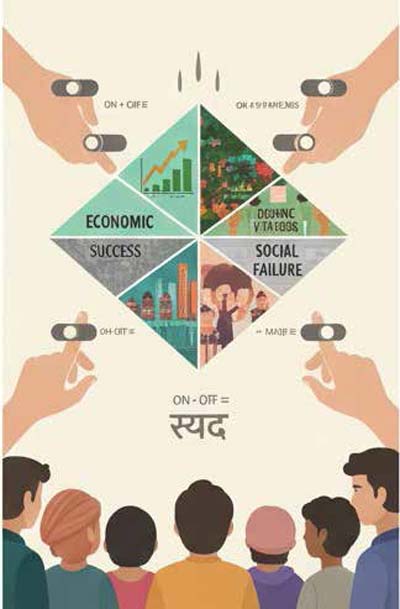 The Great Flattening. Nuance is the ability to hold two conflicting truths in the mind simultaneously without the brain short-circuiting. However, the architecture of our modern life is increasingly designed to kill it. This flattening is not just a digital phenomenon; it has become the hallmark of 21st-century leadership. In 2025, Donald Trump’s return to the presidency significantly deepened global binary fault lines through an America First doctrine and a transactional approach to diplomacy that often forced allies and rivals alike into rigid with-us or against-us positions. This disruption of the post-war economic order and the use of trade as a geopolitical weapon have further eroded the middle ground of multilateral cooperation, replacing complex international dialogue with high-stakes choices that leave little room for grey-area compromise.
The “Strategic Captain” and the Iron Fist. To understand the cost of losing nuance, look at the Indian Army’s operational doctrine of Iron Fist in a Velvet Glove. It is a mandate for moral adaptability. Imagine a young Captain leading a small patrol through the volatile, narrow lanes of a town like Sopore or Downtown Srinagar. Within the span of a few city blocks, he must pivot between three diametrically opposed realities. In one street, he is the Velvet Glove, overseeing a medical camp or providing humanitarian relief under Operation Sadbhavna. Two streets away, he is a peacekeeper, using immense restraint to de-escalate an agitated crowd of stone-pelters. In the third, he must be the Iron Fist, engaging in a high-stakes, lethal encounter with armed militants. This isn’t a scenario where you can just follow the rules blindly. It requires what the military calls Mission Command—a philosophy where senior leaders provide a clear intent, but the actual execution is decentralized to the person on the ground. We can call him the Strategic Captain. Why strategic? Because in the age of viral videos and instant communication, his split-second decision – whether to pull the trigger or hold fire – has the power to define the national narrative before the sun sets. The moral failure of a single individual can derail an entire national mission. If our soldiers on the frontlines require this level of nuanced judgement to survive and succeed, why do we settle for binary outrage in our daily lives by being ever eager to press a Like or Dislike button?
The Vow that Becomes a Cage. We often mistake rigidity for virtue. Look at Bhishma Pitamah, the grand patriarch of the Kuru dynasty. Bhishma is famous for his terrible vow of lifelong celibacy and unwavering loyalty to the throne. He was a paragon of discipline, but his ethical rigidity became his greatest tragedy. Because he was bound by the binary logic of his vow, Bhishma remained a passive spectator during the public humiliation of Draupadi. He chose the status quo over the virtue of justice because his oath left him no room for moral adaptability. Bhishma teaches us that when we prioritize blind loyalty or rigid formalism over the spirit of Dharma, we become inactive precisely when we are most needed.
The Jain Art of “Maybe”. Perhaps the most powerful tool for reclaiming nuance is the Jaina doctrine of Anekantavada—the principle of non-absolutism. It suggests that reality is multifaceted and no single perspective can capture its entirety. This is logically expressed through Syadvada, or conditioned predication. It requires us to prefix our assertions with Syat (meaning in some ways or from a certain perspective). Instead of saying, This policy is a failure, a practitioner of Syadvada would say, From the perspective of economic growth, it is a success; but from the perspective of social equity, it is not.
The Pivot: How to Reclaim Complexity. Reclaiming nuance is an act of rebellion. It requires us to act like a wise commander instead of a foot soldier. A foot soldier just follows the either/or command. A commander looks at the whole map, understands the terrain, and knows that sometimes, the most moral thing you can do is change your mind. This struggle between rigid rules and complex reality reminds us that context and intent are the only things that separate a strategic manoeuvre from a moral collapse.
So, this month, I challenge you: find someone you’ve flattened. Someone you’ve labeled as the enemy or the other. Look for their Karna moment. Try to find the nuance in their story. The world isn’t black and white. It’s a beautiful, terrifying, complex shade of grey. Let’s start living like we know the difference.
ABOUT THE AUTHOR
 LLt Gen Rajeev Chaudhry, a former DGBR, is a writer and social observer. He also pursues his passion for the creative arts in his free time.