
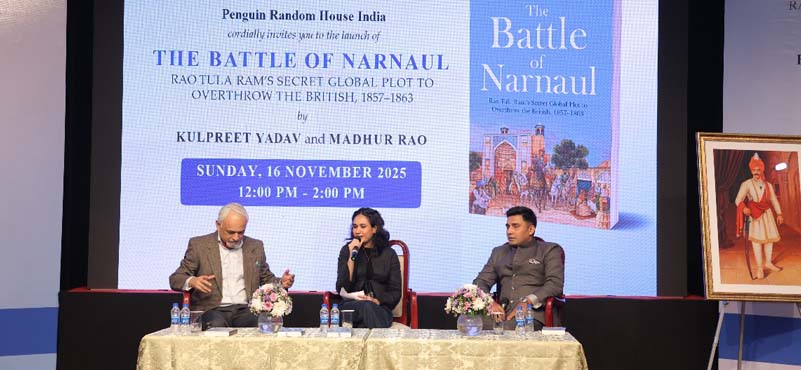
This was a book launch with a difference. It saw a packed hall, with some 400 people attending. At the end of the conversation, the ceremonial speeches, there was an animated audience that had the most relevant questions to ask. It was amidst the 1857 revolts, with a difference, in that it is not often spoken about, as the historians have so far concentrated on other parts of North India. Also, the chief protagonist, after a heroic loss in battle, escaped for the next four years, seeking foreign help.
It was said he did procure letters of support from a few rulers, including those of Jodhpur and Jaipur, Rao Tula Ram was considered by the Russians as India’s first ambassador to Moscow!
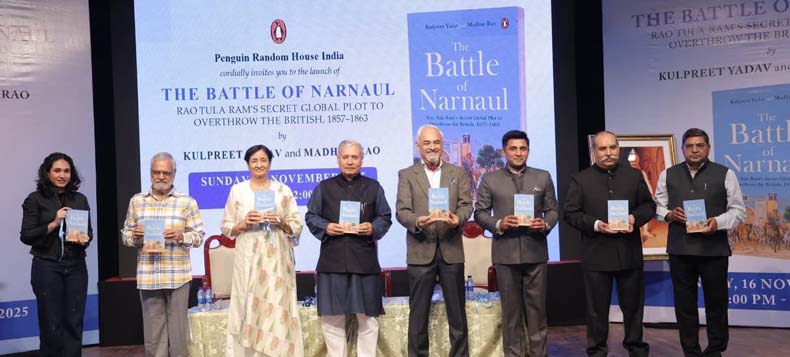
The Battle of Narnaul, the book written by Kulpreet Yadav and Madhur Rao, was released by Rao Inderjeet Singh, presently the MOS (IC), Ministry of Statistics and Programmes; he is the great-great grandson of the esteemed Rao Tula Ram. Following are some excerpts from the conversation featuring the two authors. The session was moderated through Penguin Random House India, publishers, who have brought the book to light.
Kulpreet Yadav: Later, when he was going to Bushair in a small boat, Rautularam, along with his three people, because others were left behind and he had to suddenly go, he found a Fakir on the boat who was very poor. He was from Kanpur or something. Auladhalli, if I remember. The Britishers call him Auladhalli, A -W -L -L -I -D. So Auladhalli was very poor, they didn’t have food.
So Rao Tularam ordered his assistant to give him one ser khichdi every day, so that till the time they reach there. And he was given one ser, and because of which he was healthy by the time they reached, and he did rat him out. Just on arrival.
But how he came out of that situation is a very dramatic and adventurous story. T;\alwar in hand, what’s happening in Shiraz, what’s happening in Bushra. We don’t talk about all the things which are there in the book, because we want you to buy the book after this event and read it for yourself.
Speaker 2: But coming back to your question, people didn’t rat him out. But when he fought the Battle of Narnaul, there was the army of Patiala that came with the British to fight against him. The Jaipur state forces were present, they didn’t side with the British nor did they side with him. So, there were incidences which could have gone into his favour but unfortunately they did not.
Moderator: But what other qualities would you talk about that you know set him apart from his most contemporaries? Because when we read history books and such there is usually like a short paragraph or but for many of his other contemporaries there were like chapters and chapters that go on but like he is quite missed out in history.
Kulpreet Yadav: So, while we were doing this research, the question we faced, how can a man who has lost everything, who’s been rooted out, who’s state has been captured, still have these followers who are willing to die for him, even post six years of the battle. He has traveled to Persia, he has these seven people who are with him, he reaches Kabul. Imagine Rewari, which is in Southern Haryana, and imagine Kabul. And this we are talking when there were no roads. And there were guys going up to meet him and coming back.
And it can only be if somebody has that much charisma that he can still tell people that even though I’ve lost, I’m still your ruler.
Madhur Rao: Another quality was people don’t know about this at all. Rao Tularam was educated briefly in an English medium convent school by the Britishers because of which for a couple of years, because of which his English was very good.
So, all the records mention only about Persia and Urdu but he was well conversant with English and Persian and Urdu and Hindi of course because of which he was able to confidently move about in Shiraz and other foreign lands and understand the situation.
Madhur Rao: I think that was the first point that we got to, that we went to an English boarding school. I am from an English boarding school, myself. Both Rao sahibs are from Sanar and I am sure a lot of my Sherwood friends and some other school buddies are here. Back then in 1834 -35, he went to a boarding school. At that time the hill schools did not exist. Himachal only went into British schools post the Treaty of Amritsar in 1846. Uttarakhand and Nainital only had the first building in 1841. So, back then, the hill schools did not exist.
So, the old schools only existed in Meerut where cantonments were. Now, he went to a school in Meerut which was in the cantonment, run by the British for British officers and royalty. And there is the document where his complaint goes in Shiraz. And interestingly that guy says he can read English. Now a complaint against a man who’s a ruler back then, at that time Indian royalty also did not learn English at that pace. He said he could read English and we could just connect it because he went to a British school, a boarding school to study.
Moderator: Really fascinating. A lot of things about him are quite unknown, especially about the boarding school. But what was the one thing? That something that I’ve never known, but it blew your socks off.
Kulpreet Radav: Yeah. One day, Madhur called me and said, Dada, we’ve found something very spectacular. And it’s written in cursive hand, and the ink is almost faded, 60 -odd pages of interrogation of Rao Tularam and his people in Shiraz by the British authorities, held at the British Library. We requested a friend who spent the whole day to take those pictures and send. And that interrogation is absolutely fantastic.
And I think it’s Madhur’s discovery, and Madhur should talk about it.
Madhur Rao: So Abhir Kuldeepika, the book we were talking about previously, mentions that Rao Tularam was there, there was a complaint against him, and he was caught and interrogated in Persia. Now most of the details written in Abhir Kuldeepika is very precise. So even before going to London, we were trying to search for the papers of his interrogation. We didn’t find those though we found a lot of other details. Came back, we were sitting.
I fumbled upon a website which has the Persian documents related to the petition. I kept searching. Now you cannot have his name written on the document because while he was travelling in Persia, he showed himself as a Muslim trader going to Karbala for pilgrimage. So obviously his name wouldn’t have been on the document. Rewari wouldn’t have been on the document. 1857 wouldn’t have been on the document.
So how do we track it? So how we did it, we knew what time and what place he was interrogated in, we opened over a thousand documents locked up. We read every document, not the whole thing, only the headings. And we fumbled upon a document which said four Indians apprehended in Shiraz for rebellion in British India at that time. And I said this has to be the document because there were four of them and the time was matching. So, I called him and I said, this looks like the document we need to get. And it’s a thick 60-page cursive written old document which still exists. So, we called up our friend Usman and he ended up finding this document for us. And then we sat down and we, you know, we typed it out, obviously, because it’s cursive and it’s very old. Some of the words are, you know, off, but it’s a beautiful document. And that man had to face 75 questions, and he answered.
The three people along with him had 30 odd questions to answer in a foreign land. He’s facing a foreign government and he’s the enemy of the state. And he has no support but he could face it and get out of it.
Obviously, the Persian government may have helped him, the Persian king helped him, but it’s fantastic.
Moderator: I want everyone to take a glance at the book cover. Kudos to the authors because in an AI-led world where you can easily generate this image, I’m sure, but they really commissioned, they went beyond – they got it commissioned and it is actually Rao Tularam in Iran and he is being supported by the ruler over there. So, do you want to talk about the book cover which is absolutely amazing.
Kulpreet Yadav: We commissioned the paintings to Mr. Yogi. So, he did the portrait, and he also did that. That is Shiraz Waqil Basar. Surprisingly, it is exactly how it was in 1860 and it is preserved exactly the same way even today. So, we were able to get the reference material and we wanted to create this scene where Rao Tularam, along with his three people and the Qazi and Kotwal of Shiraz, is being escorted to the Prince of Shiraz. All this is documented.
And when he’s asked to come, he’s having a trunk with him in which he’s got his regal attire, which he opens for the first time in Shiraz. In fact, Auladh Ali mentions about him having a topi and a regal dress in a box to the Britishers in his spy letter. So, he opens this, he mounts the horse which has been given to him and we were very moved by this scene and we and Madhur spoke to each other and said, why don’t we capture this in a professional painting rather than doing AI, you know. So that’s how we’re grateful that Yogi has been able to capture it so well. We never asked Penguin to put this on our cover.
They designed the first cover option, it was exactly like this, and we thought this represents a great man’s resistance in the most profound manner and that’s how it’s here.
Madhur Rao: About the second painting, that of Rao Tularam, was something done while he was in hiding. So, the Pagdi that he wears in this, which is on the back cover of the book, the Pagdi that he wears is the Ahirwal Pagdi where the Turi mostly comes more central. The Muslims during that time would have a topi in the center, the Sikh community would have a straight pagdi and most of the Rajputana would have a little tilted turi. I hope I’m correct on that. So plus the khanjar that he has and the sword that he has, still exist.
His clothes still exist with the family. So, we could compile all that up and now when he fought the battle, he was only 32 years old. The background is the present background of the Darbar of Rewari in the Rampura Palace. So, we took all of this together, we combined it, we thought of it and it took us quite a little time and thanks to Yogi, we could manage it. He’s got some prints if somebody wants to buy and take home so you can get in touch with him.
Kulpreet Yadav: So, in the battle, what happened was, as I briefly described earlier, these were 3,500 British troops and cavalry with the latest arms of the time and cannons against the Indians led by Rao Tularam’s 5,000 -odd people. And this was a battle which was very interesting and had many swings. And Rao Tularam nearly won, though he had inferior arms and ammunition, compared to those of the British. But in doing so, they were able to kill the leader of the British Army, a gentleman called Colonel John Grant. Madhur was able to trace the great, great granddaughter of Colonel Girard and he contacted her.
So, Madhur got in touch with her. In fact, he met her in the US as well. And we had gone to Nasipur and we’d seen the grave of Colonel John Grant Girrard, which is preserved as it is. And when he shared this grave picture with this octogenarian lady, who is the great, great, granddaughter of this British officer, she was moved to tears and she asked who does this, is this how well your people have preserved the grave of an enemy and we’ve captured this emotion very well.
Probably I might be a little more emotional now but we preserved it very well. In the epilogue of the book, a villager has been quoted saying to us that
‘dushman tha jab ladd raha tha, but marne ke baad yeh ek warrior ki grave hai, aur hum isko aahse hi preserve karenge’
(it is the grave of an enemy, but after his death, he becomes a warrior, and this is how we preserve the grave of a warrior).
History is written by the Victor!
There is no mention of the Battle of Narnaul, says Rao Inderjeet Singh, the great-great grandson of Rao Tula Ram
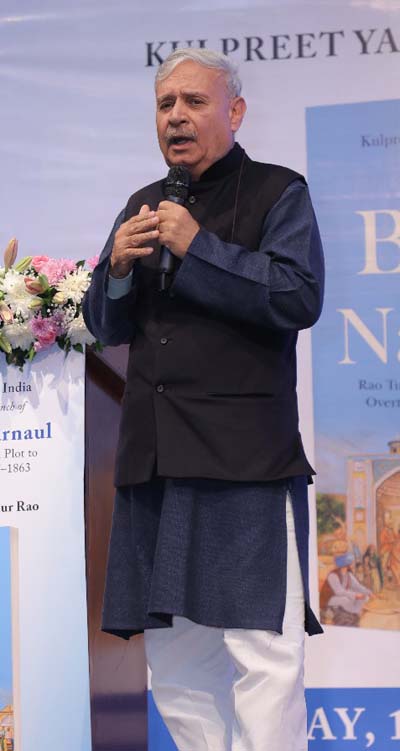 “I am a little inadequate for this job right now, that I am the great, great, great grandson of Rao Tularam, but these authors know more about him and his family than I do. A lot of research has gone into this. Not only has research been done in India, it has been done internationally.
I want to give you two episodes which will address the story that these gentlemen have put in print. After my law in 1974, I thought I’ll embark on a backpacking journey to Europe. And the first stop I made was in Kabul, Afghanistan with a princely sum of $20 as the FTS was then known as. And why I went to Afghanistan was because I knew that my great -grandfather had been cremated there. I arrived at the Sarai and I asked if there was any cemetery or crematorium, nearby, where we could find some idea as to who all were cremated there or burnt there. And the gentleman who was in charge of the Sarai, he told me that four kilometers down the line, if I went on this road, I would find a Hindu crematorium. ‘Aur main wahan gaya pehdal, puchte puchte’.
And finally, we arrived at this crematorium ground and I find four ‘chhatris’. All very well done, Indian style, Rajasthani style. And I said, when I grow a little older, have a little more money, I will probably try and get back his ‘asteez’ from Afghanistan back to India and back to Rewari in our hometown. As time passed, the dream remained, but an opportunity rose in 2004, when in Manmohan Singh’s government, I was given charge of the Minister of State for external affairs. And I deputed this gentleman who was the ambassador to Kabul.
I asked if we could find out where is Rao Tularam’s ‘chhatri’. Because when I had gone there 20 years earlier or 30 years earlier, I found the ‘chhatris’. But I could not distinguish which was Rao Tularam’s because it was all written in Persian or Arabic script. But in between this time, the Taliban had taken over and destroyed a lot of Hindu remnants. So, there was only more confusion ahead. …………….
The second episode is during 2004 and 2006, I was the MOS in External Affairs and I was in charge of Latin America and I was in charge of Sub -Saharan Africa. One day, I got a request from the Russian ambassador, that he wanted to see me. I was perplexed as these bigger nations would call on the senior minister, not me.
Anyway, I called him over, had a cup of tea and then he said, I have come here to present you with this document, which said that Russia recognizes Rao Tularam as the first Ambassador of India to the Russia state.
Now they’ve talked about the war itself. I want to talk about the post-war scenario. History as you know, is written by the victors. So, there was no mention of the Battle of Narnaul!”