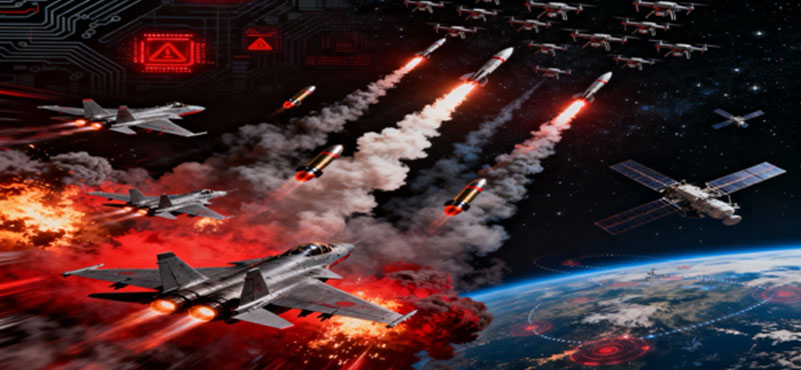
What is the notion of victory in modern war? The conflict between the United States and Iran brings that question into sharp focus. For Tehran, it lies in proving that such dismantling is impossible. Washington pursues calculated destruction to erode Iran’s capacity to resist. Tehran employs a quieter form of strength: survival itself as the ultimate rebuke, combined with actions that gradually drain and expand the aggressor’s resources and resolve. This is attrition versus manoeuvre, two worldviews clashing in the skies over the Gulf, the shadows of Hormuz, and the back channels of proxy wars. Neither side seeks the other’s complete destruction in traditional terms. Instead, the conflict relies on endurance, perception, and the slow unravelling of willpower. What starts as thunderous air campaigns risks becoming a prolonged struggle where time becomes the decisive factor.
America’s strategy focuses on striking Iran’s strengths, targeting the foundations that support the regime. Precision attacks target political leaders, aiming to eliminate key figures and create uncertainty at the top. Military commanders, often in fortified locations, become the next target, with their loss intended to disrupt decision-making. Missile depots, both stationary and mobile, face continuous assaults by Tomahawks and stealth bombers to prevent missile launches. Oil infrastructure- refineries, export terminals, pipeline hubs- critical to Tehran’s economy- is exposed and vulnerable to surgical strikes that could cut off war funding. Proxies are also targeted, with operations in Iraq, Yemen, and Lebanon disrupted through intelligence-based raids. Broader military assets, such as radars, naval yards, and air defences, are also degraded. This strategy of attrition aligns with a superpower’s approach: degrade enough nodes in Iran’s military and economic system that the state loses its capacity or willingness to continue the fight. This approach avoids the chaos of invasion and assumes that the opponent’s system can be dismantled faster than it can adapt.
The appeal runs deep. It echoes the industrial wars of old, where factories and firepower decided fates. Today, satellites target locations, networks trigger strikes, and drones fill gaps. Victory appears as a record of dominance: Iran’s arsenal reduced, proxies dispersed, economy restrained. Submit or fracture, the message is clear. Yet this calls for an opponent who follows predictable rules, one whose strengths are easy to dismantle. Iran refuses to play that way. For Iran’s leadership, the conflict is framed less as a conventional war and more as a struggle for regime and ideology survival.
Tehran strikes back by shifting the battlefield, testing American vulnerabilities with cold precision. U.S. bases across the region top the list, from vast complexes in Qatar and Bahrain to forward outposts in Iraq and Syria. These are not just dots on a map; they house troops, aircraft, radars and logistics hubs vulnerable to missile strikes or drone attacks. The Strait of Hormuz becomes the decisive pressure point. This narrow passageway carries a fifth of global oil. Mines are quietly dropped, fast boats race in swarms, anti-ship missiles lie in wait—all ready to block flows and send prices soaring. The global economy feels the ripple instantly, markets react sharply, and allies from Europe to Asia protest as supply chains become uncertain. Hybrid warfare through proxies adds complexity: Houthi disruptions in the Red Sea, Hezbollah threats along Israel’s borders, militia attacks in Baghdad’s green zone. Cyber intrusions slip in, corrupting data feeds or disrupting carrier group operations. Electronic warfare disables sensors mid-flight. No large armoured offensives, just persistent friction that forces Washington to defend everywhere at once.
This asymmetry shapes their visions of victory. For America, anything less than a win is a loss. Stalemate breeds doubt: why invest billions, risk lives, strain alliances if success remains distant? Tactical gains must build into strategic advantage, or frustration grows. Domestic voices question the purpose, budgets increase, and partners waver. Iran perceives it differently. Not losing equals winning. The regime withstands shocks, command flows sideways through redundancies, and missiles are launched from desert trucks. Proxies reorganise, and oil denial intensifies over time. Survival affirms sovereignty; imposed costs prevent further rounds. Endurance outweighs erasure.
Extend the timeline, and the scales shift. Days turn into weeks, and America’s stress grows. Oil shocks disrupt global growth, while global pressures increase with the USA cast as the villain. Access points weaken amid protests across host nations, and Gulf states secretly diversify their alliances. Military prestige declines not from battlefield defeats but from elusive pursuits that never yield clear results. Geopolitical influence diminishes: Europe resents the energy crisis, Asia explores alternatives, and the global South supports the resilience of the underdog. Washington appears to have underestimated the degree to which Iran has structured its defence around dispersion, redundancy, and indirect pressure. Years of sanctions and posturing made Iran seem fragile, a hollow shell dependent on bluster. Misunderstandings accumulated: dismissing Mosaic Defence as propaganda, downplaying proxy networks, and ignoring the web of mobile assets designed for denial. The belief was that technology dominance would win. However, reality proves more brutal. The contrast between the two approaches becomes clearer when viewed across several strategic dimensions.
| Strategic Element | U.S. Attrition Focus | Iranian Manoeuvre Focus |
|---|---|---|
| Primary Targets | Regime core, leadership, missiles, oil, proxies, bases | U.S. bases, Hormuz flows, global economy, hybrid fronts |
| Notion of Victory | Destruction yielding submission | Endurance combined with cost imposition |
| Coercive Mechanism | Systematic erosion of strengths | Asymmetric hits on vulnerabilities |
| Prolonged Conflict | Frustration, eroding prestige | Bolstered deterrence, narrative edge |
| Doctrinal Assumption | Concentrated foes fall to precision | Dispersion and mosaic defence turns to strength |
The table reveals the fundamental mismatch. Attrition relies on fixed targets, but Iran disperses deliberately: leadership layered among successors, launchers constantly on the move, proxies self-sustaining. Strikes land, headlines celebrate success, yet the system endures. Manoeuvre exploits this by fracturing U.S. focus. Carriers reposition endlessly, air wings chase illusions, and commands juggle dilemmas from spectrum to sea. Resources become stretched thin, tempo slows, and cohesion begins to weaken.

The contest between American attrition and Iranian manoeuvre thus offers more than just a regional case study. It demonstrates how modern warfare increasingly values dispersion, adaptability, and the ability to impose costs across multiple domains. For countries analysing the future nature of conflict, the implications are hard to ignore.
For India, the implications are significant. The battlefield of the twenty-first century will look very different from the linear fronts of the past. It is becoming fluid, dispersed and heavily watched. Satellites, drones and electronic surveillance can reveal troop concentrations almost immediately, while precision weapons punish anything that remains exposed for too long. In such conditions, rigidity becomes a weakness. Forces tied to fixed positions risk being neutralised before they can influence the fight. Recent conflicts suggest that survival and effectiveness increasingly depend on dispersion, deception, and rapid manoeuvre rather than on mass alone.
This demands a corresponding shift in doctrine. Concepts built around static defence lines and prolonged attrition must give way to approaches that emphasise dislocation and denial. Deterrence through punishment rarely produces decisive outcomes unless it generates a deeper shock that unsettles an adversary’s decision-making. Operational advantage instead lies in identifying weak points in the enemy’s system and striking them at the right moment. Physical destruction matters, but the greater effect often lies in disrupting cohesion and undermining the will to act.
India’s geography reinforces this logic. Along the Himalayan frontier, terrain limits the concentration of large formations and rewards mobility and adaptability. On the Line of Control, dispersed engagements and information dominance shape the dynamics of escalation. At sea, the vast expanse of the Indian Ocean favours manoeuvre over static defence. Sea control depends less on permanent presence than on the ability to threaten vital sea lanes and impose uncertainty on an adversary’s calculations.
Technology will play a central role, but only if guided by a clear doctrine. Networked surveillance, long-range fires and resilient command systems must support distributed operations and mission-oriented leadership. In modern conflict, strength is measured not simply by numbers, but by the ability to control tempo, dominate information and impose surprise. Nations that master these elements often shape the battlefield before the war truly begins. India must hasten both the National Security Strategy and the Functional Commands.
Iran’s war indicates a doctrinal shift. Basic attrition tactics struggle against resilient networks. Manoeuvre’s adaptable strategy avoids destruction and rewards those who exploit opponents’ strengths. Iran fits this pattern perfectly: weaker in numbers but stronger in networks. America faces overextension, echoing past mistakes from Baghdad to Kabul.
Modern war rarely produces the clear victories imagined in traditional strategy. When a technologically superior power relies on attrition against a dispersed and adaptive opponent, destruction alone may not produce decisive results. The contest then becomes one of endurance, perception, and political will. In such conflicts, victory often belongs not to the side that strikes hardest, but to the one that proves hardest to break.
ABOUT THE AUTHOR
 Lieutenant General A B Shivane, is the former Strike Corps Commander and Director General of Mechanised Forces. As a scholar warrior, he has authored over 200 publications on national security and matters defence, besides four books and is an internationally renowned keynote speaker. The General was a Consultant to the Ministry of Defence (Ordnance Factory Board) post-superannuation. He was the Distinguished Fellow and held COAS Chair of Excellence at the Centre for Land Warfare Studies 2021 2022. He is also the Senior Advisor Board Member to several organisations and Think Tanks.