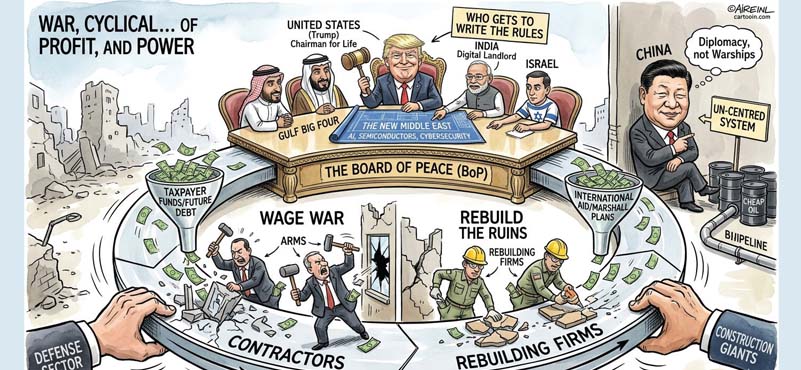
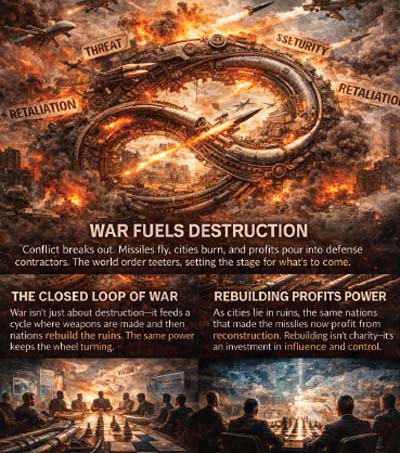
You first wage war, spend money on arms and demolitions, and when it ends, you spend money again to rebuild what you have destroyed. It is not that simple as it appears. In the interim, you have changed the world order, made it what you want it to look for the next 50 years.
The question that touches on one of the most debated theories in political science: the Military-Industrial Complex. When you see the same nations that supplied the missiles now drafting “Marshall Plans” to rebuild the ruins, it certainly looks like a closed loop designed to keep the “wheels of the global economy” turning. If not global, at least, of primary nations, that are leading the global churning. Why does this happen and whether it is a deliberate economic strategy?
While it looks like breaking a window (or a city) creates work for the glazier (or the construction company), that money was actually diverted from something else—like healthcare, education, or new technology. War doesn’t usually “create” wealth for the world; it reallocates it. It takes money from taxpayers and future generations (via debt) and hands it to specific sectors: defence contractors, energy giants, and engineering firms.
The “urge” to wage war is rarely about the profit of rebuilding alone; it’s usually about who gets to write the rules afterward. Rebuilding isn’t just a business deal; it’s a form of soft power. By funding the reconstruction of Iran or Israel, a country like the U.S., China, or the EU ensures that the new power grid, the new internet, and the new laws are aligned with their standards. As we’ve seen with the Strait of Hormuz closure in 2026, the war was likely fought over the “urge” to control energy flow. Settling the loss is the price the world pays to get the oil moving again.
In many major economies, the defence sector is a massive employer. If there is no conflict, demand for high-tech munitions drops. War “empties the shelves,” allowing these companies to secure new contracts for the “next generation” of weapons. Large engineering firms often have deep ties to the same governments that fund the military. They are essentially waiting in the wings to turn “military aid” into “infrastructure grants.”
If the financial loss is so devastating, why do it? Leaders often prioritize immediate security or ideological goals over long-term economic stability. For the Israeli government or the Iranian leadership, the “threat” from the other side is seen as an existential risk that outweighs any dollar amount. Some theorists have suggested that the U.S. and its allies may be willing to endure a $500 billion loss now if it prevents a rival (like a nuclear-armed Iran) from controlling 20% of the world’s energy for the next 50 years.
The Big Power Game!
The “Board of Peace” (BoP) is the primary vehicle for this post-war settlement, and its membership list confirms suspicion that this is a “big power game.” It is composed of a very specific group of nations that have traded financial and military support for a seat at the table where the new Middle East is being designed.
 As of March 2026, the following nations are the key players in this “charade”:
The “Founding Donors” (The Bankrollers): These are the nations that have pledged the billions required for reconstruction. In exchange, they gain a “permanent seat” on the board and direct influence over the new infrastructure.
United States is said to have pledged $10 billion and holds the “Chairman for Life” position (Donald Trump). The Gulf “Big Four”- Saudi Arabia, the UAE, Qatar, and Kuwait – have each pledged $1 billion or more. Their involvement is crucial as they are the primary source of the capital needed to “settle” the war’s losses. Other Donors: Kazakhstan, Azerbaijan, Uzbekistan, Morocco, and Bahrain have also committed to the initial $7 billion reconstruction fund for Gaza and the wider region. These figures may be off the mark, but could be seen as sufficiently suggestive.
To ensure the reconstruction “sticks,” these nations are providing the boots on the ground for the International Stabilization Force (ISF). Indonesia is said to have committed at least 8,000 troops and accepted the “Deputy Command” of the force. Egypt & Jordan have agreed to train the new 12,000-strong police force that will govern the rebuilt areas. Albania, Kosovo, and Morocco have also pledged troop contingents for the 20,000-soldier ISF.
More than mere donors, these nations become the hubs for the new “Innovation and Prosperity” projects. Israel is a founding member and central to the “Special Strategic Partnership” with India. This partnership focuses on AI, semiconductors, and cybersecurity—the “digital backbone” of the rebuilt region. Argentina, Hungary, and Turkey are nations that have joined the board to align themselves with the new “transactional” international order, bypassing traditional UN structures.
The Corporate “Second Layer”
Beyond nations, private power is baked into the board’s DNA. The Gaza Executive Board—which manages the actual $115 billion in “unlocked value”—includes figures like Marc Rowan (CEO of Apollo Global Management) and Ajay Banga (President of the World Bank Group). This confirms any observation that the “settlement” is being run like a private equity deal, where the nations provide the “collateral” and the corporations build the “Riviera.”
Is China Missing from the Big Show?
China is far from “missing,” but its absence from the Board of Peace and the U.S.-led reconstruction headlines is a calculated, strategic choice. While the West is playing a high-stakes “game of thrones” in the Middle East, China is quietly positioning itself to be the only major power left standing with its hands clean.
 China has publicly refused to join the Board of Peace because it views it as a “small clique” designed to bypass the United Nations. China is a permanent member of the UN Security Council with veto power. By joining the Board of Peace (where the U.S. and its allies set the rules), China would effectively be demoting itself. Beijing is pushing back by championing the “UN-centred international system.” This allows them to paint the U.S. and Israel as “rule-breakers” while China acts as the “defender of international law.”
While they aren’t sending troops, China is arguably the most active “silent partner” in the conflict. Intelligence reports from March 2026 suggest China is providing Iran with BeiDou satellite navigation (a more secure alternative to GPS) and advanced radar systems. This helps Iran sustain its defence without China having to fire a single shot. Analysts believe China is staying out of the “rebuild” drama now so they have maximum leverage to negotiate trade and energy deals once the dust settles.
China is the world’s largest oil importer, and it currently buys over 80% of Iran’s oil exports. The closure of the Strait of Hormuz is a direct hit to China’s heart. However, instead of joining the U.S.-led “Hormuz Coalition” to reopen it, China is using its “neutral” status to talk to both Tehran and Riyadh. They want to be the mediator that reopens the strait through diplomacy, not warships. If China succeeds where the U.S. military failed, they become the new “guarantor of security” in the region.
China’s long-term plan is to be the “non-colonial” rebuilder. While the Board of Peace talks about “international guardianship” (which sounds like the old colonial mandates), China is offering its Global Development Initiative (GDI). Its pitch to Iran would read: “We won’t ask for political changes or human rights reforms; we will just rebuild your refineries in exchange for 25 years of cheap oil.” For a battered nation, that’s often a more attractive deal than Western aid tied to political strings.
How is China faring in the midst of the War?
In the high-stakes “charade” we discussed, China is being hit with a “dual-reality.” While they gain long-term strategic leverage, their domestic economy is currently under severe strain.
China is the world’s largest oil importer. Even though they have massive strategic reserves (roughly 1.4 billion barrels), the market price for energy has spike. China’s small, private “teapot” refineries—which handle about 80–90% of Iran’s oil exports—have seen their supply chain collapse. They relied on discounted Iranian crude to stay profitable; now, they are forced to buy expensive alternatives, driving up fuel prices across China. In March 2026, China saw its fifth consecutive domestic fuel price hike. This is particularly painful for a government trying to fight off deflation (falling prices/demand) in other parts of its economy.
 China’s “economic miracle” is built on exports, which are now being “squeezed” from two directions. The cost of raw materials (like aluminum and copper) and petrochemicals has surged. For giant appliance makers like Midea and Haier, a 10% rise in these costs can shave 6% off their profit margins. As the rest of the world (Europe, U.S., India) pays more for gas and heating, they have less money to buy Chinese electronics and toys. This “wobbly” export pillar is the reason China set its 2026 GDP target at 4.5%–5%—the lowest in over three decades.
To settle its losses, China is pivoting hard toward its northern neighbour. In early 2026, Chinese imports of Russian Urals crude reached their highest monthly volumes ever. China is effectively using Russia as its “gas station” to bypass the blocked Strait of Hormuz. China is likely to “settle” its current losses by demanding even better terms on the Power of Siberia 2 gas pipeline, ensuring that Russia remains an energy vassal to Beijing for the next 50 years.
The war is exacerbating existing internal problems in China. Youth unemployment remains high (around 17–20%), and the manufacturing slowdown caused by high energy costs makes it harder for the government to create the “quality jobs” it promised. The Chinese property sector has been in decline for five years. The added weight of a global energy crisis makes a “quick fix” for the housing market almost impossible in 2026.
What role will a country like India have in the post war scenario?
In the post-war landscape of 2026, India is emerging not as a military player, but as a “Strategic Bridge” and a critical economic architect. While the U.S. and China are locked in a struggle for dominance, India is positioning itself to be the “middle ground” that keeps global trade moving.
India has taken a unique, “de-hyphenated” stance. Unlike European nations that stayed away, India participated as an observer in the inaugural Board of Peace meeting in Washington D.C. (February 2026.) By being an observer rather than a full member, India avoids the “pay-to-play” billions required for permanent seats while ensuring it has a front-row seat to the reconstruction contracts.
India is the only founding BRICS member that has not formally condemned the strikes on Iran, yet it continues to co-sponsor UN resolutions protecting Gulf sovereignty. This allows India to work with both the “Trump-led” rebuild in Gaza and its traditional partners in Tehran.
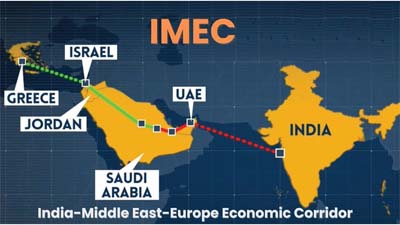
The 2026 war and the closure of the Strait of Hormuz proved that the world is too dependent on a single chokepoint. India’s biggest post-war role is accelerating the India-Middle East-Europe Economic Corridor (IMEC). This corridor—connecting India to the UAE, Saudi Arabia, Jordan, Israel, and Europe via rail and ship—could be fast-tracked as a permanent alternative to the volatile Persian Gulf routes. The pace may gather speed.
During PM Modi’s February 2026 visit to Israel, a “Special Strategic Partnership for Peace, Innovation & Prosperity” was signed. India is set to provide the “human capital” and manufacturing scale for the AI, semiconductor, and cybersecurity backbone of this new corridor.
India is focusing on maritime security in the Arabian Sea to protect its 10 million-strong diaspora in the Gulf. India is likely to lead the “soft security” side—training local police forces and building “digital governance” tools rather than engaging in military occupations.
The 2026 post-war scenario has pitched India’s role as the “Technological and Logistics Backbone” of the new Middle Eastern order. PM Modi’s state visit to Israel in February 2026, where the relationship was elevated to a “Special Strategic Partnership for Peace, Innovation, and Prosperity,” confirmed that Indian firms will not just be builders, but the “digital landlords” of the region. While politics plays its part within the Indian domestic playbook, India has done more than well, for itself, not just during the war, but also after it ends.
Who’s War? Waged by whom? For What?
The US bombed Iran’s missile sites. Pentagon said the threat was destroyed. Then Iran kept launching missiles. How?
Reuters confirmed it: Iran was in talks to buy supersonic anti-ship missiles directly from China.Global Defence Corps reported China secretly sent $5 billion in weapons to Iran. Iran’s own Foreign Minister admitted it. He called China a “strategic partner” giving Iran “military cooperation.” Iran is still shooting because China is still supplying.
The B-2 Spirit is America’s most advanced stealth bomber. It is supposed to be invisible. A Chinese company called Jingan Technology said their AI system “Jingqi” intercepted radio signals from B-2 bombers during the March 1 strike on Iran. They detected US military mobilization weeks before the attack. China was watching every US move in real time.
Iran just announced something that should terrify every person holding US dollars. Oil tankers can pass through the Strait of Hormuz. But only if they pay in yuan. Not dollars. Yuan. The mBridge platform, China’s cross-border payment system, already processed $55 billion in transactions. 95% of that volume was in digital yuan.
The US asked NATO to join the war. Every single NATO ally refused. Then Trump asked China to send warships to the Gulf. China said no.
The Pentagon admitted the war cost $15 billion That’s just the part they’re counting. China’s cost: zero. China’s gain: cheap discounted oil, global credibility, yuan adoption, US military distracted from Taiwan. Every dollar the US spends in this war is a dollar that doesn’t go toward competing with China. Every week of war makes the dollar weaker. Every week of war makes the yuan stronger. Every week of war pushes more countries into China’s orbit. This isn’t a war between the US and Iran. This is China using Iran as a weapon against America. It was thought that it was America’s war on China?
Quoted from a post on Quora website
ABOUT THE AUTHOR
 Navin Berry, Editor, CS Conversations, over five decades has edited publications like CityScan, India Debates and Travel Trends Today. He is the founder of SATTE, India’s first inbound tourism mart, biggest in Asia.
Blogs at: https://www.csconversations.in/nb-blogs