
An Unusual Story of Valour: Donning all the Three Uniforms of the Services
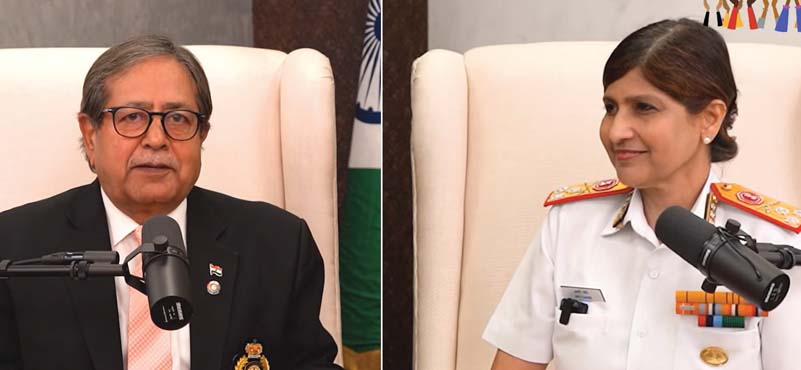
The Highest-Ranking Woman Officer in Indian Armed Forces, Vice Admiral Arti Sarin, talks to PP Rtn. AKS Hemant Bhasin in his TrueRotarian Podcast.
Hemant Bhasin: Joining us today is Surgeon Vice Admiral Arti Sarin, who’s also been decorated with PVSM, AVSM and VSM. The first Women Director General Armoured Forces Medical Services and the highest-ranking woman officer in the history of Indian Armoured Forces. She carries a rare distinction of serving across all the services, the Army, the Navy and the Air Force. A journey that reflects dedication, excellence and unwavering commitment to the nation.
Ma’am, let’s start with the right at the beginning. You came from a naval family. Your father and brother both served in uniform. How did growing up in that environment shape your values, your disciplines and your sense of service?
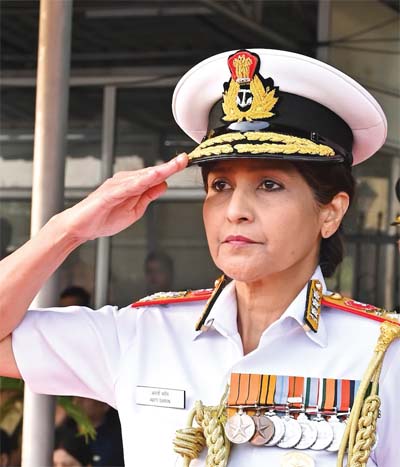 Surgeon Vice Admiral Arti Sarin: I was very fortunate to grow up in a very service-oriented background. That was in Visakhapatnam. My father was in the Navy and growing up in a service household always entails and you know puts into you a sense of nation comes first. And your team before yourself. And in day-to-day activities, you will learn, when you’re growing up, you learn a sense of discipline, you learn a sense of keeping a routine, using physical exercise, which is a must, doing your studies well, being well behaved, learning how to respect your elders and your teachers. And it slowly moulds you into a personality that is probably able to adjust to anything, anywhere.
Hemant Bhasin: Was joining Armored Forces Medical Services always part of your dream or did your life lead you to here, step by step?
Surgeon Vice Admiral Arti Sarin: I always, I think, since I was maybe 10 years old, wanted to be a doctor. I kept that as my prime aim and we came from a service-oriented background and I was taken to the hospital for a small ailment where I saw this very very smart lady who had just graduated from Armed Forces Medical College. Her name was Mala Pandey and she was from the M-batch and I think I got a little motivation from that. And that was an inspiration. Wow. And I said that if I want to be a doctor, I can be one like this. A doctor and an officer.
Hemant Bhasin: Your training at AFMC is legendary for shaping leaders. What were those formative years like and what lessons still stay with you till today?
Surgeon Vice Admiral Arti Sarin: The Armed Forces Medical College is one of the premier medical colleges of the country. It is always rated amongst the top five undergraduate colleges every year, ever since even I joined. …………… We have so much diversity because we have people from all over the country who come and join it from various states. They learn from each other and they form a great team at the end of it and we are very proud of them.
Hemant Bhasin: Excellent. One of the most remarkable aspects of your career is that you served in all the three branches and have worn three uniforms – Army, Navy and the Air Force. That is really incredibly rare. And what does wearing a uniform truly mean to you as a person?
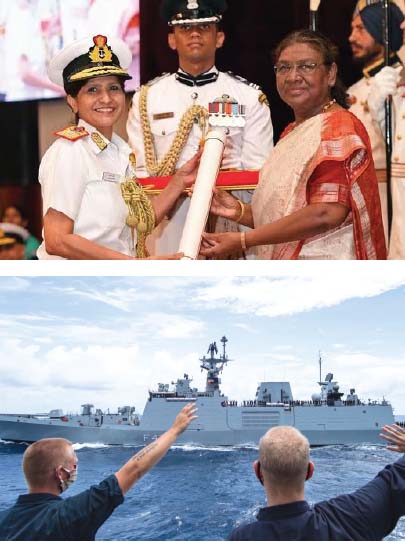 Surgeon Vice Admiral Arti Sarin: Wearing a uniform itself means that you, apart from what you have to do as your profession, it reminds you that you are in the service of the nation. The color of it in our context as medical officers is a matter of just where you are deputed to go. We are a tri-service organization.
And we are the epitome of jointness. We are working more and more towards being more and more joint in our tri-service operations that we do. ……….. So, it was easy, saving lives, preventive, promotive, secondary, tertiary care, all inclusive is what we provide in the Armed Forces Medical Services.
Hemant Bhasin: But it’s very rare for a person I think to wear three uniforms in one lifetime.
Surgeon Vice Admiral Arti Sarin: Absolutely, I think I’m the only woman. There have been other gentlemen officers who have had this opportunity, so that is actually the ethos of the armed forces medical services, where you can convert from one uniform to the other for organizational benefit and if there is a vacancy in one place and they require your services there, you can be easily shifted.
Hemant Bhasin: And this is only related to the medical services?
Surgeon Vice Admiral Arti Sarin: Only to the medical services. That is the beauty of it and that’s what helps us being so truly joint and we are able to just move effortlessly across all the three services.
Hemant Bhasin: What did each service teach you about leadership, culture and teamwork? Were they different or the ethos was the same?
Surgeon Vice Admiral Arti Sarin: The ethos remains, like we said, operational readiness, but each service has a little bit what they have to teach you. The army teaches you how to operate in a very, very resource limited environment. So, we there have a lot of innovation, there’s a lot of endurance, indeed, and there’s a lot again professionalism. The Navy teaches you to work as a team, highly professional, some technical, everybody’s in the same boat. You work as a team across all ranks, that’s one very important aspect of the Navy. You all have to stay afloat. You’re all in the same boat. And the Air Force is all about technicality, operational readiness and continuous training. But what is common across is training, professionalism, all towards operational readiness in the service of the nation.
Hemant Bhasin: Did moving between services expand your perspective on national defense and health care?
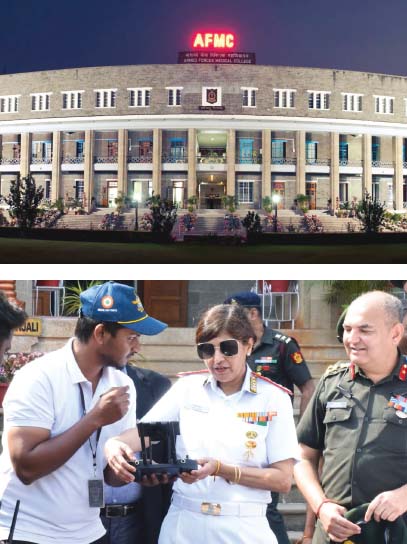 Surgeon Vice Admiral Arti Sarin: It did. Yes, it helped me. There were various different ways in which the services functions. ……And this is what has helped me a lot now in my present job.
Hemant Bhasin: You were not only a military leader, but also a very highly accomplished medical professional. How do you balance the identity of a doctor and the identity of an officer?
Vice Admiral Arti Sarin: I have to look after patients in peace and in war. So, when I have to look after patients in war, I have to be trained like an officer, to be able to operate in resource limited settings, at sea, at remote air bases. So, all of that, when I’m a doctor, I’m a professional, but the uniform reminds me that I’m there for national service and it’s just me and I need to do this and I need to do this really quick.
Hemant Bhasin: How is military medicine different from civilian health care, ma’am?
Vice Admiral Arti Sarin: Civilian health care is very similar. I mean the professional part is the same. After all, the patient is the same, the medicine that is taught is the same, what we do with the patient is the same. But I think military medicine encompasses combat medicine, which is looking after patients in a remote location without help, without specialist cover. ……We have other duties, too. You must have heard of Operation Brahma which we did for the earthquake at Myanmar. And recently the one in Sri Lanka – Operation Ditwa – where we sent out our 60 parafield hospital, they are you know a trained force which is meant to go quickly. Disaster management. Set up a hospital in 48 hours and they can treat up to thousands of casualties.
Hemant Bhasin: This is again readiness which probably the civilian doctors are not geared to do.
Vice Admiral Arti Sarin: They are not geared to do that but they can be trained to do that.
Hemant Bhasin: What does innovation look like inside military health care?
 Vice Admiral Arti Sarin: If you see that all medical innovations, they all came from military operations in World War One and World War Two, worldwide. The introduction of antibiotics and any kind of any kind of medical care that you see, military operations have had a great role in that. At the moment, what we are looking at in innovations in military care would be drone technology to help us, in logistic drones, drones to carry blood bags across a place which is inaccessible. Medicines. Yes, and we’re looking forward to drones that can actually evacuate a casualty. We are awaiting that because there is a little weight restriction on that and I believe worldwide they have already started that. So, there are going to be drone evacuations of casualties in the future.
We also want to look at the health of the soldier which we can remotely access. So, you know, looking at variables, AI appointed variables whereby we can actually monitor the ECG or the heart rate or the blood pressure of a person remotely, to be able to find out, is he getting exhausted. It’s only happening in the ICUs where we are doing, where people are using them as exercise monitors. We would like to extend this to the combat situation where we can actually monitor a soldier to be able to evacuate, not evacuate and cut down false alarms and also aid in evacuation if it’s required. We are looking at innovating some blood products which can have a longer life, which can be used in combat.
Hemant Bhasin: You know what invisible challenges do the women officer sometimes face that people outside may not understand?
Vice Admiral Arti Sarin: So, some of the challenges which women officers may face would be some infrastructural issues which are being looked after very well at the present moment. Like if you see at sea, we have to maintain the privacy of lady, they would have had to have separate living accommodation, washrooms and such like. So that’s why I said just some logistic issues which are there. Otherwise, I think the three forces at the moment are extremely poised to be very gender neutral and gender just and they’re doing their very best to ensure that all women officers and women Agniveer are very comfortable in what they’re doing and helping them serve their nation, you know, shoulder to shoulder with the men.
Hemant Bhasin: What does service to nation truly mean to you personally?
Vice Admiral Arti Sarin: Service to nation to me personally is do your best in whatever you do and that will ultimately be a service to the nation. Do your best and be honest and be a great human being.
Hemant Bhasin: Beyond the uniform who is actually, Arti Sarin?
Vice Admiral Arti Sarin: That is for others to say but what I would say is just a doctor who’s done, like I just said you know, I looked after patients, really enjoyed doing what she did with a great support from her family starting with her parents, her husband, her son who’s been the most adjusting of them all during this entire career of 40 years; of course he came in late. But he and my brother and his family, too, have been great support.
So that’s me and I usually spend most of my time concerning things with the medical profession. I would admit, in my spare time too I probably read oncology and to stay abreast, because you know how quickly medical science changes. Now I have to keep abreast with so many things when I deal with infrastructure, manpower, equipment – so I kind of keep myself very busy just doing that, so that is me.
Hemant Bhasin: Every long journey has moments where everything changes. A moment where responsibility suddenly feels heavier and the leadership becomes real. What were these defining moments in your career when you realized, now I must lead differently?
Vice Admiral Arti Sarin: If you say that, I think it starts and it continued at every phase of my career. Because like I told you, we first become doctors and we become interns. Then we go as medical officers. Where again we lead. We lead in small proportions. So that role keeps changing. Then I became a specialist where I had to give opinions on patients; that was a responsibility at that time which I thought was my main mandate. Then I moved on to, you know opening departments, looking after equipment and my sphere increased so there itself again, I thought that is a different kind of a responsibility and now this is a larger responsibility. So this went on, and the armed forces, they keep giving you administrative responsibilities; of course they train you for it, too, and so like your question said, it came up maximally, I would say when when I went to Pune as the head of the Malignant Diseases Treatment Center, where as a Commodore, I had to handle a 110 bed facility and I had to shift it from one location to the other. So that was a responsibility.
At that point of time, I thought that was a huge responsibility till my commanding officer told me, now you have to handle radiology and radiation oncology together, along with that. So, as the responsibility kept rising you kept, you know evolving with it, but yes, I think, when I had to think differently was when COVID came and we had to think like we were moving in unchartered territory, evolving protocols and we had to put in so much of communication between ourselves, the non-medicals, the civilian administration. That’s the time which taught me a whole lot of new responsibility and showed me that I’m moving into a different role.
Hemant Bhasin: That’s so wonderful. You are seen as someone who have broken many barriers, but from your perspective, is the leadership about gender or about the character or the training?
Vice Admiral Arti Sarin: I think leadership is about the character. You know, there are several descriptions to your character in terms of you know how competent you are, how empathetic you are, what is your integrity like, will you be transparent, will you be efficient enough to handle all of this, will you be able to take a team forward, so that is all about you know your character and there are problems which happen and if you are good at it, I think you would be entrusted with this responsibility and when the problem comes, it’s not going to ask you who you are; it is what you do and how you resolve that problem. So, I think it’s all basically about character and your eligibility and training and mindset.
Hemant Bhasin: One message you would like to give it to the young Indians today on International Women’s Day and to all the women who are watching this program, what message would you like to give it to them, Ma’am?
Vice Admiral Arti Sarin: I would like to wish all of you very well. I would also wish that all of you in your own spheres actually empower education, looking forward, professionalism and excellence. You should mentor your juniors and I would also say that excellence and diligence is what gets you the best in life to be entrusted with leadership and responsibility. So, work hard, train hard and look after your health and be leaders of tomorrow.