
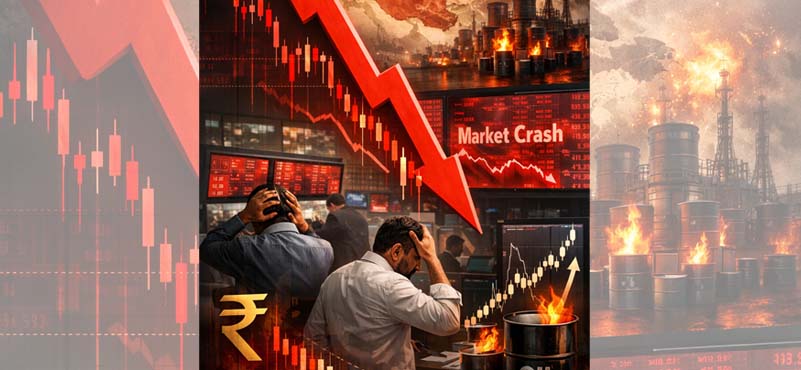
Contrary to what we hear more often, some of India’s real fundamentals, in many respects, have been consistely weak well before the current West Asia crisis. Being strong is not being equivalent to not being vulnerable. Many countries globally are taking pro-active steps to mitigate the likely effects of the war. Oil is a common resource globally and higher prices by 50% will spoil many a party. To each economy its own issues and challenges. A few have already begun rationing petrol at their stations. The Indian government has already sent out oil supplies to neighbouring Sir Lanka and Bangladesh, a significant gesture in times like these, as their need was felt as more immediate – Editor.
The Indian people, its population and economy, have been plagued for many years by numerous systemic issues including high real levels of structural unemployment, underemployment, unemployability, ill-suited employment and informal unpaid work, the latter especially for women in the agricultural sector. All of this worsened substantially with demonetization and by our initial response to Covid-19; these two compounded earlier deficiences from which India has not yet fully recovered.
While India’s strong foreign exchange reserves were sizeable and adequate before this new crisis, they are now under severe pressure from multiple sources (eg. rupee depreciation, current account deficit increases). Other traditional macroeconomic fundamentals such as the fiscal deficit and inflation which were recently cited by the Indian Finance Minister as strengths the world admires need to be unpacked to understand their components, and especially the reasons why the current fiscal deficit is relatively contained. This is not because of increasing Government revenue generation through progressive taxes and other means but because of relatively low public expenditure on crucial public goods such as health, education and other crucial basic social infrastructure and India’s very low public research and development expenditure as a percentage of GDP.
Moreover, India had a chronic and growing overall trade deficit with all major economies (eg. China) or groupings (eg. ASEAN) except the US till recently. The trade surplus with the US also went into deficit in late 2025 in the lead up to the recent 2026 US-India Bilateral Trade Agreement, which is now in dispute both because of the US Supreme Court ruling illegitimizing the Trump Administration’s 1977 International Emergency Act related tariffs and the US Administration’s response to the Supreme Court ruling placing India, China and a few other countries under Article 301 investigation.
The West Asian Crisis’ Visible Recent Impacts on India’s Economy and Financial Markets
India’s pre-existing vulnerabilites have made it one of the more susceptible countries in Asia and globally to the many downsides of the Israel-US invasion of Iran and the resulting regional and global structural shocks which have led to the West Asian crisis as a result of the war which began on February 28, 2026, over a month ago.
 Its most visible current impacts on India include a US Dollar (USD)-Indian Rupees (Rs.) exchange rate which has depreciated by over 4% in less than a month. As a result, the exchange rate which reached a new all-time low of USD 1 to Rs 95.20 on March 30, crossing yet another pyschological threshold after 90, only a few months back. The Indian currency appears to be racing towards the USD 1 to 100 rupee mark, inconceivable at the beginning of 2026. This is directly related to a burgeoning current account deficit caused by the increased USD values of critical imports on which India is extremely dependent ( eg. petroleum, oil, lubricants such as silicone oil and ammonia which are apparently critical for condoms, fertilizers such as urea for food production) which will continue to further depreciate the rupee’s value unless the government intervenes decisively.
The impact of this significant currency depreciation on India’s real economy of tangible goods and services is and will also continue to be significant. India’s overall GDP has already significantly diminished in USD terms to USD 3.75 trillion, and its relatively low USD per capita income has sunk further, putting its ambitions of both Viksit Bharat by 2047 and becoming the world’s 3rd largest economy by 2030 in even more serious jeopardy.
Simultaneously, India’s stock market has taken a beating in March precipitated by unprecedented foreign equity outflows (both foreign portfolio capital—FPI—and foreign direct investment—FDI) exceeding USD 11.5 billion by March 25, 2026. This represented their steepest exodus ever in a month. SENSEX was down 635 points and NIFTY by 488 on 30 March, reflecting a huge sell-off across all sectors of the economy.
Why is India More Vulnerable than Most Global Economies to the West Asia Crisis?
Half of India’s natural gas and 50-60% of its crude oil has to cross the Straits of Hormuz which are now heavily restricted by Iran in retaliation against Israel and the US, including for most Indian ships and tankers. This is compounded by the fact that West Asia and the Gulf States comprise India’s lowest- priced suppliers which greatly magnifies India’s crisis since there is both a physical quantity choke on all petrol, oil and lubricant related products and many fertilizers and significant price increases for all of them.
 This has already led to very significant price increases which are likely to sustain for a protracted period of time even if they do not increase further, even if the war ends tomorrow which is unlikely. Spot prices for LNG and LPG are particularly grim (increases of more than 40%) and are likely to remain so for the medium-term since 20% of Qatar’s infrastructure, the world’s major supplier, is now off-line for at least around 5 years due to war damage to the world’s largest natural gas production facility. Crude oil prices at around USD 100 per barrel will rise further, the longer the conflict continues, and as their inventories and reserve stocks in India are exhausted. Under no circumstance is the price of oil likely to go below USD 80 per barrel, a huge increase from its pre-war price. This price is likely to remain for a long time to come, even if the war stops tomorrow.
Sajjid Chinoy of JP Morgan has presented the most concrete and credible data on the impacts on the Indian economy of a prolonged three quarters of a year conflict in 2026. He suggests a GDP reduction of 1% and a rise of Consumer Price Index (CPI) inflation by 0.8%, although his estimate of the latter seems on the low side since it does not appear to fully factor in a significant increase in food price inflation resulting from a compromised Indian planting and harvest season as a result of both the shortege of urea and other fertilizers as well as a simultaneous depletion of their current stocks. Concerning as these figures are, it is India’s current account deficit (CAD) expected to increase by 1.6%, even under the current scenario, which is more worrying.
In a worst-case scenario of a protracted war with ground troops which cannot be ruled out at the time of writing, oil prices will rise to USD 120 per barrel. Under this scenario, Mr Chinoy projects a CAD increase of 2.4% of GDP, increasing it to 3.6% of GDP from its current much more manageable 1.2%. This will create a Balance of Payments (BoP) crisis, a GDP decline of 1.6% (from the projected 7%) and a CPI inflation increase of 1.3% to the 2-6% zone.
While the negative GDP and CPI impacts can still be considered relatively modest, given the seriousness of the West Asia crisis, it is the CAD and BoP situations which need to be strictly and consistently monitored and urgently responded to by the Government. This is because almost all the most severely affected imports from West Asia and the Gulf States are essentially price inelastic, meaning that a major consumption decline cannot be anticipated and they will continue to be needed in substantial quantities regardless of the extent of their price increases. There will also be significant remittance reductions from the 8 lakh Indians in the Gulf, a significant number of whom have already fled home or to other countries.
What Options does the Government of India Have to Mitigate the Crisis?
A higher BoP, caused both by increased import prices and substantially reduced remittances from West Asian Gulf States which currently account for a very significant share of its annual overall Indian remittances will need significant emergency financing. This is partly because traditional sources of financing like FPI and FDI are not likely to return to India in any meaningful amount in the forseeable future given their dramatic exodus in March and given concerns about many of India’s fundamentals even prior to the West Asia crisis.
 There are already increasing pressures on India’s foreign exchange reserves to stem the dramatic depreciation of the Indian Rupee. While this can be regarded as throwing money to curtail something which cannot be stopped, the political pressure for the Reserve Bank of India (RBI) to do this is likely to remain high, notwithstanding the recent RBI directive to all SCBs to reduce their net open position on the Rupee-USD exchange rate to USD 100 million by 10 April. This RBI measure is likely to be inadequate, even if fully complied with.
The pressures on the RBI foreign exchange reserves are likely to increase with both further rupee depreciation and because of the fast deteriorating CAD situation. This crisis also comes at a time when the currency component of India’s foreign exchange reserves have reduced from 90-78% due to the RBI converting part of them into gold whose value is now down 15%.
Another option for the RBI which will impact India’s fundamentals is to increase interest rates, not least to try and attract back fleeing FDI and FPI.
There will also be huge pressure now on the fiscal deficit which already has very little leeway to increase. This is now bound to increase in a year which has many critical State elections in the next quarter, but sadly, the only viable recourse for the Government appears to be to cut public capital expenditure to finance subsidies and petrol and other excise tax waivers or reductions on the concerned products to shield consumers from the significant price increases (some such waivers have been recently announced by the Government before the forthcoming critical West Bengal election). These cuts, almost inevitable now, will further negatively impact GDP growth and the inflation rate.
Contrary to capital account liberalisation which some are advocating, a serious option for the government is to tighten capital controls on discretionary and luxury products including Harley Davidson motorcycles, luxury yachts, Bourbon whisky and luxury automobiles which India agreed to eliminate or reduce tariffs on in the India-US BTA. Given the dubious status of the BTA, and the Section 301 investigation on India by the US Administration, this is a good time to reverse course on those trade tariff concessions India recently made to the US.
ABOUT THE AUTHOR

Kamal Malhotra is Distinguished Visiting Professor of Global Trade Policy and Sustainable Human Development at the NALSAR University of Law, Hyderabad, India and a Non-Resident Senior Fellow at TEPAV, The Economic Policy Research Foundation of Turkiye. He was a Non-Resident Senior Fellow at the Global Economic Governance Initiative of Boston University’s Global Development Policy Center between June 2022-May 2025. He has degrees in Economics (Hons.) from the University of Delhi, the Indian Institute of Management (Economics, Finance) and Columbia University, New York, USA (Master’s in Public and International Affairs with specializations in Economic and Political Development and South Asia).
Prior to his retirement (September 2021), Mr. Malhotra had a rich career of over four decades including in the United Nations as its Head in Malaysia, Turkiye and Vietnam (2008-21). He was Senior Adviser on Inclusive Globalization for the United Nations Development Programme (UNDP), New York, USA, for most of the prior decade, leading major work on global finance, trade, debt and development economics and financing issues.
Mr. Malhotra is widely published on geopolitics, geo-economics and other related issues. These include 6 books, chapters in 10 additional books and authoring or co-authoring over 150 journal and other articles. The books include conceptualizing and leading UNDPs “Making Global Trade Work for People” (Earthscan, London, 2003) and “Making Globalization Work for the Least Developed Countries (UNDP, Republic of Turkey, UN-OHRLLS, 2008).


