
Solutions cannot be left to fragmented local agencies. A coordinated national framework led by institutions like NITI Aayog or a dedicated National Urban Mobility Authority must set performance benchmarks, pool best practices, and offer funding incentives linked to integration outcomes.
India’s cities are in the throes of a mobility crisis. From mega-metropolises like Delhi and Mumbai to rapidly expanding Tier 2 and Tier 3 cities, urban transport systems are failing to meet the demands of an increasingly mobile population. The result is a tangled web of inefficiency, pollution, danger, and economic loss.
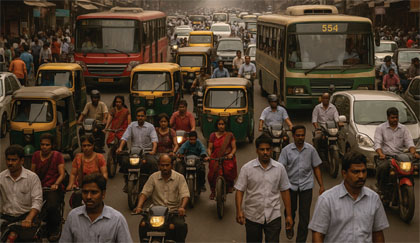 Each day, millions of Indians endure long, unpredictable commutes often packed into overcrowded buses, squeezed into shared autos, or stuck in endless traffic snarls. The average urban commuter in India spends upwards of 1.5–2 hours daily just getting to and from work. This loss of time translates directly into lost productivity, lowered economic output, and reduced quality of life. It also exacerbates stress and anxiety, particularly among those in lower-income groups who lack access to safe and reliable alternatives.
More troubling is the human cost. According to official data, India records over 150,000 road traffic fatalities annually one of the highest in the world. A significant share occurs in urban areas, involving vulnerable road users such as pedestrians, cyclists, and two-wheeler riders. Thousands more are permanently injured. Most of these tragedies are preventable.
Urban air quality, too, has deteriorated sharply, with transportation being a major contributor. Vehicle emissions account for up to 30% of PM2.5 levels in cities like Delhi, Bangalore, and Kolkata. The health consequences are staggering: rising cases of asthma, cardiovascular disease, and premature deaths especially among children and the elderly.
Yet at the root of this chaos is not simply a lack of infrastructure but a lack of integration and foresight. Urban mobility in India has largely evolved through ad hoc, siloed projects. Metro systems, bus rapid transit corridors, flyovers, elevated roads, and expressways are often developed independently, without proper planning for multimodal connectivity. Metro stations lack feeder services. Bus networks are uncoordinated and outdated. Pedestrian infrastructure is either absent or unsafe. The result: high-capex projects that underperform or fail to attract sufficient ridership, leading to grossly inefficient use of public funds.
Correcting this trajectory requires a systemic rethink. First, Indian cities must adopt Integrated Urban Mobility Plans (IUMPs) that prioritize multimodal connectivity, with an emphasis on high-capacity, clean mass transit and last-mile solutions such as e-rickshaws, shared bicycles, and autonomous PRTs. Seamless transfers between modes bus, metro, rail, and pedestrian pathways should be the default, not the exception.
Second, digital integration must accompany physical integration. Unified ticketing, route planning, and real-time data can significantly improve user experience and optimize transport flows.
India stands at a critical juncture. With 400 million more urban dwellers expected by 2050, the choices made today will define the livability, productivity, and sustainability of its cities for generations. Investing in smart, integrated mobility isn’t a luxury it’s a national imperative.
The author is a global expert on sustainability and mobility, based in New Delhi