
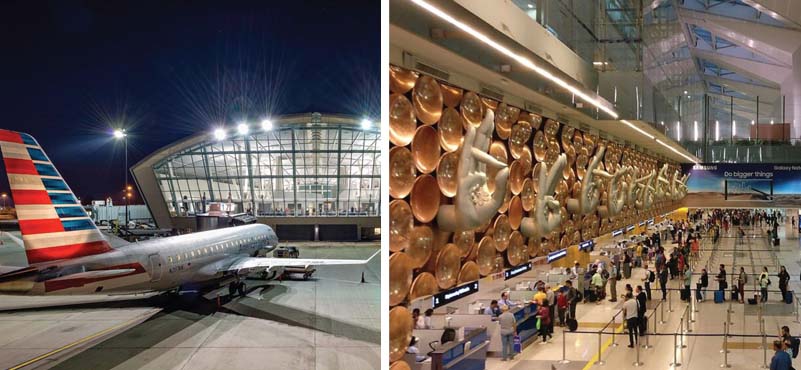
India is entering a moment of profound transformation in its aviation story. For decades, the country’s busiest gateways—Delhi and Mumbai—were limited by the pressure of accommodating more passengers than their infrastructure could comfortably hold. Now, both metros are on the cusp of becoming dual-airport systems, a shift that will unlock capacity on a scale seen only in the world’s most advanced aviation hubs.
The Delhi National Capital Region and the Mumbai Metropolitan Region are quietly preparing to join the ranks of Tokyo, London, New York, and Istanbul—cities that function through two or more major airports working in synchrony. By the late 2030s, Delhi NCR and Mumbai MMR together will handle an estimated 250–300 million passengers annually, depending on India’s economic and aviation growth trajectory. This represents nothing less than a strategic repositioning of India on the global aviation map.
DELHI’S DUAL ENGINE: IGI AND JEWAR
Delhi’s transformation is already visible at Indira Gandhi International Airport, which continues to expand its terminals, airside capacity, and support systems. By 2035–38, IGI alone is expected to handle between 100 and 120 million passengers. The real disruptor, however, is the upcoming Noida International Airport at Jewar.
Jewar’s first two phases will take it to around 30–35 million passengers, while later phases could elevate it to 50–60 million. Together, the two airports give Delhi NCR an augmented future capacity of roughly 140–180 million passengers annually.
MUMBAI’S BREAKOUT MOMENT
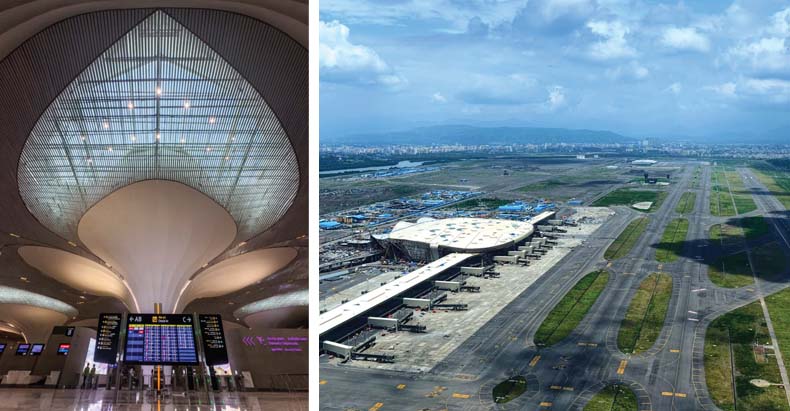
Where Delhi expands from strength to strength, Mumbai breaks free from constraints. Chhatrapati Shivaji Maharaj International Airport has long been a bottleneck—operating at near-saturation due to its single-runway configuration. Navi Mumbai International Airport, slated to open soon and expand in phases, is therefore a game-changer.
Summary Table (Passengers per Year)

By the late 2030s, CSMIA is expected to stabilise around 58–65 million passengers, while Navi Mumbai may scale to 50–70 million, depending on rollout speed. Combined, Mumbai MMR’s system capacity could reach 108–135 million passengers a year.
WHAT THIS MEANS FOR INDIA
With these two dual-airport systems, India secures its place as the world’s third-largest aviation market—and ensures it has the infrastructure to absorb decades of rising demand. Airfares stabilise as capacity increases. More routes open from tier-2 and tier-3 cities. Tourism expands as access improves. Business districts rise around Jewar and Navi Mumbai, driving hotel, convention, retail, and logistics growth on unprecedented scales.
By 2040, Delhi and Mumbai will not just be bigger—they will be differently connected, differently organised, and, in many ways, differently imagined.
Here are three clear, data-driven future scenarios for how the Delhi–NCR region (IGIA + Jewar) and Mumbai Metropolitan Region (CSMIA + Navi Mumbai) may look by 2035–2040. These scenarios use what we already know:
- Current capacities
- Expected scale-ups
- Indian aviation growth rates
- Metro-region population and economic growth
— so no new searches were needed.
2035–2040 AIRPORT CAPACITY SCENARIOS between the two mega cities with two aiports each
A: HIGH-GROWTH INDIA (8–10% aviation growth per year) Given that many of the government’s big policy announcements fructify in the rest of the economy.
Delhi NCR
- IGI Airport: Expands to 110–120 million annual passengers
- Jewar Airport: Reaches Phase 3, about 50–60 million
- TOTAL NCR CAPACITY: 160–180 million passengers/year by 2038
Mumbai MMR
- CSMIA: Slight increases within its constraint — about 60–65 million
- Navi Mumbai: Reaches Phase 3, 60–70 million
- TOTAL MMR: 120–135 million passengers/year by 2038
Impact of these changes can be expected on following lines:
- Delhi becomes a massive dual-hub, comparable to Seoul, Istanbul, or Dubai + Abu Dhabi combined.
- Mumbai becomes a balanced twin-airport system, similar to Tokyo (Haneda + Narita).
- India emerges as the world’s third-largest aviation market — possibly earlier than projected.
- Tourism jumps strongly: easier access, more airport-city corridors, hotel clusters, MICE travel.
 B: MODERATE GROWTH (6–7% aviation growth per year
This is the more likely, the more realistic scenario:
Delhi NCR
IGI: Expands to 100–110 million, Jewar: Grows to 40–45 million – total NCR: 140–155 million passengers/year
Mumbai MMR
CSMIA: 58–62 million, Navi Mumbai: 50–60 million – total MMR: 108–120 million passengers/year
Impact of these will be that both cities remain constrained but functional, with smooth flow in peak seasons, Strong growth in hotel demand around both airports, logistics parks, airport-metro link corridors and tourism sees steady growth; domestic travel surges.
C: CONSERVATIVE / DELAYED EXECUTION (4–5% growth)
This would assume cost overruns, slow airline expansion, or weaker economy.
Delhi NCR
IGI: 95–100 million. Jewar: Only Phase 2 completed — 25–35 million – total NCR: 120–135 million
Mumbai MMR
CSMIA: 55–58 million, Navi Mumbai: Only Phase 2 completed — 35–45 million – total MMR: 90–103 million
Impact could be airports decongested, but not transformed, airlines remain cautious; fewer new international routes, and tourism grows, but without dramatic expansion.
What This Means (Tourism + Infrastructure + Urban effect)
India will have two mega-regions able to handle >100 million passengers each. Equivalent to New York (JFK + Newark), Tokyo (Narita + Haneda), London (Heathrow + Gatwick + others)
Delhi pulls ahead as a long-haul international hub
Jewar’s design + IGI expansion could make it a preferred stopover hub for: Europe–SE Asia, Middle East–East Asia, US–India direct routes
Mumbai becomes India’s cargo + business-travel powerhouse. Navi Mumbai will unlock large cargo capacity, crucial for pharma, gems/jewellery, textiles.
Tourism impact will be that More tier-2/3 cities get direct flights, cheaper fares due to greater slot availability, larger hotel, MICE, and retail ecosystems around both new airports. Growth of “aerotropolis” zones (like GMR Aerospace City, Navi Mumbai Airport City)
Projected Augmented Capacity (Delhi NCR vs Mumbai MMR)
THE BIG PERSPECTIVE: TWO CITIES, TWO-AIRPORT SYSTEMS (2035–2040)
India is doing something only a handful of major economies have done successfully: building dual-airport metropolitan systems in both Delhi NCR and Mumbai MMR. This changes the aviation landscape in three fundamental ways.
What It Means for India’s Aviation Future is that India becomes the world’s 3rd-largest aviation market — and stays there
Dual-airport systems are essential for this. Without them, Delhi and Mumbai would hit congestion walls and block national growth.
Expect: Cheaper fares, more airline competition, direct international flights from tier-2/3 cities, big boom in service-sector jobs (hotels, MICE, ground handling, cargo logistics)
Tourism and Urban Growth Consequences
Tourism impact: easier inbound travel → more leisure visitors, more capacity for festivals, events, exhibitions, hotel development around Jewar and Navi Mumbai skyrockets, new corridors like Yamuna Expressway tourism belt (Jewar → Mathura → Agra) and Navi Mumbai–Alibaug–Konkan belt
Urban impact: cities expand outward, demand for infrastructure: metro, expressways, hotels, convention centres, entire new business districts around both new airports
THE CORE MESSAGE is that by the late 2030s, Delhi and Mumbai will each operate as 100+ million-passenger mega-aviation regions — together reshaping India’s global connectivity, tourism flows, and economic geography.