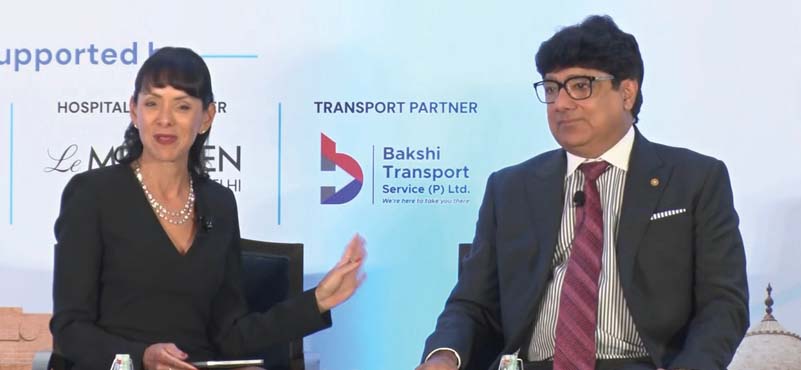
Anita Mandirata, Advisor to the UN Secretary General on tourism matters, in conversation with Puneet Chhatwal, MD and CEO, IHCL at the recently concluded PATA India Chapter conclave, Tourism PowerHouse in New Delhi. We bring you the highlights.
Anita Mandirata: However, in addition to my role with UN Tourism, I’m also one of the members of the Puneet Chhatwal fan club. As we know, when Puneet walks in the room, something changes. It can be a little bit of fear that you bring, but most importantly, it’s excitement. Because as all of us know, Puneet has become one of the true leaders of global hospitality and of global brand India around the world. We know him here in his capacity of FAITH, being the chairman.
He’s the chairman of many organizations. But very importantly, on top of that, he’s become someone who is recognized as truly transforming not only the industry, but the identity of the country. Through his role at IHCL, we know him very much as the CEO, he’s been the leader of IHCL, but he came in, as he said to me, as the Indian bridegroom.
People questioning who was the son of India that was coming back to take on one of the most beloved family brands in the world. The man has transformed a 120-year-old legacy into a global powerhouse of profitability and asset-light innovation, and he joins us today in a way that is going to be able to share not only what he is doing for hospitality and what he feels hospitality needs to do for Indian tourism and for India around the world, but we also want to get to know a little bit about Puneet.
This is where he gets a little bit nervous. Because, very importantly and very recently, his honours include the IOD Distinguished Fellowship, he’s been named Forbes India’s turnaround star, only to confirm that we have in the room someone who is truly a global ambassador.
And right now, sir, you’re on a quest of global domination. So, as we start and we start talking about India’s tourism momentum, I want you please to rewind to your FAITH chairmanship. Can you please, in 30 seconds, what exactly is FAITH and why is it so important to everyone here in the room?
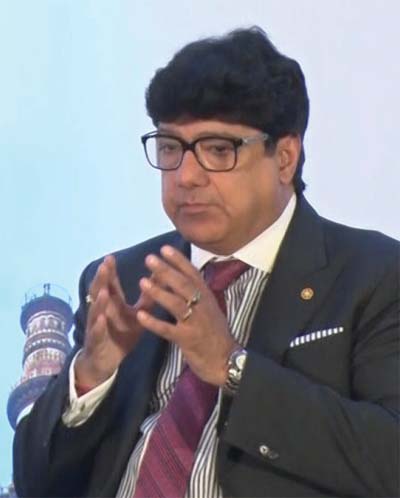 Puneet Chhatwal: FAITH is the apex body of all important travel and hospitality associations and this was formed long ago because the sector was so fragmented that the government said there should be one body which comes and represents everyone otherwise the attention gets divided. So, it does the lobbying for the wants and needs of the tourism sector and I’ve been blessed to be a part of it reluctantly initially but enjoying it especially in the last couple of years.
If you want to make a difference, certain platforms are needed. And for me, it’s always been first, the sector. So, sector first, organization second, the person is the third. And if you want to contribute to the sector, automatic contribution will happen in your organization and in your individual capacity. So, the best platform from a tourism perspective, there are very few. It’s WTTC, it’s FAITH, and it’s CII and maybe FICCI but I think CII is the strongest in my personal opinion so I happen to be there.
CII is the Confederation of Indian Industry, it represents all sectors so it’s not limited to tourism, it is conducting its business with the support of the government, so it has the possibilities to get to the policy makers directly and FAITH in its capacity for the tourism apex body has the same opportunities and I think spending certain time, not free time, actual active time for leaders in the sector, for the betterment of the sector, no matter whether you get something now or not; when you go to trade shows, you have to think three years before you can think of a return. So, I think from all these bodies, you have to think of a consistent investment in time, in resources, in lobbying over a three, five, seven-year period before you will actually be able to make any changes. So, I think a lot of patience, a lot of hard work, a lot of perseverance is needed but this platform allows you to do so.
 Anita Mandirata: And on top of that and I thought you’re usually one who plays around with words so when I said why is FAITH so important I thought you were going to actually answer me in a spiritual way to catch me out because FAITH is important. But on that, one of the beauties of FAITH and one of the beauties of you as a leader, quite honestly, is that you bring a remarkable humanity into it. So, it’s not just working with Suman, because he’s the ministry. You like Suman. You have a personal relationship with him. You have the ability to call him.
If you need something, you know how to reach Vikram. You know he’ll answer the phone in the middle of the night. Those relationships are so important. And I say that because when we get in a situation like this, we always end up in an argument, a very diplomatic argument, but an argument between the private sector and the public sector. And it’s not only two hands that must clap; they are two hands that must come together.
How do you work out the ability to effectively, as an industry and also using your IHCL lens, work with government to be able to ensure that the marketing of the destination is as strong as it can be, even if the budgets are not as strong as they can be?
Puneet Chhatwal: I’m known to be pretty upfront and straight, there is no budget. I mean it’s very sad. The international marketing budget of Taj to help the tourism sector to market at various global events is triple than that of the government. I think we as a private sector, came in at the IATO annual event a year and a half ago and we committed to do that over the next three years…………… ….. So, what we do is try to lobby so he gets the money that is needed and that allocation is needed very, very badly. Because you can have the best of the product, you can have the best of the opportunities, but if no one knows about it, how are you going to make it work? I’m quite hopeful that in the coming budget, that would be a help. So that’s one thing which you do in terms of lobbying.
Second is what can you do as a private sector? That’s what I said we did. We are doing, we open our hotels in London at WTM. We rent other spaces at the ITB because we don’t have a hotel in Berlin. We’ll very soon be doing that in Frankfurt at the IMEX when we open the Taj in Frankfurt. It should be open before the next IMEX.
We do the India evening at the ATM – Arabian Travel Mart in Dubai, and enable our fraternity to invite their guests to be part of that evening at our expense. And I’m sure the rest of the sector is following and will help to do that also. Now, something you mentioned about responsible tourism. I think a lot of our companies and groups have been very responsible not for now but for over a century.
When I think of you mentioned Tata, so the founder Jamshedji Tata said 155 plus years ago that community is not just another stakeholder, rather the purpose of the existence of any business. So just imagine that purpose and community which includes responsibility was defined 155 years ago and is a part of every Tata Group company. We are sitting in ITC Maurya. What is ITC slogan? The main slogan of ITC hotels is responsible luxury. I think a lot of that is happening but as I said the sector is very fragmented.
The branded part of the sector is less than 200,000 rooms which is equal to number of branded hotels supply in Dubai and Singapore put together. The rest is unbranded. I think as India has evolved in the last 10 years, it will continue to evolve in the next 10 years and a lot of that will get sorted on its own and a lot will need to get sorted and that’s where we have the FAITH and we have other apex bodies trying to bring in policy, planning, processes all together so that it works for the betterment of the sector.
Anita Mandirata: I think pulling together, because you’ve covered off many ticks, so thank you very much for that. Because when we speak about, as we were saying about budgets, the ability to market, et cetera, I think there’s an important point that Puneet is saying that you’re not going to complain about the lack of funding coming from ministry. You are complementing in kind. It’s not about complementing in cash, it’s complementing in kind to be able to make that work. And that ultimately, as well, is responsible destination development.
Because as we were talking earlier, then again, the word sustainability, what is the opposite of a sustainable business? It’s bankrupt. What is the opposite of sustainable wildlife? It’s extinct. So, it’s not a choice. Sustainability is in your DNA, the responsibility. It’s in brand slogans. The challenge, however, is that the language is everywhere. And it’s usually a word written in green, sadly. How do we measure that? That’s the question…… How does something like that work within an Indian context and how can FAITH stimulate that?
Puneet Chhatwal: I can only give an example of our own company. We have a program called Pathya. There are six pieces of Pathya which is all measurable and we give actually defined goals. It actually ties into the Tata Group program which is called Alingana of getting to net zero. There is otherwise also no choice. Why do I say that?
If you are a publicly listed company, most of the investors are not allowed to invest in your company if you don’t have a comprehensive ESG plus program. So, you have to add E and G to the S and a plus on top of it to be able to attract good investment community across the globe. I think most of the listed companies are or have been doing it and are very well set to contribute. The challenge is when you are not listed or you are totally private, that’s where it becomes difficult to measure. I think as a requirement, in Indian companies, so you have a CSR committee meeting, just like you have an audit committee meeting, you also have a CSR committee meeting, you have a risk management meeting, different kinds of committees and I don’t know of any serious top 100 organizations which does not have a comprehensive CSR program.
Anita Mandirata: But to your point, for those that are not listed, for those that are medium size, smaller size, Suman was speaking about the need to support entrepreneurs now coming into the tourism industry. What role can FAITH play in embedding the fundamental need to ensure that sustainability is monitored, is measured, and from a market point of view, can be accepted as yes, that is legitimate?
Puneet chhatwal: See, there is a very long answer to it, but I’ll try to shorten it. Firstly, it starts when you start conceiving a place itself, a destination. India’s tourism activity is still very much limited to 10-12 destinations. I see Mr. Soin here, anytime anything goes wrong, the first WhatsApp message you get in the morning is see what overtourism is doing to Uttarakhand and all these places. I think one of the things is when you decide on the place. The second is how it is built because it starts there.
If you build sustainable or sustainability friendly properties, it may cost you to build 5 to 10 % more but in your operations, it will cost you 20 % less. I think that kind of education, awareness, building permits and even incentivization should be there. People who build on solar energy, people who build more sustainable properties, they should get certain incentives and nothing works better than incentives. I don’t want that India should build incentive driven culture but there should be an incentive for those who do and for those who don’t. So those who actually do should be incentivized in one way or the other.
Those who create employment, those who create skilling centers, those who create jobs for so many millions of people and there is no better multiplicator of job than tourism can be, then we have to do something from a policy perspective. And that’s where Suman can help because of his vast knowledge, his exposure across the globe, but his also very good ability to articulate. Now, what we can do with Suman or the rest of the ministry and the ministers and others is to we can keep pushing that through other channels which we have been doing. I think it would be fair to say under the leadership of the current tourism minister and the tourism department as such with people like Suman out there, an effort is there and at some point, the effort also leads to results. Only problem is we don’t know when, is it in two months or in two years.
Anita Mandirata: But you make an important point as well because an organization like FAITH for instance can provide the industry with those best practice models. It will cost you money, more in the engineering, but it’ll cost you less in the operations. Marry that with accreditation, marry that with policies, and that simply creates a new way of destination development based on best practice, based on best leadership. I think that’s important.
Puneet chhatwal: And as far as our sector is concerned, it has become a bit boring, but for last five years, our ask has been limited to simple three things. Infrastructure status, we don’t want to have the question what’s the real benefit, how many people use it. We don’t need it. We are a debt-free company. But if it enables a lot more new entrepreneurs, it will help the sector to build the destinations. Industry status, because not only the cost of capital is prohibitive in building a hotel versus another form of real estate, your cost of operation is the highest because you are taxed the highest. And that’s where many states have actually implemented the industry status, but not all and not all the Union territories.
And finally, marketing of India, outside of India, so we get to not this 10 million, which is also not 10 million, because it includes a lot of people with foreign passports, but they’re Indians or with the OCI cards. So, to get that figure to 25 million, which is what a city like Paris gets. I think these are very simple three asks, the rest is a lot of detail around it, how we package it, but if we do these three things in the short term, I think the sector will benefit because of which the GDP which is already benefiting. I think one of the most important exercises we have to do is when we say the GDP is growing at 7 .4%, how much of that increase in the last three years has come from tourism and hospitality and I think people will be shocked.
Anita Mandirata: Because I think in fairness, and I’m sure Suman would attest to this, no country in the world will ever say that their marketing budget is enough. No one will. Even Saudi now cannot say that with all of their wealth, because their ambitions are so large. And that’s where I’m going to pivot slightly, because we’ve had great presentations, around the opportunity when it comes to demand. But the supply of a critical, critical part of the ecosystem just isn’t there. And it’s airlift.
And I was with your Tata brother yesterday, Campbell Wilson, the CEO of Air India. And despite the transformation strategy of Air India, globally, Airbus and Boeing cannot supply enough aircraft. They just can’t do it.
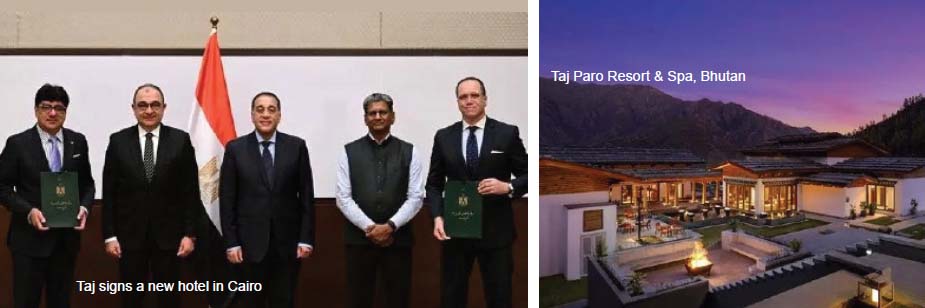
So, it’s about smart development then of the marketing, of the product, of the expansion. Now, shifting from FAITH to IHCL, Brand Taj and a little bit of Brand Puneet, you are truly, with Tajness, one of the greatest marketing vehicles of what incredible India and incredible Indians represent around the world. And you, sir, are now creeping and if anyone should be enjoying retail therapy it’s you right now because it’s Cairo, Frankfurt, Bhutan you were saying. Your runway for 2026 rollout is what?
Puneet chhatwal: We have taken a conscious decision that outside of the Indian subcontinent we just want to grow with Taj and Taj has now been consistently rated as world’s strongest hotel brand and India’s strongest brand across all sectors. They were done by our forefathers, the lovely palaces and you know, the iconic assets that are there including the two in Delhi. I think Taj is not just a brand. I’ve gone on record saying Taj is an emotion. And I genuinely feel the way Taj rises to special occasions, be it G20, be it somebody’s daughter’s wedding at the Rambagh Palace, followed by a reception at Taj Mahal Palace in Colaba.
It’s something very special, very unique, which creates that emotional connect over generations. So, I wish I could take the credit for it that I started it. No, I inherited it and I’m I’m very privileged to be the custodian of it. Taj will continue to grow its presence internationally. When I joined eight years ago, we took a conscious decision to focus on India only. As things stand today, we will keep our focus in India, but we will selectively grow international destinations because that is the need and that is the opportunity.
I’ll explain also a bit. Something went wrong during COVID and post COVID. On the Western Hemisphere, service levels have dropped to a level that I would have never imagined being 40 plus years in the sector. The prices have more than tripled. People complain about prices in India, but when they go to New York, they pay $1,000.
We closed last month at The Pier at $1 ,250 average rate and nothing has changed in that property. So, there is an opportunity for Asian brands in general and Indian brands in particular to make that difference whether you do it through Tajness or other brands do it through other USPs that they have to revive what was the hospitality. Hospitality is not just some loyalty points. It’s very personal. You have to use data. You use data but don’t make just data loyalty points as your billboard.
But that’s fine. Others are doing it. I’m not complaining about that. What I’m saying is we have an opportunity because we can do both. We can use loyalty. But our whole concept of guest is God, etc. can be leveraged in such a strong way like never done before and so is the truth for all other major Asian luxury operators.
Only we need help from the Vikrams and the (late) Inder Sharma’s not to complain so much about hospitality in India because what you get here, he doesn’t get here when he goes to visit his kids in Switzerland.
Anita Mandirata: Coming out of COVID particularly, where there was a scramble to rebuild the numbers, rebuild the revenues. To your point, there was a lot of dilution of what exactly the brand experience is in many hotels, many destinations around the world. It takes courage to stay true to self. It takes courage to say that Taj represents an emotion, and this emotion will remain wherever we are in the world, whether it’s in Dubai, Frankfurt, now going into Cairo. That emotion is what? What is that that I can feel whether I’m in your property?
Puneet chhatwal: I thought there was time that we should define what is Taj and we created a definition which was so easy for any dishwasher to a housekeeper to a general manager to anybody across the globe to follow it. We said T stands for the trust of all our stakeholders. A, that is linked to your S, awareness of the communities we work in and live in and J, for the joy in doing whatever we do.
Do it happily, do it with your heart. So, it’s not like a processed luxury. When you make your strategy a part of your culture and your core values, it will sustain the test of time because you can change your business strategies every three years, every five years, but you can’t change your core values or your culture. I think that’s how we will make it work across the globe.
Anita Mandirata: To close this down now, and you’ve walked into it beautifully. I don’t know many people who work as hard as you do. I don’t know many people who spend as much time up at 35 ,000 feet compared to on the ground. I don’t know as many people who have as much fun in their job as you do.
And the second part of that question, why is India the best country in the world to represent all of us?
Puneet chhatwal: It’s the best sector to work in because this sector, anybody can work. It does not require you to be some data scientist. It’s really a business of common sense, relationships, and having your heart in the right place. I think that everyone can do or the majority of the people can do. It’s not that 10-20% who cannot do. I think it’s more like almost everyone can do.
And the second was why India is the best place. Today, definitely it is the best place. It is a fast-growing economy. Indians are in a very good space. I have never seen Indians being so proud of themselves. I’ll share a very quick personal thing. When I first went to Europe in 89 and stayed on for 28 years, I was not even a third or a fourth-class citizen. I was a classless citizen. So, it was like you have come from some place and now you are very poor and you are not going to go away, which actually happened. I went and I came back.
Today Indians in the same countries, where you never used to get visa, are getting visa friendly conditions to please come, please help us, we don’t have the people, the population is aging. So, the positioning of India and Indians has changed from an economic perspective, from a social perspective and for me it is just the beginning because tourism and hospitality is a consequence of all those first things that happen. It’s now when the GDP keeps growing, when India’s disposable income will start growing or per capita income starts growing, more and more investment will come into this sector and with our style of operation, with our heart in the right place, I think India can create a soft power through tourism like nobody else has been able to do. And a day will come when it will not be Disney or Las Vegas. It might be Banaras and Ayodhya or a Bengaluru and Kochi or where you are going, I think Ranthambore, has had a 10x increase in visitors from last year.
So, I think it’s actually happening in motion. One thing which we now need to lobby together with the help of Suman is the cheapest, fastest and easiest way to create the soft power of brand India is through tourism and hospitality and that’s it. India is a great place to be in.