
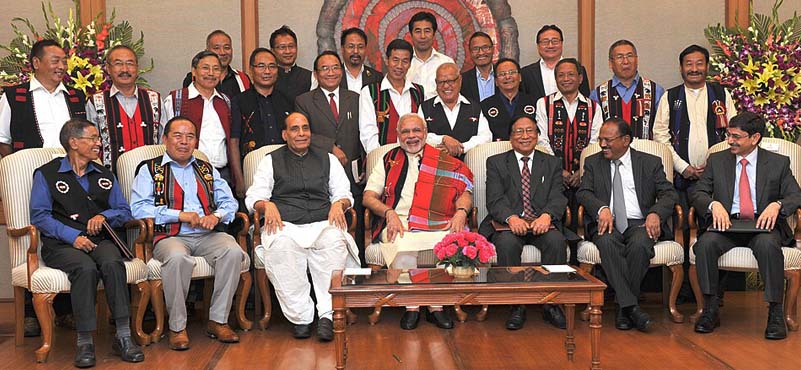
“It is time for Muivah to abandon his stubborn position on a separate flag and constitution and reach an honourable solution to the Naga Political Issue within the framework of Indian Constitution”
India’s internal security landscape has witnessed renewed pressures in recent times, driven by episodic military crisis resulting in relative de-prioritisation of the Naga Political Issue, one of the long standing, intractable and complex internal security challenges in the North East. The security establishment has had much on their hands, including the blast in Delhi; the consequential responses to the unprecedented success of Operation Sindoor; follow up operations in J&K, the protracted Manipur crisis and the sustained ongoing operations against Left Wing Extremism.
The recent visit of Thuingaleng Muivah, the leader of National Socialist Council of Nagaland (Isac Chishi Swu & Muivah), (NSCN(IM)) and chief negotiator with Indian Government on the Naga Peace Accord, to his home village in the Ukhrul district of Manipur, however, brings back into focus a primordial faultline. The vexatious and lingering Naga political issue can accentuate India’s internal security complexities if ignored for long. Since Oct 2019, formal negotiations have seemingly stalemated (though there were a few informal meetings between the Indian interlocutor and the NSCN(IM) leadership), due to the intractable position of NSCN(IM) on an independent flag and constitution.
The negotiating position of NSCN(IM) has been significantly degraded over the years due to factionalism within the group, sprouting of alternate power centres, aging leadership, lack of local support, operational attrition and fatigue. However, given the fluid security challenges in the region, it has the potential to exacerbate matters.
One, the coup in Myanmar in 2021and internal conflicts has resulted in ungoverned and unstable border regions ( Indo-Myanmar Border) where most of the insurgent bases are located. This provides immunity and freedom of operation to sustain residual militant capability to the Indian Insurgent groups. This can be further exploited by external inimical elements through collusive support, training and supply of arms.
Second, with the continuing impasse between the Meitei and Kuki communities in Manipur, internal security threats along the Indo-Bangladesh border, consequentially the Siliguri corridor will have its deleterious impact in Nagaland, in terms of operational focus and synergy.
Historical Context
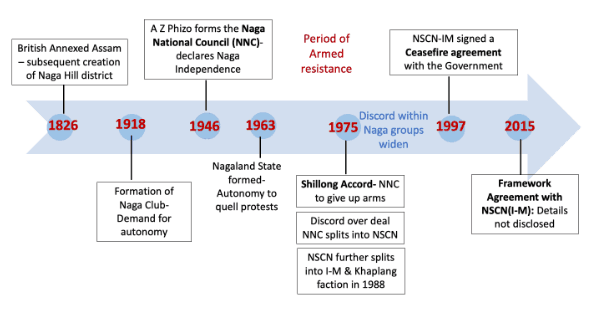
To recapitulate, the Naga issue is one of India’s oldest ethno- nationalist and insurgent movements. It is rooted in questions of identity, sovereignty, autonomy and territorial integration of Naga inhabited areas spread across present-day Nagaland, Manipur, Arunachal Pradesh, Assam and North Western Myanmar; the idea of a Greater Nagaland or Nagalim. The key drivers of such a sentiment encompasses strong tribal identity, geographical isolation, governance alienation and lack of political integration. Guided by Naga people’s demand for self-determination and autonomy, the Naga National Council (NNC) was formed in 1946 under the leadership of AZ Phizo, often called the father of the Naga nation. He played a pivotal role in shaping the Naga movement, transforming it into a secessionist crusade and resistance against Indian state authority since independence.
Following the Shillong Accord of November 1975, between the Government of India and the NNC, Naga groups agreed to accept supremacy of the Indian constitution, surrender arms and renounced demand for secession. Though the accord led to a temporary peace in the region, many leaders including Muivah who joined NNC in 1964, saw it as a betrayal of the cause for sovereignty leading to a split in the NNC. It resulted in the formation of NSCN(IM) in 1980 including factions of Muivah, Isak Chishi Swu and SS Khaplang. After violent internal conflicts, NSCN(IM) split into NSCN(Isak-Muivah ie IM) and NSCN- K factions. The NSCN(IM) emerged as the dominant and most potent insurgent group in Manipur and Nagaland with its armed wing and the Government of People’s Republic of Nagalim(GPRN), based at Dimapur (Camp Hebron). NSCN-K based in Myanmar.
The Peace Process
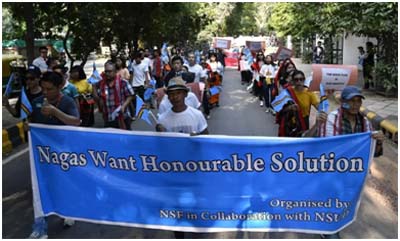 After protracted armed conflict, NSCN(IM) entered into a ceasefire agreement with Government of India in 1997 to halt armed hostilities and create a peaceful environment for negotiation towards a political solution. The insurgent cadres were to be confined to “designated camps” in Nagaland and “Taken Note of Camps” in Manipur; though technically the ceasefire agreement was applicable to Nagaland only. A Ceasefire Monitoring Group(CFMG) with representatives of Central and State Governments and NSCN(IM) were to monitor, supervise and ensure compliance with the ceasefire ground rules. Prolonged and sustained negotiations led by number of Indian interlocutors ( from Mr Saraj Kaushal in 1998 to Mr AK Mishra now) have not led to a final solution. NSCN(IM) cadres in Nagaland and Manipur have been accused of extortion, intimidation, illegal taxation and resource collection under the cover of ceasefire where kinetic operations are constrained.
During the tenure of Mr RN Ravi (later, Governor of Nagaland and now Governor of Tamil Nadu) as the interlocutor between 2014 and 2021, a Framework Agreement was signed on 3rd August 1915, principally laying the political foundation for a final settlement and recognising the unique history, culture and position of the nagas. There has been controversy regarding the interpretation of the text of the Framework Agreement as regards “Shared Sovereignty” and “Partnership”.
Concurrently, the government has diversified the peace talks with parallel negotiations with other prominent Naga groups that resulted in the signing of the Agreed Position with Naga National Political Group (NNPG), a conglomerate of seven Naga political groups on 17th November 2017. The document recognised the historical and political rights of the Nagas to self-determine their future involving tribes, church organizations and civil societies within the Indian constitutional framework, to find an honourable solution sans the maximalist sovereign claims of NSCN(IM). The agreement is often criticised by NSCN(IM) asserting that it cannot dilute the 2015 Framework Agreement.
Subsequently, realising splits within various Naga organisations, the Forum for Naga Reconciliation(FNR) facilitated a significant agreement in Oct 2022 leading to the formation of Council of Naga Relationships and Cooperation, following a meeting between NNPGs and NSCN(IM), committing both groups to work for reconciliation, unity and peaceful resolution of the Naga issue. The Naga Consultative Meeting held on 15th October 2020 convened by Chief Minister of Nagaland adopted a seven point resolution calling for unity amongst Naga groups and one solution to the Indo Naga political issue.
The Eastern Naga People’s Organisation (ENPO) representing seven major Naga tribes and six districts in Eastern Nagaland demand creation of a Frontier Nagaland Territory (FNT) with autonomous governance, separate budget and dedicated administrative machinery. It neither demands sovereignty nor secession from India thus distinctly varying from corrosive legacy of NSCN(IM) demands.
Current State/Prognosis
With the Chief Negotiating Group, NSCN(IM)’s irreconcilable position on separate flag and constitution, the formal negotiations have meandered to a dead end. There are several factors why NSCN(IM) can no longer have a strong bargaining position it once wielded at the negotiations
- Overtime, the NSCN(IM) has suffered multiple irreversible splits ( into NSCN-K, NCSN K (YA), NSCN-R, NSCN-U etc) due to leadership rivalry, tribal loyalties, ideological and tactical differences. Many prominent Naga groups are not aligned with its maximalist position on flag and constitution. Its kinetic potential and support amongst the local population has been severely degraded. This is evident from the significant decline in insurgent related incidents in the region. To that extent, Muivah’s recent visit to his village may well be his last.
- Following the abrogation of Article 370 in J&K and bringing the region firmly under Indian Constitutional framework, there is little scope for the government yielding on the twin absurd and unacceptable demands.
- Since 2019, in the neighbouring State of Assam, the government has signed a number of peace agreements including Bodo Peace Accord(2020), Karbi Peace Agreement(Sep 2021), Adivasi Peace Accord (Sep 2022), DNLA Peace Agreement(April 2023), ULFA Peace Agreement (Dec 2023, pro talk faction) leading to surrender of over 8000 cadres. This has led to political integration, selective autonomy and rehabilitation of the insurgents. Winds of change is thus in favour of joining the national mainstream and interstate collusion between insurgent groups is a thing of the past.
- The remarkable success of security forces against Left Wing Extremism in Central India (either surrender or get eliminated) only goes to demonstrate the resolve of the government, that while being sympathetic to ethnicity and cultural preservation, threats to national security through coercion will not be acceptable. The government is likely to be more assertive than apologetic/accommodative in its future negotiations with the NSCN(IM).
- Manipur, Assam and Arunachal Pradesh, let alone Myanmar, will never agree to detach their Naga speaking areas under the so called Nagalim. Recent initiatives of the government to fence the Indo-Myanmar Border and place greater emphasis on border guarding, compared to combating insurgency in the hinterland by Assam Rifles, will only confine and constrict operational freedom of the Naga insurgents.
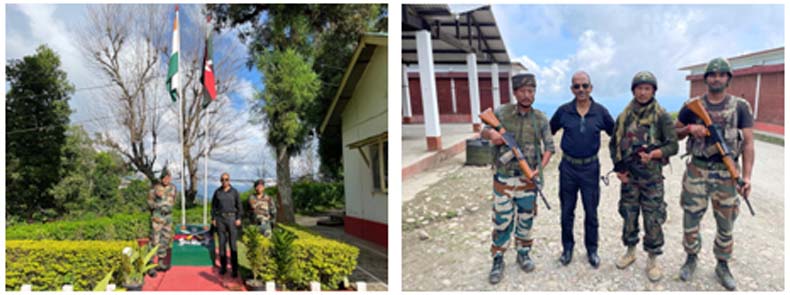
- During a visit to Mokokchung in Northern Nagaland in 2022 by the author, it was observed that most of the senior leadership of NSCN(IM) were located in privileged townships, leaving the rank and file to languish in jungles to execute extortion, intimidation and tax collection to sustain the movement. This is indicative of the movement being on life support.
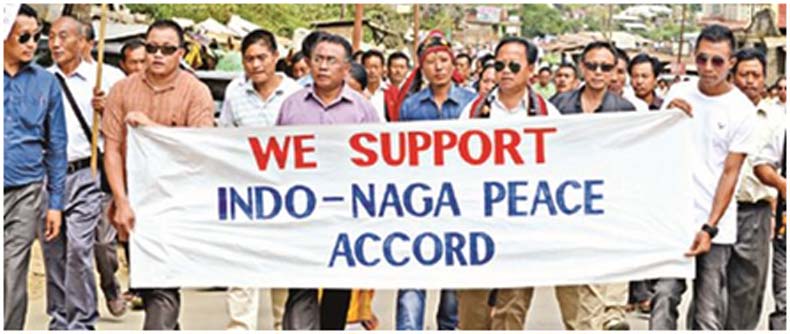
Time may be running out for Muivah whose promise of greater Nagaland to his followers remains delusional with progressive marginalisation of the group. He must abandon his flirtation on Nagalim, separate flag and constitution, and to accept an honourable solution within the framework of Indian constitution as a parting gift for his followers who have been with him for last 50 years. For the Government of India, it is another festering internal security quagmire which must be wound up, it should be laid to rest for good.
ABOUT THE AUTHOR
 Major General SC Mohanty, AVSM (Retd), was commissioned in June 1983. The officer commanded a Mechanised Infantry Battalion, a Mechanised Brigade and an Infantry Division (RAPID Strike) in the Western Sector. As a Brigade Major, he took active part in the Kargil Operations while located at Drass. As part of Military Operations Directorate, he headed the Information Warfare, Cyber and Electronic Warfare branches. Post retirement, he was the Security Advisor to Government of Arunachal Pradesh from July 2020 to May 2023.