
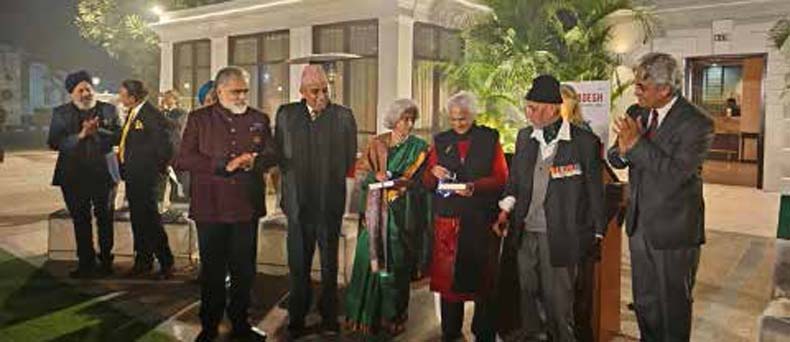
A conversation on the release of the book “Bangladesh: Humiliation, Carnage, Liberation, Chaos”, authored by Iqbal Malhotra and Subroto Chattopapadhay, published by Ink Publishers.
What started with partitioning of the subcontinent in 1947 ended with liberating Bangladesh in 1971. Thousands of Bengali Mukti Bahini fighters died fighting for the freedom of their country. 3843 Indian soldiers on both fronts laid down their lives for what has been described as a just war.
25th March 1971 is a day Bangladeshis remember vividly. On that night the Pakistan army cracked down on its unarmed citizens. That one incident destabilized the subcontinent and sucked India into a cyclone of violence next door.
Poor, besieged but morally certain, Indira Gandhi’s India—alongside the fearless Mukti Bahini trained by the Indian Army and Navy—fought a secret war over nine months along with other Bengali citizens and freedom fighters. Finally, a lightning thirteen-day campaign shattered Pakistan’s army, took 93,000 prisoners, and birthed Bangladesh in history’s fastest liberation.
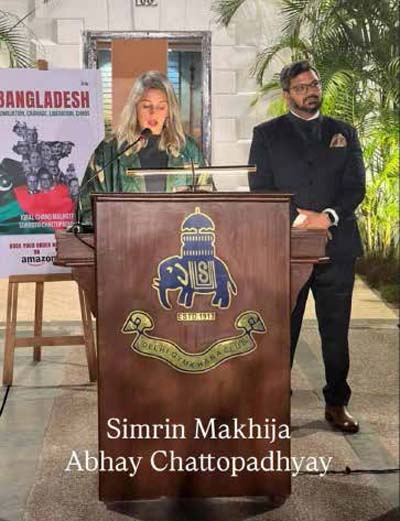
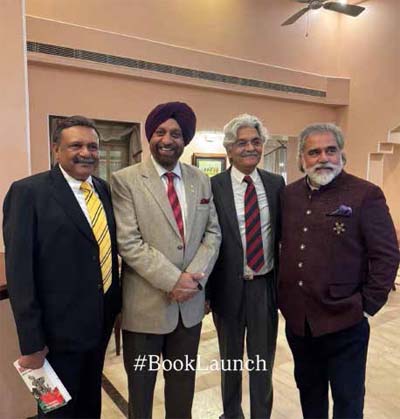
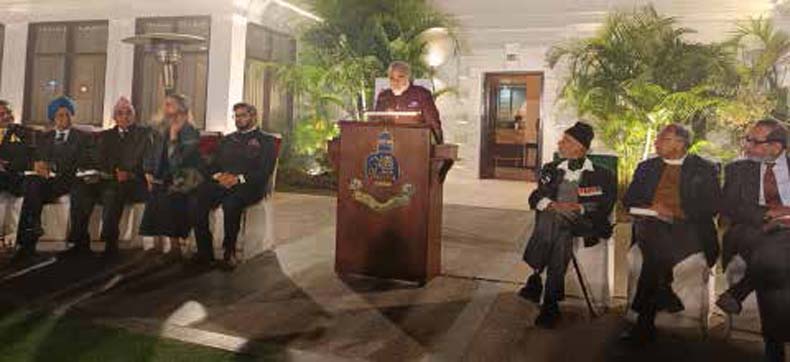
An unusual Book Release function, where not only the two authors but also a dozen plus of the leading protagonists and their loved ones, participated and shared their experiences of the war. One war veteran talked of the Distant Thunders that can be heard today.
We bring you excerpts from the experiences shared. These are extracted from the original texts that were delivered at the event.
Iqbal Chand Malhotra
 In popular imagination the narrative of the 1971 war and the resulting creation of Bangladesh is telescoped to a narrow focus starting with the military crackdown and ending with the surrender ceremony on 16 December 1971 with a few war stories thrown in.
But if one takes a deep dive into the story, it conclusively appears that the events in 1971 had their roots in 1947. Therefore, the scale of our book spans 78 years from 1947 to 2025 and is akin to a modern-day epic because never has a country been midwifed the way Bangladesh was, by a then relatively poor and morally steadfast India.
While the roots of the conflict between East and West Pakistan go back to the tragic partitioning of the subcontinent in 1947, Pakistan was united by religion and divided by language and culture. There is hard evidence of the West Pakistanis humiliating the
Bengali population, depriving them of their just economic dividends; insisting Urdu be the national language; disregarding their rich syncretic culture, and imposing an aggressive form of neo-Arab Sunni Islam that propagated a racism, humbling them into a subordinate partner.
…………….West Bengal was put under Governor’s rule a few times and a serious attempt was made to extinguish the problem though a covert black operation coordinated by the Indian Army, called “Operation Steeplechase.” If you read between the lines, Op Steeplechase was a hot pursuit operation to simultaneously decimate the Marxist-Leninist Cadres on both sides of the border and simultaneously under cover of this operation move the Army to the border without mobilization. There are fascinating details of this in the book.
With the left-wing cadres significantly eliminated, the Awami League workers were able to swing a significant part of the left’s popular base to their side to win 167 out of 313 seats in Pakistan’s 1970 general election, and an absolute majority in Pakistan’s prospective parliament. Did Steeplechase thus significantly alter the outcome of the verdict in Pakistan in 1970?
Col Ajai Shukla
 In 1970, the government of Pakistan conducted elections which were remarkably free. The Awami League swept the polls. Bhutto, big business, the West Pakistani elite and the Pakistani military were stunned.
Yahya Khan refused to call the National Assembly to session, disregarding election results even 3 months after Mujib was elected prime minister. The Bengalis had always suspected this would happen and East Pakistan exploded in violence.
……………………………………………. On the night of 25th March, the Pakistan Army rolled out US made M24 tanks and artillery guns from Dacca Cantonment into the city. Mujib was picked up and sent to Faislabad, and later Mianwali, and the genocide began.
The Bengalis hit back in Chittagong and Joydebpur cants, killing their West Pakistani colleagues. The Pak army reprisal was brutal. There were massacres in Comilla, Jessore and other cantonments. The Ramna Kali Bari, Dacca built by the Nepalese was like a battle ground with hundreds killed and the temple damaged. Let me scope out the magnitude of the carnage. Women were brutalized and there are detailed records to show over 200,000 were sexually violated, 3 million Bangladeshis were killed and 10 million people fled to India. Pakistan’s internal problem became a nightmare for us. The Indian army saw evidence of barbarism of the PAK army up close all over in particular Brahmanbaria and Dacca as they closed in. And no one in the PAK Army was punished for these war crimes.
I am afraid some of the people of Bangladesh seem to have forgotten this nightmare.
Lt Gen Pannu
 The subcontinent unfortunately is no stranger to violence. The partition of British India into India and Pakistan was announced on 3 June 1947 in New Delhi and London, following the Mountbatten Plan, which was approved by Prime Minister Clement Attlee and accepted by Nehru, Jinnah, and Patel. This led to the Indian Independence Act on 15 July 1947 and the creation of both nations on 15 August 1947. About 14–16 million people migrated across borders and an estimated 1–2 million succumbed to senseless violence. Families were separated, properties lost, and trauma continues. Migration was more sudden and violent in the west.
The tragedy revisited us in 1971 this time in the east, if truth be told we were overtaken and overwhelmed by the events described. The tsunami of refugees paralyzed us. We never imagined this scale of barbarism could be carried out by a professional army.
 …………Initially in April and May the Mukti Bahini was beaten back by the PAK Army, and they suffered huge casualties but by July led by Maj Gen (later Lt Gen) Jimmy Sircar this operation was on a roll. In addition, the Mukti Bahini regulars who were PAK Army officers and men who had deserted were also organized into sectors to fight along with the guerrillas.
………………..In all, India’s secret war was a huge operation where the Indian intelligence agencies worked closely with the military. It was also evaluated whether it should be the only offensive to liberate Bangladesh, but the casualties were staggering and it was assessed the time taken to liberate would be stretched and the lives lost would be huge which influenced the decision to open a regular war and wrap it up fast.
Amitabh Mathur
 Well, there is always a shroud of secrecy over the role of intelligence agencies and that is perhaps how it should be. In a nutshell the agencies are required to keep the government abreast of matters concerning national security and act in furtherance of national objectives. This was also the task on hand in 1971. The intelligence and police community then were headed by stalwarts. The R&AW, the external intelligence agency carved out of the Intelligence Bureau in 1968 was led by RN Kao ably assisted by his deputy K Shankaran Nair and the legendary PN Bannerji. The IB by its veteran Atma Jayaram who was brought back in 1971 to head the agency to ensure harmonious coordination with its sister agency. The BSF was headed by the institution builder KF Rustomji assisted by Golak Majumder.
 In the intelligence community folklore, the liberation of Bangladesh in 1971 is generally accepted as the R&AW’s hour of glory. Based on intelligence collected from its vast network of engagement with all stakeholders in then east Pakistan, Kao had concluded that efforts at political compromise notwithstanding, the two wings of Pakistan could no longer co-exist in any form. This possibly, in the absence of the incarcerated Mujib, before even the Awami League leadership grasped it. Barring perhaps the astute Tajuddin Ahmed.
In the coordinated intelligence effort, the IB under Jayaram ensured internal security cohesion by alerting state police chiefs of not only fifth columnists infiltrating in the garb of refugees but of the danger of communal riots given the outrage over the systematic targeting of the Hindu community by the Pakistan army and collaborating Razakars in East Pakistan.
Meanwhile those adherents of the 1947 partition mentality, firmly opposed to liberation of the country or split from Pakistan, were conspiring to sabotage the freedom struggle. Aided by the CIA, as America did not want a break up of Pakistan which was at that time assisting a breakthrough in relations with China, they established contact with two representatives of the government in exile to reach a compromise under which autonomy would be granted without the breakup of Pakistan.
Sqn Ldr Rana Chhina
 As regards the magnificent men and their flying machines. There is a first-hand account by a young Naval Aviator who flew not with the Navy but with the IAF out of Pathankot and amongst his other achievements the US believed he rocketed the US Defense Advisor Chuck Yeager’s plane in Chaklala next to Rawalpindi now called PAF Nur Khan. It caused an international furor since the DA was a celebrated aviator, a US citizen and was the 1st to break the sound barrier. The pilot did not claim the “kill” as he had forgotten to switch on his gun camera. The pilot is none other than the highly respected Adm Arun Prakash who was awarded a VrC for his gallantry and later retired as the CNS.
 A great story is narrated by RAdm Santosh Gupta MVC about the initial strikes by the pilots flying off the INS Vikrant when the Naval pilots struck Cox’s Bazar and Chittagong. The strikes by the navy’s Sea Hawkes and Alizes that attacked from INS Vikrant were the main reason why the Navy could secure the Bay of Bengal.
The IAF was able to gain total air superiority in the East within 48 hours of the commencement of operations. The PAK pilots fought bravely but the PAF was knocked out of the war by cratering Dacca runway.
That story is told in first person by the late AVM BK Bishnoi VrC and BAR who conducted that mission and after a week rocketed the Governor’s house on the 14th of Dec forcing the Governor of East Pakistan to resign.
Vice Adm Anup Singh
 What is largely known about the Navy is that it is called the silent service! What is largely unknown to our world is that in the 1965 war, the Indian Navy was literally ‘silenced’ by the political executive, who confined it to South of the Porbandar parallel. That was the only time the white uniform—across its rank and file—pulled its hair apart. But that episode only made the Navy stronger in its intent for the future.
Many moons later, that opportunity presented itself in 1971. This time, the Navy got into the game rather early as its marine commandos trained and mentored the Mukti Bahini sea-guerillas.
In the formal war in the West, while we did deploy the one cruiser and some destroyers and frigates, what primed the fuse in Karachi’s oil farms and warships in harbour, were the minuscule missile boats acquired from the Soviets, that launched the first-ever surface-to-surface missiles in this part of the world under code names Trident and Python on the 4th and8th of December. Karachi was actually set ablaze as these missiles hit oil tanks and ships with equal ease.
More than the shock amongst Pakis, it was the Soviets who were mighty impressed by such innovative use beyond endurance range. Yes, they were secretly towed to a release point. So much on the West coast—which shattered the maritime-military-economic hub of the Pakistani state. The real battleground lay on the East. The sole aircraft carrier Vikrant had been in poor material state with 1 of its 4 boilers completely out of action and the other 3 requiring extensive maintenance. We neither had the time nor the critical spares for such an overhaul. The situation left 2 options: either sail her only for show or keep her far from harm’s way. An atypical innovation by her marine engineers completely changed things and she embarked her squadrons.
Ambassador Rakesh Sood
 1971 was not the first of the India-Pakistan wars; the two nations had gone to war twice earlier. It was not to be the last one, as we saw in following decades and even today, we are told that Op Sindoor is ongoing, whatever it means.
All wars lead to outcomes, interpreted as victory or defeat by the protagonists. The India Pakistan wars have been no different, except for the 1971 war. And 1971 was a military victory for India because it changed the map of the region forever. And if after 75 years, it remains a decisive victory for India, it is because India succeeded in shaping the narrative, domestically, regionally, and globally.
Yet, as in all wars, there are uncertainties, and, the unexpected. The Indian leadership adapted, and modified the goalposts but kept control of the narrative. Parliament was regularly briefed to ensure a domestic national consensus. …………………………………………. The geopolitics of the Cold War had entered the subcontinent and the Indian leadership needed to adapt. The U.S. outreach to China was guided by their objective of deepening the Sino-Soviet split that had come into the open with 1969 border conflicts.
The Indo-Soviet Treaty of Peace, Friendship and Cooperation was concluded in August, catching the U.S. by surprise. In September, the action shifted to the UN. The U.S. blocked attempts by a delegation of the government-in-exile even as Pakistan mounted a campaign for international support for preserving its sovereignty and territorial integrity. Finally, the Soviet leaders accepted the idea of an independent Bangladesh and exercised its ‘veto’ repeatedly in India’s favour in the Security Council.
Eventually, China declined to commit to Pakistan’s defence by the time the war broke out in the Western sector though at the time, India was unaware of this. Miffed, the U.S. tried its gunboat diplomacy tactics in December but backed off after Soviet signaling.
On 16 December, Dacca surrendered. A ceasefire resolution was adopted. Bangladesh was born. The geopolitics of the 21st century world is different from those times but the Indian strategic community would do well to remember the politico-diplomatic-military lessons of 1971.
Maj Gen Anil Dere
 The 1971 Operations in East Pakistan, are a classic, where the history of warfare is concerned. The Mukti Bahini trained in the 11 camps run by the Indians, harassed the PAK Forces, bleeding them from say August. Their contribution to the outcome was significant.
As you heard, the Indian Navy deployed the aircraft carrier Vikrant to dominate the Bay of Bengal from the South and the IAF was successful in dominating the skies early in the war in the East. It was a grand plan that needs to be understood.
As was said earlier, it was a blitzkrieg, and in 13 days, East Pakistan fell with 93000 PoWs and a new nation was born. May I add a little-known anecdote of significance. A day after the fall of Dacca, a Awami League worker came to an Indian unit sharing some information. Major Ashok Tara of 14 Guards who had fought from Gangasagar to Dacca was sent to investigate. What seemed like an innocuous request turned out to be an expedition to rescue Shiekh Mujib’s wife, and children including the former PM Shiekh Haseena, who were held hostage by the PAK Army.
I wish to reiterate that it was no walkover, the PAK Military is formidable as acknowledged by General Manekshaw and by Gen Sagat in his biography quoted in the book.
As would be obvious from the conversation today, it was nuanced, complex, uncertain and challenged imagination. The Bangladesh Government in exile and a large cohort of professionals in our government belonging to the military, MEA, intelligence agencies and civil service, rose to the occasion, worked in unison, and delivered way beyond their call of duty with frugal resources available. The political leadership stood firm and displayed clarity of purpose. The Indians and the Bangladesh Government in Exile outplayed a formidable alliance Pakistan had with the US and China, with help from the Russians and some amount of good luck that came our way.
Subroto Chattopadhya
 Iqbal and I went into a myriad rabbit holes helped by veterans who guided us. I learnt the subcontinent is complex to say the least and my journey in the past 10 years leaves me baffled to say the least.
Well after Dacca fell and while the Pakistani troops were surrendering there was enormous joy but at the same time here was an unfortunate country Bangladesh that had survived a cyclone where according to the State Department half a million had died, a nine month long civil war and now a war. It was in a word ravaged, the infrastructure was destroyed roads, railway tracks and bridges gone, power pylons blown up, river channels which is the lifeline of Bangladesh choked with debris of sunk vessels, there was shortage of food, fuel and medicines, and a huge number of young freedom fighters still carrying their weapons were roaming the countryside.
Almost immediately after the fall of Dacca there was widespread violence between the Mukti Bahini and the Razakars and Al Badr militia from East Pakistanis who were raised by the PAK army, a caucus against the idea of liberation and freedom and clearly hostile to India. Soon rumors began swirling in the bazaars that now that the Pakistanis have been defeated the Indian Army will be the new occupation force and the deepest fears of the Bangladeshis that it will become a vassal state to India was stoked. It is obvious mischief was on the prowl, and the fresh political challenges were staggering.
Maj Gen Cardozo
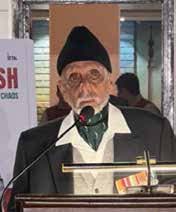 I would endorse that in a word Liberation of Bangladesh is an “EPIC” nothing less. This is a shining moment in our history, what you heard from all the distinguished guests gives a glimpse of what is there in the book of how the Indians and Bangladeshis fought together and out maneuvered the Americans, Chinese and Pakistanis. And there is lots more in the book. Gen Nambiar and I went to war and are here to tell the tale but there were many who did not come back.
This is the reality of war. I replaced Major Shyam Kelkar who was killed in action in Gazipur Tea factory, he left behind his wife and three young daughters. My Battalion, the 4th Battalion the 5th Gorkha Rifles, entered the war with 18 officers, and by the end of this 13-day war, 4 had been killed and 11 wounded. Only 7 survived unscathed or with minor wounds. Among the men, 27 were killed and 39 were wounded.
We had fought for 9 days and nights without food or water and diminished ammunition and on16th December, 3 Pakistani Brigadiers, 2 Colonels, 170 officers, 290 JCOs, and 8,000 men surrendered to us. By this time our strength was just 352.
Indian lost 2307 officers and men in 1971 on the Eastern Front. I believe India fought for a just cause.
People in the subcontinent need to be familiar with this epic since in the coming months Lal Monir Hat, Chicken’s Neck, Jamaat, Pakistan Bangladesh tango, US and China in the subcontinent may return to dominate the conversation. Half a century later, as the same hatreds of language, identity and faith erupt again, the ghosts of 1971 might return—not as memory, but as warning.
There is a chapter in this book tilted Asani Sanket, I figured it was a phrase in Bangla, and I asked Subroto what it meant, he said it is inspired by a film by Satyajit Ray by the same name, which is about the great Bengal famine where 4 million people died. In English it translates to Distant Thunder. Having served for 40 years in uniform I am concerned since I think I can hear the rumblings.