Formerly Islamnagar, here is a first person account as seen by the cluster of monuments that define the Gond architecture.
The History of Jagdishpur
I am Jagdishpur, and I will tell you the story of my past. Yes, I am a fort, which was one of the 52 forts of the Gond kingdom in the 15th century. Our magnificent high walls are a beautiful example of Gond architecture. I stand on that sacred land where King Bhojdev Parmar once built a massive lake by constructing a dam. Yes, I am talking about the city of Bhopal, which was also called Bhojpal because of the large dam or embankment built there. When King Bhojdev Parmar built a magnificent temple of Lord Shiva on the banks of this lake, he could not complete the construction due to external invasions, nor did his successors have the time to complete the temple. Today, it is called Bhojpur.
Even when the Parmar kings were ruling from Dhar, the Gond rulers were the local rulers in the surrounding forest areas. However, in the 12th century, this fertile land witnessed the valor of the Mahakumars. The beautiful layout of Bhopal city was based on classical principles. The capital of Parmar Mahakumar Udayavarman was in Bhopal city itself, where several temples and Sanskrit schools were built, which could not preserve their existence over time. I came into existence after the destruction of the Bhopal fort.
In the 15th century, when Sangram Shah, the ruler of Garha, was constructing many forts, I was established in place of Bhopal. Yes, I am the same fort that Akbar acquired along with other forts after the defeat of Rani Durgavati. During the Mughal period, I became a stronghold of the Devda Rajputs and was given the name Jagdishpur. In the 18th century, Dost Muhammad Khan captured me and renamed me Islamnagar.
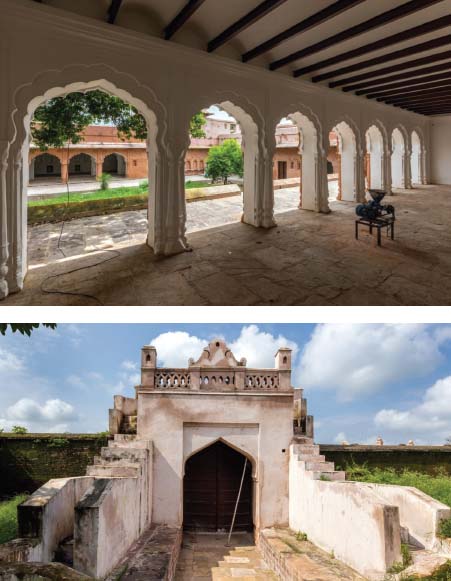
Come to Jagdishpur today and witness its transformed appearance. The high ramparts of the vast fort are secured on three sides by the Kolas and Tahal rivers. A moat was dug on the southern side, connecting the two rivers and giving it the form of an impregnable water fort. Our defensive walls are not only impenetrable, but also feature strong bastions at regular intervals. The ornamentation on the bastions is reminiscent of Gond-era architecture. The decorated eaves curving outwards are a characteristic feature of Gond architecture. There is a wide path on the fort walls for deploying soldiers, and battlements are built on the outer side, allowing soldiers to take accurate aim at the enemy army. This vast city fort has three entrance gates; the fourth entrance gate has become part of the royal complex. Guard rooms are built on both sides of the entrance gates. The vast inner area enclosed by the defensive walls is now a village settlement, in the middle of which, on the western side, is the Gond Palace. To the east is the royal complex, for whose security an inner wall was built. Let’s take a tour of our palaces.
GOND PALACE
The oldest palace in the fort complex, built in the 15th-16th century. The 15th century was the period when kings and emperors began building palaces within forts for their own residences. The Gond rulers were not far behind in this achievement. The Gond Palace, built during this time, is an important example of Gond architecture. The main entrance is on the east side, in front of which is a large bastion. This three-story building is divided into two parts. The first part includes arched verandas with an open courtyard in the middle, residential rooms, and a assembly hall (Diwan-i-Aam). The second part contains pleasure pavilions, fountains, bathrooms, waterworks, a cowshed, a stable, and a rectangular garden. Arches adorned with creeper motifs, ornate pillars, and intricately carved windows are the epitome of the Gond palace’s grandeur.
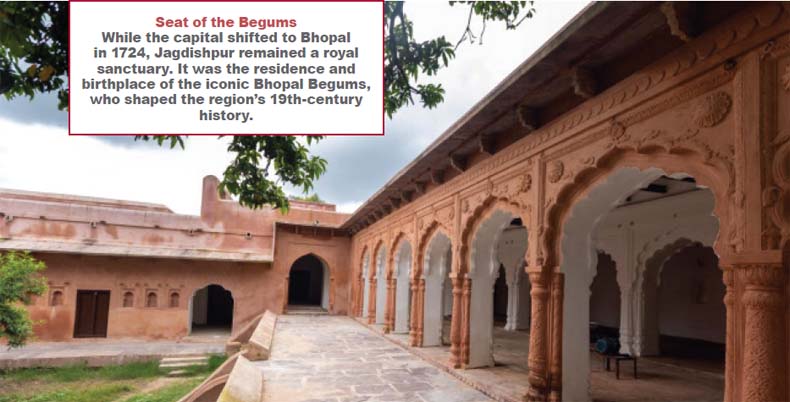
Let us enter the royal complex on the eastern side – passing through the inner defensive wall, we find the Queen’s Palace situated in front of a vast open area.
RANI MAHAL
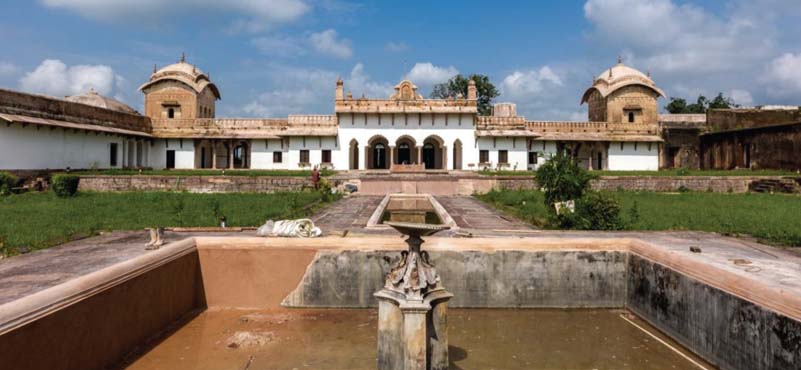
Upon entering through the massive arched gateway, one arrives at the famous Rani Mahal (Queen’s Palace). The original structure of the Rani Mahal, including the third-floor turrets, dates back to the 16th century and is built in the Gond style. In the 17th century, porticoes with multi-faceted arched doorways were added to the Rani Mahal. These Mughal-style arches came into existence in the 17th century. Inside the grand and impressive entrance gate, there is a structure of courtyards, porticoes, and chambers in both the outer and inner courtyards.
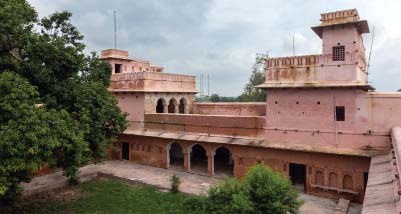 The Rani Mahal, built in the Gond style, underwent modifications as needed. During the Mughal period, it also served as the residence of the Rajput Deora landlords. In the 18th century, after necessary repairs by Dost Muhammad Khan, the Rani Mahal was used, but the original structure was not altered.
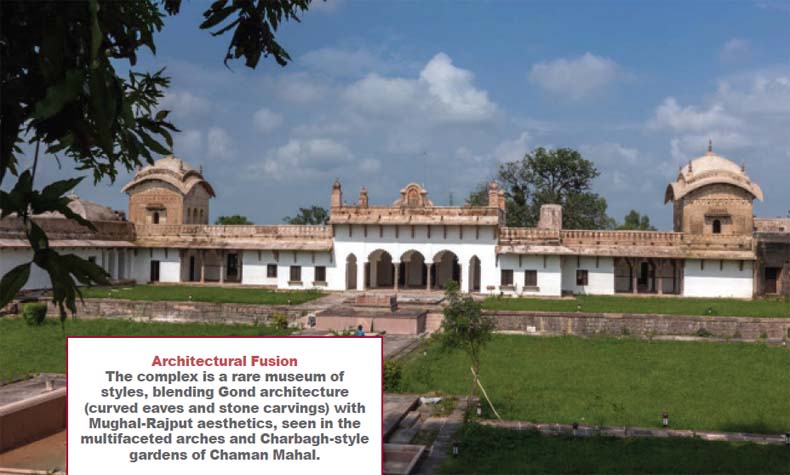
The most attractive feature of the royal complex is the Chaman Mahal, which is enclosed by a strong fortified wall to the north of the Rani Mahal. The open area between the Rani Mahal and the Chaman Mahal was also a garden, but the Chaman Mahal itself is an attractive structure built in the Mughal style.
CHAMAN MAHAL
This palace and garden of the royal family was named Chaman Mahal (Garden Palace) because of its beauty and grandeur. The magnificent palace structure, located to the east of the beautiful garden, is built in the Rajput-Mughal style. During the Mughal period, the Rajput Deora clan were the local rulers here.
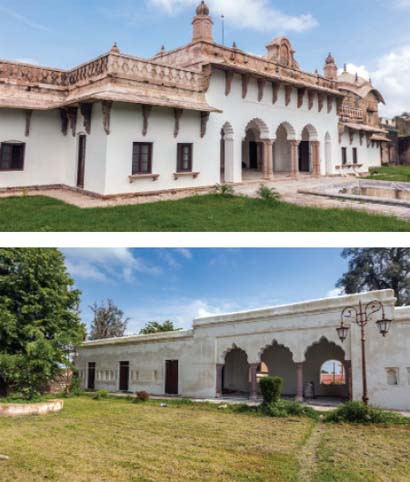 Chaman Mahal was built during this time. The Rajput-style column capitals, arches, and domes, along with the pointed Amer-style arched semi-arches on both sides, enhance the beauty of the palace. The hammam (bathhouse) in the northeast corner is in the Mughal style; the ceilings are circular, and it contains a dressing room and a main chamber accessed through a corridor, with a water tank on three sides. One tank has a copper plate at the bottom, and beneath it, on the outside, is a furnace where wood was burned to heat the water. The square rooms on the second floor of the palace have Rajput-style ceilings.
The garden, enclosed by a high wall, is in the famous Charbagh style of the Mughal period. This Charbagh-style garden features geometrically shaped flowerbeds planted with flowering trees. The water supply system, with its fountains and channels, is similar to other Mughal gardens, where water flows from small pools downwards through a network of channels on the ground level, irrigating the shrubs and flowerbeds. The fountains cool the air with their sprays of water. Seeing this evokes memories of the famous Mughal gardens of Kashmir, such as Nishat, Shalimar, Chashma Shahi, Serinag, and Achchabal.
Chaman Mahal and this Mughal-style garden were probably built in the 17th century during the time of the local rulers of Jagdishpur. Dost Muhammad Khan renovated Chaman Mahal and the garden in the 18th century, giving it its present form.
The journey from Jagdishpur to Islamnagar also began with a gruesome event. I clearly remember that night in the year 1715 when a highly ambitious Afghan soldier, after gathering his forces, treacherously carried out a massacre in Jagdishpur. Before this, he had targeted smaller principalities like Mangalgarh and Berasia.
Although Jagdishpur was a fort situated on a plain, it was surrounded on three sides by the Kolans and Tahal rivers. The moat on the southern side was connected to the river water, transforming the fort into an impregnable water fortress. Conquering Jagdishpur was not easy, so the ruler of Jagdishpur, Narsingh Devda, and his Rajput army were brutally murdered through treachery. So much blood was shed in this horrific incident that the river water turned red, as the river was filled with the bodies of the Rajputs. It was after this gruesome event that the river came to be known as Halali River.
 Dost Muhammad Khan made me his capital and adorned me like a bride. It was at this time that Jagdishpur became Islamnagar. The activity of the begums (queens) increased in the Rani Mahal (Queen’s Palace), and the beauty of the Chaman Mahal (Garden Palace) reached its zenith.
By 1719 AD, Dost Muhammad Khan had brought a vast territory around Bhopal under his control and used Islamnagar as his capital. In 1724 AD, Dost Muhammad Khan shifted his capital to Bhopal and began the construction of the Fatehgarh fort, but the royal family continued to reside in Islamnagar. Dost Muhammad Khan’s successors.
Nawab Yar Muhammad Khan died in Islamnagar in 1742 and was buried on the other side of the Halali River. The third Nawab, Nazar Muhammad Khan, was also buried in the same place. The tombs of both these Nawabs are located on the other side of the river.
From 1808 to 1817, Islamnagar was under the control of Daulat Rao Scindia. After the treaty of 1818, Islamnagar again became a part of the Bhopal princely state. I witnessed the royal ceremony that took place during the marriage of Nawab Ghaus Muhammad Khan’s daughter, Gauhar Begum (Qudasia Begum), and Nazar Muhammad Khan. Their only child, Sikandar Jahan Begum, was also married to Jahangir Muhammad Khan in this same royal complex in 1835.
After her marriage, Sikandar Jahan Begum resided in Islamnagar with Qudasia Begum. It was here that Shah Jahan Begum was born, who later became the 11th Nawab of the state. Sikandar Jahan Begum lived in this royal complex with her mother, Qudasia Begum, and daughter, Shah Jahan Begum, until 1844.
After independence, the monuments of Islamnagar were taken over by the Government of Madhya Pradesh in 1977 for preservation. Since then, this heritage has been continuously maintained by the Directorate of Archaeology, Archives and Museums, Bhopal.
LOCATION: Jagdishpur Memorial is located near Bhopal, approximately 24 km from the city, in Berasia tehsil, 1 km from the Bhopal outer bypass.
HOW TO REACH: Jagdishpur can be reached from Bhopal via major roads. It is • 13 km from Bhopal Railway Station; 28 km from Rani Kamalapati Station; 13 km from Bhopal Airport.
ACCOMMODATION: Comfortable hotels (up to 5-star rating) are available in Bhopal or nearby areas, from where Jagdishpur can be easily accessed by vehicle.
OTHER PLACES OF INTEREST: Sanchi Stupa, Udaygiri Caves, Bhimbetka Caves, Bhojpur, Salkanpur, Bharat Bhavan, Ravindra Bhavan, State Museum, Museum of Man, Tribal Museum, Van Vihar, Bhopal Lake, Lakshmi Narayan Temple.