

Human civilisation is entering an age of “Compressed living” – where technology expands faster than society can emotionally, institutionally, and morally absorb it.
Midnight in the Accelerated City
It is past midnight, yet the city shows no intention of resting. Headlights stream endlessly across elevated roads, phones glow in darkened rooms, and algorithms quietly choreograph the rhythms of modern life. Meals arrive in minutes, replies are expected instantly, and relevance expires almost as soon as it is earned. We are no longer merely living faster; we are being carried forward by a momentum that rarely permits pause. Humanity has entered an age where speed is not a choice—it is the condition of existence. Decisions are expected instantly, responses are measured in seconds, and relevance is fleeting. This is not merely technological evolution. It is civilizational acceleration.
Against this backdrop, New Delhi hosted the global AI Impact Summit 2026 from 16–20 February 2026—a gathering that symbolized not just innovation, but a decisive turning point. The conversations that unfolded there were less about the distant future and more about a reality already reshaping economies, institutions, and everyday life.
The defining question before us is no longer whether artificial intelligence will advance. It is whether society can advance without leaving humanity behind.
When the World Gathered in Delhi
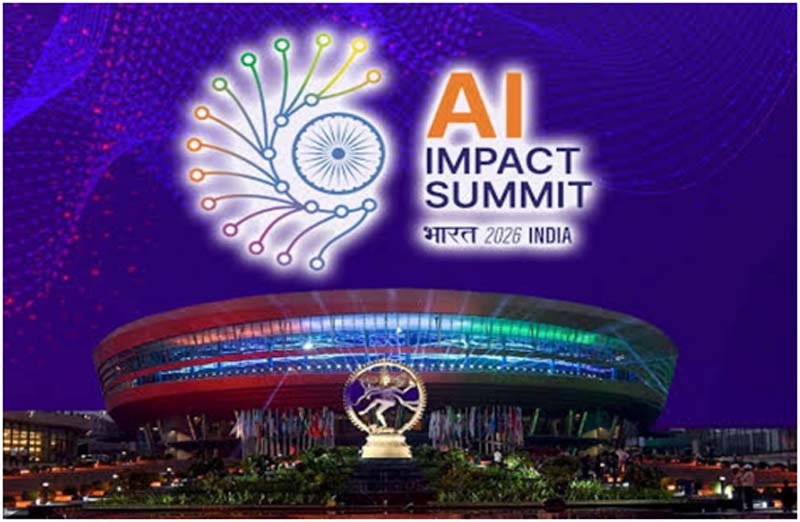
The AI Impact Summit 2026 held at Delhi was, in many ways, a declaration: the age of artificial intelligence has arrived, and nations are racing not merely to adopt it but to lead it. Policymakers, technologists, industry leaders, and scholars converged to deliberate on governance frameworks, sovereign AI capabilities, ethical safeguards, and the enormous economic potential embedded within intelligent systems.
For India, the moment carried particular significance. A country balancing demographic scale with digital ambition sees in AI both a developmental leap and a strategic instrument. Discussions emphasized inclusive growth, data governance, innovation ecosystems, and the need to ensure that technological power remains aligned with democratic values. Yet beyond policy statements and keynote addresses lay a deeper message—the world has entered a phase where technological capability is expanding faster than social preparedness. The summit did not create this reality; it illuminated it.
Artificial intelligence is no longer confined to laboratories or speculative fiction. It is diagnosing diseases, managing financial risk, optimizing traffic flows, predicting crop patterns, and drafting legal briefs. The future is not approaching in careful increments; it is unfolding in real time. And with it comes a paradox: never before has humanity possessed tools of such transformative promise, yet never has the responsibility to guide them wisely felt so urgent.
The Promise: AI as Civilization’s Force Multiplier
Every transformative technology in history has extended human capability—but few have done so across as many domains as artificial intelligence.
- In healthcare, AI is enabling early detection of diseases, accelerating drug discovery, and supporting physicians with predictive insights that can save lives. Rural diagnostics, once constrained by distance and resource scarcity, may soon become dramatically more accessible.
- In the realm of climate science, intelligent models are improving disaster forecasting, helping communities prepare for extreme weather, and guiding smarter energy use. As environmental volatility increases, such foresight may prove indispensable.
- Agriculture—still the backbone of many economies—is being reshaped through precision farming. AI-driven tools can assess soil health, optimize irrigation, anticipate pest threats, and reduce waste. For farmers navigating uncertain climate patterns, information may become as valuable as rainfall.
- Governance and public administration are also poised for reinvention. Intelligent data systems can streamline service delivery, detect fraud, and enhance transparency. Properly deployed, they hold the potential to strengthen the relationship between citizen and state.
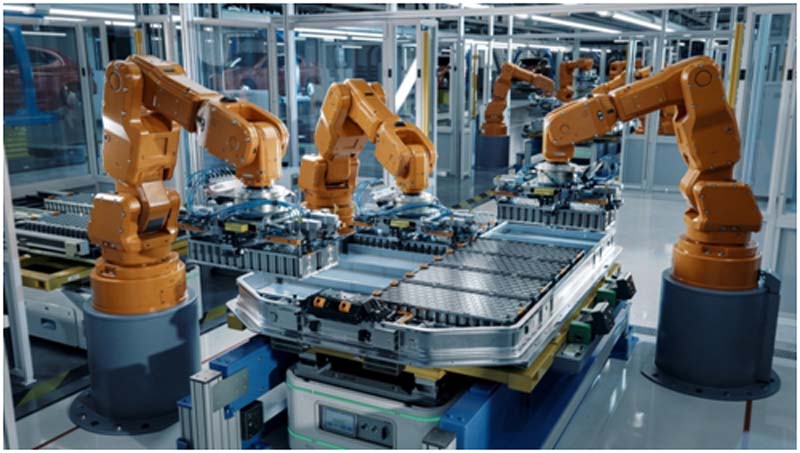
- Manufacturing floors are becoming safer and more efficient through predictive maintenance and automated quality checks. Logistics networks are learning to anticipate disruptions before they occur. Transportation systems are evolving toward autonomy and real-time optimization.
Few technologies have offered such sweeping augmentation of human effort. AI does not merely perform tasks; it expands the horizon of what societies can attempt. Yet progress, when it gathers momentum, casts long shadows.
The Shadow of Speed
The most significant disruptions of the AI era may not announce themselves dramatically. They may arrive quietly—embedded in efficiency gains, subtle workflow changes, and invisible algorithmic decisions.

- The Quiet Disappearance of Work. Automation is often framed in stark terms—machines replacing humans—but the reality is more nuanced and, perhaps, more unsettling. Entire categories of cognitive and routine work are gradually being absorbed by intelligent systems. Work, however, is more than income. It is identity, dignity, and structure. It anchors self-worth and shapes social belonging. When roles fade faster than new ones emerge, societies must confront not only economic displacement but existential unease. The real disruption may not be unemployment alone; it may be the experience of redundancy.
- Cities Under Strain. At the same time, global populations continue to cluster around urban centres. Cities have become holding zones of aspiration—places where opportunity is pursued with relentless hope. Yet infrastructure expands in measured kilometres while demand grows exponentially. Housing pressures mount, transit systems strain, and civic authorities struggle to keep pace with swelling expectations. Intelligent technologies can optimize systems, but they cannot instantly resolve spatial limits or social inequities. We have learned to build taller structures, but not always wider emotional spaces.

- The New Inequality: Speed. In earlier eras, inequality was largely defined by access to wealth, education, or resources. In the decades ahead, a subtler divide may emerge—the gap between those who can adapt quickly and those who cannot. Speed itself becomes privilege. Individuals and institutions capable of continuous learning will surge ahead, while others risk quiet marginalization. Exclusion may arise not from lack of effort, but from the inability to keep up with relentless change.
- Psychological Overload. Perhaps the least discussed cost of acceleration is psychological. Constant connectivity fragments attention; urgency becomes habitual. The boundary between professional and personal time dissolves, and the mind rarely experiences stillness. Paradoxically, hyper-connectivity can deepen loneliness. When life becomes a sequence of rapid responses, reflection begins to feel like a luxury. A civilization that never pauses risks forgetting how to reflect—and, eventually, why it is running at all.

The Leadership Imperative: Governing the Acceleration
Technological evolution is largely organic; it follows curiosity, competition, and possibility. Social evolution, however, demands intention. Without thoughtful guidance, acceleration can outpace cohesion.

- Leadership in this era must resist the temptation to be merely reactive. The task is not to slow innovation but to ensure that human systems grow resilient enough to absorb it.
- Education stands at the forefront of this challenge. Models designed for predictability must give way to frameworks that cultivate adaptability. Lifelong learning can no longer be an aspirational phrase—it must become structural reality.
- Urban planning requires a similar shift from incremental expansion to anticipatory design. Cities must prepare not just for population growth, but for transformed patterns of work and mobility.
- Ethical frameworks for AI cannot remain abstract principles; they must translate into enforceable guardrails that preserve accountability and trust. Equally important are social safety nets capable of supporting transitions rather than merely responding to crises.
The question is no longer what machines can do—but what societies must protect.
Balancing Progress with Human Dignity
The path forward lies not in resisting technological advancement, but in shaping it around enduring human values. Several guiding principles can help anchor this balance.
- Augmentation Over Replacement. Systems should be designed to enhance human capability rather than render it obsolete wherever possible.
- Lifelong Learning Ecosystems. Continuous reskilling must become accessible across age groups and economic strata, ensuring that adaptability is not confined to elites.
- Humane Urban Design. As cities densify, planners must prioritize liveability—green spaces, community zones, and infrastructure that fosters well-being alongside productivity.
- Ethical Guardrails. Transparency in algorithmic decision-making and clarity in accountability are essential to sustaining public trust.
- Shared Responsibility. Governments, private enterprises, and civil society must collaborate. The stewardship of transformative technology cannot rest with any single actor.
Ultimately, progress must remain measurable not only in efficiency or output, but in preserved human dignity.
The Wisdom Gap

Every technological leap widens the space between what humanity can do and what it has learned to manage wisely. That space—the wisdom gap—may define the stability of the coming decades. History offers reassurance: societies have navigated upheavals before. The Industrial Revolution displaced traditional labour yet eventually generated new economic ecosystems. The digital revolution rewired communication but also democratized knowledge.
The AI era, however, differs in one crucial respect—its velocity. Change that once unfolded across generations now compresses into years. This makes foresight not a luxury, but a necessity. Calmer leadership will be indispensable. Those accustomed to high, silent terrains understand a timeless truth: speed without direction is merely drift. Progress, if left unguided, can carry societies forward without ensuring they remain cohesive. The challenge before us is therefore not to temper intelligence, but to deepen wisdom.
For the future will not be decided solely by how intelligent our machines become. It will be decided by how thoughtfully we design institutions, how compassionately we manage transitions, and how firmly we hold on to the idea that technology exists to serve humanity—not the other way around. In the coming decades, inequality may not stem from poverty alone, but from the inability to keep up.
As the world accelerates, one insight grows increasingly clear: the true measure of advancement is not how fast we move, but whether we move forward together. Machines may think faster. Systems may respond quicker. Progress may surge ahead with breath-taking momentum. But the enduring task of civilization is to ensure that, even in an age of relentless acceleration, we do not lose sight of the human pace—the rhythm at which meaning is created, communities are sustained, and wisdom takes root. For if progress ever truly outruns people, it will not be progress at all.
ABOUT THE AUTHOR
 Lt Gen Rajeev Chaudhry (Retd) is a social observer and writes on contemporary national and international issues, strategic implications of infrastructure development towards national power, geo-moral dimension of international relations and leadership nuances in changing social construct.