Why is America so keen to reclaim Bagram Air Base in Afghanistan, against joint opposition from India, Pakistan, China, Russia and the Taliban leadership in Kabul?
For many Americans, the loss of Bagram was a symbolic humiliation. Reclaiming the base could be seen as a message that the U.S. is “back in the great game”.
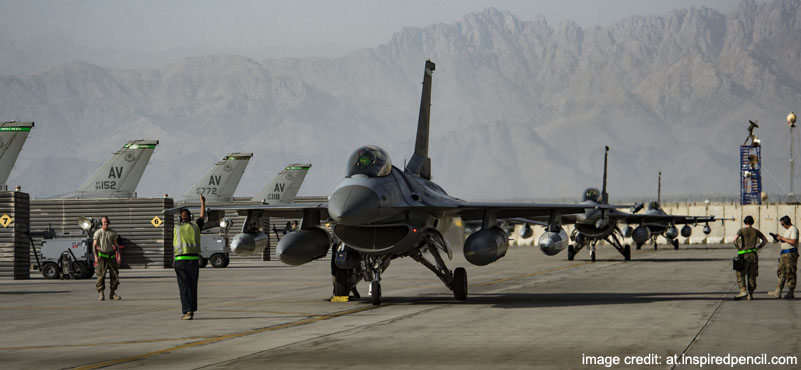
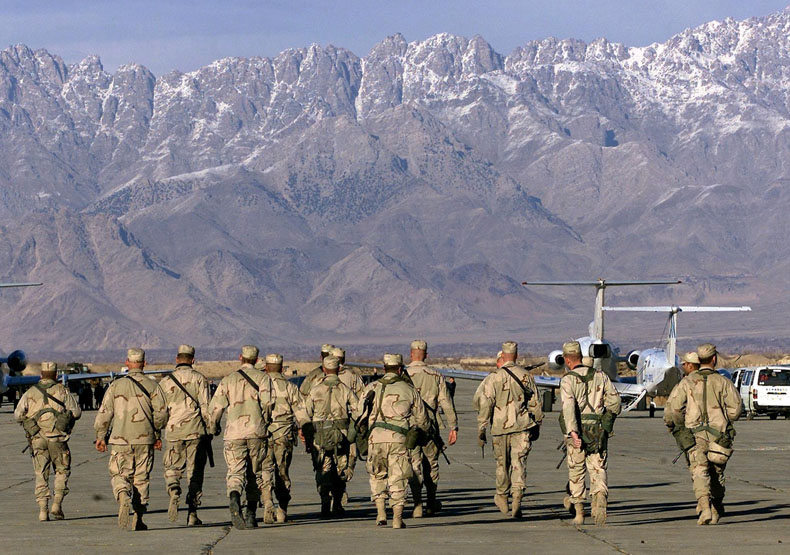
It is rare for India and Pakistan to be on the same page, but the two countries, battle-hardened enemies, have, along with China and Russia, opposed US President Donald Trump’s publicly stated goal to get Afghanistan to hand over Bagram air base to the Americans. The Taliban-led government has also rejected the demand, but Trump continues with his threat that “bad things” will happen if his demand is not met. He has a connection with Bagram airport, the fulcrum of all US-led military operations when American-led forces were in Afghanistan looking for Osama bib Laden. On 28 November 2019, then U.S. President Donald Trump visited the Bagram Airfield for the first time to celebrate Thanksgiving with the U.S. troops based there. As part of the US withdrawal from Afghanistan, after nearly 20 years of continuous U.S. presence at the site, the Bagram Air Base was secretly evacuated when the last remaining U.S. troops left the base by shutting off the electricity and slipping away in the night without notifying the Afghan Armed Forces. The Afghan National Army later took control of the area, including Bagram air base.
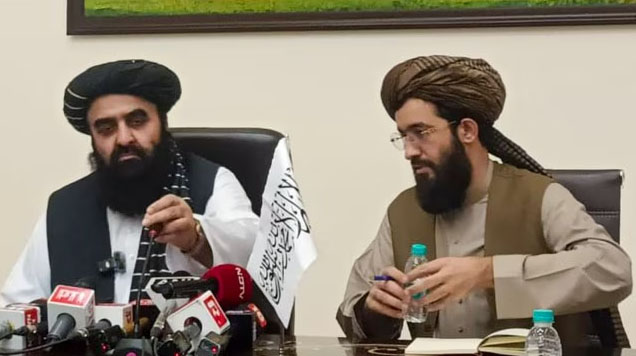
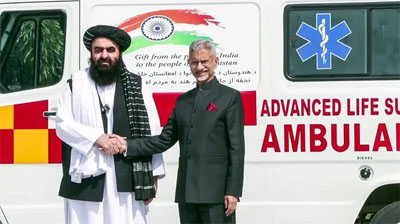
Trump now wants it back, and those opposing his demand have a common agenda: most of Afghanistan’s neighbours have deepening engagements with the Taliban, even though Russia is the only country that has formally recognised them diplomatically as the Afghan government. The visit of Afghan foreign minister to Moscow and New Delhi this week is the first by a top Taliban leader since they returned to power in 2021, following the withdrawal of US-led forces and the fall of Kabul. Amir Khan Muttaqi’s trip was made possible after the UN Security Council granted him a travel waiver and is expected to be closely watched by India’s regional foe Pakistan, as New Delhi deepens its engagement with the Taliban government.
Muttaqi attended a regional meeting in Moscow where Afghanistan’s neighbours, including India, Pakistan, Iran, China and several Central Asian countries, issued a joint statement opposing the deployment of foreign military infrastructure in the region. The statement, a rare showing of a unified front, was regarded as a signal of opposition to US President Donald Trump’s stated objective to retake Bagram.
China and Russia have obvious reasons to oppose a major US air base in its neighbourhood.
Pakistan, despite its attempts to cosy up to Trump, is keen to repair its strained relations with the Taliban government, because of the unrest and regular attacks against its security forces on its shared border. Militants belonging to internationally designated terrorist groups Tehreek-i-Taliban Pakistan (TTP) and Jamaat-ul-Ahrar use Afghanistan’s territory to target Pakistani security personnel deployed along the border. In fact, a Pakistan air force jet bombed a building in Kabul last week that was suspected to be used by TTP chief Noor Wali Mehsud. The timing of the attack coincided with Taliban Foreign Minister Amir Khan Muttaqi’s maiden visit to India which seems to have rattled Pakistan as New Delhi ramps up its Afghan outreach.
India’s deepening ties with the Taliban government has been on New Delhi’s agenda, short of diplomatic recognition, which is why it extended an invitation to Muttaqi. The reasons are strategic as well as economic.
It helps India capitalise on the growing mistrust between the Taliban and Pakistan, which accuses Kabul of funding and arming the TTP. India also has major economic stakes in Afghanistan. It funded multiple infrastructure projects under the previous civilian government, which were spread across 34 provinces in Afghanistan. New Delhi is keen to restart them, using Indian expertise, along with the humanitarian aid it has supplied Kabul when required.
India sees Trump’s plan to reclaim Bagram air base as bringing instability to an already volatile region. India’s position is not anti-American, but is based on its long-standing foreign policy principles of strategic autonomy and regional stability. A US presence could also make India a proxy in broader geopolitical disputes involving the US, China, or Russia.
Pakistan, while blaming Kabul for supporting the TTP, is also keen to mend ties with Afghanistan. According to Chinese Foreign Minister Wang Yi, there is a renewed willingness by both Pakistan and Afghanistan to restore diplomatic relations after heightened tensions in recent years. “Afghanistan and Pakistan expressed clear willingness to elevate diplomatic relations and agreed in principle to exchange ambassadors as soon as possible. China welcomed this and will continue to provide assistance for the improvement of Afghanistan-Pakistan relations,” Wang said. His remarks came after an informal trilateral meeting between the foreign ministers of China, Pakistan and Afghanistan in Beijing. He added that the China-Pakistan Economic Corridor, the $62bn mega project under China’s Belt and Road Initiative (BRI), will now be extended into Afghanistan.
There are, of course, strategic reasons why the US is so keen to reclaim the Bagram air base, having spent billions to build its runways and facilities, making it almost a mini-city to accommodate soldiers, airmen and intelligence officials, along with other NATO forces, most notably, British.
Location is one key reason. For decades, Bagram provided a launchpad for the U.S. to project power and influence across Central Asia. A return to the base could be useful in countering China’s expanding economic and diplomatic footprint in the region, including projects under its Belt and Road Initiative.
Plus, it is located at a crossroads of Iran, Pakistan, China’s Xinjiang province, and Central Asia. Its proximity to sensitive Chinese sites, including missile fields and the Lop Nur nuclear test site in Xinjiang, provides a critical vantage point for surveillance and intelligence gathering on China’s military modernization.
Addressing journalists on Air Force One, Trump said Bagram was “one of the most powerful bases in the world in terms of runway strength and length,” adding: “You could land anything there.” He emphasized again that the base was “an hour away from where they make their missiles — China.”
Bagram also offers America a base to conduct what it calls “over-the-horizon” counterterrorism operations against groups like ISIS-K and al-Qaeda. A presence at Bagram would provide a crucial launchpad for these operations, which have become more difficult since the 2021 withdrawal.
Additionally, the airbase could be used to prevent a resurgence of militant groups that have taken advantage of the power vacuum in Afghanistan. Terrorist groups pose a threat not only to the West but also to regional stability, a concern shared by countries like Pakistan, China and Russia.
Bagram served as the nerve centre for U.S. military operations in Afghanistan for nearly two decades. The manner of the U.S. withdrawal in 2021 under President Joe Biden was widely criticized as chaotic. The U.S. left behind billions of dollars’ worth of military equipment that was subsequently seized by the Taliban. While the U.S. military retrograded or destroyed most of its own equipment, the majority of the captured hardware was originally provided to the Afghan National Army (ANA), which collapsed as the Taliban advanced.
According to a 2022 report of the Department of Defence, now the redesignated Department of War, the equipment left behind was valued at approximately $7 billion. The cache included a wide range of hardware, from small arms to Humvees and even aircraft.
For many Americans, the loss of Bagram was a symbolic humiliation. Reclaiming the base could be seen as a message that the U.S. is “back in the great game”.
ABOUT THE AUTHOR
 Dilip Bobb is a former senior managing editor, India Today (1975 -2010), and Group Editor, Features and Special Projects, Indian Express (February 2011-October 2014)