ITRHD organizes the first ever PRBH Conference, as a Prelude to Establishing a Buddhist Academy
The Indian Trust for Rural Heritage and Development, in partnership with Archaeological Survey of India, Dr Ambedkar International Center, School of Planning & Architecture, New Delhi, Gautam Buddha University, Sushant University and International Buddhist Association of America, Berkeley conducted an International Conference on Preservation of Rural Buddhist Heritage in New Delhi.
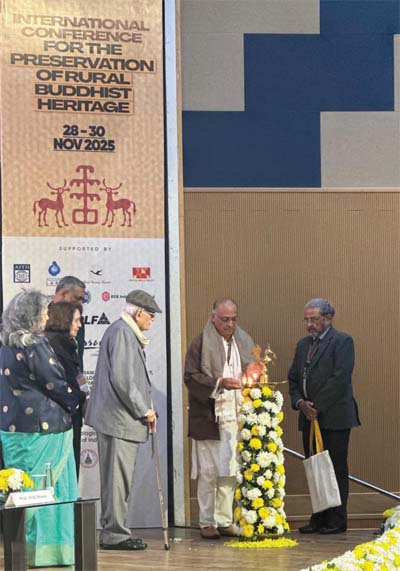 With land allotted and a shared roadmap in place, the Delhi Declaration gathering marks a significant step toward coordinated national action on rural Buddhist heritage. The proposed academy is expected to anchor long-term research, training and community development efforts, linking conservation with sustainable rural livelihoods and strengthening India’s role in shaping the future of Buddhist heritage across Asia.
The event marked the start of a collaborative blueprint for preserving India and Southeast Asia’s shared Buddhist legacy.
The Conference, which was organized to discuss and deliberate the issues that needed to be addressed in setting up the Academy on Preservation of Rural Buddhist Heritage had Indian and International scholars share their knowledge and suggest ideas on which to base the curriculum, syllabus and other related issues for the Academy, which is coming up in Andhra Pradesh, where the state government has allotted 5 acres of land absolutely free at Nagarjunakonda.
ITRHD’s proposed Academy which will train administrators, scholars, conservators, skilled workers, and local communities, pioneering methods that blend traditional knowledge with contemporary practices to safeguard unprotected heritage. It is a first of its kind, recognizes the need to put together a team that will ensure longevity of priceless Buddhist heritage across India.
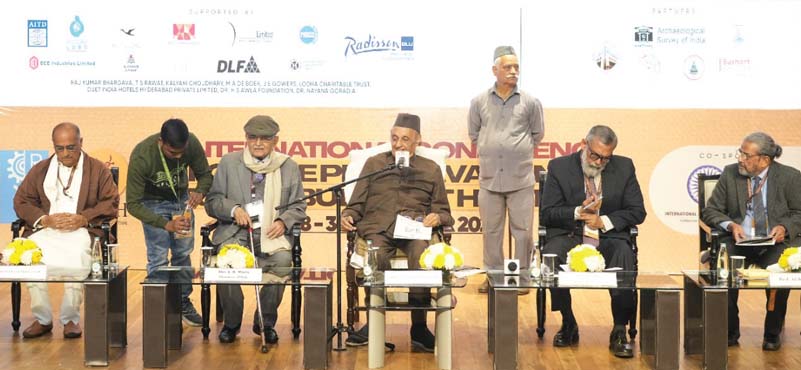
 Across all plenary and parallel sessions, the conference hosted over 80 speakers, including monks, scholars/delegates, conservation professionals, architects, researchers, and administrators, the Panel Discussions & Parallel Sessions.The programme featured 22 Chairs and Co-Chairs guiding the various academic and thematic sessions, representing India’s leading universities, heritage organizations, and cultural institutions.
A dedicated team of 12 rapporteurs from institutes such SPA Delhi, INTACH New Delhi documented all sessions—plenary and parallel—ensuring that key insights feed into the upcoming Academy’s curriculum.
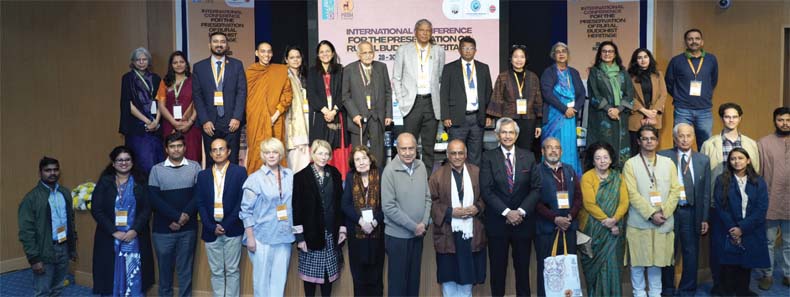
The conference had participation from 10+ countries, including Switzerland, Sri Lanka, Nepal, Bhutan, Thailand, Vietnam, South Korea, Russia, the United States, Myanmar, and Japan—reflecting the truly global nature of Buddhist heritage.
Speakers and delegates represented 18 states and union territories across India, including Andhra Pradesh, Telangana, Tamil Nadu, Maharashtra, Uttar Pradesh, Bihar, Rajasthan, Delhi, Karnataka, Odisha, West Bengal, Himachal Pradesh, Punjab, Sikkim, Gujarat, Madhya Pradesh, Haryana, and Ladakh.
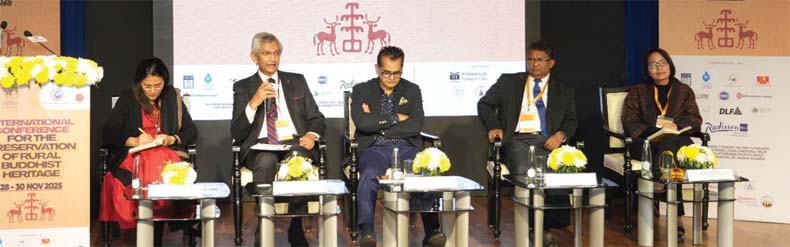
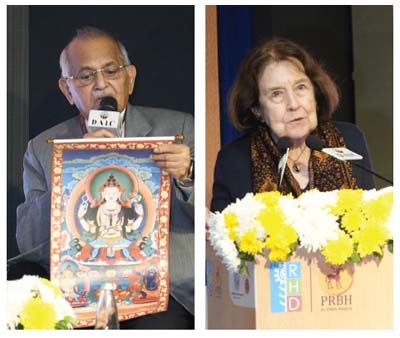 5 different monastic lineages represented across the conference, bringing voices from Theravada, Mahayana, Vajrayana, Indo-Tibetan, and Vietnamese traditions.
The Conference focussed on 12 distinct rural cultural regions, including Central India, Andhra Pradesh, Telangana, Tamil Nadu, Maharashtra, Ladakh, Sikkim, Sri Lankan rural monastic landscapes, and Southeast Asian rural Buddhist architecture.
This in turn confirmed the Conference’s unique contribution to regional and community-grounded heritage research.
The key points that were deliberated at the Conference:
- Strong consensus on the need for community-led conservation models—heritage must benefit local people.
- Respecting the living traditions.
- Importance of interdisciplinary approaches, combining archaeology, architecture, philosophy, ecology, and living traditions.
- Need for documentation, mapping, digital archives, and scientific conservation methods.
- Repeated emphasis on international collaboration, given Buddhism’s transnational heritage pathways.
- Recognition that intangible heritage—chants, crafts, rituals, monastic knowledge—is as important as physical monuments.
- Importance of skill development, capacity building, and new pedagogical models for training future conservators and researchers.
- Support for sustainable and responsible tourism, aligned with cultural sensitivity and local livelihoods.
- Acknowledgment that risk preparedness and resilience planning are crucial for heritage sites threatened by climate and human pressures.
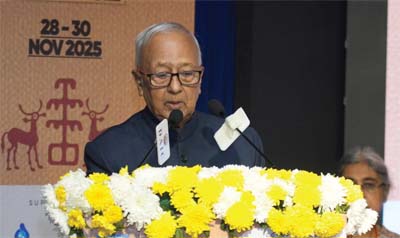 The conference began with its plenary session, the traditional lighting of the lamp followed by the inaugural address by S.K. Misra, Chairman of ITRHD. The morning session featured addresses by Padma Vibhushan Dr. Karan Singh, Dharamacharya Shantum Seth, and other distinguished guests, and concluded with the release of the ITRHD Journal on Buddhist Studies.
S.K Misra welcomed the delegates to the International Conference on Rural Buddhist Heritage, thanking contributors for their support. He highlighted ITRHD’s work in restoring rural heritage sites and announced that five acres in Andhra Pradesh have been allotted for a new academy dedicated to Buddhist heritage. Calling the project ambitious but necessary, he urged collective efforts to document and conserve rural sites and affirmed that local communities remain their true custodians.
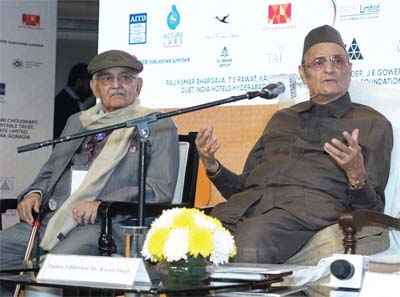
Padma Vibhushan Dr. Karan Singh, addressing the gathering, said, “India’s strength lies in its multiplicity.” Noting that Buddhism though followed by few today has profoundly shaped the country’s cultural ethos, he welcomed efforts to uncover rural Buddhist sites but emphasized that local communities must recognize this heritage as their own.
Reaffirming that “India will always be the land of the Buddha,” he urged people to rise above division and work together in a spirit of harmony.
Shantum Seth highlighted how artisans across rural villages preserve traditions ranging from stone and textile work to local culinary practices, providing pride and livelihood to communities. He urged Indians to “reclaim the Buddha as an Indian ancestor,” noting that countries like China are advancing more rapidly in developing Buddhist pilgrimage circuits. He emphasized the role of education in understanding the mind and emotions and described the collective revival of Buddhist heritage as “sangha work” involving everyone.
Speaking at the occasion Abhijit Halder, Director General of the International Buddhist Confederation, underscored the communal aspect of conservation, stating that “Buddha’s teachings remind us that conservation is everyone’s duty, and when communities thrive, monuments and monasteries breathe. Preserving rural Buddhist heritage is not just about structures, but also the people, traditions, and ecosystems that sustain them.”
India’s rural Buddhist sites—many unprotected, undocumented, and vulnerable—represent a profound civilizational legacy. While iconic sites such as Bodhgaya, Sarnath, and Kushinagar receive global attention, hundreds of lesser-known rural sites face threats from neglect, development, climate impacts, and lack of community-led conservation.
The conference lays the groundwork for ITRHD’s proposed Academy for Rural Heritage Conservation and Development at Nagarjunakonda, Andhra Pradesh. The Academy will train administrators, scholars, conservators, skilled workers, and local communities, pioneering methods that blend traditional knowledge with contemporary practices to safeguard unprotected heritage.
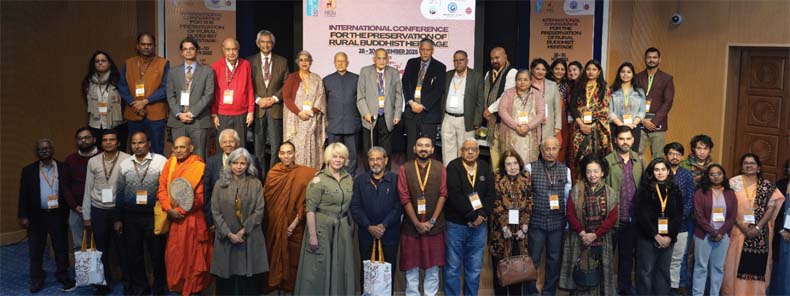
Two sessions held on the first day explored rural heritage conservation and global perspectives, contributing to a multidisciplinary roadmap for the Academy’s curriculum, pedagogical structure, and long-term strategy.
On the second day, Former NITI Aayog CEO Dr. Amitabh Kant said the conservation of Buddhist heritage must be treated as a national mission and urged the creation of reflective, community-benefiting Buddhist tourism models.
Heritage experts including Professor Amareswar Galla and Dr. Prajapati Trivedi from the Harvard University called for stronger documentation, academic training and international best-practice exchanges, noting that India cannot protect what it has not yet fully understood.
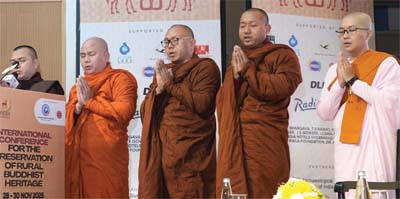 Apart from a galaxy of speakers, a live presentation was made by Dr Akira Shimada from New York while Dr Sujeong Lee and Dr Supitcha Suthanukol who could not make it to the Conference, sent in their presentations which were shared during the conference.
International delegates praised India’s leadership, describing the conference as a potential global model for integrated heritage preservation.
The Delhi Declaration is an eight-point commitment that will serve the task well in the coming years. It underscores the importance of the following:
- Recognition of a shared civilizational legacy
- Preservation of rural Buddhist sites as living heritage
- Inclusive Development and Community Engagement
- Establishment of the Academy for Preservation and • Development of Rural Buddhist rural Heritage and Sites
- Regional and International Cooperation
- Embracing Technology and Education
A vision for the future
The Declaration ends with a Commitment to Continued Action and states that as delegates, scholars, policy makers and community representatives we commit ourselves to:
- Strengthening cooperation among nations and institutions
- Supporting the work of the proposed Academy
- Mobilising resources and policy frameworks that protect heritage in its cultural and environmental context, and
- Sharing our learning with future generations
The Conference was widely covered in national and international media. The sessions were attended by students of various universities, Bhikkhus and Bhikkhunis from various parts of the world and all sessions were relayed live on ITRHD youtube channel.
In addition to the deliberations, a set of Parallel Sessions were also conducted wherein monks and scholars from various part of the Buddhist world presented their Research Papers on related subjects.
The Trust is now working on the material gathered from the Conference and moving ahead towards setting up the academy.
A highlight of the Conference was the staging of the multi-media opera The Life of Gautam Buddha by Theatre World, scripted and directed by Lushin Dubey and Bubbles Sabharwal. It was very well attended by a very appreciative audience who gave the actors a standing ovation.
A special journal on Journal of Buddhist Studies was also released by the chairman. It contains a set of articles on various aspects of Buddhist studies by scholars all over the world and has been edited and designed under the supervision of Ms Amal Allana. In addition, an attractive Conference Brochure was published for the Trust, by CS Conversations.
ABOUT THE AUTHOR
 Sujit Sanyal is the Sherpa, ITRHD’s Conference on Preserving Rural Buddhist Heritage, held recently at Ambedkar Auditorium, New Delhi