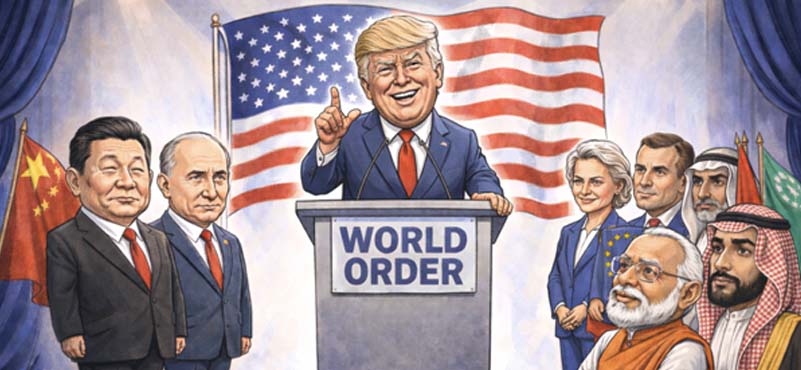
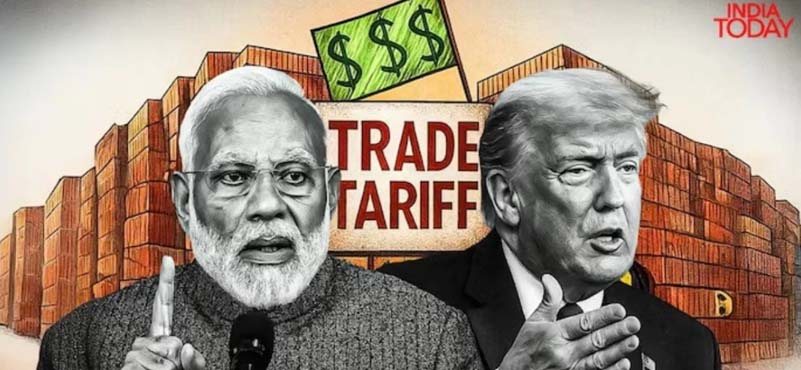
Relations between India and the United States have long been described as a “strategic partnership”. Yet the rhetoric emerging from Washington since the return of Donald Trump to office has introduced a noticeably sharper tone. Statements by senior officials increasingly reflect a transactional and belligerent worldview in which economic leverage, military power and geopolitical pressure are openly deployed as tools of policy.
A striking example came from Christopher Landau, the US Deputy Secretary of State during the 2026 Raisina Dialogue in New Delhi. Describing the Indo-US trade deal as “close to the finish line”, he warned that Washington would “not make the same mistakes with India that it made with China 20 years ago.” The remark was revealing. The implicit message was that the United States believes it had once enabled China’s economic rise through trade concessions and technology access and that it would now guard against repeating such an outcome with India. In essence, India was being cautioned that Washington would carefully manage the terms of engagement explicitly to ensure American advantage irrespective of Indian sensitivities and national interests.
The statement also came in the context of discussions surrounding a bilateral trade framework and massive investment plans projected to reach hundreds of billions of dollars. In tone and implication, the comment suggested that economic cooperation would occur strictly on terms aligned with Washington’s interpretation of “America First.”
The Russian Oil Question and the Optics of Permission
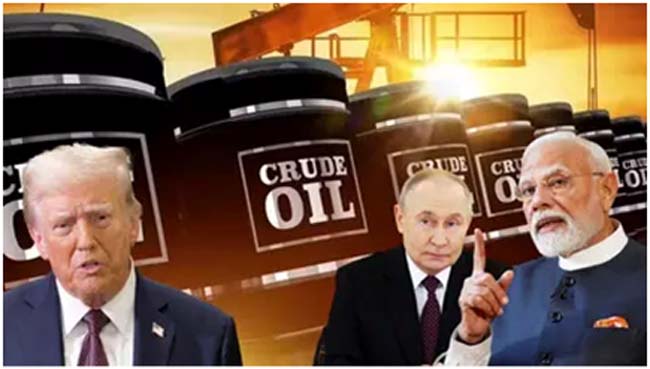
Another episode that raised eyebrows in India concerned the issue of Russian oil imports in the backdrop of war between Israel/US and Iran and the closure of Strait of Hormuz, that sent the oil prices soaring. The United States signalled a temporary 30 days waiver period for transactions involving Russian energy, effectively permitting Indian purchases for a limited time window. While framed diplomatically as a practical accommodation amid global energy disruptions, it rang like an edict from the throne to the peasantry. The arrangement created the impression that India required Washington’s approval regarding with whom it could conduct trade—a notion fundamentally at odds with India’s long-standing doctrine of strategic autonomy.
For New Delhi, Russian oil purchases were an economic necessity after Western sanctions disrupted global energy markets, especially in Iran and Venezuela. Yet Washington’s language often suggested that India’s commercial decisions should align with broader American geopolitical priorities.
Pressure from Washington: The Navarro and Bessent Line
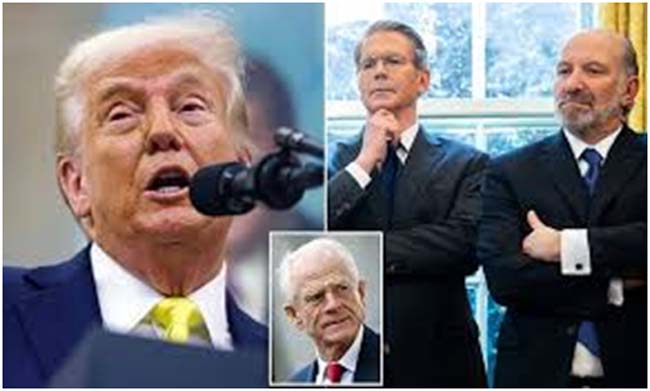
The sharper edge of the Trump administration’s rhetoric became evident through statements from several officials. Peter Navarro was among the most vocal critics of India’s energy policy. In public comments he described India’s refining and re-export of Russian crude as a “laundromat for the Kremlin”, implying that India was effectively helping Moscow circumvent sanctions. The accusation went further. Some American officials suggested that Indian purchases of discounted Russian oil were indirectly financing Russia’s war in Ukraine, thereby placing India in the uncomfortable position of being publicly associated with the conflict. Similar sentiments surfaced in discussions surrounding the interim trade framework agreement announced in early 2026 as a step towards a full bilateral trade agreement. The tone of these remarks was unusually blunt for two countries often described as “natural partners.”
Statements from officials such as Scott Bessent emphasised monitoring mechanisms for Indian oil imports and broader compliance with Western sanctions regimes. The suggestion of institutional monitoring of India’s energy trade again carried an implication that Washington expected alignment by a vassal state with its strategic objectives.
Trade Negotiations and the $500 Billion Framework
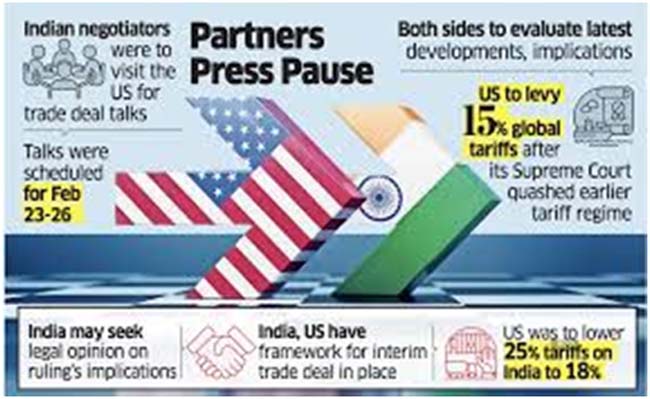
The rhetoric intensified during negotiations over a proposed trade framework that envisaged massive bilateral investment flows over the coming years. Washington pushed for deeper access to India’s markets in areas such as:
- agriculture
- digital trade
- financial services
- technology investment
One particularly sensitive demand concerned opening India’s agricultural sector—an issue that touches the livelihoods of hundreds of millions of Indian farmers and carries enormous political implications. It also included cutting tariffs on US industrial goods to zero and potentially purchase American goods ( including energy, technology, agriculture and defence) worth $ 500 bn in the ensuing five years. The United States framed these demands as necessary for achieving the ambitious bilateral investment targets under discussion. Some of these unrealistic demands were watered down in subsequent statements following domestic disquiet. From the Indian perspective, such expectations appeared to reflect a pattern; economic engagement accompanied by pressure for structural concessions. The comment by Christopher Landau, that US would not repeat its “China mistake” reinforced this perception. It suggested that Washington intended to shape India’s economic trajectory in a manner that prevented it from emerging as a major commercial rival.
Why Does Washington Believe It Can Pressure India?
An important question arises: what gives the United States the confidence to exert such pressure on India? One explanation lies in the structural asymmetry between the two countries in key sectors. India remains dependent on the United States and its allies in several critical areas:
- advanced semiconductor technology
- artificial intelligence platforms
- aerospace and defence technology
- financial capital flows
- global digital infrastructure
This dependence creates leverage that Washington may believe it can deploy in negotiations. Another factor is geopolitical perception. The United States may assume that India ultimately requires American support in balancing the rise of China besides having the potential to influence its neighbourhood inimical to India’s interests. From this viewpoint, Washington might conclude that New Delhi has limited room to challenge US pressure.
A More Aggressive United States
The broader global context also shapes Washington’s confidence. Recent US actions have demonstrated a willingness to pursue aggressive policies including use of military force with scant regard for international criticism. Examples include:
- Abduction of a sitting head of State from Venezuela through military action with muted reactions from the global community
- War against Iran when all options for diplomatic resolution of the crisis had not been exhausted.
- Threat against states perceived to challenge American interests.
Some analysts argue that the perceived success of US military operations—particularly against Iranian forces and allied militias—has reinforced a belief in Washington that coercive strategies remain effective. Incidents like torpedoing an Iranian vessel in the exclusive economic zone of Sri Lanka, not far from Indian coastline reinforce the perception that the United States is willing to project power globally with little hesitation.
The End of the “Rules-Based Order”?
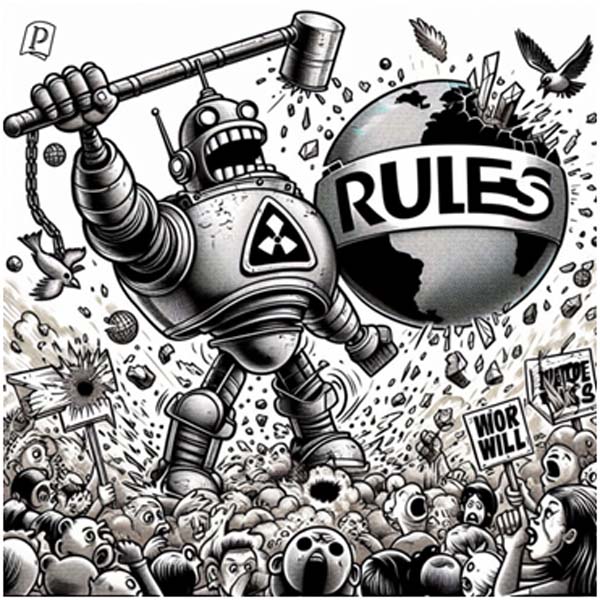
Another dimension of the new rhetoric concerns the ideological framing of US foreign policy. The language of US defence secretary Pete Hegseth during a recent briefing on the Iran war; “ No stupid rules of engagement, no nation-building quagmire, no democracy building exercise. No politically correct wars. We fight to win and we don’t waste time or lives” , suggests that emphasis appears to be shifting toward a more explicit doctrine of power politics—one in which the United States intends to defend its interests decisively and without hesitation. The message conveyed is stark: no ideological crusades—only strategic victory. President Trump himself has hinted at the possibility of new confrontations, including renewed pressure on countries such as Cuba.
Fractured Alliances and Strategic Uncertainty
Washington’s rhetoric has not been limited to adversaries. Several traditional allied partners have also faced pressure. These include
- European allies have been castigated for free speech, migration and departure from western values. Pressurised to dramatically increase defence spending from longstanding 2% of GDP to 5% and contribute trillions of dollars toward the cost of the US security umbrella since the Second World War.
- Canada has faced unusually harsh rhetoric in trade and security discussions including a demand of $25 bn to support US military defence. Canada’s resolute pushback has shattered joint NORAD/NATO interoperability.
- Japan and South Korea have been pressured to expand unsustainable investment in the United States to the tune of $550 bn and $350 bn respectively while adjusting their trade policies.
These developments raise an important question: how sustainable is the US alliance system if Washington increasingly treats even allies in transactional terms?
Global Credibility and the Taiwan Question
The consequences extend beyond bilateral relations. Countries across Asia may increasingly wonder whether US security guarantees remain reliable. If Washington demands economic concessions in exchange for protection, confidence in its commitments could weaken. For instance:
- Would the United States defend Taiwan unconditionally if China attempted an invasion without a economic quid-pro-quo.
- Countries in West Asia are being increasingly reticent on their security reliance on Washington with inadequate defence arrangements against a “war of choice” by the Trump administration which prioritises its own strategic goals. Similar questions may arise in Japan and South Korea, both of which depend heavily on the US security umbrella.
India’s Response: Quiet Resilience
Despite the rhetorical pressure from Washington, India’s response has been measured and restrained. New Delhi has demonstrated considerable strategic maturity by avoiding public confrontation while firmly defending its interests. Several actions illustrate this approach:
- Delaying the trade Agreement. India has shown no urgency in concluding the bilateral trade deal until terms align with its domestic priorities.
- Continuing Russian Oil Purchases. Despite relentless pressure, India continues to source Russian oil supplies. Notwithstanding US claims of reduced Russian oil imports, Russia remained the largest supplier of oil to India in Feb 26(over 30 percent).
- Diversifying Partnerships. India has actively expanded economic engagement with multiple partners including UK, Australia, New Zealand, Oman, European Union, Brazil, Finland and the Nordic states. Such diversification reduces dependence on any single economic partner.
- Protecting Core Economic Sectors. New Delhi has resisted demands that could destabilise its agricultural system, recognising the immense social and political importance of the sector.
- Strategic Rebalancing. India has maintained robust relations with Russia even during the height of the Ukraine war while simultaneously engaging with Western partners. Participation in forums such as the Shanghai Cooperation Organisation alongside Russia and China underscores India’s commitment to a multi-aligned foreign policy.
What Should India Do Next?
While India has handled the situation with composure, resilience and maturity, long-term strategy requires further steps.
- Strengthening Defence Partnerships. India should continue expanding defence cooperation not only with the United States but also with other partners to avoid excessive dependence.
- Retaining Russian Technological Links Russia remains an important and steadfast source of defence technology and strategic cooperation despite the Ukraine war; particularly in areas such as missile systems and nuclear energy.
- Strengthening the Global South With the ever increasing suspicion of US, India’s leadership among developing countries could provide a valuable diplomatic counterweight in an era of renewed great-power rivalry.
- Enhancing Strategic Deterrence India must continue augmentation and modernising its nuclear arsenal, missile capabilities, space assets and satellite infrastructure to ensure credible deterrence besides politico-economic embrace of its volatile neighbourhood.
- Technology Sovereignty Perhaps; most importantly, India must invest heavily in indigenous semiconductor production, artificial intelligence, advanced manufacturing and cyber infrastructure. Technological sovereignty is the ultimate guarantee of strategic autonomy.
Prognosis
The rhetoric emerging from Washington since the return of the Trump administration reflects a more assertive and transactional approach to global politics. Statements warning that the United States will not repeat its “China mistake” with India symbolise a broader shift toward hard-nosed bargaining. Yet India has responded with notable restraint which will be ill interpreted as weakness. By maintaining strategic autonomy, diversifying partnerships and avoiding rhetorical escalation, New Delhi has demonstrated the resilience of its foreign policy tradition. The coming years will test whether the US-India relationship can evolve beyond episodic pressure and remain anchored in genuine strategic convergence. For now, the partnership stands at a delicate crossroads—shaped as much by power politics as by shared interests.
ABOUT THE AUTHOR
 Major General SC Mohanty, AVSM (Retd), was commissioned in June 1983. The officer commanded a Mechanised Infantry Battalion, a Mechanised Brigade and an Infantry Division (RAPID Strike) in the Western Sector. As a Brigade Major, he took active part in the Kargil Operations while located at Drass. As part of Military Operations Directorate, he headed the Information Warfare, Cyber and Electronic Warfare branches. Post retirement, he was the Security Advisor to Government of Arunachal Pradesh from July 2020 to May 2023.