

A Strategic Shift Without the Sound of Guns.
In the unforgiving heights of the Karakoram, far from television cameras and crisis-driven diplomacy, a strategic shift is underway. China has accelerated infrastructure development in the Shaksgam Valley, a remote, sparsely inhabited tract of territory that legally belongs to India as part of the erstwhile princely state of Jammu and Kashmir, but has been under Chinese control since Pakistan’s illegal cession in 1963.
Unlike the standoffs at Doklam, Galwan or Yangtse, Shaksgam is witnessing no troop clashes, no disengagement talks, and no headlines. Instead, it represents something more enduring—and potentially more consequential: the conversion of disputed geography into strategic depth through infrastructure. Roads, tracks, bridges, logistics nodes, and communications facilities—ostensibly civilian—are steadily knitting Shaksgam into China’s Xinjiang and Pakistan’s Gilgit-Baltistan. The result is a quiet consolidation of power, executed not by battalions, but by bulldozers.
For India, the challenge is not tactical. It is structural, legal, diplomatic, and strategic—and demands a response that goes well beyond routine border management.
Shaksgam Valley: Geography That Shapes Strategy. Shaksgam—also referred to as the Trans-Karakoram Tract—covers approximately 5,180 square kilometres North of the Siachen Glacier. Bounded by the Karakoram Range, it lies at the confluence of three strategic regions: Ladakh, Xinjiang, and Gilgit-Baltistan.
Once dismissed as inhospitable and militarily irrelevant, Shaksgam has acquired renewed importance for three reasons:
- Modern military logistics now negate terrain isolation.
- China’s Western security priorities demand redundancy and depth.
- Sino–Pak strategic convergence has matured from coordination to integration.
What was once a cartographic footnote has become a geostrategic hinge.
 The Legal Fault Line: An Illegality Frozen in Time.
At the heart of the Shaksgam issue lies the 1963 Sino–Pakistan Boundary Agreement, under which Pakistan transferred control of Shaksgam to China, pending a final settlement of the Kashmir dispute.
India rejected the agreement outright—and continues to do so—for sound legal reasons:
- Pakistan lacked sovereign authority over the territory.
- Disputed territory cannot be legally transferred to a third party.
- China’s acceptance violates the principle of non-recognition of unlawful territorial acquisition.
Yet, international law does not enforce itself. Over time, physical control, administrative presence, and economic integration can blur illegality into normalcy. China’s infrastructure push seeks precisely this transformation.
Shaksgam at a Glance
- Area: ~5,180 sq km.
- Altitude: 14,000–18,000 feet.
- Legal Status: Indian territory under illegal Chinese control.
- Transferred by Pakistan: 1963 (India does not recognise).
- Strategic Locations:Siachen Glacier, Xinjiang, Gilgit-Baltistan.
China’s Infrastructure Push: What Is Being Built—and Why It Matters.
Recent satellite imagery and open-source analysis reveal a qualitative acceleration in infrastructure development in Shaksgam:
- Motorable roads and feeder tracks capable of sustaining heavy vehicles.
- Bridges and culverts designed for military load classifications.
- Logistics staging areas consistent with PLA operational requirements.
- Telecommunications and surveillance installations, likely satellite-linked.
- Winterisation features, indicating intent for year-round use.
While China describes these projects as border management or connectivity initiatives, their engineering specifications, alignment, and redundancy tell a different story. Infrastructure in Shaksgam is not about access—it is about optionality.
Infrastructure as Strategy – The PLA Doctrine
The PLA treats infrastructure as a force multiplier, not a support function. Roads, tunnels, and logistics hubs are designed to:
- Reduce mobilisation time.
- Enable rapid force concentration.
- Sustain operations in high-altitude terrain.
- Create multiple axes of approach.
Shaksgam fits seamlessly into this doctrine.
Integration with CPEC: The Northern Spine.
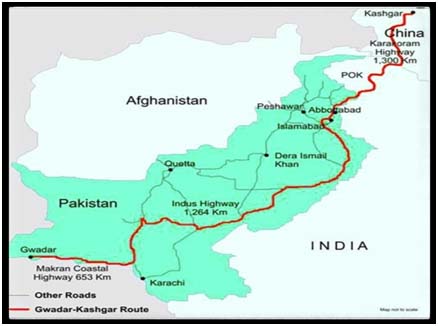
The Shaksgam infrastructure does not exist in isolation. It increasingly connects to the China–Pakistan Economic Corridor (CPEC) via Gilgit-Baltistan and the Karakoram Highway (KKH).
This creates:
- Redundancy to the KKH, which is vulnerable to disruption.
- An alternative North–South military corridor.
- Enhanced PLA access to Pakistan’s Northern areas.
- Greater interoperability between Chinese and Pakistani logistics networks.
CPEC’s Northern arc thus acquires a military subtext, despite its economic branding.
Chinese Classical Contrast: Sun Tzu vs Kautilya.
To be analytically complete, it is instructive to contrast Indian strategic caution with China’s own classical traditions. Sun Tzu, in The Art of War, advocates winning without fighting and emphasises deception, positional advantage, and psychological dominance—principles clearly reflected in China’s preference for incremental infrastructure-led consolidation below the threshold of conflict. However, where Sun Tzu remains largely silent on legitimacy, Kautilya explicitly integrates moral authority into calculations of state power. The Arthashastra recognises deception as a tool, but warns that its overuse corrodes alliances and provokes balancing behaviour by other states. China’s approach in Shaksgam aligns more with a narrow Sun Tzu–style reading of advantage, while India’s response reflects a Kautilyan synthesis—deterrence tempered by restraint, and power anchored in legitimacy. This divergence explains why Beijing prioritises facts on the ground, while New Delhi emphasises law, consistency, and coalition-building as force multipliers.
In the high Himalayas, where history, geography, and power intersect, concrete is never just concrete—it is policy, posture, and projection.
Military Implications for India: The Silent Squeeze.
Pressure on Siachen and Sub-Sector North. Shaksgam’s development subtly alters the operational environment North of Siachen:
- Improves PLA observation and intelligence coverage.
- Enables lateral movement behind Indian deployments.
- Creates the potential for collusive pressure in a crisis scenario.
This does not imply imminent conflict. Rather, it reshapes the geometry of deterrence.
Grey-Zone Warfare and Strategic Patience. China’s approach in Shaksgam exemplifies grey-zone tactics:
- Civilian-led construction with military utility.
- Absence of provocative troop deployments.
- Incremental normalisation of presence.
For India, responding with symmetrical escalation would be counterproductive. The answer lies in denial, resilience, and preparedness, not reaction.
Pakistan’s Role: Enabler, Not Bystander. Pakistan’s involvement goes beyond historical cession:
- Facilitating Chinese access via Gilgit-Baltistan.
- Politically shielding projects under CPEC narratives.
- Coordinating security and logistics planning.
The Shaksgam issue reinforces a central strategic reality:
China–Pakistan alignment is no longer situational—it is systemic. India must therefore plan for integrated contingencies, not isolated threats.
Why Gilgit-Baltistan Matters
Gilgit-Baltistan provides:
- Physical access to Shaksgam.
- Legal ambiguity exploited by Pakistan.
- Strategic depth for CPEC.
- A bridge between PLA and Pakistan Army operational spaces.
Diplomatic and Legal Battles: Fighting Silence.
China complements infrastructure with cartographic assertion:
- Official maps depict Shaksgam as Chinese territory.
- Academic and strategic literature reinforces this claim.
- Pakistan’s acquiescence strengthens Beijing’s narrative.
India’s challenge is to ensure non-recognition does not become non-assertion.
What India Must Do Diplomatically.
- Register consistent protests, not episodic objections.
- Embed Shaksgam references in multilateral forums.
- Brief strategic partners on legal and strategic implications.
- Counter narratives with maps, scholarship, and policy papers.
Maps matter. Silence matters more.
Technology and Surveillance: The New High Ground.
Shaksgam is emerging as a sensor-rich environment, giving China enhanced situational awareness across the Northern arc.
India must respond by strengthening:
- ISR integration.
- Space-based monitoring.
- Cyber and electronic resilience.
Recommended Indian Response
- Military and Infrastructure Counter-Balance.
- Accelerate all-weather roads in Sub-Sector North.
- Expand forward logistics and habitat infrastructure.
- Enhance airlift, heliborne, and UAV capabilities.
- Integrate Northern theatre planning across services.
- Legal and Diplomatic Assertion.
- Reiterate non-recognition of the 1963 agreement in all forums.
- Challenge third-party investments touching Shaksgam.
- Institutionalise legal narratives within MEA and MoD processes.
- Global Coalition-Building.
- Position Shaksgam within the global discourse on unilateral territorial revisionism.
- Draw parallels—carefully—with South China Sea precedents.
- Convert shared concern into shared messaging, not rhetorics.
- Economic & Technical Initiatives.
- Tighten CPEC-linked investment screening.
- Invest in alternative regional connectivity projects.
- Fund research into cold-region infrastructure to match technical capabilities.
India’s Strategic Toolkit
- Deterrence: Credible presence without provocation.
- Diplomacy: Persistent, institutional, multi-level.
- Lawfare: Continuous assertion, not episodic protest.
- Infrastructure: Speed, quality, and sustainability.
- Narratives: Maps, data, and the scholarship.
Conclusion: Sovereignty is a Process, not an Event
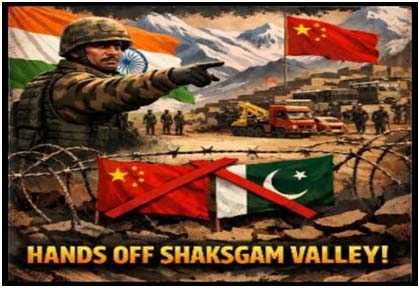
Shaksgam is not a flashpoint. It is something more challenging—a test of strategic endurance. China’s infrastructure push is designed to operate below thresholds, outlast political cycles, and convert physical permanence into political legitimacy. Pakistan’s role ensures that this effort is shielded, enabled, and normalised. For India, the answer lies not in alarmism, but in clarity of purpose. Sovereignty is not defended only by soldiers at the frontier, but by engineers, diplomats, lawyers, strategists, and storytellers working in concert. In the high Himalayas, concrete is never just concrete. It is intent made visible. And intent, left unchallenged, becomes reality.
Shaksgam ultimately illustrates a timeless lesson from Indian statecraft: power divorced from legitimacy must be constantly defended, while legitimacy, patiently sustained, multiplies power over time. China’s infrastructure-driven consolidation, facilitated by Pakistan’s illegal cession, seeks to convert physical permanence into political acceptance. Yet history—from the Shanti Parva to the Arthashastra—suggests that such gains remain inherently unstable, demanding ever-greater coercion and inviting external balancing. India’s challenge, therefore, is not to mirror every road or outpost, but to ensure that military preparedness, diplomatic persistence, legal assertion, and narrative clarity operate in concert. Sovereignty, as Indian tradition reminds us, is not merely held—it is earned daily tradition reminds us, is not merely held—it is earned daily through restraint, resolve, and moral coherence. In the high Himalayas, where maps are contested and concrete advances silently, India’s greatest strategic asset may lie in aligning power with principle, ensuring that time works in its favour rather than against it.
Unlike other cyclic border standoffs, Shaksgam represents a slow-burn strategic consolidation—one that fuses concrete, cartography, and coercive geopolitics. For New Delhi, the challenge is not merely to react tactically, but to craft a calibrated, multi-domain response that preserves sovereignty claims, deters military disadvantage, and mobilises global opinion. In the high Himalayas, where history, geography, and power intersect, concrete is never just concrete—it is policy, posture, and projection.
ABOUT THE AUTHOR
 LLt Gen Rajeev Chaudhry, a former DGBR, is a writer and social observer. He also pursues his passion for the creative arts in his free time.