
In this environment of uncertainty and moral drift, India occupies a position of growing strategic consequence. Neither a declining hegemon nor a revisionist disruptor, India brings to the table civilisational depth, strategic patience and increasing material capability. Crucially, it also brings a tradition of restrained statecraft, increasingly valued in an anxious world.
Strategic affairs are often analysed through the prisms of power, deterrence and interest. Yet history repeatedly demonstrates that enduring stability depends as much on moral restraint as on material capability. When leadership abandons restraint—when impulse replaces deliberation—strategic order degrades rapidly. The presidency of Donald Trump offers a compelling case study of how unmoored leadership at the apex of a superpower can accelerate global instability, weaken alliances, and inject volatility into already fragile security architectures.
Trump as Disruption, Not Deviation. Trump’s first year of President-ship marks a sharp departure from the norms of post-war American statecraft. Alliances that had been painstakingly built over decades are being reduced to transactional arrangements; multilateral institutions are being treated with open disdain; diplomacy has been personalised and often weaponised for domestic political consumption. While challenging legacy structures is not inherently destabilising, Trump’s method lacked strategic discipline and moral anchoring—two qualities essential for responsible leadership in an interconnected security environment.
NATO under Strain. From a defence perspective, the most consequential damage lay in the erosion of alliance credibility. NATO, the cornerstone of Western collective security, was repeatedly undermined through public disparagement. Security guarantees were portrayed as burdens rather than strategic investments. This had predictable effects: allies began hedging, adversaries tested thresholds, and deterrence—dependent as much on trust as on force—was weakened. Strategic ambiguity can be useful; strategic capriciousness is not.
Export of Uncertainty. The turbulence witnessed across multiple regions in recent years cannot be explained solely through local political failures or abstract systemic stress. A critical accelerant has been the interaction between impulsive leadership at the apex of global power and the counter-manoeuvres of entrenched institutional interests beneath it. Donald Trump’s first year of presidency marked a sharp departure from the restrained, scripted exercise of American power. His transactional diplomacy, abrupt policy shifts, public questioning of alliances, and willingness to personalise statecraft fractured the predictability that had long underpinned the Western-led order. Yet this disruption did not translate into strategic clarity. Instead, it collided with resistance from the permanent national security, intelligence, financial, and alliance bureaucracies—the so-called deep state—whose efforts to preserve continuity often operated at cross-purposes with elected authority.
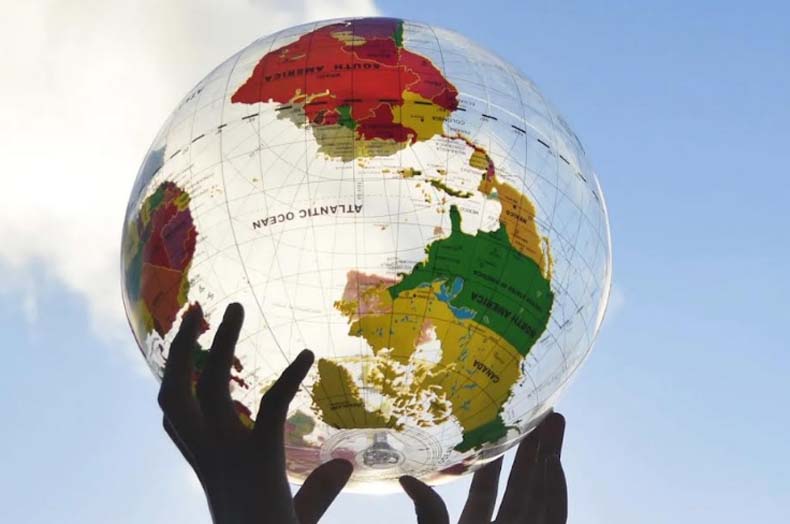
From Unipolar Order to Systemic Volatility. This unresolved struggle at the core of the system was projected outward. Allies were left uncertain which signals to trust, adversaries probed for advantage, and peripheral regions became zones of heightened anxiety. Pakistan’s recurring power resets, Nepal’s externally constrained collapse, Bangladesh’s regime change, Venezuela’s President’s bloodless abduction, and Iran’s protests for Pahlavi’s return must be read alongside emerging unease in places once considered stable—Greenland, suddenly thrust into great-power Arctic competition; Canada, grappling with economic and identity pressures; Mexico facing institutional erosion; and Nigeria straining under demographic weight. These are not disconnected crises, but second- and third-order effects of a hegemon experiencing moral drift and strategic incoherence. Power exercised without restraint, yet without institutional harmony, does not merely weaken the centre—it exports uncertainty to the entire system.
The Deep State and the Impulsive Hegemon. Trump’s conduct normalised impulsiveness as a policy tool. Sudden troop withdrawal announcements, contradictory signalling on conflict zones, and erratic positions on adversaries created operational uncertainty for partners and commanders alike. For the global security environment, the message was clear: commitments could no longer be assumed to be durable. Such uncertainty is destabilising, particularly in regions already prone to miscalculation.
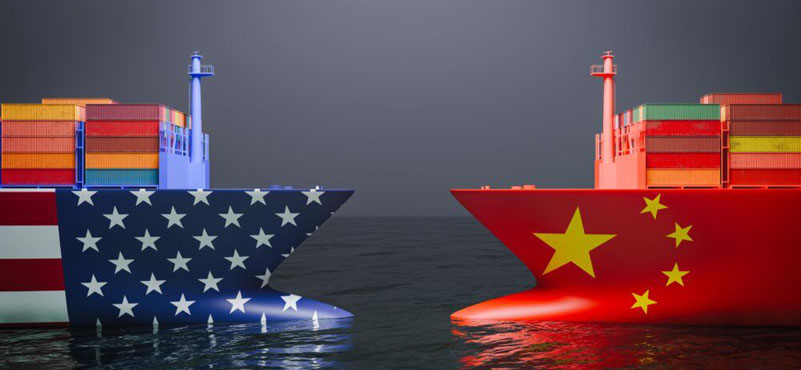
Trade Wars. The economic dimension compounded these risks. Trade wars were launched with little appreciation of second- and third-order effects on global supply chains, defence production ecosystems, and strategic industries. In a world where economic resilience underpins military preparedness, this approach was strategically short-sighted. The moral failing was not the pursuit of national interest, but the absence of systemic responsibility—a failure to recognise that coercive economics can weaken allies as much as adversaries.
Weakening of Institutional Trust. Equally concerning was the internal impact on American institutions. Civil–military relations, intelligence credibility, and the authority of constitutional processes came under sustained pressure. For defence professionals worldwide, this raised uncomfortable questions: when political leadership undermines institutions, who anchors continuity in crisis? The weakening of institutional trust at home inevitably translated into diminished credibility abroad.
Tariffs and Turbulence in the Global Economy. The economic fallout from President Trump’s tariff-driven trade policies in his first year back in power has had measurable negative effects on global growth, jobs, and financial stability, beyond the United States. The International Monetary Fund (IMF) concluded that elevated tariffs and trade tensions contributed to a downgrade in global growth projections from 3.3% to about 2.8% in 2025, slowing output and business confidence worldwide—a cumulative downgrade of roughly 0.8 percentage points relative to earlier forecasts and slowing global trade growth to nearly half its pre-tension pace. According to research using multi-regional trade models, renewed tariff escalation could eventually result in global employment losses exceeding 23 million jobs, with low-skilled and informal workers bearing most of the burden. Advanced economies felt the drag acutely: the Organisation for Economic Co-operation and Development (OECD) projected Canada’s GDP growth nearly halved to around 0.7%, while Mexico faced recession-level contraction scenarios. The IMF also forecast China’s growth slowing from roughly 5.0% to about 4.0%, and Japan’s expansion weakening to just around 0.6%, while regions like ASEAN saw lowered growth due to weaker external demand and tighter global financial conditions. Financial markets reacted to this uncertainty with elevated volatility and repricing of risk assets, forcing institutions to reassess credit exposures and increasing borrowing costs for emerging-market governments and corporations. Collectively, these dynamics reflect not only slower global output and trade volumes but also heightened fragility in interconnected financial systems—a structural risk exacerbated by unpredictable tariff actions and policy uncertainty emanating from the US.
Geo-Moral Dimension of Power. Great powers do not merely enforce order; they model behaviour. When the leading military power exhibits disregard for restraint, consultation and consistency, it lowers the normative threshold across the system. Smaller states emulate recklessness; adversaries exploit chaos. Moral authority—an intangible but decisive component of strategic leadership—erodes.
Lessons from the History. Indian strategic thought has long warned against such outcomes. The Mahabharata, often read superficially as a tale of war, is in fact a sophisticated discourse on leadership and restraint. Duryodhana’s failure was not military weakness but ethical blindness—a refusal to heed counsel, an obsession with personal grievance, and an inability to subordinate ego to long-term stability. Despite possessing formidable allies and resources, his impulsive conduct destroyed relationships and made conflict inevitable. The lesson is stark and relevant: when leadership abandons dharma, even overwhelming power cannot prevent strategic ruin.
Trump’s global approach reflected a similar pattern. Diplomacy became performative, alliances became bargaining chips, and unpredictability was mistaken for leverage. The consequence was not strategic renewal, but accelerated fragmentation of the international order. The United States did not merely lose influence; it ceded moral leadership, creating vacuums that revisionist powers were quick to exploit.
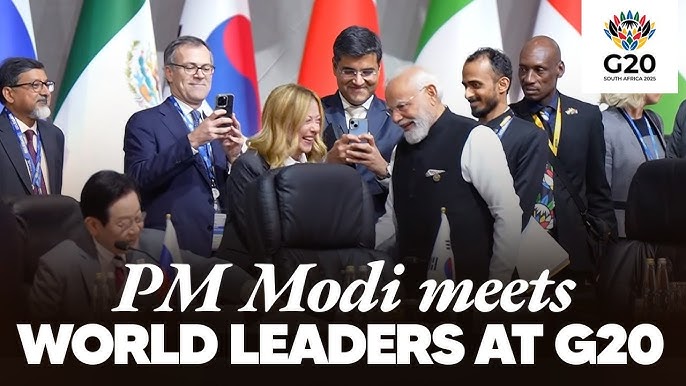
India’s Strategic Opportunity. In this environment of uncertainty and moral drift, India occupies a position of growing strategic consequence. Neither a declining hegemon nor a revisionist disruptor, India brings to the table civilisational depth, strategic patience and increasing material capability. Crucially, it also brings a tradition of restrained statecraft, increasingly valued in an anxious world.
India’s strategic culture recognises shakti (power) as essential, but always within the framework of dharma—balance, responsibility and long-term vision. This is not idealism; it is strategic realism informed by history. Kautilya himself warned that power exercised without ethical calibration invites both internal decay and external hostility.
India can contribute meaningfully in three areas.
- First, as a stabilising bridge power. India’s ability to engage diverse actors—Western powers, Russia, the Indo-Pacific, and the Global South—without rigid bloc alignment enhances its credibility. Strategic autonomy, when exercised with consistency, becomes a force for stability rather than ambiguity.
- Second, as a model of disciplined conduct. India’s calibrated military response during Operation Sindoor, emphasis on signalling without escalation, and preference for dialogue even amid confrontation offer an alternative to impulsive leadership. In defence affairs, predictability and credibility are strategic assets.
- Third, as a credible voice of the Global South in security and economic governance. India articulates concerns of equity, development and resilience without adopting confrontational postures. This enhances its moral standing and soft power, complementing its growing hard power.
India need not position itself as a moral arbiter. Its strength lies in demonstrated conduct, not rhetorical assertion. In strategic affairs, example carries greater weight than exhortation.
Strategic Restraint in an Age of Unrestrained Power. The fragmentation of the global order offers a hard but clarifying lesson for India and other middle powers: stability in the coming decades will belong not to those who seek dominance, but to those who master restraint. The Trump year revealed that raw power, when decoupled from institutional coherence and moral discipline, becomes a source of global volatility rather than security. For states without the luxury of hegemonic insulation, this is not an abstract warning—it is a survival imperative.
India’s advantage lies precisely in what the fractured great powers increasingly lack: civilizational patience, strategic ambiguity, and an instinct for balance rather than binaries. In a world where impulsive leadership collides with entrenched deep-state interests, middle powers must avoid becoming instruments of either disruption or covert correction. This demands strategic autonomy not as rhetoric, but as practice—diversified partnerships, resilient domestic institutions, narrative sovereignty, and a refusal to outsource national decision-making to external alliances or ideological camps.
Equally, middle powers must recognise that legitimacy has become as decisive as capability. Economic resilience, social cohesion, credible governance, and moral consistency now matter as much as military strength. The lesson of recent regime churn—from South Asia to Latin America and the Arctic frontier—is that states which neglect internal balance invite external manipulation.
Conclusion. Donald Trump did not create global disorder, but his impulsive and ethically unanchored leadership accelerated strategic instability and weakened the moral foundations of international order. The enduring lesson for defence planners and policymakers is clear: power divorced from restraint becomes a liability.
The emerging order will not reward those who shout the loudest or strike first, but those who endure longest. For India, the task is neither to inherit a collapsing order nor to confront it head-on, but to outgrow it—patiently, strategically, and with civilizational confidence. In a world drifting towards volatility, India’s challenge—and opportunity—is to combine growing military capability with moral discipline, offering the international system something increasingly scarce: reliable power exercised with restraint. That, ultimately, is the strongest form of strategic leadership.
ABOUT THE AUTHOR
 LLt Gen Rajeev Chaudhry, a former DGBR, is a writer and social observer. He also pursues his passion for the creative arts in his free time.