
A recent study published in the Harvard Business Review by Roberto Stefan Foa and Rachel Kleinfeld states that “far from growing private-sector wealth, we find that equity returns under right-wing populists often prove dismal.” More specifically they “underperform benchmarks by around a quarter during a first term in office, and by half after a decade.” This is because right-wing populists typically undermine the rule of law. Nobel Prize winning economists Acemoglu, Johnson and Robinson also demonstrated in “Why Nations Fail,” that authoritarian assaults on institutions are associated with lower growth.
President Donald Trump appeared visited the Washington DC headquarters of the US Federal Reserve (the US’ central bank, known as the Fed) on July 25 as tensions continued to escalate between his Administration and the independent overseer of the US’ monetary policy, whose conduct has significant implications for the rest of the world as well as the US dollar’s (USD’s) future as the world’s reserve currency. This visit came in a context where Trump has repeatedly demanded that Fed Chair Jerome Powell slash US interest rates to close to zero and that inflation will not rise. He has also frequently raised the possibility of firing him (although he often then rolls this back) and repeatedly used highly objectionable language against him. One of the latest slurs directly aimed at Powell by the US President was “numbskull” for Powell’s unwillingness to cut the Fed’s interest rates while the latest timeframe he has given Powell to stay is eight months, even though the Fed Chair’s current four-year term does not end till May 2026 and his Fed Board term does not expire till 2028.
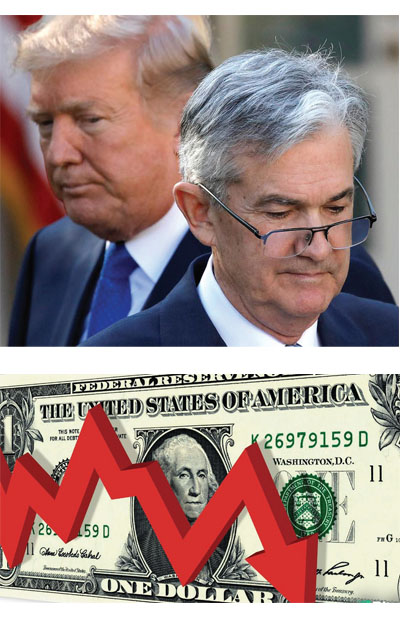 Unsurprisingly, President Trump sparred with Federal Reserve Chair Powell not just on the costs of the ongoing renovation to the historical building which he has said are tantamount to a “fraud”, wrongly alleging that their cost was about $3.1 billion when it is $2.5 billion. While he backed away from earlier statements in which had suggested he would fire Powell, he demanded that the Fed lower its interest rates by three percentage points to between 1.25-1.5%.
This rare Presidential visit to the Fed takes place a week before its 19 policy makers gather for a two day interest rate setting meeting at which they are widely expected to leave the Fed’s benchmark interest rate in the 4.25-4.50 per cent range, where it has been since December 2024, as they sensibly wait to see how the US economy, inflation and employment perform in the face of both the US Administration’s new global tariffs expected to come into effect on August 1, as well as his other economic policies, some of which were just approved in the One Big Beautiful Bill Act (OBBBA).
Central banks, in both economically advanced and developing countries, play a crucial role in maintaining economic stability and promoting economic growth, even though their specific roles and priorities may differ, depending on a country’s stage of economic development. They manage monetary policy, oversee the banking system and act as a lender of last resort. They must balance price stability and employment objectives in all countries.
The independence and integrity of any central bank is vital for the effective performance of all these functions. In the case of the US, the Fed’s independence and integrity is also vital for the health of both the global economy and global financial markets given the US economy’s still dominating influence in both. Its periodic interest rate announcements serve as particularly important signals for Wall Street and the Treasury bond market and directly impact the value of the USD and its role as the world’s reserve currency.
What is particularly perturbing at this time is not just Trump’s attacks on Powell, whom ironically, he appointed during Trump 1.0 expecting loyalty, but, as Gillian Tett pointed out in a recent opinion piece in London’s Financial Times, Trump and some of his loyalists want to “smash” the Fed’s independence.
Influential US right-wingers like Curtis Yarvin, the “self-styled populist authoritarian” want to go much further. They are advising Trump and his relevant loyalist senior colleagues to merge the Fed with the US Treasury, effectively placing the former under the latter. They also want the Treasury to restructure the US’ current $36.2 trillion debt and “unplug” it from the rest of the world’s financial system. Yarvin wants a revaluation of US debt and other assets and says, “it is very incorrect to regard Treasury obligations as debt—they are restricted stock.”
Most economists rightly consider this crazy, but many senior Trump 2.0 officials follow Yarvin whose ideas are apparently also being cited approvingly by US Vice President JD Vance. There is also speculation that if Trump does, indeed, fire Powell, he will appoint Scott Bessent, his Treasury Secretary, to oversee both institutions.
A Similar Assault on Turkiye’s Central Bank: Implications and Impact
It is worthwhile, in this context, to consider Turkiye’s central bank experience over the last decade, after President Erdogan made similar repeated assertions about lowering the central bank’s interest rates despite high inflation, thereby inverting the standard economic textbook relationship between inflation and interest rates. This has had serious continuing political economy consequences for both Turkiye’s domestic economy and its role in West Asia and globally.

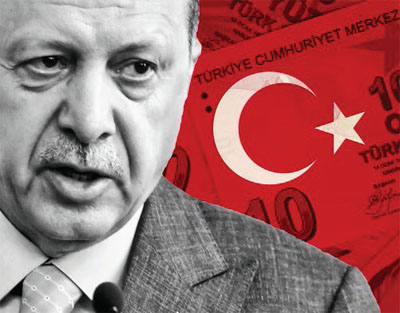 There are many differences between the political economies of the US and Turkiye. For one, the US economy’s influence is global while Turkiye’s is now barely regional, while the USD is the world’s reserve currency and the Turkish Lira (TL) clearly is not. Nevertheless, there are still important lessons to be learnt by both the US and other emerging BRICS economies such as India from the Turkish President’s political interferences in the functioning of the country’s central bank.
Till even as recently as 2015, when the Turkish Central Bank Governor was Erdem Basci, when he started to come under severe political pressure from President Erdogan, facing similar slurs and pressures which President Trump is currently hurling at Fed Chair Powell, Turkiye’s Central Bank was arguably one of the best in the advanced economy 38-member Organization for Economic Cooperation and Development (OECD). It clearly became amongst its worst performers and in terms of its credibility and reputation between 2016-2023. It has been struggling to regain its credibility over the last two years when Erdogan was forced to return to economic orthodoxy. It is likely that its reputation will continue to suffer for a long time to come.
While the US economy’s inflation rates thus far are not unmanageable, the US Consumer Price Index rose 2.7% in June 2025 from a year earlier, as the global trade war began to bite, and this is only the beginning, with much higher inflation, lower economic growth, employment and even stagflation almost inevitable before the end of the year, especially if Trump’s threatened tariffs come into effect on August 1 as he says they will.
Similarly, in Turkiye, economic lunacy has created an unnecessarily huge economic burden for the country for a decade. Erdogan’s stubborn insistence on populist economic policies kept Central Bank interest rates very low for years despite high inflation, declining foreign exchange reserves and significant declines in the value of the Turkish Lira (TL).
Erdogan insisted, against economic orthodoxy, that high interest rates were “the mother of all evil” and the cause of high inflation. He pushed the Central Bank Governor to lower rates as the way to cool inflation, which President Trump is currently trying to push Fed Chair Powell to do to pre-empt coming high inflation.
The cumulative results of hyperinflation and the nosediving currency forced Türkiye to the wall for close to a decade, finally forcing Erdogan to agree to an embarrassing U-turn on interest rates in June 2023. The Central Bank has returned to economic orthodoxy since then when it was forced to hike interest rates by 40% to 50%.
On July 24, 2025, interest rates remained very high at 43%, despite a rate cut of three percentage points from 46%, the first rate cut since April, when the Central Bank was forced to increase the interest rate after the politically motivated arrest of Istanbul Mayor Imamoglu which sent the TL tumbling to a record low against the USD (40.96 to the USD, recovering only slightly to 40.55 as of July 25, 2025).
The 2023 rate increases did not make a dent on price and wage inflation which remained at 67% over the next twelve months, only slightly lower than its peak of 85.5% in October 2022. While inflation in Turkiye has been steadily declining since then, it still sat at 35.05% on July 25, 2025.
 High interest rates have clearly failed to stabilize the currency. The TL at 40.55 to the USD in late July 2025 has fallen more than 50% since the start of 2024 when it was slightly under 30 TL to the US dollar (it was slightly more than 35 to the USD on December 31, 2024) having depreciated significantly from 10 to the US dollar in September 2021 and a little over 3.5 to the US dollar at the end of 2016.
As a result of inflation, minimum wages had to be increased by 49% before the March 2024 local elections, threatening a wage price spiral. The sad state of the economy was clearly a major reason for the defeat of President Erdogan and his ruling Adalet ve Kalkinma Partisi (AKP) in the March 31, 2024, local elections.
Turkiye still refuses to turn to the IMF for an economic stabilization program since this would be politically very difficult for President Erdogan given past vocal oppositions to dealings with it. The population, therefore, continues to deal with a greater degree of pain over a protracted time frame as the Minister of Treasury and Finance, Mehmet Simsek, tries to stabilize and grow the economy without IMF support.
Despite the return to economic orthodoxy, Turkiye’s Central Bank remains anything but independent as evidenced by Erdogan’s firing of numerous Central Bank Governors since 2013 from when there have been six Central Bank Governors. Naci Agbal lasted less than five months (November 7, 2020-March 20,2021). The current Governor, Fatih Karahan, has been in office less than 18 months, starting February 2024.
Some Key Overall Lessons for Both Economically Advanced and Developing Countries
Indeed, right-wing populist leaders do more long-term structural damage to the economy the longer they stay in power. This has certainly been the case in Turkiye over Erdogan’s 23 years in power. In India, the surprise 2016 demonetization of large banknotes by the Reserve Bank of India (RBI) with no advance notice literally shortchanged approximately 90% of the population and many micro, small and medium enterprises (MSMEs) largely reliant on the cash economy. It has certainly done long-term structural damage to the Indian economy as well from which it is yet to recover and may never recover.
Will something similar, if not identical, be the fate of the US economy and financial markets under Trump 2.0 given his repeated and continuing attempted assaults on the Fed’s independence and integrity? Only time will tell. We must hope President Trump fails in such efforts, not just for the sake of the US economy, but for the economic health of both the global economy and its financial markets.