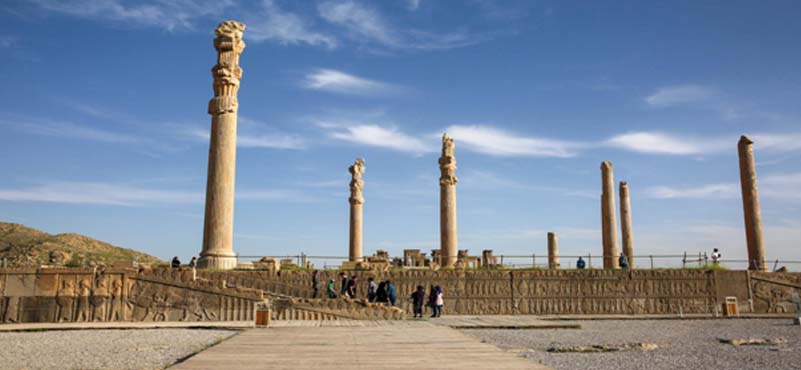
Empires generate power, but civilizations generate consequences.
Persia’s Long Memory: A Civilization Beneath the State
Iran is often analysed through the narrow lens of contemporary geopolitics—sanctions, nuclear negotiations, regional proxies, and oil politics. Yet such frameworks miss the deeper reality that Iran is not merely a modern nation-state. It is the latest political expression of an ancient civilization whose historical memory stretches back more than two millennia.
The lands known today as Iran formed the heart of ancient Persia, one of the world’s earliest imperial civilizations. Under rulers such as Cyrus and Darius, Persian governance created administrative systems and cultural networks that extended across Asia and the Mediterranean. Unlike many ancient empires, Persian civilization did not disappear with conquest. Instead it adapted, absorbed, and re-emerged in different forms across history.
The Arab conquest of the seventh century introduced Islam into Persia, but the Persian cultural core remained resilient. Persian language, literature, and administrative traditions profoundly shaped Islamic civilization itself. Over centuries, Iran evolved into the principal centre of Shia Islam, particularly after the Safavid dynasty institutionalized Shia identity in the sixteenth century.
Thus Iran today reflects a layered identity: Persian civilizational memory intertwined with Shia theological worldview. The modern Iranian state, especially after the 1979 revolution led by Ruhollah Khomeini, fused religious authority with anti-imperial political ideology. Beneath this revolutionary framework, however, lies something deeper: a civilizational instinct for autonomy and strategic patience.
This long historical memory shapes Iran’s strategic behaviour. Unlike powers operating within short electoral cycles, Iranian strategic thinking often unfolds across decades. The state sees itself not merely defending territory but protecting a civilizational identity that has survived invasions, dynastic collapse, and foreign interference. Understanding Iran therefore requires acknowledging that its policies are driven not only by contemporary politics but by the accumulated experiences of centuries.
Iran’s Historical Karma: Intervention, Resistance, and Strategic Defiance
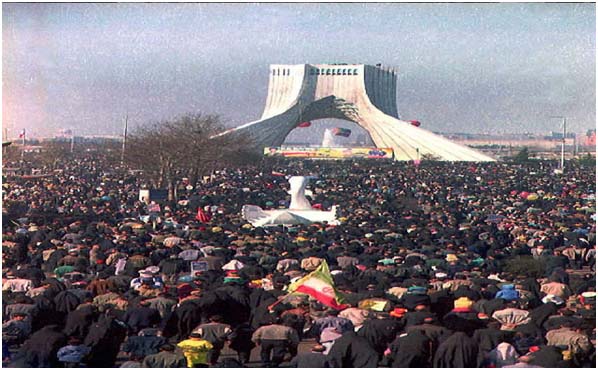
Iran’s modern political consciousness is deeply influenced by a series of historical experiences that fostered a persistent sense of external intrusion. Throughout the nineteenth and early twentieth centuries, Iran found itself caught between imperial powers seeking influence over its territory and resources.
The most consequential event in modern Iranian memory occurred in 1953, when the elected government of Mohammad Mossadegh was overthrown following his attempt to nationalize Iranian oil resources. The episode left a lasting imprint on Iran’s political psyche. It reinforced the belief that foreign powers were willing to undermine Iranian sovereignty to preserve strategic and economic interests.
This perception became a central ideological pillar of the 1979 revolution. The new Islamic Republic presented itself as a force resisting global domination and restoring national dignity. In doing so, Iran’s leadership framed its geopolitical stance not merely as strategic necessity but as a moral struggle against injustice.
Within Shia theological thought, the concept of enduring resistance against oppression occupies a central place. The historical memory of Karbala—the martyrdom of Imam Hussain—became a symbolic framework through which political struggle was interpreted. The Iranian state thus cultivated a strategic culture emphasizing patience, sacrifice, and resilience.
From Tehran’s perspective, its network of regional alliances and proxies represents defensive depth against perceived encirclement. Critics see expansionism; Iranian leaders see deterrence born from historical vulnerability.
In philosophical terms, Iran’s contemporary posture can be understood as an expression of historical “karma”—a civilizational response shaped by accumulated experiences of humiliation, intervention, and survival. Whether one agrees with this interpretation or not, it remains essential for understanding why Iran views global politics as a long contest for sovereignty and dignity.
The American Moment: Power, Intervention, and Strategic Overreach
If Iran’s geopolitical behaviour reflects the memory of historical intrusion, the United States represents the opposite phenomenon: a power accustomed to projecting influence far beyond its borders. Since the end of the Second World War, American foreign policy has been shaped by the ambition to maintain global leadership and stabilize international order under its strategic umbrella.
In practice, however, this leadership has often translated into repeated interventions across different regions of the world. During the Cold War and after, Washington has justified many of these actions as necessary to preserve global stability or protect democratic values. Yet the outcomes have frequently been contested.
The Vietnam War remains one of the earliest and most significant examples of the limits of American power. Despite overwhelming military capability, the conflict ended with profound domestic and international repercussions. Decades later, interventions in the Middle East—particularly the invasion of Iraq in 2003—once again demonstrated how attempts to reshape political systems through external force could produce unintended consequences.
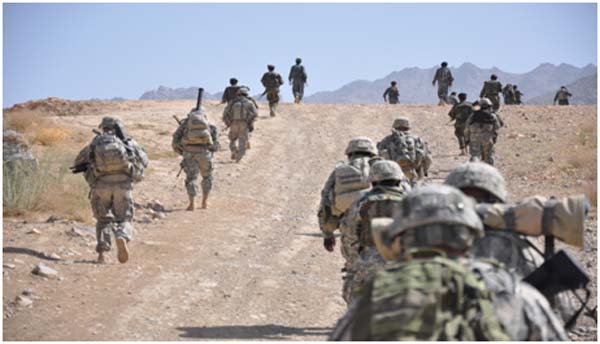
The long conflict in Afghanistan further reinforced this lesson. What began as a response to terrorism evolved into a prolonged military engagement that ultimately concluded without achieving the ambitious goals initially envisioned. These experiences have gradually raised deeper questions about the sustainability of hegemonic intervention as a strategy for maintaining global order.
Expanding Intervention: From Iraq to Venezuela
The pattern of American engagement extends beyond military operations alone. Economic sanctions, political pressure, and strategic isolation have also become tools for influencing governments perceived as adversarial.
Countries such as Venezuela, Iran, and others have experienced prolonged economic pressure designed to alter domestic political trajectories. Supporters of these policies argue that sanctions represent non-military alternatives to coercion. Critics, however, contend that such measures often deepen humanitarian crises while failing to produce lasting political transformation.
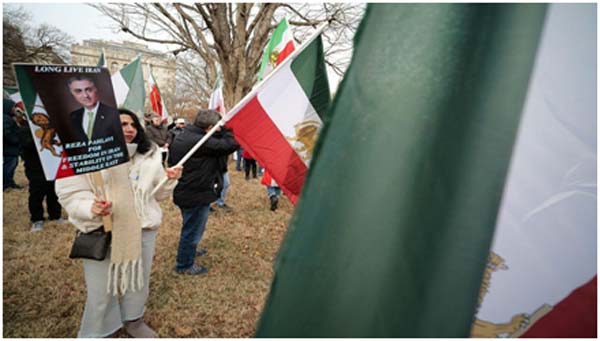
This broader pattern reveals a structural dilemma within hegemonic power. The more frequently intervention becomes a tool of policy, the more resistance it tends to generate among targeted states. Over time, this cycle can produce geopolitical counter-coalitions and deepen global polarization. In this sense, interventions intended to preserve stability may inadvertently create new arenas of confrontation.
Future Ambitions and Strategic Signals
Contemporary political discourse in the United States continues to reflect an expansive understanding of strategic influence. Statements about potential territorial acquisitions or strategic claims—whether concerning regions like Greenland or broader geopolitical ambitions—illustrate how great powers often frame global politics through the language of strategic opportunity.
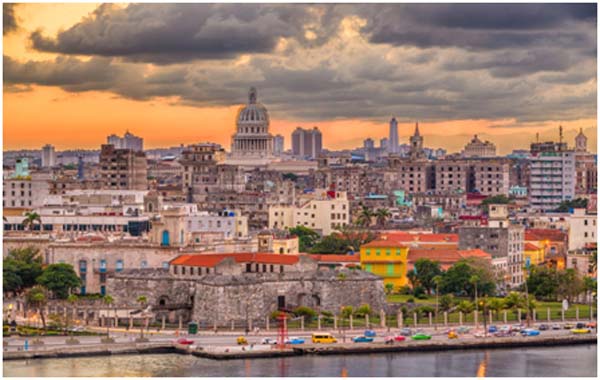
Historically, such ambitions are not unique to any one nation. Rising powers frequently articulate visions of expanded influence when they perceive their capabilities to be growing. Yet when expressed by a dominant global power, such aspirations can trigger concern among other states about the balance between leadership and dominance. In the emerging multipolar environment, even rhetorical signals can influence perceptions of intent and legitimacy.
Beyond Oil and Nuclear Deterrence: A Civilizational Dimension
While economic and strategic interests undoubtedly shape the Iran conflict, reducing the confrontation solely to oil politics or nuclear deterrence overlooks deeper civilizational dynamics. Political scientist Samuel P. Huntington famously argued that future global conflicts might increasingly emerge along civilizational lines, a thesis presented in The Clash of Civilizations and the Remaking of World Order.
In the Iranian case, elements of this civilizational tension are visible. On one side stands a Western-led international order emphasizing liberal institutions and economic globalization. On the other stands a revolutionary Islamic state that frames itself as a defender of sovereignty and resistance.
Yet the confrontation is not simply “Islam versus the West.” Beneath the ideological layer lies the deeper historical identity of Persia—a civilization that predates both modern nationalism and contemporary geopolitics. Thus the Iranian conflict may represent not merely a clash of states but a collision of historical narratives about legitimacy, authority, and cultural autonomy.
The Karma of Power: Cycles of Intervention and Resistance
Across history, great powers have often experienced cycles in which repeated interventions eventually generate strategic pushback. Empires accumulate influence through expansion but may also accumulate resistance as affected societies respond over time.
This dynamic resembles a form of geopolitical karma. Actions taken in pursuit of strategic advantage can produce consequences that unfold decades later. The cumulative effect may alter the balance of power and reshape global alliances. From this perspective, the tensions surrounding Iran are not simply about nuclear programs or regional rivalries. They also reflect broader historical processes in which intervention, resistance, and shifting legitimacy interact to reshape international politics.
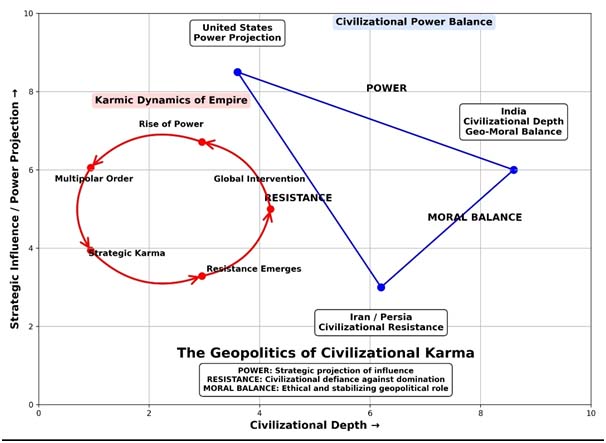
This framework illustrates the interaction between civilizational depth, strategic power, and historical consequences in shaping the emerging world order. The blue triangle represents three structural forces: American power projection, Iranian civilizational resistance rooted in Persian history, and India’s potential role as a geo-moral balancing power. The red circular cycle depicts the karmic dynamics of empire, where the rise of power leads to global intervention, which generates resistance and ultimately produces unintended strategic consequences. Over time, these accumulated responses contribute to the emergence of a more multipolar international system. Together, the two structures explain how power, civilization, and historical memory interact in contemporary geopolitics.
India and the Emergence of a Geo-Moral Role
For India, the evolving dynamics of the Iran conflict present both challenges and opportunities. Historically, the Indian subcontinent maintained extensive cultural and commercial connections with Persia. Persian language and culture influenced courts and literature across South Asia for centuries.

In the modern era, India’s strategic interests in Iran include energy security, connectivity to Central Asia, and infrastructure initiatives such as the development of the Chabahar port. At the same time, India maintains strong partnerships with the United States, Israel, and Gulf countries. Balancing these relationships requires careful strategic diplomacy.
Yet India’s potential role extends beyond transactional interests. As one of the world’s oldest surviving civilizations and the largest democracy, India possesses the credibility to articulate a vision of international engagement grounded in ethical restraint and civilizational dialogue. In a world increasingly shaped by geopolitical competition, India could emerge as a geo-moral anchor—a state capable of balancing power politics with principles of sovereignty, pluralism, and coexistence.
Conclusion: Lessons for a Changing World Order
The Iran conflict ultimately reflects a broader transformation in global politics. The post-Cold War moment of unchallenged Western dominance is gradually giving way to a more complex multipolar landscape in which civilizational identities, historical memories, and regional powers play increasingly influential roles.
In this emerging environment, the actions of great powers carry consequences that extend far beyond immediate strategic objectives. Interventions undertaken in pursuit of stability may generate long-term resistance. Conversely, civilizations with deep historical roots may continue to influence global affairs long after their apparent decline.
Iran embodies one side of this dynamic: a civilization drawing upon centuries of memory to assert its autonomy. The United States represents another: a global power grappling with the responsibilities and contradictions of hegemonic leadership.
For the international community, the central lesson may lie in recognizing that sustainable order cannot be built solely through coercion or dominance. Stability ultimately requires legitimacy—an acceptance among diverse civilizations that the rules governing global interaction are fair and mutually respectful.
As the world navigates the transition toward a new balance of power, the interplay between history, morality, and strategic interest will increasingly shape the future of international relations. The challenge for emerging powers such as India will be to help craft a global order where power is tempered by responsibility and where the long memories of civilizations become a source of dialogue rather than conflict.
ABOUT THE AUTHOR

Lt Gen Rajeev Chaudhry (Retd) served for four decades in Indian Army and has acquired deep experience in infrastructure governance, institutional transparency, and administrative reforms. He has led digitisation and accountability initiatives within government systems and writes on the intersection of strategic statecraft, infrastructure as a tool of deterrence, and India’s civilisational governance traditions.