Editor’s view: A fascinating parallel between Venezuela now and Tibet, 75 years ago. The editors cannot attest to the veracity of the dates and details, which the author is best qualified to do. But the larger geopolitical point, as an academic comparison, is both provocative and critical. Resurrecting this history may not serve immediate interests of either the US or India. However, without advocating policy responses, it is good to bring this narrative into public view, and make the world aware of this historical parallel. In other words, this is a worthy academic debate at this stage rather than a diplomatic posture.
This year’s US action in Venezuela is a highly provocative and brazen take over of a neighbour, un-imaginable till this was carried out. This hostile act will go down in history as a big power play at the expense of a lesser powered sovereign state. It is regretable that it was not denounced adequately, or castigated in any neutral global forum. The 1950 invasion of eastern Tibet was an even more egregious annexation, and resulted in no condemnation or counter-measures – thus tending towards legitimizing other such provocations, including the latest in Venezuela.
Going back into history, as this article does, this account gives little credit to Nehru, who was above all, a globally statured statesman, an ardent messenger of global peace. Did he mistake the Chinese intentions, unable to foresee what did transpire in Tibet in following decades? Nehru the statesman was also the architect of modern India. He was not above mistakes, as this narrative shows.
This year’s US commercial take-over of Venezuela (following the capture and extradition of its ‘president’ Maduro) is a re-assertion of the Monroe Doctrine, through which the US colonized the Philippines and Puerto Rico, and freed Cuba from Spanish control in 1898. Nicolas Maduro lost the 2024 presidential election in Venezuela by an estimated 37% margin, but rigged the outcome to remain in power. He threatened to annex the western part of Guyana (where massive oil reserves have been discovered), and drew steadily closer to China and Iran, thereby violating the Monroe Doctrine under which the US has sought to exclude outside powers from the Americas.
Maduro’s mentor Hugo Chavez had obliged all foreign oil companies to reduce their stakes to 40% or less in 1999, with at least 51% in all joint ventures to be held by state-owned PdVSA (Petroleos de Venezuela SA). Chevron stayed on despite those conditions, while ExxonMobil and ConocoPhillips exited under duress. Between 1976 and 1999, state-owned PdVSA had been run by technocrats, with market-oriented actions optimising output. With Chavista cronies replacing technocrats, PdVSA’s output has contracted in the past 25 years. Despite Venezuela having 17% of the world’s known oil reserves, it has accounted for just 1% of world oil production in the past couple of years. This inefficiency, and the steady expropriation of American oil companies’ assets in Venezuela since 1976 (and especially since 1999) provided the casus belli for the US action on 3rd January 2026.
Tibet before China’s Annexation
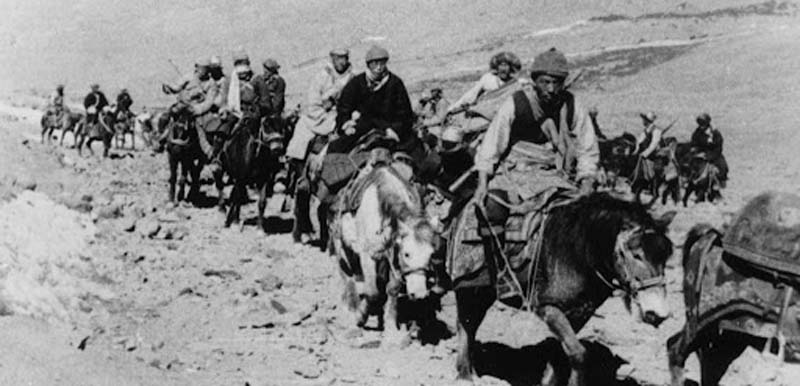
Until the October 1950 invasion of Tibet by communist China, Tibet proper (known to the Manchu dynasty as “Outer Tibet”) had never had any relations with a Han Chinese dynasty/regime. The only periods in Tibetan history during which Tibet and China had any ties at all were under the Mongol (i.e., emphatically non-Chinese) Yuan and Manchu (non-Chinese Tungusic-speaking) Qing dynasty.
The Mongols and Manchus were Buddhists, and hence had a “priest-patron” relationship with Tibet – the latter having overarching control of spiritual matters, while the Mongols/Manchus had temporal power. There was complementarity and give-and-take in the relationship – not imperial control from Beijing (the capital the Mongols renamed Khanbaliq). The term ‘Dalai Lama’ comes from a Mongol word for ocean (‘Dalai’), signifying that lama’s ‘ocean of knowledge’.
Han Chinese dynasties like the Ming and Song had no relations at all with Tibet. The storied Tang dynasty fought (and lost) the climactic Battle of Talas (751 CE), which pitted Tibet (supported by the Abbasid Caliphate) against Tang China, with the latter suffering a crushing defeat. Thereafter, the Tibetan empire expanded south and eastward, conquering what are today Qinghai, western Sichuan and Yunnan. The Manchu dynasty gained control of the Tibetan regions of western Sichuan and Qinghai (known as Amdo to Tibetans), incorporating them into their realms in the 1720s (and naming them “Inner Tibet”, much as “Inner Mongolia” comprises the parts of traditional Mongolia that the Manchus conquered from the Mongols).
In Outer Tibet, however, even the Manchus had a negligible presence. Their representative in Lhasa was called Amban (interpreted as ‘ambassador’ by Tibet, but equivalent to a ‘Resident’ in a vassal state in the eyes of the Manchus), and maintained a guard of 2000 troops there. Of the 80 ambans who served in Lhasa, just four were Han Chinese (including the last two, appointed in the dying years of the dynasty). Manchus and Mongols were the elite during the 268 years of Manchu rule, and Han Chinese were ritually humiliated. Chinese nationalists like Sun Yat-sen consequently hated the Manchus, denigrating them as foreign ‘Tartars’ needing to be rooted out.
When the Manchu (Qing) dynasty was overthrown at the beginning of 1912 by the KMT (Kuomintang, or Chinese nationalist) movement led by Sun Yat-sen, Outer Tibet expelled the amban and his armed escort, and declared full independence. This amounted to a restoration of the natural order of things, since Tibet had only had the priest-patron relationship with the Buddhist dynasties of the Mongols and Manchus, not with any Han Chinese rulers.
India and Tibet: A shared Past
Tibet had always had close cultural and religious ties to India. Vajrayana Buddhism (Tibet’s majority faith) was brought to Tibet by Atisa Dipankara, a sage from the Pala dynasty of Bengal and Bihar, in the 11th century CE. Modern India inherited some privileges in Tibet – including an armed diplomatic Mission in Lhasa, two armed consulates/trade marts in Gyantse and Yatung, an unarmed one in Gartok and full control of the principality of Minsar near Mt. Kailash. But the religio-cultural relations between India and Tibet ran much deeper, including the Sanskrit/Pali origins of the Tibetan script, which has far more in common with India’s languages, and is totally unrelated to the ideograms of the Chinese script.
Zhou Enlai, while negotiating with Nehru, put the latter on the defensive by claiming that the McMahon Line was an “imperialist” border, since it was agreed between Tibet and British India. India’s retort should have been that, in 1914, China had no locus standi on the India-Tibetan border, since Tibet was independent at the time, and Republican China had no presence whatsover in Tibet — just as previous Han Chinese dynasties like the Ming, Song and Tang had lacked any presence there, leave alone ruling it.
In fact, between 1912 and 1949, the only way Chinese officials could reach Lhasa was via Calcutta and Kalimpong. China’s claim that Tibet wasn’t a separate, independent nation rested on the Manchus’ relationship with Tibet – and the Manchus themselves were foreigners in the eyes of the Chinese (who the Manchus consciously treated as a subject people, exactly as the British behaved towards Indians).
From the start, Nehru (who was his own foreign minister) remained permanently on the defensive with regard to India’s rights in Tibet. While publicly proclaiming that India inherited all Britain’s treaty rights in Tibet, Nehru firmly rebuffed Tibet’s repeated entreaties for military or diplomatic assistance. India’s experienced diplomats in Lhasa (Sinha) and Gangtok (Dayal) repeatedly warned Nehru that an invasion of Tibet by communist China was imminent – and that India’s rights in Tibet would be jeopardised by such an invasion – but Nehru’s response was that “the best hope of an amicable solution of the Tibet problem lies in firmly establishing friendship and understanding between India and China”. The official media in China frequently labelled Nehru an “imperialist lackey”. Rather than take this as a personal affront, Nehru went out of his way to accommodate communist China.
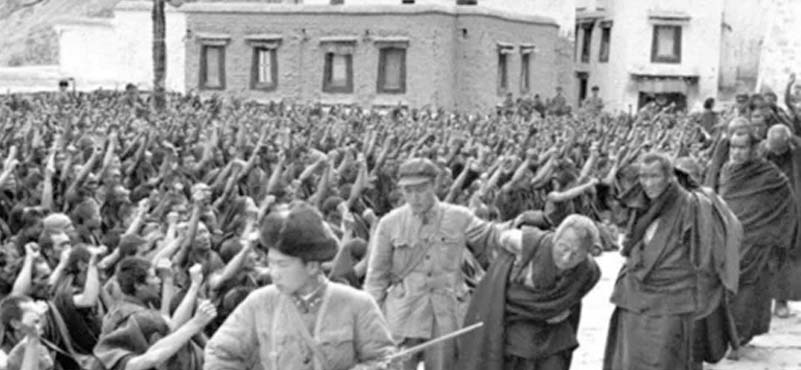
When the Chinese invaded Tibet in October 1950, Nehru said and did precious little. El Salvador introduced a resolution condemning the invasion, but India (to its eternal shame) scuttled it, alongside Britain. Deputy PM Vallabhbhai Patel had written an anguished letter to Nehru excoriating China (7 November 1950), saying emphatically that China had deluded India with its professions of peaceful intentions, and was not a friend but a potential enemy of India’s. Nehru was able to ignore that sage advice, as Patel died in mid-December.
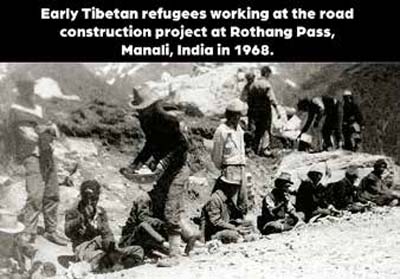
The world (especially India, which had always had Tibet as a buffer state distancing it from China) had then stayed shamefully mum. Communist China’s invasion of Tibet, following its grab for East Turkestan (‘Xinjiang’), emboldened it to pursue further territorial expansion in the South China Sea and the Himalayas. Arguably, the post-WWII Tibet template was a precedent for the Soviet invasions of Hungary (1956), Czechoslovakia (1968) and Afghanistan (1979), and various American covert actions in Latin America, including the latest one in Venezuela.
 India Quietly Eased herself out of Tibet
Between 1951 and 1954, India first allowed its Mission in Lhasa to be downgraded to a consulate reporting to the ambassador in Beijing, implying that India implicitly recognised China’s annexation of Tibet. Then India’s 3 remaining consulates were closed, and their armed escorts withdrawn. Each of these were unilateral steps taken by India, obtaining absolutely nothing in return from China. Perhaps the most egregious was that India allowed its principality of Minsar (a village and surrounding area at the foot of Mt. Kailash) to be absorbed by communist China.
Minsar was an enclave that had been granted by Tibet in perpetuity to Ladakh in 1684 (in exchange for the latter handing back control of the large but sparsely populated Ngari region, now known as western Tibet). The Indian enclave of Minsar was primarily aimed at giving Indian pilgrims easy access to Mt. Kailash and Mansarovar.
Since Minsar is constitutionally a part of India, its annexation by another country needed a constitutional amendment, which has never occurred. Instead, when foreign secretary Misri visited China in late-January 2025, one of the ‘concessions’ China made was to ‘allow’ the resumption of Indian pilgrimages to Mansarovar.
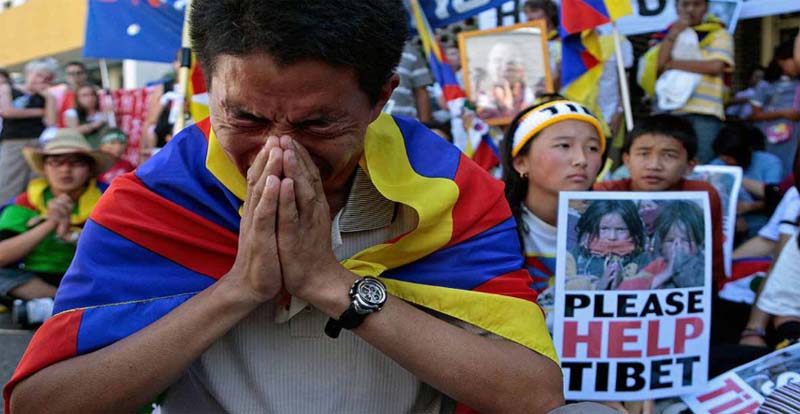
Should Venezuela serve as a timely reminder of history? Shouldn’t the world, and India, stop continuing to overlook the issue of Tibet, which is of vital national and international interest? The UN General Assembly resolution 1723 (of 1961) is a good place to start. This renewed “its call for the cessation of practices which deprive the Tibetan people of their fundamental human rights and freedoms, including the right to self-determination”. At all future interactions, should PM Modi not remind President Trump of this resolution, and EAM Jaishankar use every opportunity to reiterate it with Secretary of State Rubio (who was an anti-China hawk in the US Senate)? Or, simply put, should this issue be back on global platforms, at least not buried in perpetuity? In February 2024, the US Congress passed the ‘Promoting a Resolution to the Tibet-China Dispute Act’. How much longer should Tibet’s neighbour India remain silent on this historic dispute?
Where is the Autonomy in Tibet?
India was browbeaten into acknowledging that the “Tibet Autonomous Region” is part of China. But Tibet has never had any autonomy as part of China. All communist party secretaries in Tibet have been Han Chinese, so Tibetans have no say in the governance of their supposedly autonomous region.
China doesn’t allow multilateral development banks (World Bank, ADB) to make loans to Arunachal Pradesh, and continues to lay claim to the whole of that Indian state. Just as China has steadily altered its position to expand its territorial claims on India, is it time for India to reciprocate?
In future diplomatic engagements, should India press publicly for genuine autonomy for Tibet, failing which India (in concert with other allied nations) will lay out a time-line for changing its official position on Tibet? Since Tibet’s autonomy is a complete fiction, India should formally recognise the Dalai Lama and the Sikyong (leader of the Central Tibetan Administration) as the official representatives of the occupied nation of Tibet. Thereafter, India should begin pressing for the return of the Indian enclave of Minsar, and the restoration of India’s armed consulates in Lhasa, Gyantse and Yartung.
Finland, Estonia, Latvia, Lithuania and most of Poland were parts of Russia within the past century, but concerted global action enabled them to regain full independence. India’s past fecklessness has led China to act with increasing impunity regarding the definition of the India-Tibet frontier (mis-labeled now an India-China border). International bullies understand strength, not feckless weakness.
The best way to push back against the CCP’s egregious claims on Arunachal Pradesh and Ladakh is to re-assert historic reality: that Tibet is an independent nation that has been India’s neighbour for more than a thousand years.
ABOUT THE AUTHOR
 Prasenjit K. Basu’s ‘Asia Reborn’ won the Best First Book award at the Tata Literature Live! Mumbai LitFest, 2018. His new book, ‘India Reborn’ has just been published. PK was Chief Economist (SE Asia & India) at Credit Suisse First Boston and Chief Asia Economist at Daiwa Securities for 5 years each. Among other roles, he was Chief Economist at ICICI Securities and Malaysia’s Khazanah Nasional, CEO of Maybank Kim Eng Research Pte Ltd, board member of Tata Capital Pte Ltd, and Macquarie Malaysia, and Director of the Asia Service at Wharton Econometrics in Philadelphia, and Director of Asian Macroeconomics at UBS Securities. He has dual Master’s degrees in Public Administration and International Relations from the University of Pennsylvania, and completed PhD coursework in International Political Economy there.