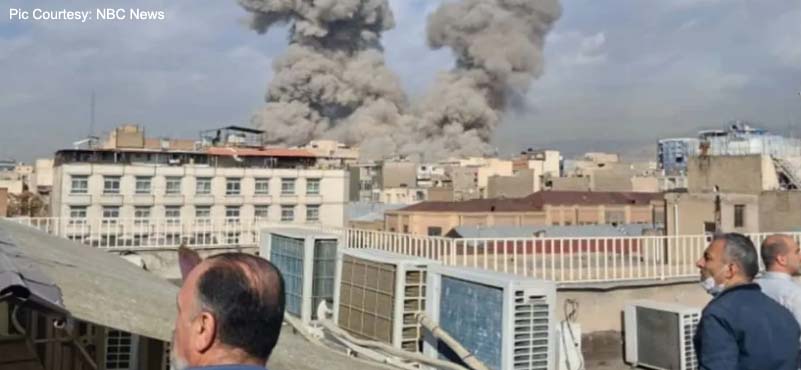
President Donald Trump has initiated “Operation Epic Fury” as a coercive air campaign launched from Israel, designed to reset the strategic balance with Iran without the commitment of US ground forces. The stated objective is to degrade Iran’s nuclear infrastructure, diminish its missile threat capability, and impose punitive costs on the Islamic Revolutionary Guard Corps to fracture regime cohesion. The conceptual foundation is familiar in the American Monroe Doctrine, now Donro Doctrine. Escalation dominance, applied rapidly and visibly, is expected to compel recalibration in Tehran while avoiding open-ended occupation. The wager is that calibrated shock can substitute for regime transformation. Yet this end state seems simplistic when applied to a nation like Iran and its proxies.
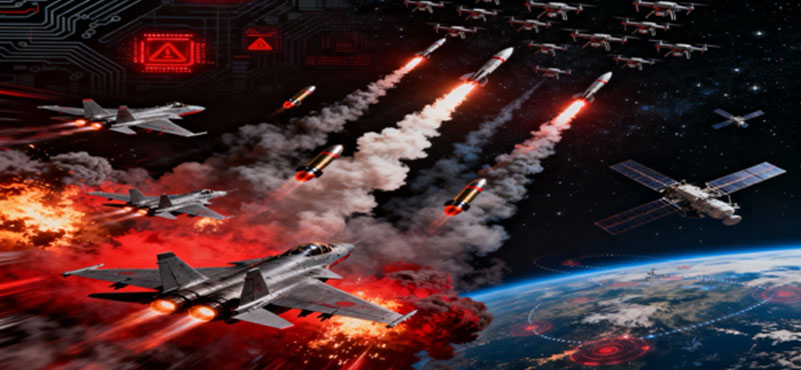
The operational design reflects confidence in American aerospace superiority. Stealth platforms, stand-off munitions, electronic warfare, and integrated missile defence are being employed to compress Iran’s command and control architecture. Israeli systems are interlocked with US assets to absorb retaliation. The question is: can such destruction be trusted to engineer political results within a resilient, ideologically rooted state without extending the conflict outside of its boundaries? Military compression, however, does not automatically translate into political capitulation.
Iran differs materially from Iraq in 2003. The regime is not a personality-centred autocracy with shallow institutional roots. It is a layered security architecture built over four decades, with redundancy embedded into its military, economic, and ideological networks. The memory of George W. Bush announcing “mission accomplished” aboard the USS Abraham Lincoln is instructive not for rhetorical reasons but for structural ones. Iraq’s regime collapse triggered state failure because the coercive apparatus disintegrated faster than a replacement order could emerge. Iran’s internal security model is decentralised and prepared for external assault. Deterrence in such a system is not personality-bound; it is institutional and therefore harder to decapitate.
Tehran’s deterrence posture is built on distributed retaliation. Its ballistic missile inventory is potent in numbers, reach, survivability and precision. Its proxy network extends through Hezbollah in Lebanon and the Houthis in Yemen, among others. These actors widen the battlefield without triggering formal war, imposing steady and deniable costs. Cyber capabilities add a non-kinetic vector capable of targeting Gulf energy installations and Western financial systems.
Early exchanges following Epic Fury illustrate this logic. The choreography suggests signalling, not surrender. Missile salvos against Israeli territory and US positions in the Gulf are calibrated demonstrations of retained capacity. Even if Iran’s fixed infrastructure is degraded, its ability to impose regional friction remains intact. The operational aim of limiting the conflict may therefore depend less on US strike efficiency and more on Tehran’s assessment of regime survival.
The immediate point of global concern remains the energy markets. The Strait of Hormuz handles about one-fifth of the oil trade conducted in the world. Iran will not be able to seal the passage permanently in the presence of combined naval forces, yet it can cause severe disruptions. Uncertainty is responded to in the markets faster than in physical strikes. A sustained disruption could push prices into triple-digit territory; the February 27 Brent benchmark closed at $79.40 before strike announcements. This could cause global inflationary strain and test political solidarity across the importing states.
India has a structural exposure. New Delhi cannot afford the crisis as a theatre far away when more than eighty per cent of its crude is imported and major quantities of its traffic pass through Hormuz. Buffers are provided by strategic petroleum reserves and diversification of suppliers, but are not long-term insulation. Such a sustained imbalance would put pressure on the economy, increase inflationary pressures, and slow industrial momentum. Monetary tightening in response would compound the strain, constraining fiscal flexibility. Moreover, India’s investment in Iran’s Chabahar port embeds it in the regional geometry. Instability in Iran’s Baluchistan region could intersect with existing insurgent currents across the Pakistan border, adding a security dimension to an energy crisis.
The external power balance compounds uncertainty. Both Vladimir Putin and Xi Jinping have packaged the campaign as unilateralism that is destabilising. Moscow has a precedent in providing hi-tech air defence equipment to Tehran. China’s long-term energy and infrastructure agreements anchor it economically to Iran’s continuity. Direct military intervention by either is improbable; indirect balancing is not. Accelerated technology transfers, intelligence sharing, or coordinated naval deployments in the Indian Ocean would complicate US escalation management while reinforcing a narrative of multipolar resistance. Escalation management becomes more complex when competitors do not fight directly but reinforce the target’s endurance.
The regime change variable remains the least predictable component. When sustained strikes undermine the central authority, the likely outcome is not automatic liberalisation but fragmentation risk. Autonomy claims could be made by ethnic peripheries such as the Kurdish and Baloch regions. Alternatively, regime hardliners could consolidate power, arguing that survival requires strategic acceleration, including potential movement toward overt nuclear weaponisation. Strategic pressure can therefore compress timelines rather than eliminate ambitions. A campaign intended to arrest proliferation could therefore alter incentives in the opposite direction.
Historical precedents underscore this risk. The removal of Muammar Gaddafi in Libya produced regime termination without state consolidation; competing militias filled the vacuum, underscoring that tactical coercion does not guarantee political order. In Iran’s case, the absence of an articulated external stabilisation framework increases the probability of prolonged turbulence should the central authority weaken abruptly.
Supporters of Epic Fury argue that previous strategies of sanctions and limited covert action allowed Iran’s nuclear latency to mature. They contend that decisive degradation now restores deterrence credibility. Critics respond that deterrence is based not only on punishment but also on predictability and coalition coherence. European states anticipate refugee flows and energy shocks. Gulf states are publicly in line with Washington but conscious of their geographical proximity to retaliation.
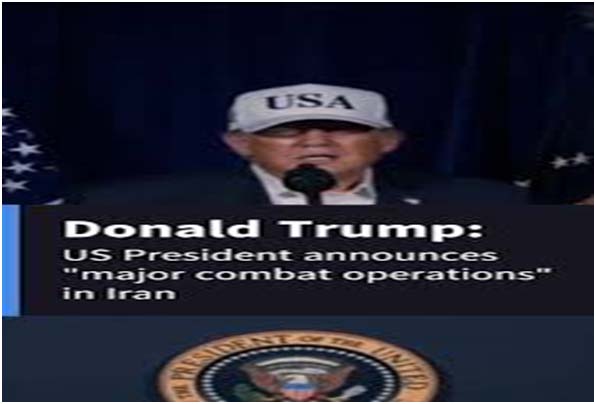
Operation Epic Fury will not ultimately be measured by bomb damage assessments or destroyed infrastructure, but by whether it keeps escalation contained while meaningfully altering Iran’s strategic judgment. Recent history is instructive. From Iraq to Libya, superior force removed regimes faster than it replaced the political order. Military success did not automatically yield stability.
In the Middle East, the dividing line between controlled coercion and widening conflict is historically thin. The present campaign seeks to operate precisely along that margin. Its outcome and spread will shape the regional balance and global energy security. The US must remember that the credibility of limited force as a strategic instrument is constrained in an era defined by interdependence and contested order.
Operation Epic Fury tests the brittle edge where air precision meets regime resilience. Iran does not have to prevail, but outlast, to claim strategic victory, with conflict seeping into a protracted shadow war across proxies, pipelines, and sea lanes with deniable reprisals. For New Delhi, the lesson is clear: secure supplies and prepare for market turbulence and global instability. The campaign’s true measure lies not in destroyed sites but in whether US coercion alters Iran’s politico-military posture without escalation that redraws energy maps. If capability is reduced but incentives for retaliation, nuclear acceleration, or rival bloc consolidation increase, the campaign may deliver tactical results while weakening long-term stability.
ABOUT THE AUTHOR
 Lieutenant General A B Shivane, is the former Strike Corps Commander and Director General of Mechanised Forces. As a scholar warrior, he has authored over 200 publications on national security and matters defence, besides four books and is an internationally renowned keynote speaker. The General was a Consultant to the Ministry of Defence (Ordnance Factory Board) post-superannuation. He was the Distinguished Fellow and held COAS Chair of Excellence at the Centre for Land Warfare Studies 2021 2022. He is also the Senior Advisor Board Member to several organisations and Think Tanks.