The South Asian region easily is one of the most politically unstable and volatile regions of the world. As the major power in this restive expanse, India accordingly holds a significant responsibility of endeavouring for both regional peace and economic growth in this otherwise explosive fraternity — the mission of harmonizing the neighbourhood which it has worked upon, conscientiously over the years, with both success and failure.
Most of these nations in South Asia have civilizational and cultural links with each other—- a factor which could effectively have been a bonding reason for them but not with much avail. However, two nations, India and Nepal are a rare example where, despite being two sovereign nations, both these countries do have open borders and citizens of both nations can freely visit each other, without any official permissions or any diplomatic legalities. Age old ties between India and Nepal, cemented by ties of religion, culture, families, marriages and geography continue to have a bearing on each other’s prevailing political, economic and social environment, which would include both the internal and external paradigm. Thus, the current serious political instability afflicting Nepal is a cause of much concern for India too.
The Republic of India and the monarchy which then ruled the latter, called the Federal Democratic Republic of Nepal, had initiated mutual relations enshrined in the parameters of the 1950 Indo-Nepal Treaty which stood the test of times despite a few hiccups. In 2025, both nations renewed their commitment to the model of open borders and measures to strengthen trade, infrastructure and socio-economic growth, commensurate with the changing geo-political, security and economic challenges. India, since its independence, has gone out of its way to assist the kingdom of Nepal in its all-round economic growth, and permitted countless lakhs of Nepalese citizens to seek and get employment in India. The finest example has been India retaining nearly a lakh of gallant Nepalese troops in its Gurkha regiments. However, India recently, adopting the 4 years only in service “Agniveer” system in the Army has met with stiff resistance from friendly Nepal. Hopefully the Indian government will look into this not so very prudent step. The Gurkhas are among India’s most gallant and loyal soldiers and have acquitted themselves with glory in all battles fought by India since our Independence—- this close family relationship must continue for mutual benefit.
To comprehend the larger contours of the grave political instability endangering Nepal currently, it will be worthwhile to look back at Nepal’s political landscape since the 1950s. During this period, Nepal had witnessed a stormy transition from an absolute monarchy to democratic republic. Apart from a long period of absolute monarchial rule, Nepal has weathered a civil war, the Maoist uprisings, enforcement of multiple constitutions and unstable democratic, rule off and on.
In 1951, Nepal saw the end of the hated and autocratic Rana oligarchy—— the Ranas were hereditary prime ministers. The then leading political party, Nepali Congress Party, supported by King Tribhuvan, led a revolution against the unpopular Ranas, ousted them and an interim government was formed in 1959. The Nepali Congress led by BP Koirala formed the first democratically elected government. However, in late 1960, King Mahendra staged a coup, dissolved Parliament, banned political parties and assumed absolute power. From 1962 to 1990, supported by the Nepalese Army, King Mahendra ruled Nepal through a party-less system of Councils (panchayats). However, the Nepalese people brought in a widespread revolution which forced King Mahendra to accept a constitutional monarchy, a new constitution and a multi-party parliamentary system. However, the transition did bring in for the next 20 years, political instability and the advent of a Maoist uprising. During this period (1996-2006), grave political instability and the ensuing civil war accounted for nearly 16000 lives.
In 2001, King Birendra and most members of his family were massacred leading to King Gyanendra ascending the throne. Gyanendra was, reportedly, one of the major suspects of this carnage. In 2005, Gyanendra dismissed the federal democratic government and assumed absolute powers. However, in 2006, a people’s movement supported by Maoists forced the King to reinstate Parliament. In May 2008, the monarchy was formally abolished and Nepal declared a federal democratic republic. In Nepal’s political set-up the two parties which have dominated Nepal’s political journey and have been bitterly against each other have been the moderate Nepali Congress and the ultra-left wing Nepali Communist Party. China too has subtly been playing a mischievous role in supporting the Nepalese leftists. That China wields a significant role in Nepali politics is widely accepted, with it being close to not only the Nepal leftists but having cultivated many other govt officials and political leaders.
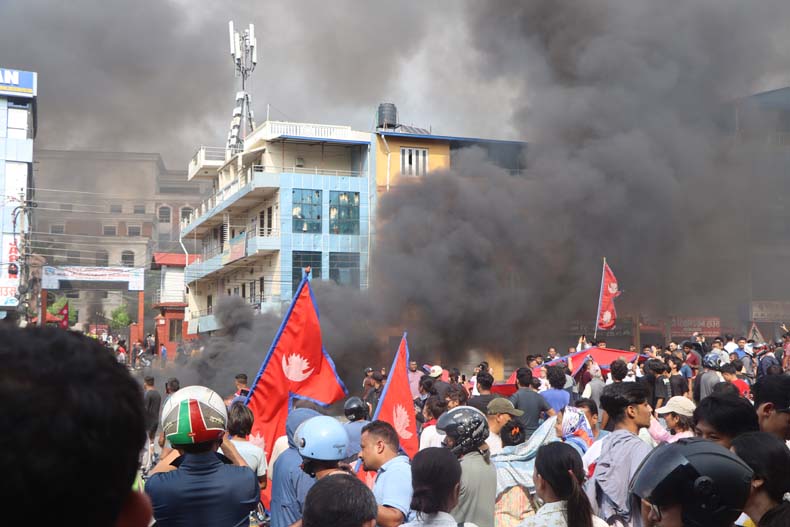
September 2015 witnessed a new Constitution being promulgated in Nepal and elections held, off and on, with uneasy coalitions and countless small political parties pitching in. However, shifting political alliances, leading to instability and governments changing frequently, have been the order of the day since the last decade. A massive and wide spread youth movement emerged in September 2025 which the Nepalese government of KP Sharma Oli and even its security forces could not handle. Lakhs of Nepalese youth (dubbed as Gen Z protestors) demonstrated against their government for banning the Internet and social media while also vigorously complaining against rampant corruption and inequality. The police response against the Gen Z protestors led to around eighty deaths but the protestors did not stop till they ensured PM Oli’s resignation. They even torched the Nepalese Parliament building and destroyed many public offices. One among the many reasons for these massive national-wide protests was the growing disparity between the haves and have-nots in Nepalese society, where poverty and growing unemployment have been rampant.
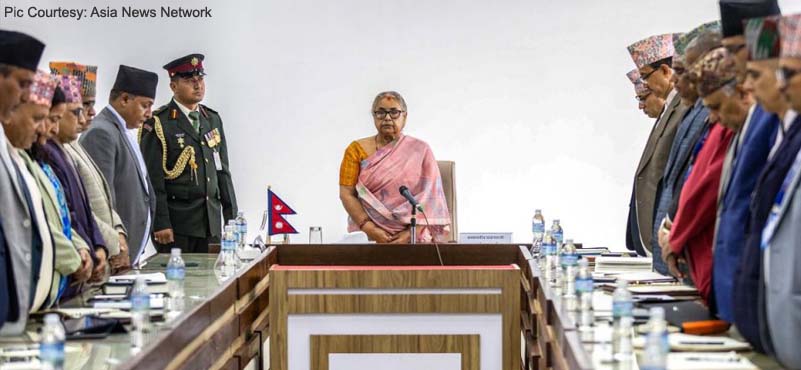
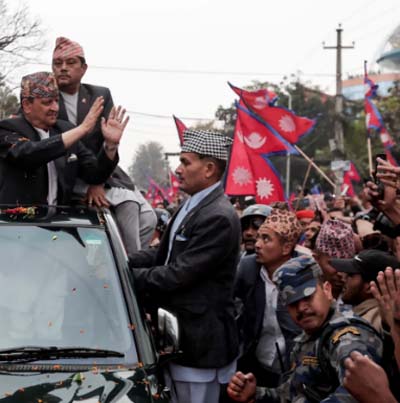
PM Oli was replaced by Nepal’s first female prime minister, Sushila Karki who formed an Interim Government and immediately got down to ushering in peace and a semblance of stability in her restive nation. Elections are likely to be held in March 2026 as announced by her. She has a monumental task on her hands and she appears currently to be on the right path to lead her turbulent nation. Meanwhile former King Gyanendra has been discreetly marshalling his supporters to agitate for the restoration of the monarchy! That currently there are not many supporters of this concept is no surprise.
In keeping with its long-standing fraternal relations with Nepal, India, as in earlier times, would do well not to be seen as interfering in Nepal’s internal matters. India will have to carefully monitor Chinese machinations in Nepal. Importantly, India must use its abundant soft power to assist Nepal in its onerous task for economic survival and sustenance. Cooperation with Nepal in security and defence matters must also be accorded additional importance and India must continue to have Nepalese Gurkhas in some of its units.
Editor’s note: The Nepalese are an emotional and sensitive people, prone to being misled, much like many of us in India. There have been instances in the past, when high-handedness of the political brass in India has resulted in impacting average lives of the people, which was unwarranted. Like the big blockade of road and cargo traffic into Nepal from West Bengal ports. The memory has lingered on, with vested interests ready to whip up anti-Indian sentiments, on every pretext, valid or not.
It is not about big and small, not about strategic interests, as much as mutual cultural, social, religious bonds we share as people. If you look at the entire eastern belt of India, bordering Nepal, notice the commonality in all walks of life. The fact that we have an open border, only highlights this unity. None of this should be disturbed, by politicians on either side, some basic values in life should be above compromise. The average Nepal and Indian citizen is aware of our common heritage, both only need consistent reminders – it is the job of not only governments but also every association in business and social life.
The recent Gen Z protests took Nepal by surprise, so sudden and impactful, that the government of the day had to resign, with numerous public figures scurrying for personal safety. This is a tough time for the nation, as it prepares for yet another election in March, 2026. A helping, understanding and re-assuring hand is what Nepal needs and surely, India will be there as friend, brother and neighbour.
ABOUT THE AUTHOR
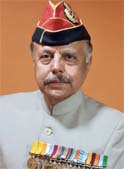 Lt Gen Kamal Davar is a veteran of the 1965 and 1971 wars and was wounded in action in the 1965 ops. In his 41 years of distinguished service has served in NEFA, Nagaland,Assam, Punjab and J&K. Was a member of the Indian Training Team in Iraq. Commanded the entire Ladakh sector, was Chief of Staff in Nagrota ( J&K) and later commanded the Corps in Punjab. After a short stint as DG Mech Forces was selected by the Government to raise India’s Defence Intelligence Agency. Is a prolific writer and a sought after speaker on strategic matters.