High on Growth, Ready to Invest, Ensuring High Community Connect, Looking at International Expansion. In conversation with Suhail Kannampilly, CEO, Fern Hotels.
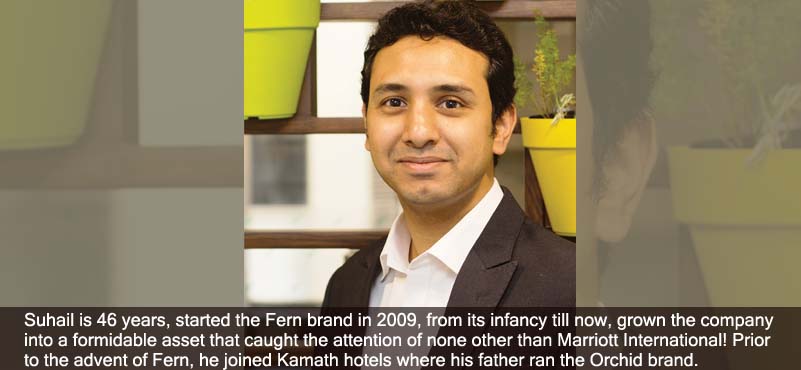
Suhail is 46 years, started the Fern brand in 2009, from its infancy till now, grown the company into a formidable asset that caught the attention of none other than Marriott International! Prior to the advent of Fern, he joined Kamath hotels where his father ran the Orchid brand.
Navin Berry: What prompted this kind of pioneering initiative with the world’s largest hotel chain. There must have been some initial thought process that went behind it. There must have been some discussion of synergy, discussion of the road ahead. The first of its kind in hospitality, when an international brand from an international company, has been sourced out of India. So just go back and just describe what was the value proposition.
 Suhail Kannampilly: We had reached a stage where we had started to look at asset acquisitions and asset heavy route as well for the company along with continuing our asset light synergy. So, with that in mind, we were looking at raising capital in the company to be able to start acquiring assets in the company.
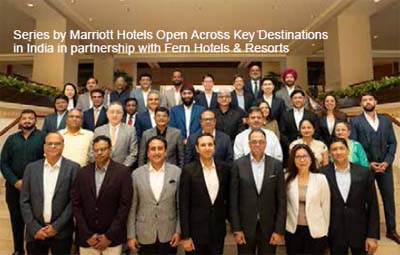
Now, when this thought process came about, we also at the same time were approached by Marriott. They reached out to us with regards to a possible synergy. Because their objective was to try and get into the tier 2, tier 3 markets of India, in which we have a very significant presence; along with this, where we saw it as a very good synergy for us, it helps us strengthen our presence in tier 1, tier 2 metros of India and gives us the distribution strength, and to be able to, at some point, even look at an international expansion.
Navin Berry: Absolutely, absolutely. And what are the contours of this agreement now, to elaborate upon them again?
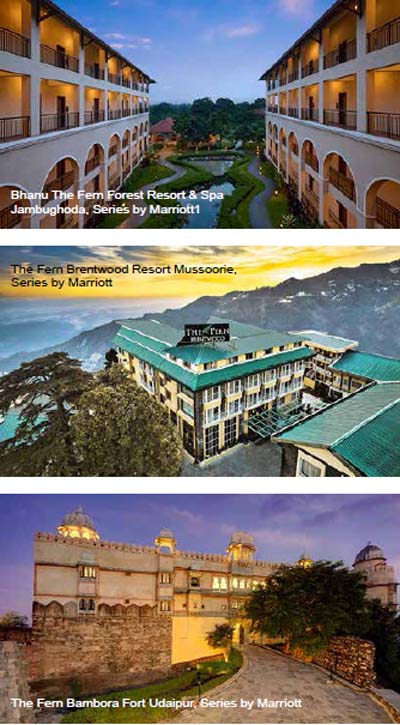
Suhail Kannampilly: So, the agreement is such that we’ve created a kind of a master franchise, Series by Marriott. So, Marriott has taken the initiative to create a new brand in their soft branding space which is called Series by Marriott and it’s the first soft brand that they have, which also encompasses the word Marriott in it. So, they have other soft brands like Luxury Collection, Tribute, Autograph Collection but none of them really have the name of Marriott linked into the soft brand. So, this is the first soft brand with the name of Marriott brought into it, because the synergy we thought is one of the biggest synergies, that most of the owners that we look at, will ask how is it really getting into the brand name of Marriott. We want the name Marriott when ever that conversation comes about.
Navin Berry: And so I believe you have a target of 500 hotels by 2030?
Suhail Kannampilly: So, when we started off with Marriott, we were 115 hotels of which 84 were operational under the Fern brand. So, we have other brands as well which is Zinc and Beacon. But under the Fern related brands we had 84 hotels operational and 115 signed. Today, we are sitting at somewhere close to 135 that are signed and we are in advanced stage of discussion with another 60 hotels almost. So, we are closing in close to the 200-mark.
Navin Berry: And is there some kind of a design when you are looking at growth areas, like where all do you need to be, how will you pan out your network?
 Suhail Kannampilly: So, our presence from a distribution perspective in terms of hotels, we are very significantly present in the west of India. So, if I look at my portfolio, currently 75 hotels out of my 115 sit in Maharashtra and Gujarat.
Navin Berry: Okay, so that means you are missing out a big chunk in the country.
Suhail Kannampilly: So, we are missing out a big chunk in the country and that’s what the distribution strength of Marriott brings us. So, we have now scaled up significantly in Karnataka. In the south of India, we have got a lot of expansion planned. We have got from Kerala from zero hotels, where we will be closing this year close to 6 hotels in Kerala.
Navin Berry: What about Delhi and the north?
Suhail Kannampilly: Delhi and north also, we have got a couple of big announcements coming in. We should be entering into NCR with a couple of large hotels this year. We’ve got 18 hotels done in Rajasthan already.
Navin Berry: Okay, tell me, are these franchised or asset-owned?
Suhail Kannampilly: The intention of getting private equity into the company or getting equity, raising equity in the company was to go asset heavy. We have currently now purchased 4 hotels and the 5th one is in advanced stage which is likely to be closed by the end of this month.
Navin Berry: So, which are these four that you have owned?
Suhail Kannampilly: We have one in Kolhapur. One in a place called Jamba Gowda which we have built. That’s a hundred and eight keys. Which is near the Statue of Unity. Close to Baroda and the Statue of Unity. We recently acquired a hotel in Chiplun which used to be the old Taj hotel. It’s just undergoing renovation and will go live within a month’s time.
 Navin Berry: Okay, so tell me typically what is the size of a hotel? That you are going to run, when you are going to chase these 500 hotels. What’s an average?
Suhail Kannampilly: Minimum size is about 60 keys. And the average inventory goes to around 80 keys.
Navin Berry: These are all standard Fern properties or you will have also some categories within the Fern?
Suhail Kannampilly: We have two categories within the Fern. Apart from the Fern which sits in the upscale segment, we have got Fern Residency which is in the mid scale and we’ve got a brand created called Fern Habitat which is in the extended stay section. Not homestays we don’t do homestays there are service departments. Okay. Only functional service departments.
Navin Berry: Who would be your competitors in the field?
Suhail Kannampilly: So, from a domestic perspective, we’ve got competitors like Lemon Tree, Sarovar, that compete in the domestic space. And in the international space, Radisson primarily.
Navin Berry: And within the Marriott hierarchy, where do you figure in into their scheme of things?
Suhail Kannampilly: We are in the select service category similar, to a Fairfield and a Courtyard.
Navin Berry: And going forward, do you see Fern as your company also going overseas?
Suhail Kannampilly: That was one of the principal decisions when we got in with Marriott is to try and build our distribution so that we can go overseas. It’s primarily a management bandwidth concern. Currently, the distribution and queries coming within the country are significant and the growth targeted within the country is huge. So, at some stage we will definitely look at expanding outside the country. And I think one of the routes for that may be through an acquisition of another company.
Navin Berry: In all this growth that you envisage, you’ll probably need a much bigger and a stronger team. But do you see your numbers also going up?
Suhail Kannampilly: We have a large corporate setup and that was one of the things that was assessed by Marriott in totality as well. Where the corporate setup already has about 130 people. We’ve got about a 12,000 square foot corporate office in Bombay. A very large, which is very divided into different segments. With each segment looking into this thing right from a sales division, operations division, finance division, distribution division. So, distribution is completely centrally controlled in terms of revenue management across the hotels.
Navin Berry: Your partnership with the Chaudhury Group? Are they the silent partners and you are in the driver’s seat, how does it work?
Suhail Kannampilly: So, see the company was the management arm for Kamath Hotels back in the early 2000s and in 2009 when we separated from Kamath Hotels, we created the Fern Brand. When we separated from Kamath Hotels to buy out the equity, we had taken private equity into the company from a fund called Lighthouse. Lighthouse exited the company in 2015 selling to Choudhury Group. So, their role is primarily strategic in terms of advisory and strategic in nature, not in terms of operational in nature.
Navin Berry: So operationally it’s with you and your company?
Suhail Kannampilly: Absolutely. It’s a professionally managed company that has got hierarchy through.
Navin Berry: A quick word on the war clouds. How is that affecting your business? You see it affecting it later. I think you have largely domestic traffic or how much is international with you?
Suhail Kannampilly: Some of the destinations are significant in terms of international traffic. I think Goa is one. Even Mumbai actually we sit with almost 45% business from international travelers. These markets that will have a slight impact with the international travelers. Domestically also, as the cost will start to rise and fuel costs will start to go up. There will be a slowdown in domestic movement if this continues. The quicker this is resolved for everyone, the better.
Navin Berry: Right. But are you feeling any impact already?
Suhail Kannampilly: There is an impact, but it’s not a very significant impact currently. But there is definitely an impact already being felt to the extent of about a 5 to 7 percent drop compared to what we were expecting. But as time goes, that impact could get much worse.
Navin Berry: I just finished doing an editorial yesterday. How does the industry play a more responsible role in ensuring that the wheels of domestic tourism keep moving? In the face of a concept like Atma Nirbharta, our tourism industry is well poised to say that we are reasonably self-reliant or self-dependent on our own numbers and we can keep that wheel moving. So, I think a lot of the responsibility would be on the industry. So do you have any thoughts on that, that if there are problems going here, how can industry stimulate traffic? Because it’s not just buying a hotel room. It’s also going there, eating, giving employment to your staff. On the way, they’ll also probably visit a monument. They’ll probably keep the wheels going of that monument. Travel and tourism can help the economy to remain on the move. So where do you see that happening?
Suhail Kannampilly: India’s got a huge population of travel ready people effectively. And at the end of the day, responsibility to ensure that this domestic tourism really is taken care of and matches to international standard. That’s what we really need to bring in. That’s not just about the hotels. It’s about the entire travel experience that we need to bring up to international standards. Right from destination management of clean roads, clean areas, safe areas, in terms of even providing entertainment, nightlife, all these things, it has to move up to international levels. It isn’t fair to our domestic population if we keep treating the domestic tourism on a different front from how we would treat international destinations.
Navin Berry: That tempts me to ask you, you have a lot of hotels in the hinterland. Like for instance, I am right now speaking with you from a place called Kasauli. And on the main highway, there’s a lovely Fern on the main road. What kind of community connect do you ask your hotels to ensure? Is there some kind of a philosophy underlying?
Suhail Kannampilly: The general managers of all the hotels have a KRA within their system, for environmental related KRAs where they have a minimum 4 community outreach programs that they need to do every year. We’ve just completed a community outreach program where all our hotels close to the sea have done complete beach cleanup drives across India. Pre-COVID, we had done a complete all India outreach program where we had done a campaign with Mr. Abid Surti for a drop-dead campaign where our engineering teams across the hotels, these teams went out to all the neighborhood societies and fixed any kind of a leak in their houses, in their taps, free of charge for them. We have calculated and saved over 5 million litres of water. Just fixing taps, leaks, free of charge for anybody.
Navin Berry: Tell me, what’s the kind of employment that you generate, especially in the remoter areas? Like, do you have a policy that at least so many people we must employ from local communities as a principle? Because it’s also cheaper perhaps to look for staff around?
Suhail Kannampilly: It’s definitely cheaper, but we don’t have a policy that drives local recruitment. It is primarily state governed. So, India as a state, employment comes as a state subject. So, therefore, every state has local requirements of how many people you have to take from the state. We have that as part of the shops and establishment regulation.
Navin Berry: Suhail, so one last question from me for you. How is profitability for the group? The big boys are talking about 1,000, 1,200, 1,500 cash surplus, cash positive every year. Somebody like an IHCL is talking about 4,000 crores cash on their balance sheets. So, I’m sure these are enviable figures. How is the Fern balance sheet looking?
Suhail Kannampilly: So, the balance sheet has been very healthy. I think we’ve been cash surplus since 2015 onward. Even during COVID, we didn’t really have a large negative. So, in terms of the balance sheet, it’s very healthy and that’s what’s actually fueled the property acquisition.
Navin Berry: And I’m sure Marriott must have done a due diligence and taken this forward. Any parting shot you want to give on Fern?
Suhail Kannampilly: I think the potential for…it’s aspirational tourism in India. And the real question is, are we going to be able to live up to that aspiration and grow in that aspiration, based on the demands of the Indian consumer. Indian consumers are demanding standards to match that. Across not only our hotels but across destinations.