
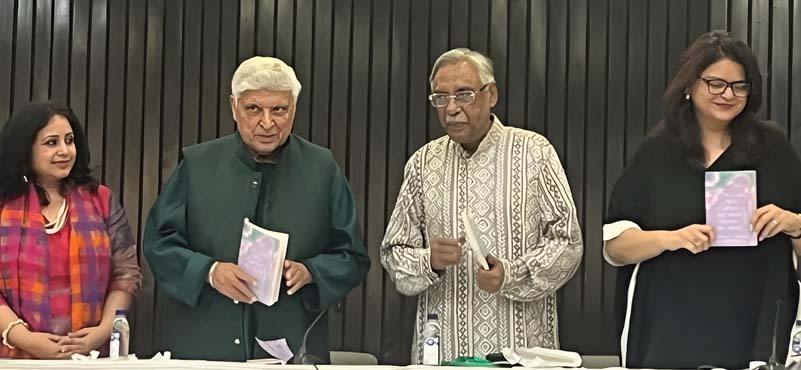
A literary event in New Delhi saw Javed Akhtar discussing Pavan Varma’s new book, “The Lady Who Carried the Monk Across the River.” A conversation on faith, desire, and the fading art of debate, reflected the novel’s deeper question: can spiritual discipline and human longing truly exist together?
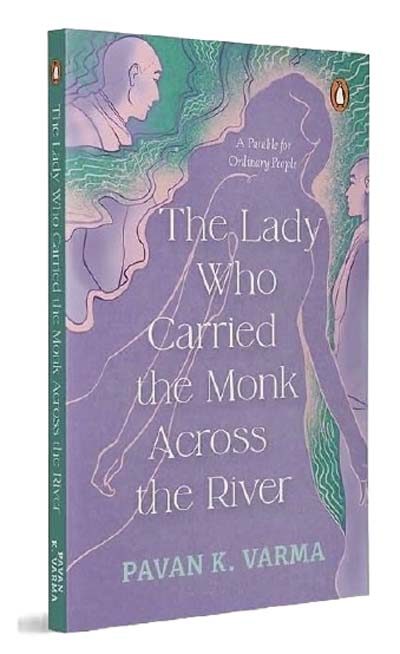 Pavan Verma spoke about the impulse that led him to write the book, where the story grew from a long-standing engagement with Indian philosophical traditions. For Verma, the richness of these traditions lies not merely in their spiritual authority but in their openness to debate and interpretation. For him, the novel explores his desire to revisit that tradition of questioning and dialogue. He has used fiction to bring philosophical ideas into the lives of ordinary people rather than presenting them as abstract doctrines.
The story follows Guru Brihaspati and his celibate disciples, Kevala and Gyan, whose lives are unsettled by the mysterious Mandakini. Over five days, guru and disciple engage in an intense philosophical debate about what truly constitutes a fulfilled life. Blending philosophy with storytelling, the novel examines the uneasy relationship between the sacred and the sensual. Rather than offering easy answers, it places its characters at the centre of difficult choices, asking whether the quest for transcendence can coexist with the pull of earthly love.
Said Akhtar, “I’ve never read a book quite like this before. In many ways it feels like a genre of its own. It’s also the kind of book you can finish in one go because the ideas grip you so strongly. It binds you with its thoughts and doesn’t let you go.”
Varma shared “At its heart, the story looks at the constant tension between spirituality and desire. Can the two exist in harmony, or must one always deny the other? In today’s time, when there is so much hypocrisy around ideas of pleasure and purity, I felt it was important to explore this honestly.”
We produce selected excerpts from the conversation between the author and the chief guest. These have been collated for the originality of thought as seen in the book. They should be read as individual pieces in themselves, not in any order.
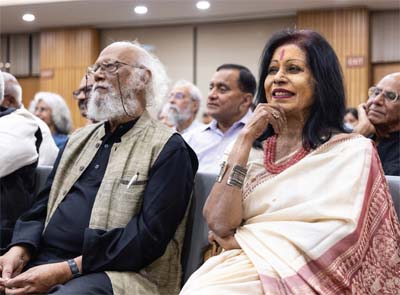 Pavan Varma: So, we are a civilization that evolved on the principle of ‘maulik soch’, the power of original thought. Brahm, the notion of Brahm, a pulsating cosmic consciousness. The six systems of Hindu philosophy can be technically called atheist because they don’t mention God. They are search for what could be the ultimate truth, behind the bewildering popularity of the cosmos. They are not looking for God. That is ‘maulik soch’. Nishkama Karma is ‘maulik soch’. In mathematics, in astronomy, in astrology, in architecture, in poetry. And later as we evolved as a civilization with many influences, building together, there have been instances of the power of original thought which made us different. We were the inventors.
Today we are content to be cogs in somebody else’s wheel, instead of becoming the wheel ourselves. And that is the difference. When I wrote on Adi Shankaracharya, I met so many educated Indians, friends of mine who said, what did he write? When did he live? People don’t know. It happens to post-colonial societies except in our case it has become a malignancy.
Javed Akhtar: I genuinely believe that there may be a limit to knowledge but there is no limit to ignorance. I feel very proud every time that I think, 3,500 years, 1000 years ago, when no Semitic religion had come to the world – Judaism, Christianity, Islam, much before that – perhaps 1,500 years before that, there was a man who preached and there was a movement of atheism. Charvata movement rejected God. Brihaspati, one of the most important leaders of that movement, said that it is totally false to believe that there is any life after death or there is some supreme power that is watching you.
It is just an accident, this whole universe and nothing, no there is no supreme power, when you are dead you will be gone. Nothing will happen.
Pavan Varma: He also said that this is the power of ‘maulik soch’. He could say and be accepted as one of the streams of Hindu philosophy that the Vedas are a bunch of untruths. The Jadavakas, imagine, the notion behind his thinking. Your life is less than a blink. Less than a 1000th fraction of a blink of an eye. You don’t know from where you came, you don’t know where you go. All attempts at believing that you will not die are the basis of religion. There is a resurrection.
Javed Akhtar: And you are really bothered about the cockroach that you killed in the bathroom. Where this cockroach will go? Will he be born again or he will go to heaven or hell? And suppose he is born again, so how much this cockroach can do to come into a better union and ultimately get moksha. This is only for human beings, rest of them die.
Pavan Varma: The Charvakas could question this. And that is what I mean by until you begin to question, to interrogate, to ask, to debate, to reason, you will remain prisoner of that uninformed surface. And that is the malaise. So, I said catch one of them, put them in a room and ask them to write three pages, in this case it was about protecting Hinduism, three pages on what is Hinduism, if they can write it properly, release them immediately, if they can’t – keep them in the room forever. Because people don’t know their own legacy.
———————————————————————————————————–
Javed Akhtar: I went back 3,500 years ago and then within the same paragraph he mentioned that they were having tea. I was very shocked. How can he make this mistake. Tea? 3,500 years? Then, on the next page or perhaps the third page, he mentioned handloom? Sorry, handloom, who will call it handloom? So, it was on sixth or seventh page, I realized that this is in contemporary times. So, my first question is, that it never came to any urban area, the story never came to it, at the most on the fringes, except for the characters like Rakesh and Vinod and there is a servant called Bablu, the names are also classical names, all the names.
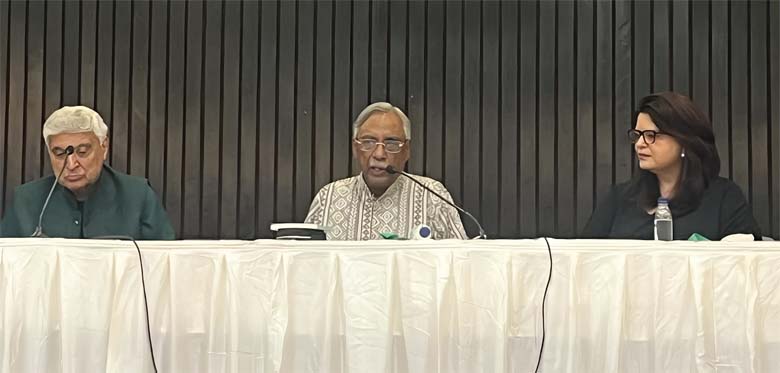
Why did you put it in contemporary times? Because you have not taken much advantage of the contemporary times except for mentioning electronic and social media. I think there are 11 or 12 words in the novel and 3 names. If you change it, nobody will know that it is not 3000 years back. So, why this duality?
Pavan Verma: I wanted to write about contemporary India. I wanted to bring the legacy of the past in a way, or terminus with, what has changed and what has not changed. Time passes, but mindsets don’t change, and in such a situation the lessons of the past have to be re-transplanted to the present. If we speak of spirituality and desire, there is a lesson from the past which is why some of the names are classical but the contemporary setting allows those legacies of the past to be tested against the modern times, where I believe they are relevant. There is still a great deal, in my view, of ambivalence, confusion and lack of clarity in this whole juxtaposition in our lives.
One is either pursued fruitfully and the other is denigrated. Spirituality and desire. Can we lead a harmonious life, giving place to both, in a manner where you are true to yourself in pursuing both and the characters drawn are such that even in their hypocrisy, they are true to themselves, if I may make such an atrocious statement.
———————————————————————————————–
Javed Akhtar: You see, if you know something, that you know something from one point of view, but you have to be a total authority on the subject to think in parallel from two points of view. And be convincing from both the points of view. Being a dialogue writer, whatever limited experience I have, what dialogue writers do, they decide that in this particular scene which character will be played up. So, when the discussion starts between the two, they very subtly, and the more subtle the better writer is, leaves some loopholes in the dialogue of the person who is supposed to be defeated. And obviously in the end, comes the trump card, and the winner whom you had decided to be winner, wins.
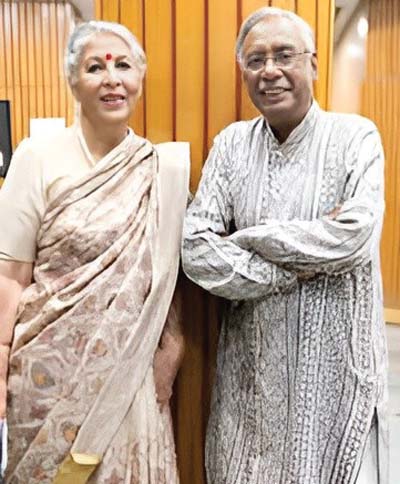 I see a complete intellectual and academic honesty in this writing. That when he is writing from this point of view, he puts all his strength, all his knowledge, all his logic, all his rationale for this character. And on the very next page, the other character speaks and then he is that loyal, totally loyal to that character also, which is a rare quality.
For that, first of all, you need a writer’s integrity, besides that you need complete control over the topic or the subject of the matter, that you can play from both ends. This is marvelous and I congratulate you for this achievement. It’s a book that, I’m not a great scholar, but I don’t think I’ve read any book of this kind.
It is its own genre because novels are generally dependent on incidents. This novel is not interested in incidents. Incidents are not the major issue. There is only one incident and then we talk about it. It is about ideas.
Now it can be monotonous, it can be dry, it can be boring, it can be preachy. But as a lady said, I also read this book in one go because the argument is holding you. The ideas are holding you. Is he right? He sounded so convincing, so let’s see what the other person says. And then again you are hooked. So, this is one book that I have felt that hooks you by thoughts, not by unexpected incidents.
Yes, towards the second half and to be precise, the second half of the second half, has some very unexpected twist but that is for you to read.