One man’s view of how an Army vision, shaped over four decades, earned global recognition.
Introduction: When the World Took Notice
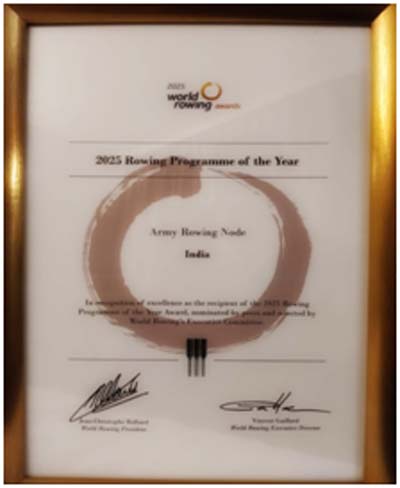 Some achievements announce themselves loudly. Others arrive with quiet inevitability, after years of effort that few outside the system notice. The World Rowing Programme of the Year Award for year 2025 bestowed upon the Army Rowing Node (ARN), Pune at Lausanne, Switzerland by World Rowing on 24 Jan 2026, belongs firmly to the latter category. The World Rowing does not reward sentiment. Its Programme of the Year honour evaluates sustainability, governance, training methodology, coaching depth, athlete welfare, and international relevance. The Army Rowing Node met these benchmarks with quiet consistency. What impressed the world was not just medals, but method—a developing nation building a rowing ecosystem patiently, purposefully, and without compromise.
For those who have watched Indian rowing grow from tentative beginnings to international respectability, this moment carries deep resonance. I have seen it grow—from the early stirrings of the 1980s to the structured excellence of today.
Rowing in India: Against the Current
Rowing has never been an easy sport for India. It demands specialised water bodies, expensive equipment, scientific coaching, and above all, time—time to build technique, endurance, and trust. For years, the sport existed on the fringes, sustained by scattered enthusiasm and limited exposure.
Yet rowing also mirrors some of the finest military virtues: endurance, teamwork, rhythm, resilience, and quiet resolve. What the sport lacked was not talent, but institutional belief. That belief would come from an organisation accustomed to thinking in decades, not seasons.
Army’s First Strokes in Rowing
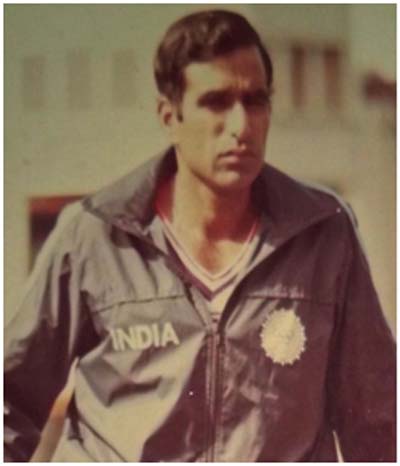
The first Bronze medal, won at the Asian Games by P. K. Oberoi, Amin Naik, and D. Tomar – all three young Army officers, marked a quiet but decisive turning point in the history of Indian rowing. Achieved on home waters in 1982, the medal transformed rowing from a sport driven largely by aspiration into one anchored in belief. It demonstrated that Indian crews could not only compete internationally but also stand on the podium through discipline, preparation, and teamwork. More than a bronze, it was a shift in mindset—strengthening institutional confidence, attracting serious attention, and setting Indian rowing irreversibly on the path from participation to performance.
P K Oberoi’s contribution to Indian rowing is best understood through the rare continuity of his recognition and responsibility. His coaching excellence, acknowledged through national honours and culminating in his nomination as the National Coach. He instituted a coaching philosophy that shaped generations of rowers and laid the technical and cultural foundations upon which later national and international achievements were built.
Rowers Who Defined an Era
The early push to introduce rowing as a serious Army sport required vision and conviction. Vishwambhar Singh- a national champion in single sculls for several years, and Ajay K Chaturvedi, exemplified this blend of belief and performance. Both rose to become Generals later in their careers. Then came R S Bhanwala and G S Sohal, who probably were the last lot of officers, as rowing started getting more competitive requiring total time and commitment. Behind these names stand generations of Army rowers—men who trained before dawn, raced without fanfare, and accepted that service to sport was also service to the nation.
One of the most significant shifts I witnessed was the transition from officer-rowers to soldier-athletes, many of them drawn from the Corps of Engineers. This change brought continuity, physical strength, and long-term commitment to the sport. The moment that truly changed Indian rowing came in 2000, when Inder Singh and Kasam Khan represented India in Coxless Pair at the Sydney Olympics. Watching them compete on the world’s biggest stage, it was clear that Army rowing had crossed a threshold—from hopeful participation to credible international presence.
These formative years were not about medals. They were about persuasion—convincing commanders, attracting athletes, and proving that rowing deserved a permanent place in the Army’s sporting ecosystem.
The Army Rowing Node Takes Shape
The formal inception of the Army Rowing Node in 2001 marked the transition of Army rowing from an inspired effort into a structured institution. What had begun as a belief-driven initiative was now anchored in permanent infrastructure, defined training systems, and long-term planning. Over the years, the Node evolved into a centre of excellence where selection, coaching, performance analysis, and athlete welfare were treated with equal seriousness. As it approaches its Silver Jubilee in 2026, the Army Rowing Node stands not merely as a training facility, but as a mature sporting institution—one that has shaped generations of rowers and quietly prepared India for sustained presence on the international rowing stage.
Building the Impossible: The Army Rowing Channel
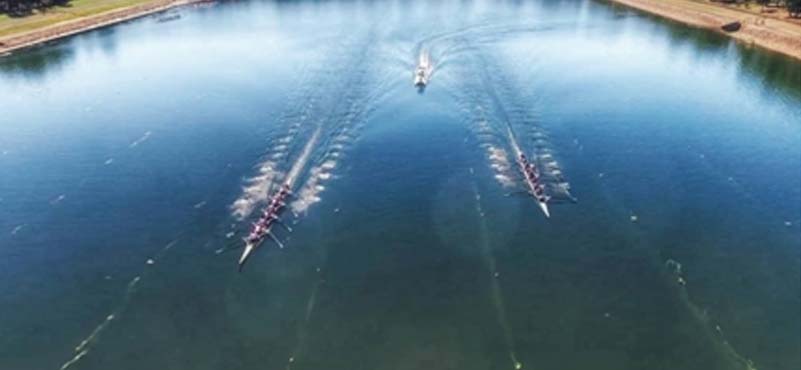
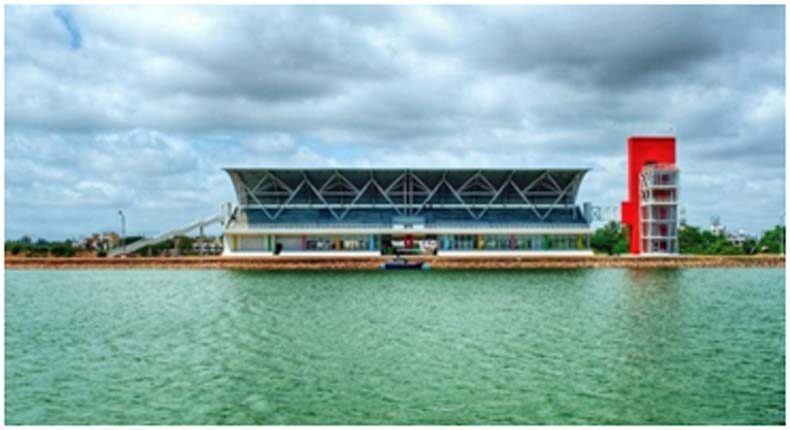
Every enduring sports programme rests on uncompromising infrastructure. For Indian rowing, the decisive moment came with the construction of a world-class rowing channel at Pune, within the campus of the College of Military Engineering (CME). Under the persuasive leadership of Lt Gen B S Dhaliwal – the then Commandant CME, the Army undertook a task few civilian institutions could attempt. This was not merely construction; it was strategic engineering—addressing water management, lane uniformity, safety, and international compliance with precision. It stretches over 2200 m, is 135 m wide, and accommodates eight competition lanes with two additional service lanes. It is one of the best in Asia. The channel did more than host regattas. It changed belief, offering Indian rowers a training environment comparable with the world’s best.
Honours Earned, Confidence Affirmed
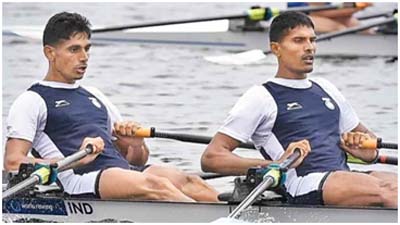
Army rowing’s journey has been richly validated at home through a rare combination of awards and performances. ARN has contributed to over 375 national medals and over 100 international medals. Fifteen Army rowers have received the Arjuna Award, while excellence in coaching and mentorship has been recognised with two Dronacharya Awards and one Dhyan Chand Award, affirming the programme’s depth and continuity. On the water, these honours were matched by performances that lifted national confidence. India’s finest Olympic rowing result came at the Tokyo Olympics in 2021, where Arjun Lal Jat and Arvind Singh reached the semi-finals of the lightweight double sculls. These achievements signalled that Indian Army rowing had not only earned respect—but had arrived with authority.
Strategic Significance and the Way Ahead
Beyond sport, ARN offers lessons in nation-building. It demonstrates how military institutions can nurture Olympic disciplines, how infrastructure must be planned for decades, and how excellence emerges when process is valued over publicity. The World Rowing award is not a destination. It is a marker. The road ahead lies in deeper talent pipelines, hosting international regattas, and sharpening Olympic focus.
For Indian rowing to translate institutional excellence into sustained international success, governance reforms will be as critical as training standards. Over the past four decades, the Rowing Federation of India has often been viewed as insufficiently aligned with the spirit of the National Sports Development Code, particularly in terms of tenure, transparency, and representative decision-making. This has led to a persistent anomaly: while nearly 100 percent of Indian Rowing Team constitutes rowers from the ARN after being nurtured through rigorous training, their institutional experience and perspectives remain largely absent from key selection and policy forums. Addressing this imbalance—through timely intervention and reform by the Sports Authority of India and the Ministry of Youth Affairs and Sports—could unlock far greater competitive potential. A governance structure that reflects performance realities on the ground would not only strengthen trust but also allow Indian rowing to convert its exceptional training ecosystem into consistent podium finish at the international level.
Conclusion: A World Moment, A Lasting Legacy
The Army Rowing Node’s world moment did not arrive by chance. It arrived because vision was protected, discipline was enforced, and will did not waver—even when recognition seemed distant. For those who have watched this journey unfold since the 1980s, the award feels less like a surprise and more like justice. The oars kept moving. The water remained patient. And the will—collective, institutional, and human—finally met the world’s gaze.
ABOUT THE AUTHOR
 LLt Gen Rajeev Chaudhry, a former DGBR, is a writer and social observer. He also pursues his passion for the creative arts in his free time.