No where else are sands shifting as much evident and impacting the business as in the world of Indian aviation. Amidst all the buying frenzy, a thousand aircraft on order, among the highest the world over, the new cluster of airports around the country, with at least two mega airports opening in Delhi and Mumbai, we are going through an extraordinary churn at the top, in the country’s top two airlines.
Coincidence, you would say, as both have their own issues, coming to a head around the same time. Among the fastest growing aviation centres globally, India is witnessing a tectonic shift in management of both Indigo and the Air India combine.
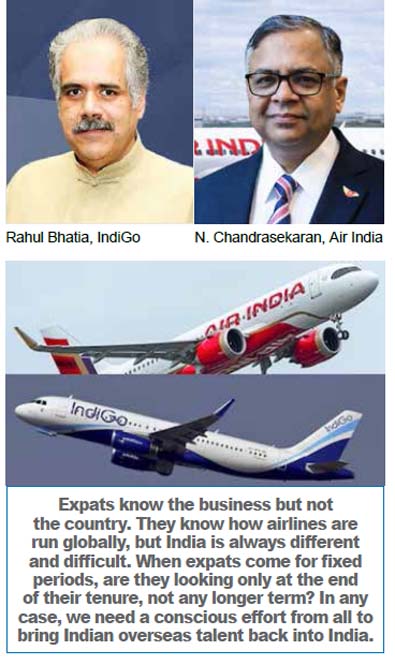
Let us take Indigo first. The CEO, Pieter Elbers, has quit, though he was seen as going, but not so soon. Remember the October Indigo meltdown that saw hundreds of flight cancellations, a lakh of customers stranded, simply because the airline failed to meet the FDTL rules. Sources now say, it was the inevitable result of a management style that Pieter had perfected over time. He had become a single power centre within the airline, and ironically also became inaccessible. Result: decisions were delayed and often when taken, they were only what he wanted. No discussion, just his word for it. Soft touches, nothing untoward, but it had all become all about Pieter only. He also went on an ego trip, preferring to prop his own persona and clearly missing promoting the airline. He was now playing favourites, cultivating sycophancy to professionalism. That too in an airline that had been built on trust, openness in decision making, cultivating talent. Remember, the same airline made Aditya Ghosh its CEO, when he was only 32. Rahul has always prided on keeping a hands-off from daily operations.
Not to take away the credit to Pieter for also having steered the airline to its present-day success. He knew his job, and well. And he did execute as well. It is also a fact that often, while dealing with expats, the Indian psyche leads them to start picking favourites, as there are adequate number of sycophants around, keen to get into the incumbent’s good books.
The fiasco was only waiting to happen, and it did. This is when matters came to a head, only a matter of time that heads had to roll. In the interim, the MD has assumed the role of CEO. Incidentally, he is fast recovering from a recent injury; in fact, he was out of the country when the October incident took place. And, now a replacement is being found. Some say, an announcement could be imminent.
The Air India Group
Now let us take the Air India group. Both the CEOs are said to be coming close to their tenures, both are not being renewed or the present incumbent is preferring to let go. The case of Air India is different and also more fundamental. The airline has made some strong and determined efforts to turn around what was an ailing and perhaps sinking organization. Not an easy ask.
The merger of Vistara with Air India is still being debated. How wise was the speed with which it was executed. Over time, sources say the airline group has got mired in a clash between cultures. There are the old Air India hands, some from TCS and from Tata Services, others from Air Asia that the company acquired, and yet others from other airlines like Indigo. Between these groups, accountability often tends to suffer; in fact, some consider the present CEO more institutional with many decisions being taken elsewhere. Meanwhile, the losses are mounting, never mind the deep pockets, somewhere these losses will start hurting. Observers point out how specialised the airline business is, no matter how much outsiders may be well qualified, it’s not the same IT across verticals, for example. Circumstances also do not favour a quick turn-around, with one challenge after another. The air crash made matters worse, not to mention the closure of airspace over Pakistan, and now the Iran-Israel war, which is witnessing more flight disruptions and rising oil prices.
In India, do as the Indians do!
Alongside, we find Akasa Airlines, the newer player in the business, performing well, to say the least. Steady, growing in comfort, the same that they deliver in the air when you fly them. A good product, seamless, just as much as the common haircut you will witness all male attendants enjoy on board service. No foreigners, all hands are Indian.
 Which brings us to the critical question? Why this fascination for foreign CEOs? Admittedly, they have an exposure that working within India will not provide. The scope and size of airlines business overseas is legendary, unlike as in India, where the track record over the few decades has been dismal. Forget the Air India of old, or the Indian Airlines in the years gone by. Amongst all the airlines that came and went, few were able to sustain any kind of talent, leave alone nurture. There is a crisis at the top, when it comes to looking around for talent. Going overseas, when scouting for expat talent, is almost mandatory. Not to say, there is little or no talent within India. There aren’t hundreds but yes there would be dozens, if only spotted and cultivated. An Indian line up is essential if we have to grow this business, which we must, given the huge investments being made in it.
Expats know the business but not the country. They know how airlines are run globally, but India is always different and difficult. When expats come for fixed periods, are they looking only at the end of their tenure, not any longer term? Is their vision often restricted to their own nose, nothing beyond. Understanding the geography of the country, the extensive untapped network, the psyche of the Indian traveller, not to mention the diverse stakeholders that you must navigate, each in itself a hurdle waiting for you to get trapped! Do they all have a long-term commitment, which is what Indian aviation needs. Of course, there are variables that are possible in the system. Having a CEO, assisted with a council of major stakeholders to advise and ensure course corrections, accountability for every action and different layers to ensure that we learn from global experiences and yet embed them into the Indian system.
In the early days of foreign hotel chains coming into India, at one time, appointing a foreigner as general manager was not permitted. Yet, the foreign chains wanted their own people to manage. The answer was found in appointing them as vice-president – technical, with an Indian as general manager. The expat ran the hotel with the GM as the face.
Understanding India and Indians is not always easy, and an easy way out emerges not friendly in the long run, where an inner group develops, comforted within its four walls bonding on mutual admiration. This can prove disastrous for any organization, no matter in whichever domain it functions.
The bigger picture is buoyant and promising, as India remains one of the biggest growth areas in aviation globally. There is no looking back for Indian aviation. It is also a service industry and thus a people business. Harnessing talent at all levels is a challenge that the industry must accept. For starters, we need a conscious effort to recognize this absence and work towards filling in this vacuum, as it affects us all.
ABOUT THE AUTHOR
 For over five decades, he has observed, reported and commented on India’s evolving story in travel, aviation, tourism and hospitality. He has edited titles like City Scan, Travel Trends, and India Debates.
Blogs at: https://www.csconversations.in/nb-blogs