
Introduction
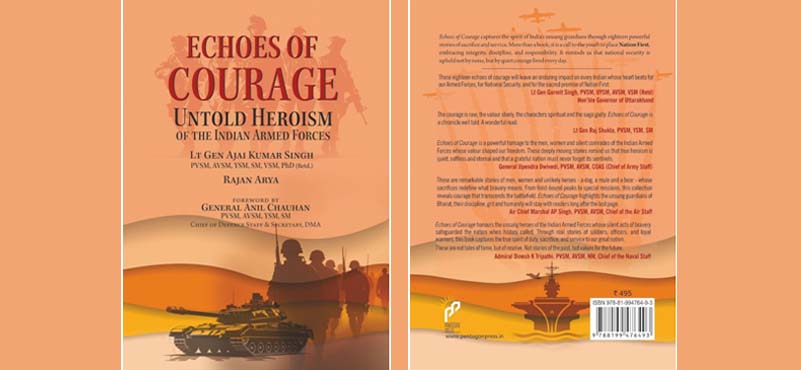
Echoes of Courage: Untold Heroism of The Armed Forces by Lieutenant General Ajai Kumar Singh (Retd) and Rajan Arya is an interesting compilation of the lesser known stories of valour and honour about the Indian soldiers, airmen and sailors. In the profession of arms, courage is a way of life sustained by discipline, conviction and an unwavering sense of responsibility. There is power, strength and resilience in words which puts these down in writing.
Through a collection of narratives spread across the length and breath of the country the book brings to light lesser known stories of those who stood firm against undaunting odds and took decisions putting the interests of the country above all. It includes men and women, those in combat and intelligence operatives as well as animal warriors; people whose loyalty and sacrifice became inseparable from their tasks.
When the country chooses a soldier to wear the uniform it also bestows a great sense of responsibility on that person. In the course of their tenure while discharging their duties they get posted to various parts of the country and are often faced with challenging tasks resulting in great experiences. There are many stories of valour and honour which are well known but there are also some which are relatively unknown outside the military circles.
This book aims at gleaning out some untold stories and bring them to a wider audience. It is not merely a collection of stories but a tribute to the bravery and the ethos of service that sustains the nation. How by the nature of their chosen profession, men and women in the Armed Forces stand apart?
About the Book
The book has been published by Pentagon Press which over the years has matured into a platform between the soldier and the citizen, a forum where courage finds its voice and knowledge becomes a national strength.
Major Onkar Singh Kalkat was the Brigade Major in Bannu in the NWFP soon after partition in 1947 when he came across the Top-Secret plan for Operation Gulmarg. The plan to invade the Princely State of Jammu and Kashmir was issued on 20 August 1947. He was shocked but decided to act normally and in the dead of the night he and four Sikh soldiers who were posted there decided to dress as ordinary villagers and make their way to Delhi armed with this knowledge to forewarn the Indian Army hierarchy. No orders, he just acted by his conscience and sense of duty and patriotism. The powers to be were forewarned.
Colonel Narendra ‘Bull’ Kumar is another legendary figure. An outstanding mountaineer he was the Commandant of the High Altitude Warfare School in Gulmarg. It was he who discovered that the Pakistani’s were sponsoring mountaineering expeditions in the Siachen area. He then led an expedition to the Saltoro Ridge to gather evidence, photographed Pakistani climbing activity and prepared ‘accurate Indian maps’ at altitudes between 16,000 to 20, 000 feet where breathing is difficult. His efforts led to India occupying the Glacier in April 1984. If ‘Bull’ Kumar had not been there, they may have been no ‘Operation Meghdoot’ and Pakistan could have occupied the icy heights. He discovered the strategic vulnerability and Pakistan’s creeping attempts to occupy it.
1967 stands out for the manner in which the Indian Army took on the Chinese in the heights of Nathu La and Chola in Sikkim. Troops of 7/11 Gorkha Rifles under Lieutenant Ram Singh Rathore had taken over Point 15450 a day earlier. In this region the boundary cuts through a huge boulder named ‘Black Rock’. It was here where a Chinese soldier thrust his bayonet into the shoulder of an Indian soldier due to a scuffle that arose as a result of the Chinese soldier kicking away the boot of Naib Subedar Gyan Bahadur Limbu as he rested his foot on Black Rock.
The Chinese opened up with automatic fire the Gorkhas responded with courage beyond reason. during the ensuing battle, Rifleman Devi Prasad Limbu pulled out his Khukri and charged into the Chinese trenches alone cutting down enemy soldiers with fierce fearless strikes till he collapsed in the enemy trench his Khukri still warm with enemy blood. A young rifleman, who when the moment came, rose higher than the mountains he defended. The Chinese acknowledged his bravery.
Rifleman Dhan Bahadur Rai also of 7/11 Gorkha Rifles was deployed in Chicken’s Neck in J&K during the 1971 War and is probably the only documented case of a soldier bringing down a supersonic aircraft with his Light Machine Gun. The Pakistani pilot Flight Lieutenant Wajid Ali Khan confirmed this unbelievable truth. Dhan Bahadur had done the impossible, his heroic act has become a part of Military History. Heroes are not born they are made in moments of choice.
Lieutenant Colonel Poonam Sangwan, an AOC officer, was part of the Indian Army on Everest expedition in 2012, where she successfully summited the mountain. She wasn’t climbing for personal glory, she climbed for her unit and the Indian Army and the nation. When she reached the summit and unfurled the Tricolor in a frozen world, she realized she pushed her body to the edge of human endurance. Climbing past every limitation, her courage became the nation’s inspiration.
Another legendary story is that of Baba Harbhajan Singh. A soldier of 23 Punjab, who died while out on patrol in Sikkim in October 1968. He fell into a rivulet and was swept away, his comrades searched for him for three days, but didn’t find him. On the third night he appeared in the dream of his colleague Pritam Singh and told him the specific spot where his body lay under snow. Today his mandir is a three-room structure, his bed is made, shoes polished and uniform neatly pressed. All those posted in that area seek the blessing of this guardian.
Naib Subedar Chunni Lal is one of the most highly decorated soldiers of the Indian Army. A Sena Medal in Siachen when he was part of the assault on Qaid Post alongwith Naib Subedar Bana Singh. A Vir Chakra in counter terror operations in 2000 in J&K and an Ashoka Chakra in Kupwara in 2007. He was a man who always stepped forward and became immortal in duty.
Zafar-4 is the tale of an Indian spy in Pakistan during the 1971 war. He put his life at stake, shunned the limelight but plodded on silently with torture and death constantly on his mind. He believed in doing what he did without flinching.
Flight Lieutenant Dalip Kumar Parulkar was a Sukhoi-7 pilot in the 1971 War. Shot down over Pakistan he was taken a Prisoner of War. His is a legendary story of escape from the Camp in August 1972 along with two other pilots Flight Lieutenant MS Grewal and Flight Lieutenant Harish Sinhji as the negotiations for their release were becoming intolerable. They nearly made it to Afghanistan when they were caught. ‘They may not have made it but they did try’. He demonstrated that you can still fight when all odds are against you.
Lieutenant Commander Firdaus Darabshah Mogal was commissioned into the Indian Navy in January 1998. In February 2010 while serving as the Executive Officer on INS Shankush; Firdaus was instrumental in saving the lives of three seamen who had got washed into the sea due to the waves while they were carrying repairs to their submarine in the middle of the ocean. Unfortunately, nature’s fury never spared the brave sea warrior and he passed away due to injuries sustained when his head was smashed against the submarine but only once he had saved the lives of the other five divers and survivors. Time will never be able to erase his memory and legacy of exceptional fearlessness and devotion to duty.
Major Ashok Tara of 14 GUARDS was instrumental in saving the lives of the family of Sheikh Mujibur Rehman when they were under house arrest in December 1971. The ‘right man for an impossible task’. When we speak of the 1971 War, we should also remember the scene in the house in Dhanmondi, a frightened family, a group of defeated soldiers, and an Indian Major saying it’s over, come out, you are safe.
There are many more stories which include that of Captain Anuj Nayyar, who was awarded the Maha Vir Chakra in the Kargil War. Brigadier Navin Kumar Maini, who rose to the occasion on the night of 02 December 1971 and saved many lives during the Bhopal Gas Tragedy. Badlu Ram’s story which has been immortalized by the Assam Regiment. Soldiers have an unsentimental way of expressing gratitude, they don’t write odes they simply write marching songs. The ghost of Lansdowne is another remarkable anecdote that revolves around the Garhwal Rifles Regimental Centre. That reminds one that commitment to duty never dies and that sacrifice however small or insignificant leaves permanent footprint.
There are three touching stories about animal warriors. Mansi, a dog, who in August 2016, in Kupwara charged towards the bushes barking wildly with her sound penetrating the dense mist. Though shot by the terrorist in the bushes she continued charging till she died. She, and her handler Bashir, had foiled an infiltration bid and saved the lives of their patrol. Sepoy Bashir Ahmed War was awarded the Sena Medal posthumously and Mansi was Mentioned in Dispatches. They were both buried side by side.
Pedongi was a mule who served in 1962 in Walong in Arunachal Pradesh where she was awarded the Vir Chakra. While in 1971 she was on the Western Front. Captured by Pakistani troops during the war, she was being used by them to transport goods, when one day she simply walked across the no man’s land into Indian territory carrying a Pakistani Light Machine Gun and ammunition. Bahadur is the story of a bear who bonded with soldiers and became a source of joy for the men while posted in the high Himalayas.
Conclusion
In the present era characterised by technology people tend to view warfare through the prism of weapon systems, machines and algorithms. While this undoubtedly shapes modern conflict but the soldier stands tall with his courage both physical and moral, dedication, commitment and ethical judgement. The decisive element remains human.
Each of the eighteen stories in the book is about grit and perseverance against all odds but at the same time they are of ordinary men who have risen to the occasion regardless of the circumstances and outcomes. Remarkable stories of men, women and animals who have redefined what bravery means.
As the Chief of Defence Staff General Anil Chauhan wrote in his foreword; ’ courage is often spoken about in moments of triumph , yet its truest expression is revealed in silence- when duty demands action without promise of recognition , when fear must be mastered without witness and when duty continues despite personal cost’.
Echoes of Courage is a powerful testament to this enduring truth. It is truly a book that needs to be read to get an insight into values that shape the character of the Indian soldier, airman and sailor. The book reflects the resolute sprit that defines the Indian Armed Forces.
ABOUT THE AUTHOR
 Major General Jagatbir Singh VSM, (Retd), has held various command, staff and instructional appointments and served in varied terrains in the country. He has served in a United Nations Peace Keeping Mission as a Military Observer in Iraq and Kuwait. He has been an instructor to Indian Military Academy and the Defence Services Staff College, Wellington. He has commanded the prestigious 1 Armoured Division. He is a prolific writer in defence& national security and is a Distinguished Fellow at USI.