
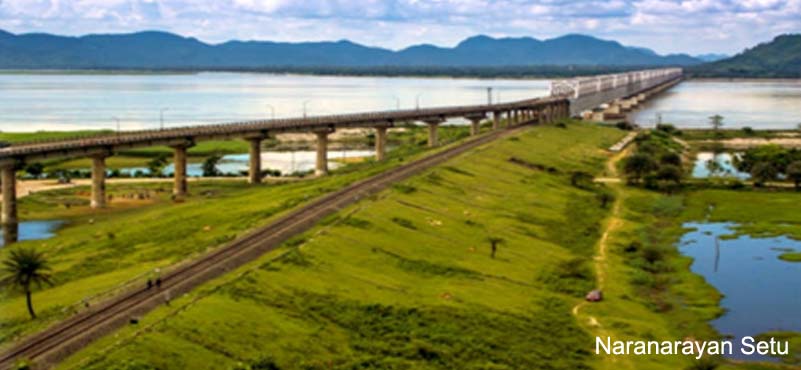
For much of independent India’s history, the North Eastern Region (NER) was treated as a distant frontier—strategically sensitive, administratively complex, yet economically peripheral. Geography, Colonial legacies, Partition, Insurgency, and Institutional neglect combined to make infrastructure both scarce and fragile. Over the last decade, however, the North East has entered a decisive transition. Connectivity is no longer episodic or symbolic; it is structural.
At this crucial juncture, there is a compelling need to understand North East first as a strategic instrument of national power, second as an enabler of economic integration, and only then as a conventional development sector. Using this strategy-first lens, the article examines the historical context, the present status of infrastructure across sectors, the tangible impacts already visible on the ground, and a focused policy roadmap to convert connectivity into long-term competitiveness, resilience, and geopolitical leverage.
STRATEGY FIRST: Infrastructure as National Power
At Independence, India inherited in the North East an infrastructure system designed by the colonial state for extraction, surveillance, and control—not for integration. Riverine trade routes linking Assam to East Bengal were severed by Partition. Railways terminated abruptly at newly drawn borders. Traditional economic flows collapsed overnight, while administrative attention shifted inward toward the heartland.
The subsequent decades were marked by insurgency, political instability, and a security-first governance paradigm. Infrastructure came to be viewed less as a development multiplier and more as a vulnerability—something that could be sabotaged or exploited. Roads were thin, railways remained Assam-centric, air connectivity was sparse, and power and digital networks lagged far behind national averages.
This long neglect imposed three cumulative national costs: strategic fragility along sensitive borders, persistently high logistics costs that discouraged investment, and a psychological distance between the region and the Indian mainstream. Infrastructure deficit thus became not merely a regional issue but a national liability.
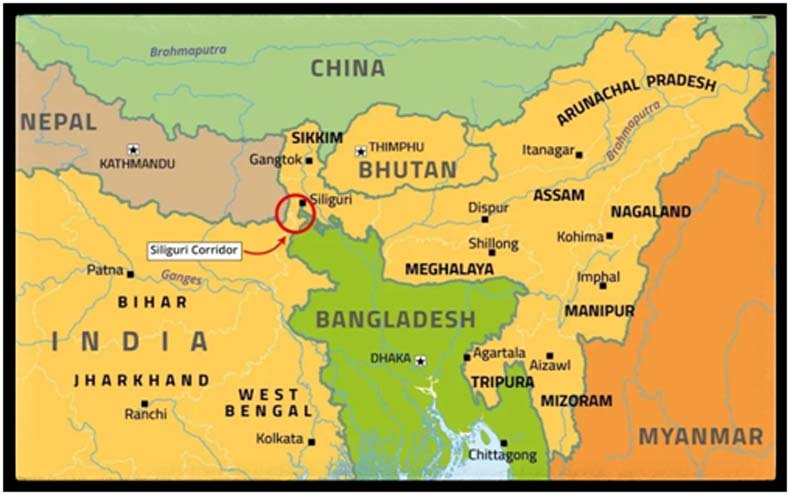
- Geography as Destiny—and Opportunity. The North East accounts for over 40% of India’s land borders while comprising barely 8% of its landmass. It abuts China, Myanmar, Bangladesh, and Bhutan, and sits astride India’s natural land bridge to Southeast Asia. Yet it remains connected to the Indian mainland primarily through the narrow Siliguri Corridor. Any disruption—natural or man-made—exposes systemic vulnerability.
- Mobility and Modern Conflict. Contemporary military doctrine places a premium on speed, flexibility, and sustainment. Static deployments without assured mobility are strategically brittle. Roads, tunnels, bridges, rail lines, airfields, and logistics hubs in the North East are dual-use assets: economic enablers in peacetime and force multipliers in crisis. Infrastructure determines whether the State arrives in hours or days—and that difference shapes legitimacy.
- Act East: From Rhetoric to Hardware. India’s Act East policy cannot be sustained on diplomatic intent alone. Trade corridors, logistics chains, and cross-border infrastructure are the hardware that gives policy credibility. The North East is not India’s periphery to Southeast Asia; it is India’s gateway. Infrastructure converts geography from burden to advantage.

THE STRATEGIC SQUEEZE: Geometry of Constraint
Infrastructure planning in India’s North Eastern Region cannot be viewed in isolation from its immediate strategic environment. The region sits at the intersection of four interlinked geographic and political realities: China’s infrastructure posture across the Tibetan plateau to the North, Myanmar’s instability to the East, Bangladesh’s evolving political dynamics to the South, and the Siliguri Corridor to the West. Together, these form a single strategic system that shapes both the vulnerabilities and imperatives of infrastructure development in the North East.
- China Contrast: Infrastructure as Strategic Signalling. Across the Line of Actual Control (LAC), China has treated infrastructure not as a developmental afterthought but as an explicit instrument of State Power. High-altitude highways, rail extensions, logistics hubs, and dual-use airfields on the Tibetan plateau have compressed mobilisation timelines and altered the tactical balance. The contrast is instructive. Where China builds redundancy, India historically accepted scarcity; where China planned infrastructure for worst-case scenarios, India optimised for peacetime budgets. The recent acceleration in the North East represents a conscious strategic correction to ensure that infrastructure asymmetry does not translate into strategic vulnerability.
- Myanmar: Imperatives of Prolonged Instability. To the East, Myanmar’s prolonged instability constrains India’s ability to fully operationalise its Eastern connectivity vision. Projects such as the Kaladan Multi-Modal Transit Transport Project, anchored at Sittwe port, are strategically sound attempts to create external redundancy and maritime access to the North East. However, internal conflict, governance breakdown, and security risks inside Myanmar have delayed execution and reduced predictability. This reinforces a core strategic reality: external corridors are valuable supplements, but unreliable as sole alternatives. Parallel to this, the evolving approach toward fencing and regulated movement along the Indo-Myanmar border reflects a necessary recalibration. While traditional free-movement regimes suited a different security environment, contemporary challenges—cross-border militancy, narcotics trafficking, arms flows, and demographic pressures—demand clearer territorial control without severing ethnic and cultural linkages. Together, calibrated border management and projects like Sittwe signal a maturing strategy: one that balances connectivity with control, engagement with resilience, and regional integration with national security.
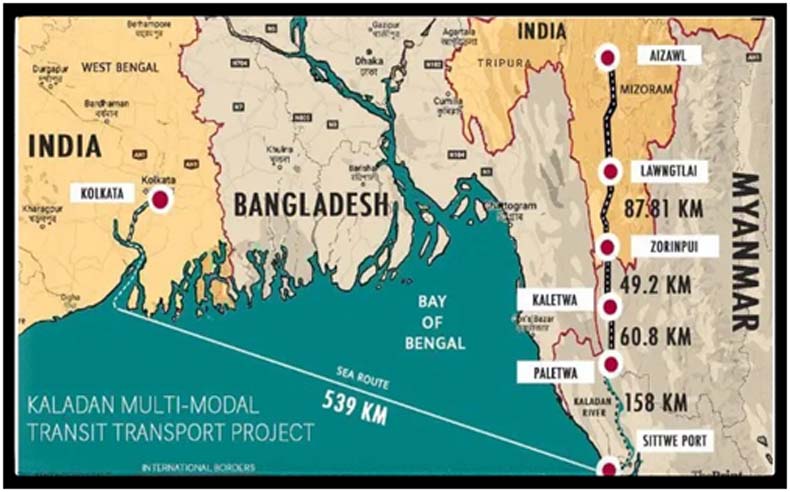
- Bangladesh: Political Uncertainty. To the South, Bangladesh has historically functioned as the most efficient transit partner for the North East, offering access to ports, inland waterways, power trade, and shorter logistics routes. Recent political uncertainty or policy recalibration in Dhaka therefore has immediate spill-over effects on North East infrastructure assumptions. When transit predictability weakens, freight and logistics loads revert back to the Siliguri axis, intensifying pressure on an already saturated corridor and exposing the risks of external dependence.
- Siliguri Corridor: The Stress Point. At the vortex of this system lies the Siliguri Corridor—a narrow, overburdened land bridge that connects the North East to the Indian mainland. Its geographic fragility, exposure to environmental disruption, and proximity to multiple borders make it a structural vulnerability rather than a mere logistical inconvenience. Any disruption—natural or strategic—would not simply slow movement but temporarily fracture national connectivity. Overdependence on this corridor therefore magnifies risk and compresses decision-making space in crises.
Seen together, these four elements form a triangular-plus-core constraint system. China alters the strategic balance through infrastructure-driven mobility; Myanmar limits Eastern optionality; Bangladesh injects uncertainty into Southern transit assumptions; and Siliguri absorbs the cumulative stress. The strategic response cannot be reactive or episodic. It must be systemic. The only durable answer is redundancy through internal resilience.
The SILIGURI CORRIDOR: Strategic Logic of Redundancy
Historically, India managed the Siliguri vulnerability through a mix of political restraint, static force deployment, and acceptance of risk. That approach is no longer sufficient. Modern strategy favours redundancy over reliance, dispersion over concentration, and assured mobility over static control. The answer to Siliguri is therefore not fortification alone, but the deliberate construction of multiple, credible, and interoperable connectivity alternatives that dilute its singular importance. This redundancy must be multimodal.
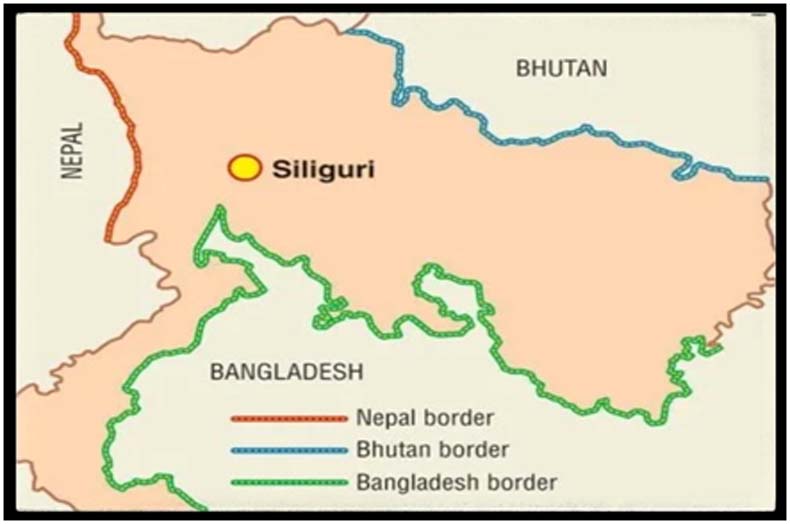
The Siliguri Corridor
The Siliguri Corridor—often termed India’s ‘Chicken’s Neck’—is not merely a geographic bottleneck; it is a strategic stress point. Overdependence on a single narrow corridor magnifies vulnerability to disruption, whether by natural disasters, accidents, or hostile action. Infrastructure development in the North East must therefore be judged by one overriding criterion: does it create redundancy? Rail links to multiple state capitals, expanded aviation networks, inland waterways on the Brahmaputra, and alternative road alignments collectively reduce systemic risk. Redundancy is not inefficiency; in strategic terms, it is insurance.
Equally vital is the internal cohesion of the North East itself. The stronger the East–West and North–South connectivity within the region, the lower the strategic shock of any disruption at Siliguri. Infrastructure must therefore be conceptualised as a network, not a corridor—where the failure of one link does not paralyse the system. Multimodal logistics hubs at nodes such as Jogighopa and Silchar acquire strategic significance precisely because they distribute risk and create optionality.
The deeper strategic principle is clear: resilience is cheaper than recovery, and redundancy is cheaper than coercion. Infrastructure redundancy does not signal weakness; it signals strategic maturity. By reducing overdependence on the Siliguri Corridor, India lowers escalation pressure in crises, enhances deterrence through assured mobility, and converts a historical vulnerability into a managed risk. The objective is not to make Siliguri irrelevant, but to ensure that it is no longer indispensable—for in strategic planning, indispensability is vulnerability, while optionality is power.
STATUS: The Backbone Taking Shape
- Roads and Highways: Engineering the Edge. The Special Accelerated Road Development Programme for North East (SARDP-NE) marks the most ambitious road intervention ever undertaken in the region. Nearly 6,000 kilometres of national highways now provide near-universal connectivity to state capitals and major district headquarters. This represents a historic break from decades of incrementalism. Border areas that earlier required days of travel are reachable within hours. Emergency response capability has improved markedly. Yet the challenge has shifted. Maintenance, not construction, is now the defining issue. The strategic task is to convert roads from mere assets into all-weather services.
BRO and Dual-Use Roads: Engineering Deterrence
The Border Roads Organisation (BRO) occupies a unique place in India’s strategic infrastructure ecosystem. Operating in some of the world’s most inhospitable terrain, BRO roads are designed for dual use—supporting civilian mobility in peacetime and rapid military movement in crisis. In the North East, BRO has not only expanded the road footprint but also reduced construction timelines through modular bridges, improved tunnelling support, and innovative contracting. These roads quietly underpin deterrence by ensuring that forces, supplies and relief can move at speed. Their value lies less in visibility and more in reliability under stress.
- Railways: Steel Corridors of Integration. Rail expansion into the North East is slow, expensive, and strategically irreversible. Projects linking Aizawl, Imphal, Kohima, Shillong, and Gangtok to the national network will permanently alter economic geography and defence logistics. The Amrit Bharat Station redevelopment across 60 stations signals a shift from colonial-era terminals to modern multimodal nodes.
- Aviation: Time Compression. In mountain and border regions, time compression is development. Regional aviation has expanded rapidly, making Guwahati an eastern hub and shrinking distances between capitals. The next challenge is sustainability—right-sized aircraft, predictable schedules, and cargo integration.
- Inland Waterways: Brahmaputra Returns. The Brahmaputra is being rediscovered as a logistics artery. Inland waterways offer the lowest-cost freight option for bulk cargo and provide resilience against road disruption. Their success depends on terminals, multimodal links and assured cargo flows.
- Digital and Power: Invisible but Decisive. Optical fibre, mobile connectivity and grid strengthening are quietly reshaping governance and enterprise. Digital access collapses distance; power reliability determines whether investment follows.
IMPACT: Connectivity Changing the Balance
- Economic Impact: From Isolation to Market Access. Improved connectivity has reduced travel-time uncertainty—a critical determinant of logistics cost. Tourism circuits are expanding, MSMEs are accessing wider markets, and agri-horticultural producers are better integrated into national value chains. The psychological barrier to investment is slowly eroding.
- Social Impact: Presence, Trust and Opportunity. Infrastructure has enhanced the everyday presence of the state. Roads, power, mobile networks, and internet access are experienced by citizens not as abstract investments but as services. This strengthens trust and reduces alienation, particularly in remote and border areas.
- Strategic Impact: Mobility Equals Deterrence. The least visible but most consequential impact lies in strategic mobility. Faster disaster response, improved border logistics, and greater operational flexibility enhance deterrence without escalation. Infrastructure thus becomes quiet power—rarely noticed until it is absent.
WAY AHEAD: From Reach to Resilience
- Redefine Success: Service Levels, Not Kilometres. Infrastructure evaluation must move from assets created to outcomes delivered—corridor uptime, ride quality, and restoration speed after disruption.
- Ring-Fenced North East Infra Resilience Fund (NEIRF). Mountain infrastructure decays faster. Dedicated financing for slope stabilisation, bridge protection, drainage, and emergency restoration is essential.
- Climate-First Engineering in the Eastern Himalayas. Mandate region-specific design standards for rainfall intensity, landslides, floods, and seismic risk. Climate resilience must be designed in, not retrofitted.
- Rail Projects as National Integration Missions. Rail corridors should be managed as national missions with empowered authorities to resolve land, forest, and logistics bottlenecks swiftly.
- World-Class Multimodal Freight Hubs. Jogighopa and Silchar should be developed as benchmark logistics nodes integrating road, rail, waterways, warehousing, and digital freight platforms.
- Sustainable Regional Aviation Model. Shift from symbolic connectivity to sustainable operations through right-sized fleets, cargo integration, and tourism-linked route planning.
- Digital Reliability over Digital Reach. Prioritise uptime, redundancy, and local last-mile service providers to ensure that connectivity translates into daily utility.
- Power Reliability for Growth and Border Districts. Distribution strengthening must be prioritised in industrial clusters, cold-chain corridors, and strategic border nodes.
- Risk-Sensitive Contracting in Mountain Terrain. Adopt balanced risk-sharing, milestone realism, and performance-based maintenance in infrastructure contracts.
- Strategic Use of the 10% North East Budget Mandate. Move from fragmented project funding to integrated regional systems that combine transport, logistics, power, digital, and skills.
CONCLUSION: North East as India’s Strategic Fulcrum
The North East is no longer India’s distant frontier; it is a strategic fulcrum where geography, infrastructure, and national power converge. Over the past decade, India has corrected a historic imbalance by building the physical backbone of connectivity—roads, railways, airfields, waterways, power and digital networks—across one of the most challenging terrains in the world. The strategic task ahead is no longer about reach, but about reliability, redundancy and resilience.
The Siliguri Corridor will remain indispensable, but it must no longer remain singular. Its vulnerability—geographic, environmental and strategic—demands a conscious shift from corridor-dependence to network-based resilience, where rail links, aviation, inland waterways and internal North East connectivity collectively dilute single-point failure. Redundancy here is not inefficiency; it is strategic insurance.
Across the Eastern frontier, Myanmar’s instability reinforces the importance of calibrated external connectivity. Projects such as the Sittwe–Kaladan corridor are not substitutes for internal resilience but strategic complements, offering optionality while anchoring India’s Act East posture. At the same time, evolving border management—including fencing and regulated movement—reflects a necessary balance between connectivity and control in a deteriorating security environment.
Finally, the Chinese infrastructure push across the Tibetan plateau offers a sobering contrast. By treating infrastructure as a tool of mobilisation, signalling and deterrence, Beijing has compressed response timelines and altered tactical equations. India’s acceleration in the North East is therefore not competitive symbolism but strategic correction—ensuring that asymmetry in infrastructure does not translate into asymmetry in options.
If sustained with strategic clarity, the North East will cease to be discussed as a vulnerability to be defended. It will instead emerge as a stabilising asset—economically integrated, strategically resilient, and central to India’s rise as a continental power.
ABOUT THE AUTHOR
 LLt Gen Rajeev Chaudhry, a former DGBR, is a writer and social observer. He also pursues his passion for the creative arts in his free time.