A War That Refuses to Be Short
The war was never meant to last this long.
In Washington’s strategic imagination, this was supposed to be swift—clinical, decisive, almost demonstrative. A calibrated show of force, a shaken adversary, and a new equilibrium imposed before markets could panic and alliances could wobble. Something fast, contained, and politically consumable.
But Iran is not a tactical problem. It is a civilisational power—layered, adaptive, and historically conditioned to absorb shocks rather than collapse under them. What was expected to fracture has instead consolidated.
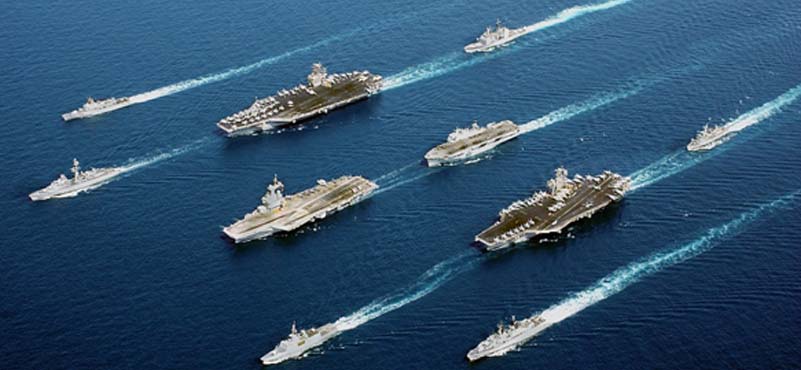
And now, time—once assumed to be America’s greatest advantage—is becoming its primary constraint. Carrier Strike Groups cannot remain indefinitely tied down in contested waters. Military bandwidth is finite. Strategic attention, even more so.
Washington is already juggling anxieties elsewhere—from renewed strategic curiosity around Greenland to persistent sensitivities in Cuba. Beyond that lies the far more consequential theatre: the Indo-Pacific. If tensions over Taiwan intensify, the United States will need flexibility, not fixation.
This is the emerging paradox: a war initiated for speed is drifting into a test of endurance. And endurance, in West Asia, has rarely favoured the outsider.
A Region on Tenterhooks
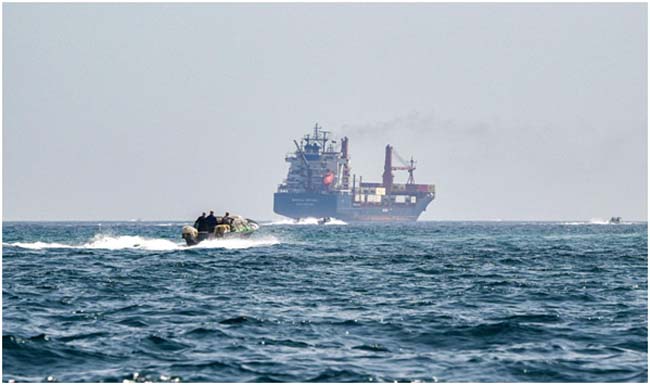
West Asia today exists in a state of suspended instability—not fully at war, yet far removed from peace. Missiles arc across skies with increasing regularity. Proxy networks stir across multiple theatres. Maritime routes—especially through the Strait of Hormuz—carry not just oil, but anxiety.
Energy markets flicker with every escalation. Governments issue advisories. Civilians adapt to uncertainty as a way of life. And yet, despite the intensity, a full-scale war has not erupted. This restraint is neither accidental nor altruistic. It reflects a shared recognition among all actors: escalation beyond a certain threshold would be uncontrollable. The region could slip from calibrated confrontation into systemic conflict—with consequences far beyond its geography.
What we are witnessing, therefore, is not chaos—but managed volatility. A conflict that is active, yet deliberately incomplete. A crisis that escalates—but stops just short of rupture.
Why Total Victory Is a Mirage
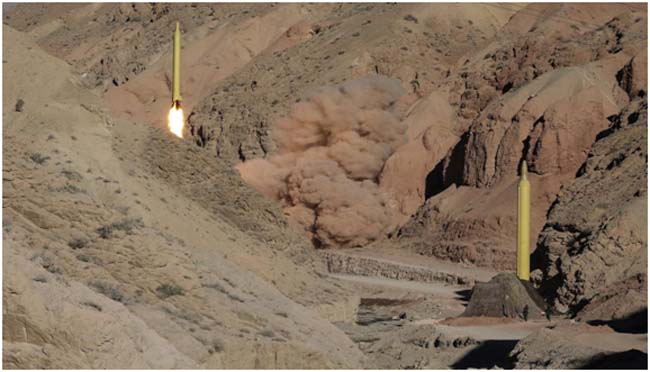
At the heart of this conflict lies a simple but uncomfortable truth: there is no decisive victory available.
- For the United States, overwhelming military superiority does not translate into durable political outcomes. The lessons of the past two decades remain instructive—force can dismantle, but it struggles to stabilise.
- For Israel, tactical brilliance meets strategic diffusion. Iran is not a conventional adversary with a singular command centre. Its influence is dispersed—across geography, ideology, and proxies. There is no definitive endpoint to such a confrontation.
- For Iran, the limitations are equally stark. It cannot win a direct conventional war. It has already activated its 31 Mosaic Provincial Commands which are functioning without central orders. Its strength lies in asymmetry—in prolonging conflict, raising costs, and avoiding decisive engagement.
This creates a rare equilibrium: each actor is capable of inflicting pain, but none capable of imposing closure. And when closure is unattainable, the logic of escalation begins to weaken.
The Politics of Not Losing
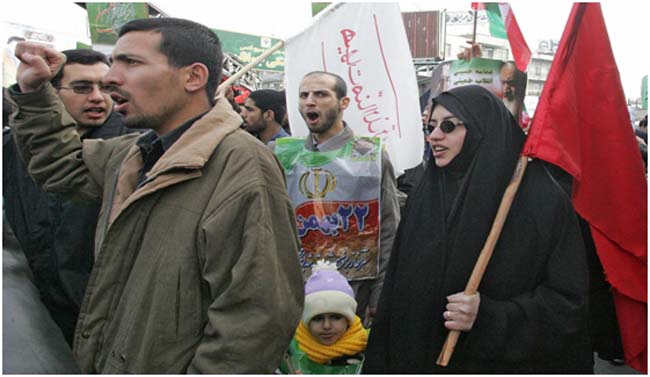
If strategy imposes limits, politics often resists them.
- In Tehran, resistance is not merely a policy—it is identity. The regime’s legitimacy is deeply tied to its posture of defiance. Any visible retreat risks internal erosion.
- In Israel, security is existential. Public confidence depends on visible strength. Even tactical restraint must be framed as strategic control.
- In Washington, credibility operates on multiple levels—alliances, deterrence, and domestic perception. Weakness, or even hesitation, carries political costs.
Thus emerges a shared constraint: no actor can afford to look like it is backing down—even if it wants to.
This transforms the nature of diplomacy.
Compromise cannot be explicit.
Restraint cannot be advertised.
De-escalation cannot look like concession.
Instead, outcomes must be carefully choreographed—
each side appearing strong, even as all step back.
The Strategic Trap of Overextension
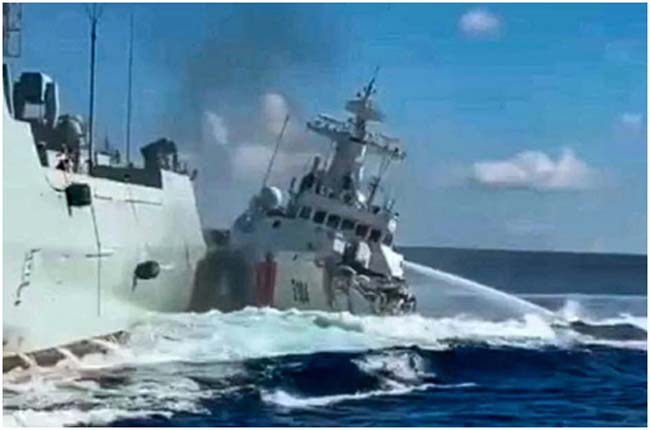
The longer this conflict lingers, the more it risks becoming a strategic distraction with global consequences. For the United States, prolonged engagement in West Asia comes at a cost—not just in resources, but in attention. The world’s geopolitical centre of gravity is shifting toward the Indo-Pacific. Managing China’s rise, securing maritime routes, and stabilising alliances in Asia require sustained focus.
A drawn-out confrontation with Iran dilutes that focus. Military assets tied down in one theatre are unavailable in another. Strategic ambiguity in one region can embolden assertiveness in another.
This is where the stakes expand beyond West Asia. If China perceives distraction or fatigue, it may choose to test boundaries—particularly around Taiwan. In that scenario, Washington’s current commitments could become a liability. Thus, what began as a regional confrontation risks evolving into a global strategic imbalance. And that is precisely why an exit—however imperfect—is no longer optional. It is necessary.
Designing the Least Bad Exit

If victory is unattainable, the only rational objective is exit. But not just any exit—one that avoids humiliation while restoring stability. In conflicts of this nature, the pathway out is rarely dramatic. There will be no grand summit, no sweeping agreement, no singular moment that marks the end. Instead, what emerges is something far subtler: a managed unwinding.
This unwinding typically unfolds in layers.
- The first is visible restraint. The tempo of strikes slows. Targets become less provocative. Public rhetoric softens—not in tone, but in frequency. The conflict begins to recede from headlines, even if it does not disappear.
- The second is operational understanding. Quiet messages are exchanged. Thresholds—once crossed—are re-established. Proxy activity is calibrated. Maritime conduct becomes more predictable. These are not agreements in the formal sense, but patterns of behaviour that signal intent.
- The third is strategic ambiguity. No document is signed. No side publicly concedes. Each retains its narrative: deterrence restored, objectives achieved, resolve demonstrated. And yet, beneath these narratives, a new equilibrium takes shape.
This is not peace as traditionally understood. It is stability without resolution. But in an unjust and unwinnable war, the best outcome is rarely ideal. It is simply the least bad.
The Silent Architects of De-escalation
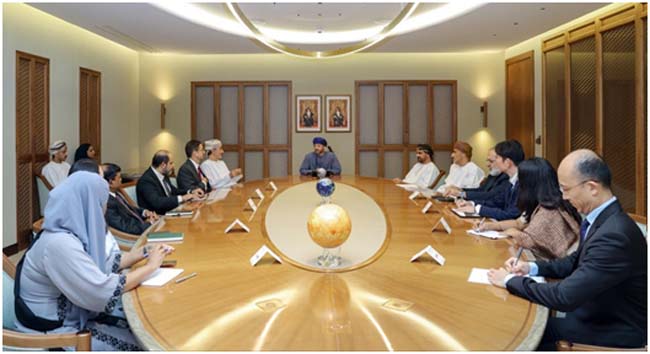
Such an exit does not materialise on its own. It must be enabled—carefully, discreetly, and often invisibly. In West Asia, the most effective diplomacy is rarely public. It is conducted through trusted intermediaries who can engage all sides without provoking suspicion.
- Oman has long played this role—offering quiet space for dialogue, away from scrutiny. Qatar, with its wide diplomatic reach, has demonstrated a similar ability to maintain channels across divides. These are not powers in the traditional sense, but they possess something equally valuable: access without baggage.
- Switzerland seems to be the quieter conduit, which can facilitate communication where formal ties do not exist. Messages that cannot be delivered publicly find their way through these channels.
- United Nations, meanwhile, provides legitimacy—but typically after the groundwork has been laid elsewhere.
This layered ecosystem of mediation reflects a deeper truth:
in highly charged conflicts, trust is built in silence, not spectacle.
Dharma and the Idea of a Just War
From an Indian civilisational perspective, the morality of conflict has never been divorced from restraint. The concept of Dharma Yuddha, articulated most profoundly in the Mahabharata, does not celebrate war—it disciplines it. War, in this tradition, is justified only when it is unavoidable, proportionate, and directed toward the restoration of order rather than the assertion of power. Even in the Bhagavad Gita, where duty compels action, the emphasis remains on detachment, ethical conduct, and the minimisation of excess. Measured against this lens, the present conflict appears not as a Dharma Yuddha, but as something far more ambiguous—driven less by necessity and more by miscalculation, perception, and the compulsions of power politics. This distinction matters. For if a war cannot be morally anchored, it becomes strategically unbounded—harder to justify, and even harder to conclude.
It is here that the Indian perspective offers a subtle but powerful insight: the legitimacy of war lies not in how it is fought, but in whether it can be brought to a just and timely end. And that, in essence, is the challenge confronting all sides today.
India: The Bridge in the Background
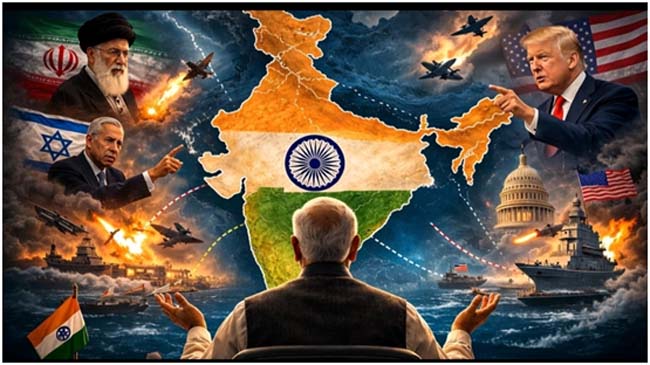
Amid this landscape, India finds itself in a position of quiet significance. It is one of the few countries that maintains functional relationships with all principal actors—the United States, Israel, and Iran. This is not merely diplomatic convenience; it is strategic design. India has, over decades, cultivated a posture of engagement without entanglement.
Its stakes are substantial. Energy flows through the Strait of Hormuz remain critical to its economy. Millions of its citizens live and work across the Gulf. Connectivity initiatives, such as Chabahar, represent long-term strategic investments. And yet, India has historically avoided overt mediation. This caution is deliberate.
In a region where visibility often complicates diplomacy, India’s strength lies in its ability to operate without spectacle. It does not need to lead negotiations to influence outcomes.
Its most effective role lies elsewhere:
- As a facilitator of backchannel dialogue, where trust matters more than visibility.
- As a voice of moderation in multilateral settings, shaping the narrative toward restraint.
- As an economic stabiliser, reinforcing confidence in energy flows and trade.
India, in this context, is not a power that imposes solutions. It is a power that enables space for solutions to emerge. A bridge—steady, understated, and essential.
The Only Victory That Matters
In the final analysis, this is a war without winners. No side will achieve total victory. No actor will decisively reshape the region to its advantage. The costs—economic, strategic, human—are simply too high, and the pathways too uncertain.
What remains, then, is a more modest ambition.
- To prevent escalation from becoming catastrophe.
- To ensure deterrence does not spiral into destruction.
- To allow all sides to step back—without appearing to step down.
This is not the kind of outcome that history celebrates. It lacks drama. It offers no clear resolution. It does not satisfy the instinct for closure. But it achieves something far more important. It preserves the possibility of stability.
In an unjust war, that may be the only victory available. And in a region that has seen too many conflicts spiral beyond control, avoiding the abyss is not failure—it is strategic success.
ABOUT THE AUTHOR

Lt Gen Rajeev Chaudhry (Retd) is a social observer and writes on contemporary national and international issues, strategic implications of infrastructure development towards national power, geo-moral dimension of international relations and leadership nuances in changing social construct.