
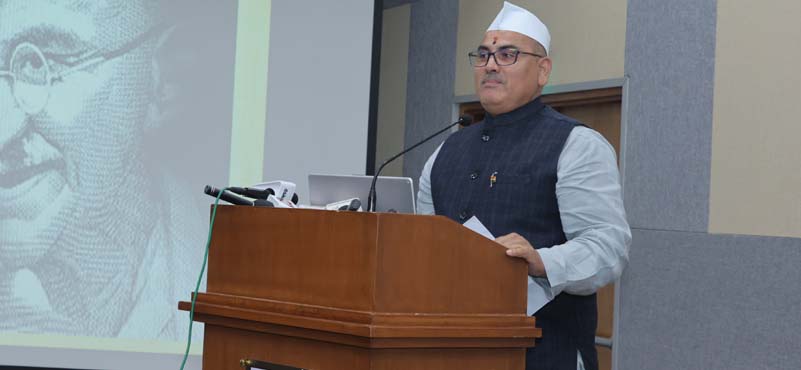
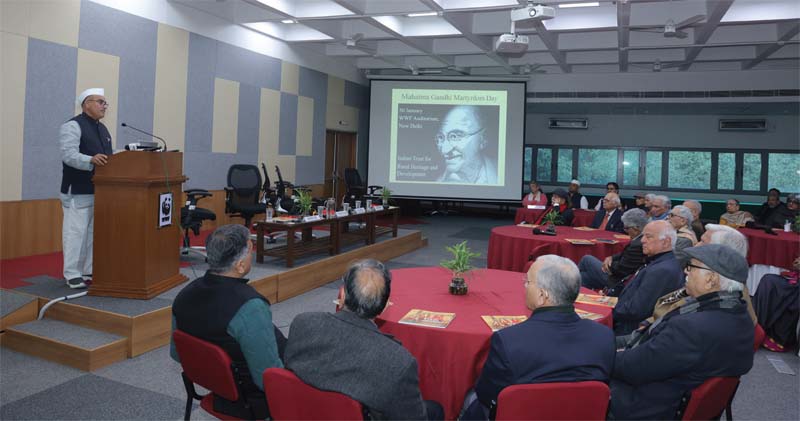
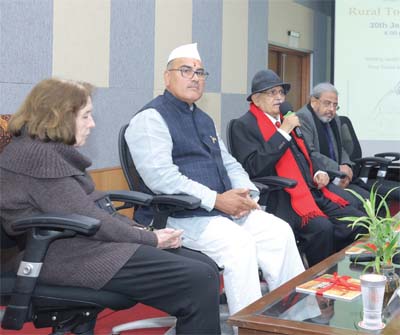
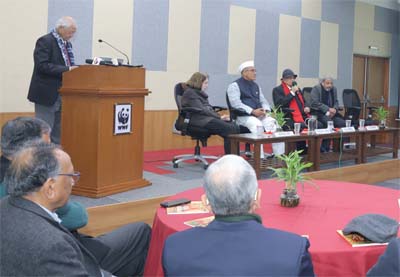
Keynote Address delivered by Pandurang Bhagvanrao Taware on the occasion of Mahatma Gandhi Martyrdom Day – 30 January, at WWF Auditorium, New Delhi. Organised by Indian Trust for Rural Heritage and Development.
On this solemn day—30th January—I stand before you with deep humility. This is the day when India lost the physical presence of Mahatma Gandhi, but the world inherited an eternal moral force. A force that continues to question us, guide us, and awaken our conscience.
Today is not merely a day of mourning. It is a day of introspection. A Day to ask ourselves—how faithfully are we living the values Gandhi lived and died for?
Gandhiji said, “My life is my message.”
Therefore, remembering him cannot be ceremonial. It must be practical.
Gandhi and the Soul of Rural India
Gandhiji believed that India lives in its villages. Not as a slogan—but as a truth. For him, villages were not symbols of poverty. They were centres of self-reliance, culture, wisdom, and dignity. His concept of Gram Swaraj envisioned:
- Local economies
- Ethical livelihoods
- Community leadership
- Harmony between humans and nature
In today’s language, this is what we call:
- Sustainable development
- Inclusive growth
- Climate responsibility
- People-centric economics
Gandhi was not behind his time—he was ahead of it.
Rural Heritage: Living Wisdom, Not the Past
When we speak of rural heritage, we are not speaking of museums or memories. We are speaking of living systems—our farms, food, crafts, water traditions, festivals, and village institutions. At a time when the world is facing:
- Climate change
- Ecological imbalance
- Farmer distress
- Cultural erosion
Our rural heritage offers answers, not questions.
Gandhiji reminded us: “The earth provides enough to satisfy every man’s needs, but not every man’s greed.”
Rural heritage teaches us balance—between consumption and conservation, growth and grace.
 Agri Tourism: Gandhian Philosophy in Action
One of the most practical and powerful ways to translate Gandhian thought into contemporary rural development is Agri Tourism. Agri Tourism is not merely tourism.
It is Gram Swaraj in practice. It embodies Gandhi’s principle of production by the masses, not mass production. Through Agri Tourism:
- Farmers become entrepreneurs, educators, and hosts
- Villages generate income without abandoning agriculture
- Women and youth find dignity and opportunity at home
- Urban visitors reconnect with land, food, and farmers
- Nature is protected, not exploited
Agri Tourism does not pull people away from villages.
It brings the world to the village—with respect, learning, and humility. In many ways, Agri Tourism is Gandhian economics in motion—local, ethical, inclusive, and sustainable.
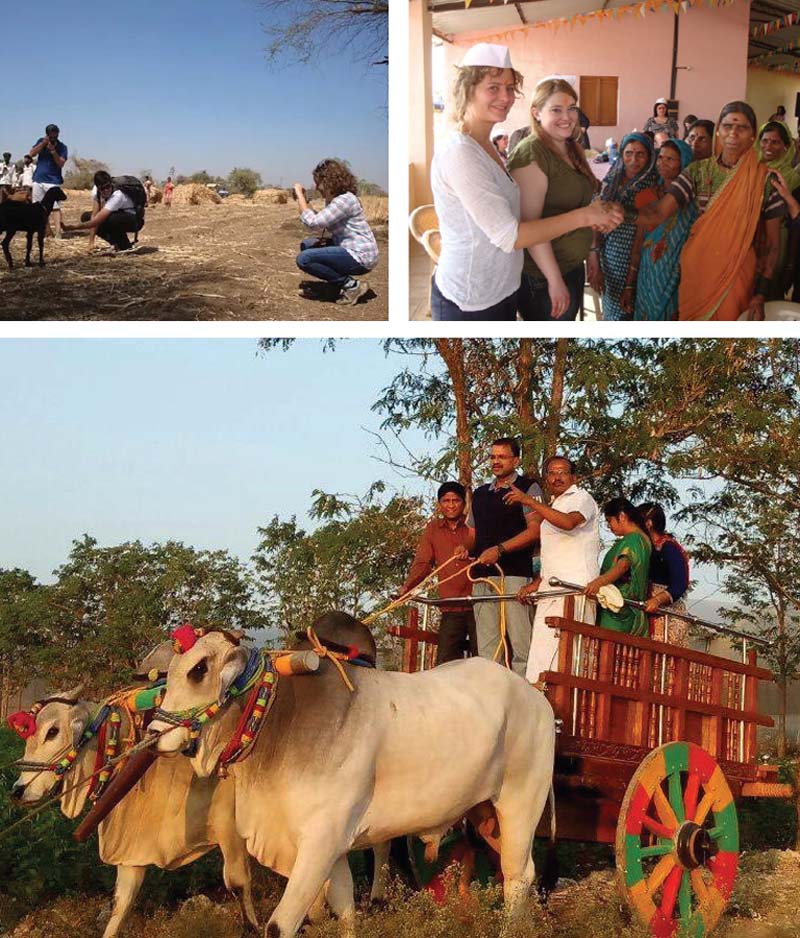
“Allow me to briefly share one real-life experience that illustrates this spirit.
In a small village in Maharashtra, a marginal farmer family—once dependent solely on uncertain farm income—opened their farm to visitors, not as a resort, but as a learning space.
Children from cities began visiting to understand where food comes from. Families started sharing meals cooked from the farm’s own produce. Women of the household became guides, storytellers, and teachers of traditional food and farming practices.
What changed was not just income—though that improved—but self-respect. Migration stopped. The next generation chose to stay back in the village. Farming regained dignity.
No forest was cut, no culture was diluted, no land was sold. Development happened with restraint, responsibility, and respect.
Watching this transformation, one is reminded of Gandhiji’s belief that true progress uplifts the weakest without harming the strongest. This is Agri Tourism—not as business alone, but as service with sustainability.”
Non-Violence in Today’s Context
When Gandhiji spoke of Ahimsa, he spoke far beyond physical violence. Today, violence appears in new forms:
- Violence against nature
- Violence against farmers
- Violence of inequality
- Violence of indifference
True non-violence today means:
- Respecting natural resources
- Supporting farmer livelihoods
- Promoting sustainable rural economies
- Choosing development with compassion
Agri Tourism reflects this modern non-violence—it creates livelihoods without harming land, culture, or community.
Trusteeship and Ethical Development
Gandhiji’s idea of Trusteeship is more relevant than ever. He believed wealth, power, and knowledge are not to be owned—but held in trust for society. In this spirit:
- Cities must become trustees of villages
- Institutions must become trustees of heritage
- Development must become a trustee of nature
The Indian Trust for Rural Heritage and Development stands as a living example of this Gandhian trusteeship—protecting rural wisdom while shaping a responsible future.
Youth, Innovation, and the Gandhian Path
Some say Gandhiji belongs to history. I firmly believe—Gandhiji belongs to the future. Today’s youth seek: Purpose / Meaning / Impact.
When rural heritage meets innovation,
When agriculture meets entrepreneurship,
When values meet opportunity— Agri Tourism becomes a platform where youth can build livelihoods with conscience.
Villages then stop being places of migration and become centres of innovation and pride.
A Moment of Reflection
Gandhiji did not wait for perfect conditions. He began with what he had, where he was. He spun the charkha not just to make cloth—but to build character. He walked for truth, not for power. If each of us adopts even one Gandhian value—simplicity, honesty, service, or compassion—our collective impact will be transformative.
Conclusion: Remembering Gandhi Through Action
On this Martyrdom Day, let us remember Mahatma Gandhi not only with silence—but with resolve. Resolve to:
- Restore dignity to rural livelihoods
- Support sustainable models like Agri Tourism
- Preserve rural heritage
- Practice ethical development
- Place humanity before profit
Let us convert remembrance into responsibility. I conclude with Gandhiji’s timeless words: “Gandhiji often asked us to judge development by its impact on the last person—Agri Tourism offers us such living examples.”
Jai Hind.
ABOUT THE AUTHOR
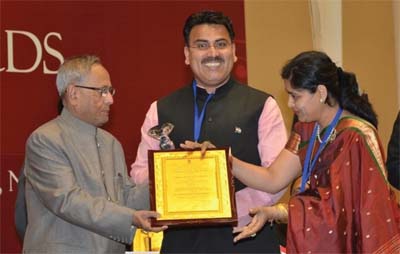 Fourth generation farmer and first generation entrepreneur, Pandurang Bhagvanrao Taware, is natively from small Village Sanghavi in Baramati Taluka, born and brought up in joint family of 50 members. He studied Computer Science and worked in hospitality industry for 20 years. In 2003 he married agriculture with tourism and launched Agri Tourism Development Corporation (ATDC) with model Agri tourism Centre in Baramati. After running Agri tourism operations successfully for three years, he took on training and skill development in Agri tourism for other farmers in Maharashtra, as of March 2024 he has replicated this idea of Agri Tourism on 1350 farms in more than 300 villages and 29 districts in the state of Maharashtra.
The Agri Tourism Sector Survey done by ATDC in FY 2022, 2023, 2024 shows that 0.24 million, 0.73million ,0.79 million tourists have visited these centres respectively, totally generating 85.79 million Indian rupees to farmer’s family, generated 11103 jobs to women and youths in the rural communities. ATDC (Agri Tourism India) Project’s OBJECTIVES are
To develop and promote agricultural tourism (Agri-tourism), through ATDC’s projects, training and support as a potential vehicle for diversifying and stabilizing rural economies.
Creating jobs, increasing farming community income, providing a broader market base, opportunities for on-farm employment so they do not have to migrate to urban areas.
Agri Tourism income to improve their livelihoods, traditional forms of art and music in rural areas.
He has also been seen on SHARK TANK season 1 on SONY TV, and The Pitch Season 3 on Bloomberg TV, widely featured on various National television channels across India and Globe, radio and national dailies.
He is a regular speaker at various International and National conferences and has been the Speaker – TEDx. He has been delivering lectures in colleges and universities encouraging taking up rural entrepreneurship. He was Instrumental to draft and declare the Maharashtra State Agri Tourism Policy 2020 He is also been the Member Maharashtra State Steering Committee Member to Launch and Implement the State Agri Tourism Policy 2020 He is the Steering Committee Member of GLOBAL AGRI TOURISM NETWORK (GAN) Spread across 73 Countries in the World Chair WORLD AGRI TOURISM DAY Committee, Global Agri Tourism Network USA and Representative South West Asia, GAN.