How Will it Play Out, for Others including India?
An exclusive Cross Section Conversation, featuring some of the best minds in geo-political play, shares their concerns. What could have been the reason, the immediate repercussions and the likely road options ahead? Joining the conversation are Iqbal Malhotra, Kamal Malhotra, Major Gen. V K Singh (retd), Air Marshal (Dr) Sanjeev Kapoor (retd) and Neeraj Kumar. Anchoring the conversation is Navin Berry, editor, Cross Section Conversations.
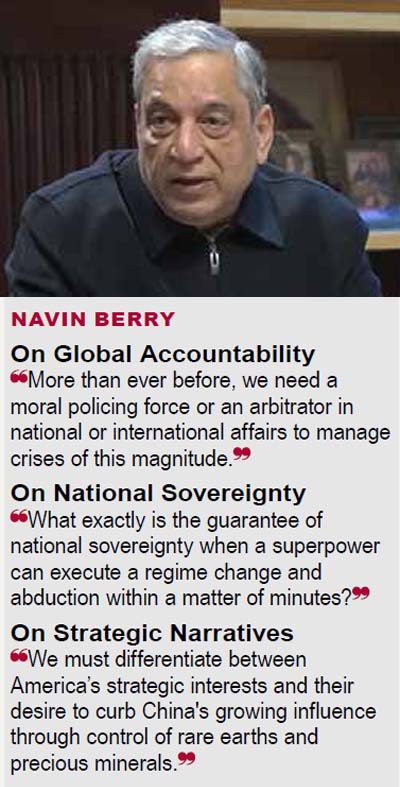 Navin Berry: What made America do what it did in Venezuela? And what are the likely repercussions of this incident in the global play of nations? What then is the guarantee of national sovereignty? And what is the role of the United Nations in crises like these? In fact, more than ever before, you need a moral policing force, an arbitrator in national or international affairs.
It seems Venezuela has been the flavor of the last one week or so. Everybody, every channel has got a panel discussion going on. Everybody is an expert. I am very happy to note that we have a genuine selection of real-time experts on various aspects of the situation as it happened, our buildup of the narrative and the consequences that we see for not just the world but obviously from an Indian point of view, what is there in it. So, what played out exactly on January 3rd? Iqbal, can you share with us your perception of what exactly played out on the 3rd?
Iqbal Malhotra: Thank you for the invitation to join this forum. And my view is that what played out on January the 3rd was a culmination of a lot of planning that had been gone into by the US in order to checkmate Chinese moves globally and in Latin America. Now, very interestingly, on the 1st of January, China upgraded the digital yuan and made it an interest-paying unit of currency or a monetary unit, the existing dollar supremacy and the Chinese also introduced a ban on the export of silver. Now, 80% of the refineries in the world that process silver are based in China. And China imports ore, it rather buys ore from Australia, from Peru, from Colombia, from Venezuela, from Mexico and it processes it into silver bars which it then sells to the global market. These two events were very troubling for the US. And a week before this, on the 23rd of December, the Venezuelan government introduced forced measures and they banned the export of silver. There was 750 metric tons, of silver that were to have been sold to three corporations. Samsung was to have been sold 347 metric tons of silver, Apple 234 metric tons and Tesla 156 metric tons.
So, what happened was on the 23rd of December, after announcing force majeure and terminating these obligations that the Venezuelan government had, they trans-shipped this silver, adding another 100 metric tons, they trans-shipped this silver in 11 aircraft to Moscow and Beijing. So, the silver went. And the silver market you have seen in the last month and a half, silver has increased tremendously and in the last year, it has increased by almost 150%. So, after that, the Chinese were going to introduce on the 10th of January a new global international settlement mechanism rivaling SWIFT called the UNIT. This was to be composed of 40% gold and 60% of a basket of the 5 BRICS currencies.
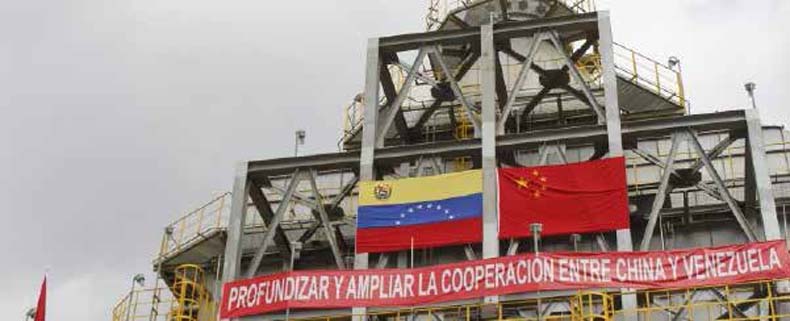
And the gold in this was to come from Venezuela. I don’t know to what extent India was involved (in the BRICS discussions), but it’s basically a Sino-Russian initiative. And 151 metric tons of gold was to come from Venezuela to Shanghai by the 10th which would support the UNIT which is this new international settlement mechanism. And Venezuela was the only country in the world that had eliminated the dollar from its export of crude oil. It approximately exports 800,000 barrels per day. It has been receiving payments, 70% of it is through cryptocurrencies, 30% is partly barter, partly debt swaps and the digital yuan.
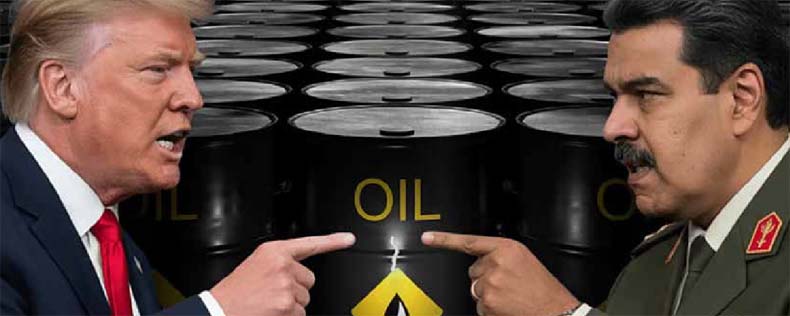
So once Venezuela has demonstrated successfully this and has further integrated to the UNIT, other countries would follow suit. So, the Americans had no choice if they had to save the dollar and by the way they need to sell 2 trillion dollar worth of treasury bills in 2026 just to keep the lights on in America and if this new unit mechanism had come in, digital yuan had been successful, other countries switched away from the dollar, then the American economy would have gone into a tailspin.
And interest rates would rise, the federal deficit would increase, the federal government would collapse and there would be monetary failure.
Navin Berry: So, immediate question, have they managed to avert it or postpone it?
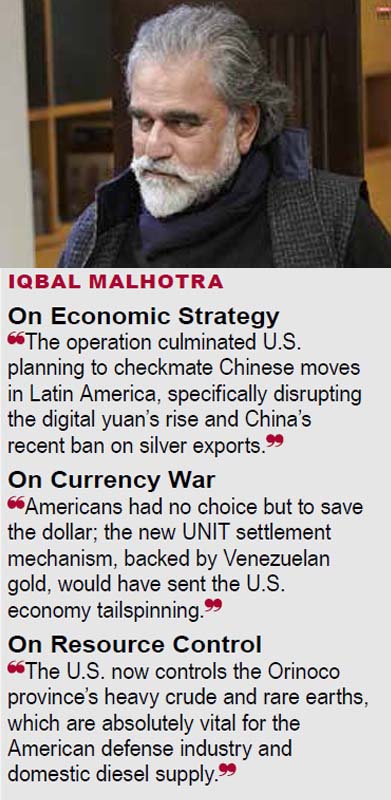 Iqbal Malhotra: They have managed to push it back by about six months to one year. And we shall see now what will unfold in the next six months to one year. And one more thing, the Chinese Navy was getting a foothold in the Caribbean in the north to mid-Atlantic and that has also been terminated for the time being.
Navin Berry: Kamal, would you like to respond?
Kamal Malhotra: Well, I’ll start by saying that this is not a black swan event. A lot of people are treating it as if it suddenly happened and no one had a clue that it was coming. I agree with Iqbal that this has been in the making for quite a while. In fact, it’s been in the making since Trump 1.0, where it was clear in Trump 1.0 that he wanted to get the Chinese out of Latin America, seeing it as the US’s backyard.
So, in fact, this is directly aimed at China. It’s also directly aimed at trying to keep the US dollar, the world’s reserve currency. I also agree with what has been said there. Because as Iqbal just said, Venezuela is the first and only country in the world that has essentially been trading in currencies outside of the US dollar for 100% of its oil and other trade. So, oil which is being put forward as the main reason for this, comes third in my view. China first, the US dollar second.
Navin Berry: You also talked about the silver lining, the literal silver lining. Sure, there are other minerals, silver, gold etc.
Kamal Malhotra: I mean Venezuela is not just about oil, it’s about other minerals. But I think the big thing is between the US and China. Latin America has amongst the world’s largest mineral resources. If you look at lithium, you have Chile and other countries. Whichever major mineral resource you look at, Latin America has been a major sort of supplier and exporter over decades. So, when we talk about a time when the fight is on for control over minerals, rare earth minerals, oil, other natural resources, Latin America becomes a major place for contestation. I should say though that even though this was quite predictable, given Trump 1.0 and 2.0 threats, it is very unpleasant and it has broken all boundaries in terms, therefore it’s a watershed in terms of the post-World War II global order.
It’s also the watershed for Latin America because despite a long history of support for coups, for example, in Guatemala and in Chile. This is the first time in the 200 years of independent history of Latin America that military force has been used by the US.
Navin Berry: So, what do we see short term, you already covered a bit of it, the immediate fallout and what’s likely to be the trend going forward?
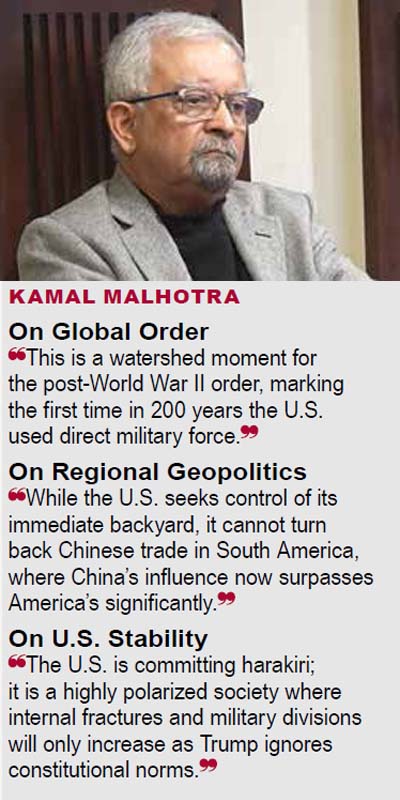 Kamal Malhotra: I think the implications are huge at many levels. As I’ve said, at the global level, this is the clearest indication of even all the madness that’s happened during Trump 2.0 in terms of overturning the post-World War II US-led global world order. So, it’s like Harakiri. The United States is committing Harakiri.
Iqbal Malhotra: There is a subtext here and that subtext is, forgive my interruption, that the Chinese have been candidly exporting two very important rare earths out of Venezuela. In the last five years they have exported 5 million metric tons of tantalum and thorium. Tantalum is used in missile guidance systems. And the Chinese are setting up a whole breed of nuclear reactors which are being powered not by uranium or by plutonium, but by thorium.
So, by doing this strike, the US has cut short the Chinese program of thorium-fed reactors and also the Guangdong Integrated Petrochemical Complex, which was going to refine 800,000 barrels per day of Venezuelan crude. I mean, today, WTI is at $56 a barrel, West Texas Intermediate, which is the benchmark crude. And the Venezuelan crude was, the Chinese were picking up for about $40 to $45 a barrel. So, their whole program and their industrial program and their cost and price structure has taken a very, very big beating in their economy.
Kamal Malhotra: Let me come back though, I want to say though that I don’t think that the US will be successful in limiting China’s influence, particularly in South America. And it is the largest trading partner of South America. I differentiate between Central America and South America and the Caribbean. So, these are three parts. But if you look at South America, which includes Peru, Colombia, Brazil, Argentina, and Chile, Bolivia, there is no way that the US will be able to turn back Chinese trade, which has now surpassed the US by many times with this region.
So, there is an attempt by the US to still keep control in its immediate backyard, which includes Mexico, Central America, and Venezuela is on the periphery of that. But South America, which is south of all of that, is very much a Chinese, it’s where, if you look at the figures, China’s trade with that region now is about four times that of the United States, including in terms of rare earth minerals, in terms of the BRI, the Belt and Road Initiative, and the infrastructure projects in Peru, etc.
Iqbal Malhotra: I think, Kamal, the Americans were not really interested in cutting down on the China trade in South America as they were in taking physical control over the Orinoco province from where this category of high sulfur content crude comes out because the US refineries on the Gulf of Mexico, eight major refineries, Exxon, Mobil, etc., all of those refineries have run out of heavy crudes because the shale oil crudes are all light crudes.
So, they needed this crude which was being sent to China to Guangdong and the oil companies needed it very badly. And Elon Musk is now back in the White House with Trump because his silver got stopped. Now, silver is very vital for Tesla and the whole program.
Navin Berry: So, let’s differentiate these two. Many other implications. One of course is America’s strategic interest and the other is the interest of China which they would have wanted to curb. But in terms of economy, in terms of dollar, in terms of all these rare earths and the precious silver and all the rest of it, they have managed to…
Iqbal Malhotra: They have won this round and they have postponed things by six months at least. And we shall see what happens in six months.
Kamal Malhotra: I don’t think in the long-term Venezuela, even in the medium term, Venezuela is of that much strategic importance to the Chinese. Their reaction so far is indicating that if you look at the bigger picture, it’s really South America which is of much bigger…
Navin Berry: V K, would you like to say something in terms of what has played out?
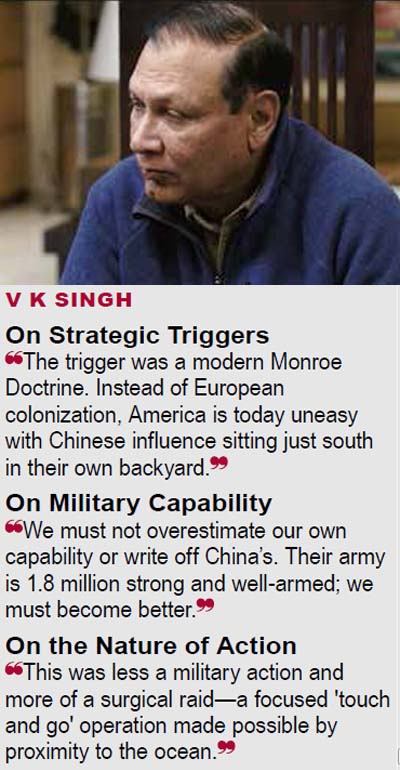 V K Singh: See, the way I look at it, as the larger picture. In the mid-19th century, what the US really did not want was European colonization of Latin America and they had taken out this Monroe doctrine and later even Woodrow Wilson had supported it in the terms that they wanted this as their own backyard. Today, what changed is that instead of European colonization, you term it as Chinese influence in the region. That is a very, very major trigger which is causing all this. So, it’s like America being uneasy with China sitting just south of it.
Second point, which they have already said is to do with the rare earth. Now there are certain elements which are only available there and certain elements like coltan which is termed as the blue gold, which is only available there and which is critical for technology, whether it be technology on day-to-day life or technology which is military technology, all these are absolutely vital. And somewhere I also feel that the kind of character which President Trump has, he has very strong likes and dislikes. And this dislike for Maduro in particular was demonstrated in Trump 1.0 also.
Even that dislike has got something to do with this timing and this particular action and the way it has happened. Of course, someone termed it as the first military action of America in South America. I would say this is actually short of a military action. This is more just like a raid, it was a kind of an operation touch and go, successful or not successful.
There is a show of force in which a very large amount of military as you were saying is present in that area. And the actual act being committed is a much smaller force which is more like a raid. I mean I am telling you as a military concept.
We will talk about implications later, as of now I feel that the major reason was the backyard, that America wants to control totally and it was being kind of stolen away day by day.
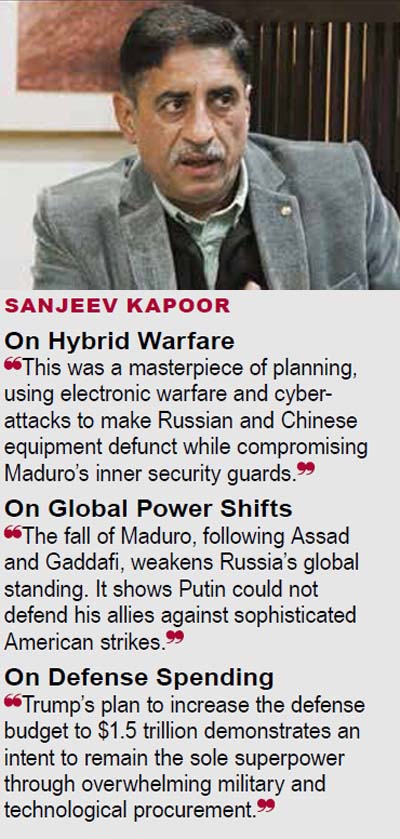
Sanjeev Kapoor: The build up to this action on 3rd Jan is one of the finest planned moves in my appreciation in the last few years. It is totally having a Mossad kind of a footprint and it is the first time that electronic warfare, satellite and cyber has been used for any operation of this magnitude. The Russian and Chinese equipment was made defunct. The 150 airborne platforms from 20 different bases across Venezuela. This CIA work, we have to highlight, that they compromised three of the inner security personnel of Mudaro’s inner defense. They were compromised. I don’t know whether you have seen this program, it is widely circulated, that one guard’s child was unwell, one person was disillusioned seeing how a common man lives to how these people live. And third, like Iqbal was saying, we had seen Hugo Chavez days, and he’s seen these days, a little elderly person. So, these three people were tapped by the CIA. This is we will get the treatment done for this child free of cost. Your families will move out and become US citizens. All your assets will be protected. You will be protected. You will have to enroll more people. And a senior guy, a general, I forget his name, was also compromised who has been picked up now.
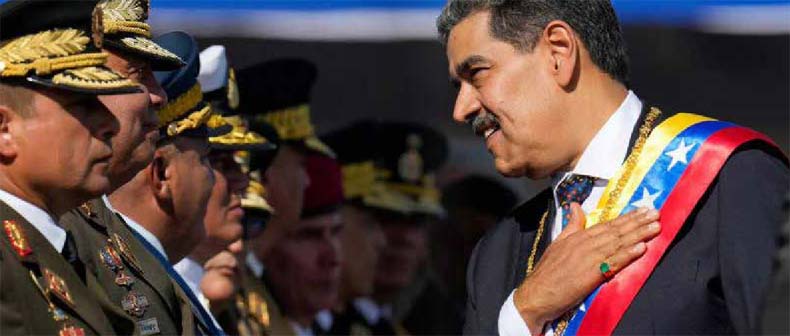
So, this work has been going on for the last 6 to 8 months. When there is abject poverty, when people are struggling for basics, it is very easy to compromise people at the top position which the Americans did. It is only now on this day that weather suited, the president was at a known place and the compromised people were in charge. So, the Delta Force coordinated with the local people.
About 22 or 32 of the Cuban people were shot by the special forces. The doors were open. There is a saying that the doors are open from inside. In 19 minutes flat, from entry to taking the president and his wife away onto an aircraft carrier this operation happened. So, the helicopters were used, the jammers were used, the Russian S-300s were made defunct…………….
This kind of operation using satellites, cyber, space, electronic warfare and 150 airplanes in that area has never been done. So, this is in my opinion, in military parlance, other than the strategy which has been discussed, is one key takeaway.
V K Singh: See, this particular narrative is now being read over social media. And it is well available that the girl child was not well and all these families were transported out of Venezuela well in advance and this was just the culmination and these officers involved were actually flown out with the President and his wife at this time. My only, after having read this and read it in different posts, it also does look like a plant. So, it may be false information. What I am trying to say is that we need to look at this information very intelligently. A part of it may be right. And a part of it may not be. But the point he has made is that overall, the environment was conducive for some amount of subversion to be possible.
Iqbal Malhotra: The economy has shrunk by 80% over 10 years of Maduro’s rule.
 V K Singh: So when you have this kind of discontentment such a thing is more possible. So overall I am saying the package which was used, the number of aircraft and all that, most of it was a kind of a diversionary force that attention goes there. There are a certain number of bombs dropped somewhere. The main was only this, which was a very focused Delta force coming in. As he says 19 minutes, somebody says 12 minutes, drop down, stealth helicopters and what played out more is that a lot of people I feel world over are those who are landlocked and are very happy that there is no ocean nearby. You know what made it possible was also the water next door because had that not been there, this kind of operation could not have taken place.
Sanjeev Kapoor: What stood out is the harmony of intelligence agencies. About five to six different intelligence agencies of the US and Israel have worked to make this possible. For one year, they have worked together on this.
It has, you know, implication to Russia and China to say in my appreciation to lay off the western hemisphere. Because now instead of a global power, America has realized that it cannot put, you know, foot on ground. Here also they don’t want to put troops on ground. So, after they pulled out of Afghanistan in 2021, they have now reconciled mentally that let’s hold this area from the Middle East till the Western Hemisphere. Their influence on the Middle East has increased. Their influence, their selling of everything to be it Qatar, UAE, Saudi Arabia, Israel, 49% of global exports of arms is controlled by the United States. And Trump said yesterday that $1.5 trillion is going to be the defence budget for 2027. Which was earlier $1 trillion. 50% increase, you put together the complete global purchase, it will not match this value that America is trying to put in its defence procurement in the coming two years.
So, this has the implication that they want to get back their old-world order wherein they remain the sole super power. And Assad going, in Syria, the Libyan person going and now Venezuela going has put the Russian president’s position a little on the weaker side. Because he could not defend Iran, to that extent in the June bombing. He could not defend Syria, he could not defend Libya, he could not defend Venezuela. So, he has been quietly asked to remain on that side. Now the next thing would be testing the waters in Taiwan.
Kamal Malhotra: I think the military part of it is one part of it. I’m more focused on the economic and trade part of it, where I think China is in a much stronger position. And in fact, in terms of great power contestation, we have the US in decline. Whereas China is definitely on the rise. Unlike the Cold War, where Russia was never a major economic power, it’s even less so now. It’s an economic crisis. China is a major part to contend with economically and will continue to be so.
Iqbal Malhotra: How do you say that there’s a decline in the US part when the Air Marshal has just said that their defence budget for 2027 is going to be raised by 500 billion dollars.
 Kamal Malhotra: In my view, you don’t sustain triumphs through narrow military means. I’m sorry, I don’t believe in that. So you can increase your defense budget by whatever it is. In fact, the US has always had much higher defense budgets than any other country. It has not succeeded once so far. Afghanistan, Iraq, Libya, you name it, the US has failed. Vietnam, which I know particularly well, the US has failed. And the US, in my view, will fail again. It has still got a military advantage and it has got a technological advantage. The technological advantage is fast diminishing vis-a-vis China.
China does not act the same way as the US does. China acts in somewhat different ways. We can have a separate discussion on that, particularly in East Asia, where I’ve spent 20 years, in the South China Sea, vis-a-vis Taiwan. This has huge implications for East Asia as well. It has huge implications for Europe as well.
Sanjeev Kapoor: I agree with him partly that the military might, America is supreme at this stage. Economic might of China is growing. The economic might of the US is reducing. There is absolutely no contest in this statement. But the Chinese military and civil have huge rifts. Their air chief, their six generals were purged. The last PLA plenary meeting had an empty enclosure of senior military people. The generals have said, that we will not be in a position to take over Taiwan at which the president is infuriated. He has serious doubts about his military capability. I will give you an example of Galwan. The Galwan conflict with India, India lost 20 people.
The Chinese have lost 60 plus people. With one child between two grandparents, single child policy, the Chinese can ill afford to lose any people because the backlash of the society would be huge. The Chinese are now working on developing non-contact warfare with like all of us know – rockets, drones, missiles, cyber, all this.
In my appreciation, this action has actually helped the US in the South China Sea. That is of American image and capability.
Kamal Malhotra: The US is a highly polarized and divided society, including with resignations of top commanders before the Venezuela operation, as we know. There is great division within the military, the way that Trump is using it, both domestically and internationally. And I think it’s only a matter of time, if he continues to do this, that there will be a rupture in terms of the constitution of the United States and what the military is supposed to follow is the constitution, not an individual.
There have been enough people who have resigned already or been sacked because they were not willing to follow the orders. Peter Heskett is a joke as the Defense Secretary, and I think it’s only a matter of time before he crumbles. So, I think that you can throw a huge budget, but I think that it’s a highly divided and divisive society. Those fractures are simply going to increase with time. There are economic reasons for the fractures, social reasons for the fractures, and there are increasingly how he’s using ICE, how he’s using the military domestically, the National Guard, etc. Midterm elections are coming. I get an impression that there’s an attempt to suggest that the American forces are somehow all united and that there aren’t any fissures or divisions in that.
Iqbal Malhotra: American society is not going to war with Venezuela. American society is not there. It’s the president who is in charge. They have a presidential system. And the American military machine is absolutely in top gear. There is no question about that. I think there are divisions in every other military.
What we are talking about here is, I think there are three key things that have emerged out of this.
Firstly, China has been checkmated in its attempt to get into South America and use South America as a base to project its power in the North Atlantic and threaten the United States.
Secondly, the Americans have introduced this concept of abducting a head of state, which has never been done before, which is quite revolutionary and we shall see in the times to come whether other people follow this practice or whether they also follow this practice.
The third thing is kinetic forfeiture of a nation’s assets. The 151 metric tons of gold that was going to Shanghai has now been flown to New York and it has got into the custodial ledger of the United States Treasury. And now advances will be made against that. So that gold has gone, 151 metric tons. It will be melted and all the hallmarks removed and it will be re-hallmarked with the US Mint and will go into circulation within the US banks etc. And what they have done is that they have blocked the Chinese from getting the rare earths from Indonesia. They have provided the supply of crude because if the heavy crudes didn’t go into the US refineries on the Gulf coast, there would be no diesel.
In the US today, they are down to 15 days’ supply of diesel. And if diesel supply goes down, the trucking industry comes to a halt. If the trucking industry comes to a halt, there is no food in the supermarkets. If there is no food in the supermarkets, there is inflation, there will be riots, there will be all kinds of things. So, they had to move. Because this was not an isolated event. It was a link in a chain of multiple events that were happening at the same time. That actually crystallized in this action. So, if you have to study this action, you cannot study in isolation. You have to look at all of the events and say that a war game was done. Where you looked at the economy, you looked at the politics, you looked at the military aspect of it and you saw immediate gains and potential gains in the future as well. It’s not like a night and day action that this is what they did, they just picked up Maduro and went off.
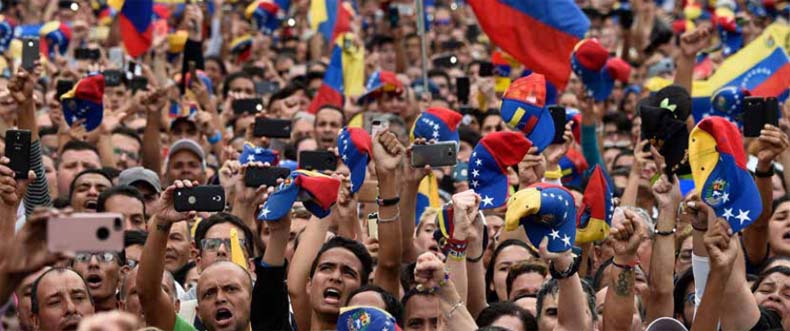
Navin Berry: So, just one very impressive analysis, very interesting. Trump’s statements coming after 3rd of January indicated as if he doesn’t know what he is going to do with Venezuela next.
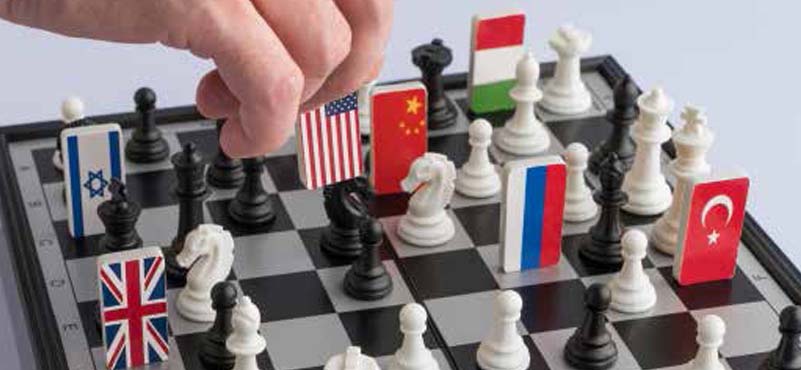
Iqbal Malhotra: He said the United States will run Venezuela. Now, the United States is not going to run the whole of Venezuela. They are going to run the Orinoco province where the crude is, where you have 14% of the world’s petroleum reserves. Where you have rare earths which are very vital for the American defense industry. And where you have silver also. So, they will control Orinoco province through their proxies. Venezuela will be run by the elected representatives, the vice president. She has already made peace with them. And you will see that things will go on. But now the Americans will be in control. This is actually a game of chess, they have moved a pawn which is threatening one of their rooks, their Chinese rooks or horses. So, that is now on the chess board. We have to see what the next move will be.
VK Singh: I feel that some of these narratives should be taken with a pinch of salt. Big pinch of salt. Now, India, for example, was supposed to have a certain number of days of diesel reserve, let us say, today, the diesel reserve is at 74 days, out of which 10 odd days is strategic and balances a kind of a running reserve.
For America to have only 15 days, though I have also read those pieces, is something like being sold a story that you want to hear and you want to justify an action that has taken place. So, I am saying going ahead, the military operation was one of its kind. The American army, American defense forces have proved that they are the best in the world. That’s what they wanted to do. And that is why we are all saying that now they have gone up. This could have also failed. But leaving that, they did plan for months and months. We don’t know how long and how many rehearsals and what kind were done.
Navin Berry: So if the planning was going on for months and months, they were seeing these crises also building over those months.
Iqbal Malhotra: The crisis was about oil, let me make the point that the Americans had a strategic reserve of oil which had begun to be released in 2018-19 by Trump and it was accelerated under Biden because they wanted to keep prices down for the elections. And that strategic reserve got exhausted. The strategic reserve along with the oil from Alberta in Canada was providing the input into the refineries.
The Canadian oil is pumping at the maximum, the demand has grown and the ability to source heavy crudes was put in question because the only American company allowed to import crude oil from Venezuela was Chevron and they could only import 100,000 barrels a day. So these guys have been putting pressure, the American corporates, on the Trump administration for the last three months. They must have obviously sourced the crude from other countries as well, but it’s much cheaper to get it from here and it’s much easier to get it from here. At the bottom of all these games, as it is in the case of Venezuela, you are today controlling 14% of the world’s oil reserves.
Kamal Malhotra: It is largely theoretical. It will require billions and billions of dollars to develop it. And so far, no companies, not even the American companies, are willing to commit that kind of money given the uncertainty, the political uncertainty, including what is to come because there could be civil war, there could be lots of things that happen inside Venezuela as a result of these actions. So, this is theoretical.
VK Singh: The third point where I said with a pinch of salt is that we should not overestimate our own capability, our own military might, vis a vis the Chinese, as we often do, or as often the media also does. Galwan is a point, if we were well prepared, it wouldn’t have happened and this narrative that I have heard time and again, that the Chinese have never fought a war, Chinese have not tasted blood, it doesn’t work. You don’t have to get yourself killed to be able to fire a rifle. It is a point undoubtedly. We should keep it as a point. But when you have an army which is 1.8 million strong and now in some reports it is 2.4, well they are all trained, they are all worth something. They are all well-armed. So, keep that in mind also.
Navin Berry: What you are saying is, if they are not all that mighty, don’t also write them off.
VK Singh: Don’t write them off at all. Make yourself as good or better than them. My point is that. We need to become better.
Navin Berry: With this action in Venezuela, does it become a template for similar takeovers of regimes which you feel are hostile to your interests? Because what you have established is that America’s interests were totally at stake and they had to do something drastic. They have obviously shot quite a few birds in one attack.
Iqbal Malhotra: You see, America did this in central America in Panama and on the 3rd of January when they got, many years ago when they got President Norega out and they did the same thing with Maduro. I don’t think they are going to need to do it anywhere because everybody will come, and will be brought to the line. And they will all accept the American hegemony in Latin America.
Kamal Malhotra: As I said earlier, you have to differentiate. I have studied Latin American studies and spent a lot of time in that region. You have to differentiate between Central America, the Caribbean and South America. And as I have said before and I will say again, I don’t believe that in South America, they’re going to abandon the Chinese.
In fact, they can’t abandon the Chinese because their economies and trade now is so integrated. And there’s such a huge project, and such huge amounts of investments, and also the Chileans, the Peruvians, the Bolivians, and the Brazilians, and the Argentinians, even though Trump has his soulmate as the president, he’s now gone back and also made a deal with China. So, I don’t see that in the large countries of South America that they’re suddenly going to toe the line. They have put forward, since 2019 and 2020, what they call active non-alignment. Brazil is the best example of that. And they are not going to abandon this. They’re not going to toe the line.
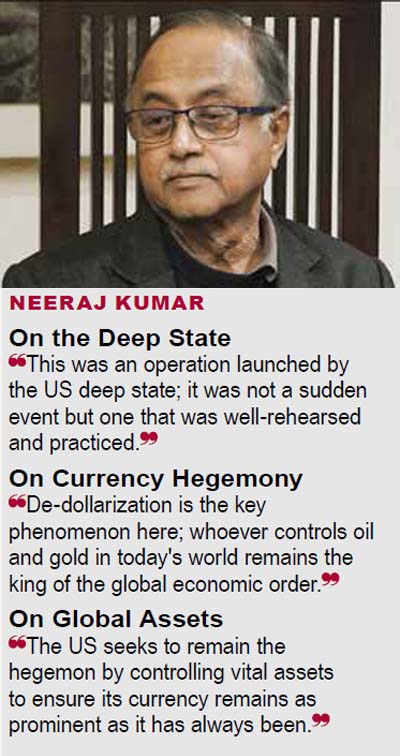
Neeraj Kumar: First of all, we all know that it is an operation launched by the deep state of the US and secondly, it is not suddenly out of the blue. It has been well rehearsed, well practiced and I agree with Iqbal that this was rehearsed well in advance. What we should not also lose track of, is the phenomena of de-dollarization that is happening all over the world. De-dollarization, this is the surest way. Whoever controls oil or whoever controls gold is the king in today’s wide world and America wants, as is expected of any hegemony to be, that person, that country, which controls these assets so that its currency remains as prominent and as important as it has always been.
I also agree with the view that at no stage should we take China lightly. Irrespective of this one-child norm and this and that. And also, not go by the propaganda that the Chinese equipment failed in Pakistan and the Chinese equipment has failed even in Venezuela when this operation took place. There is much more to it than meets the eye. And we know, another report that one has heard is that before the operation took place, this gadgetry was neutralized much beforehand. So, there is no question of the military not working.
Navin Berry: Some discussion will happen presumably in the next couple of weeks. There’s a backlash from Europe. Will America carry on, this time, annoying and upsetting NATO totally?
Iqbal Malhotra: I think what is being proved by this entire episode is that the concept of sovereign immunity is now dead. If you can’t defend it, you can’t own it. So, you have to be able to defend what is yours, otherwise it will be taken away by somebody else. So, this is something very important.
And the second thing is that they have shown to the world that they have been able to punch the Chinese in the face. And the Chinese have not been able to retaliate. Now, they may retaliate through the currency markets. They will definitely retaliate but in a kinetic sense, in a military sense, they have been unable to do that. And they are still thinking that when they have purged 6-7 generals, the remaining generals have to have the experience to be able to provide options to Chairman Xi Jinping.
Sanjeev Kapoor: The Air Chief is dead while in interrogation. Can it happen in any country other than China? Air chief, serving air chief of the PLAF is taken for interrogation; after a few days, it appears he is no more. So, what kind of a military are they running, I don’t know.
VK Singh: One statement you made is that China has not retaliated. Why should they retaliate? We need to keep that apart and we also need to be very watchful in the coming days. How will China retaliate whether economically or militarily.
Kamal Malhotra: I don’t agree that Venezuela is of huge strategic value to China. So I don’t think the retaliation in Venezuela is on the top of their agenda.
Firstly, it’s too early. But secondly, I don’t think that Venezuela is of the level of strategic importance. If something happened in Taiwan, the Chinese reaction would be entirely different.
Iqbal Malhotra: Venezuela was the launchpad of the Chinese Navy’s expansion into the North Atlantic, Western Atlantic and the Caribbean. The presence of the Chinese Navy would bolster the Cubans, and would have bolstered the left-wing government of Maduro in Venezuela. They have in effect short circuited that process.
Kamal Malhotra: I think China’s main interest is economic.
Iqbal Malhotra: Not at all. Chinese interest is world domination. They are the middle kingdom between heaven and earth.
Kamal Malhotra: Their way of dominating is much more focused on trade and the economy and their preferred option is not some military, group military takeover. I think it’s a different approach from the United States in many ways. And I think that what this has done is that it has given moral equivalence now in China and Russia’s favour, because all this hypocrisy about Russia invading Ukraine and China and Taiwan and all of that is now essentially thrown out of the window by this particular act.
Iqbal Malhotra: Listen, let’s not get into a semantic debate about hypocrisy because hypocrisy is all over the world. There is no nation today which is not hypocritical. So, let’s not get into that. And as regards the Russians go, the Russians today have been singularly responsible in creating their biggest enemy who is going to rise from the grave and threaten them in three years. Germany.
Sanjeev Kapoor: The Germans’ rise will be defined and I said it will be the rise for the third world war. The program (a recent one) on television which I did, was on the rise of Germany.