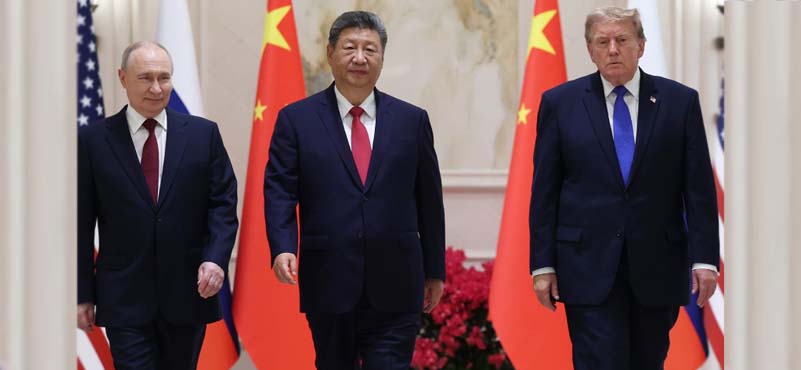
The first meeting of the three largest nuclear powers produced warm words and no paper. That is exactly why it deserves a close read.
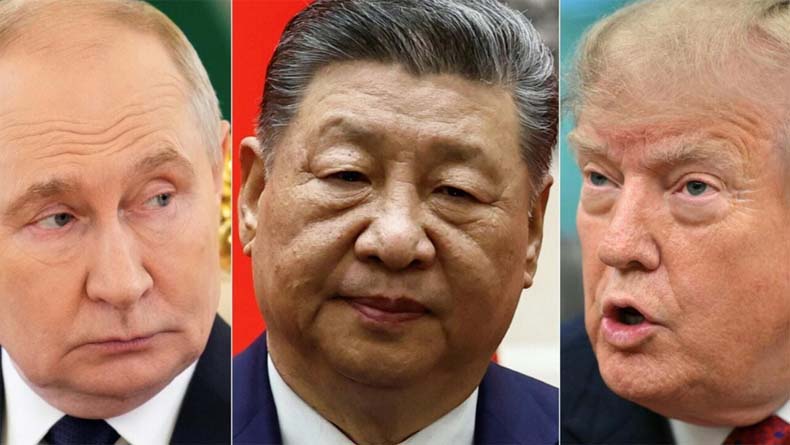
For about ninety minutes on Thursday afternoon, the leaders of the United States, China and Russia sat in one room at Xi Jinping’s lakeside residence in Shenzhen. It was the first time the three had ever done so. Trump called it making history. Xi called it ground-breaking. Officials had warned beforehand that no concrete agreement was expected, and at the time of writing I have found no joint statement. The Kremlin had said that if no communiqué was agreed, each leader would give his own account. So the useful question is what the meeting was for, because it plainly was not for a deal.
A table with no treaty on it
The timing gives the meeting its weight. New START expired in February 2026 without a replacement, which removed the last treaty limits on American and Russian strategic arsenals. Trump opened by saying that the three countries, as the world’s largest nuclear powers by far, are uniquely positioned to discuss reducing the number of weapons on Earth. Xi went further, at least on paper. Chinese state media quoted him calling nuclear arms a sword of Damocles over humanity, saying they should be comprehensively prohibited and thoroughly destroyed, and adding that a nuclear war cannot be won and must never be fought.
Both statements are easy to make and expensive to act on. Beijing’s position has been the same for years: it cannot be asked to join trilateral talks while its arsenal is far smaller than the other two. A Chinese envoy called the idea unfair, unreasonable and infeasible back in 2020, and the foreign ministry has repeated the line more recently. Calling for total abolition fits that position neatly. Abolition is a destination with no timetable. Arms control is a schedule with inspections. Xi offered the first and left the second alone. Trump, to his credit, admitted in front of the other two that giving up these weapons is not an easy thing to do.
What each man took home
Xi’s gain is status. Hosting the first trilateral lets him present China as a co-equal arbiter, and he used the platform to set out four principles for how large countries should deal with one another: mutual respect, peaceful coexistence, win-win cooperation and dialogue. He also reminded the other two that, as permanent members of the UN Security Council, they should work together on global challenges. Read beside his bilateral remarks to Trump, where he spoke of a new positioning for the relationship, the message holds together. China wants its place at the top table recognised in language, well before any constraint is placed on it in a treaty.
Putin’s gain is rehabilitation, and time. He sits beside two leaders who each find him useful in different ways, and Trump spoke warmly of their long relationship. The Kremlin’s aide Yuri Ushakov said Ukraine dominated Putin’s earlier bilateral with Trump, while spokesman Dmitry Peskov said the Ukraine process is currently on hold. Putin told the trilateral that all three states share an interest in ending the war. He also proposed that the trilateral concentrate on global and regional ties and energy security, a list that hardly touches warheads. A shared interest is not a shared plan, and Kyiv was not in the room. A Russia that looks constructive on nuclear talks while its main war stays unresolved loses nothing by doing so.
Trump’s gain is the headline and a tidier story on Iran. He told the other two that the United States will not let Iran have a nuclear weapon, and after meeting Xi he said both sides share an interest in keeping the Strait of Hormuz open. Neither is a commitment from Moscow or Beijing. He also said he would propose ways for the three countries to protect their sovereignty from the International Criminal Court. That last line deserved more attention than it got. Putin has been the subject of an ICC arrest warrant since 2023. An arrangement among three great powers to shield themselves from international accountability would be a strange thing to start building in a meeting about reducing nuclear danger.
The three-body problem
Arms control was built for two. The Cold War logic of parity, verification and mutual vulnerability fitted two arsenals of broadly matching size and a shared fear. A third party with a smaller but growing arsenal breaks the arithmetic. If Washington and Moscow cut, Beijing’s relative share rises. If China builds, the other two have a reason to hold back. Each capital also has to plan against the other two together. A triangle does not settle into balance on its own. It tends to produce shifting pairs.
Shenzhen showed those pairs already. Trump and Xi traded warm lines on stability. Xi and Putin had met a day earlier. Trump and Putin talked Ukraine on the side. None of this makes talking pointless. Contact between nuclear powers lowers the odds of misreading one another, and a first meeting always has to happen before a second. The realistic expectation is a process: working-level talks on risk reduction and crisis communication, perhaps limits on new categories of weapons, and nothing like reductions. If the three leaders announce numbers in the coming months, I would be surprised, and I would want to know exactly how they are verified.
Who was not in the room
The meeting also drew a line around who counts. Europe was absent. So was Ukraine, whose war was discussed without it. So were India, Pakistan, France, Britain and every state whose security depends on what the three decide. Xi’s language about large countries interacting correctly sounds harmless. In practice it describes a concert of the biggest, with everyone else as audience.
For India, three points follow. First, a nuclear conversation among three states that never includes the other nuclear powers hardens the habit of discussing arsenals only at the very top. India has long argued for disarmament that applies to everyone equally, and Shenzhen is a reminder of how far the real process sits from that. Second, India’s nuclear environment is shaped by China on one side and by a Pakistan that leans on Chinese support on the other. A Beijing that presents itself as a champion of abolition pays nothing for it along the Line of Actual Control or in the Indian Ocean. Third, New Delhi should not mistake the warmth in Shenzhen for a settled order. Three leaders who differ on Ukraine, Iran and Taiwan do not form a bloc. What they do form is a precedent, that the biggest powers can meet and be seen to decide. India’s task is to make sure the next such table has more chairs, and to build the capability and credibility that earn one.
The fair assessment is that Shenzhen produced a photograph and the outline of a process, not a settlement. The tests ahead are modest and measurable: whether working-level talks are actually scheduled, whether any of the three accepts verification on anything, and whether the Ukraine track moves. Until one of those happens, the safest conclusion is that the three are willing to be seen together, and not much more.
ABOUT THE AUTHOR
 Lieutenant General A B Shivane, is the former Strike Corps Commander and Director General of Mechanised Forces. As a scholar warrior, he has authored over 200 publications on national security and matters defence, besides four books and is an internationally renowned keynote speaker. The General was a Consultant to the Ministry of Defence (Ordnance Factory Board) post-superannuation. He was the Distinguished Fellow and held COAS Chair of Excellence at the Centre for Land Warfare Studies 2021 2022. He is also the Senior Advisor Board Member to several organisations and Think Tanks.