Introduction
Normally a visit by a US President to China has three major issues on the table, trade, technology and Taiwan. But this time there is an elephant in the room in the form of the Iran War.
Trump’s approval ratings have been dragged down by the protracted war in Iran and a surge in inflation, which is due to the disruption of global energy supplies. The war has closed the Strait of Hormuz through which roughly a fifth of the world’s oil supply flows causing energy prices to spike to levels that are affecting economic growth across the globe.
He thought he would come here as a victor in the Iran War but the reality is different as he touched down on 13 May. Iran’s resilience in the conflict, the inability to put boots on the ground and the dissonance amongst NATO members all are pointers events that have not gone according to script. The fact is that the US has got bogged down in a conflict it started with a far lesser power. The question now isn’t whether Trump will secure his war aims with dignity. It is whether his presidency can recover from the war’s body blow. Further, as far as his host is concerned the status of the US as a superpower in decline remains.
But Trump true to form offered conflicting signals on how central Iran would be to his discussions with President Xi. We’re going to have a long talk about it. I think he’s been relatively good, to be honest with you,” Trump said before boarding Air Force One. Minutes later, he appeared to reverse course.
“We have a lot of things to discuss. I wouldn’t say Iran is one of them, to be honest with you, because we have Iran very much under control.”
The past year of US-Chinese relations has also followed this pattern. Last year, President Trump imposed a de facto trade embargo on China, a measure swiftly reciprocated by Beijing. Months later, he was touting a “G-2” partnership between the two countries. In recent weeks, Trump has both invited Chinese warships to the Strait of Hormuz and threatened to strike China-bound oil tankers passing through it.
The Three T’s
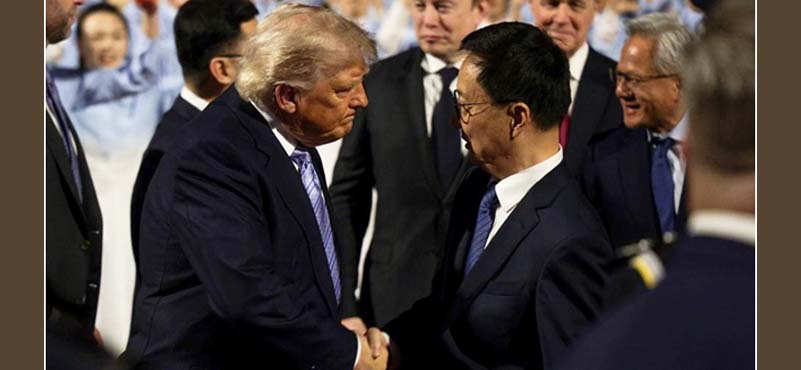
This is the second time President Trump is traveling to China as the President and the first time since his second term began on 20 January 2025. Trump is seeking a win in Beijing by signing deals with China. Among his aims are Chinese purchases of American products like soybeans, LNG and Boeing aircraft. While such purchases, even if fulfilled, are unlikely to compensate for the damage to US businesses from the 2025 trade war, the optics are helpful for a politically vulnerable administration. No wonder President Trump said he will be talking with Xi about trade “more than anything else”.
Underscoring the initiative, Trump is being accompanied by US business leaders including Tesla CEO Elon Musk and Apple CEO Tim Cook, Nvidia CEO Jensen Huang, Larry Fink of BlackRock, and Kelly Ortberg of Boeing.
The Trump administration also hopes to begin the process of establishing a “Board of Trade” with China to address differences between the countries. The board could help prevent the trade war ignited last year after Trump hiked tariffs, which China countered by restricting exports of rare earth minerals.
China emerged from the 2025 trade war in a position of relative strength. After Beijing blocked exports of key rare-earth elements and critical minerals, threatening the viability of US manufacturing, the Trump administration quickly sought an off-ramp. China saw their assumptions vindicated. Their confidence soared and they felt held the stronger hand.
But the US has leverage against China, through controlling access to its advanced chips, sanctions on Chinese purchases of Iranian oil, and a consumer market China cannot ignore.
The US list of concrete deliverables from China is short: keep rare earths flowing, create a board of trade mechanism for non-sensitive sectors, and secure Chinese purchase commitments.
Another potential focus is likely to be AI, with both countries facing calls to cooperate on global standards and safeguards. Bernie Sanders, an independent US senator, urged both Presidents to agree on allowing top scientists to share technical information and develop “AI redlines” about dangerous behaviour.
Sanders said: “At the height of the cold war, Reagan and Gorbachev found a way to negotiate nuclear arms control. The existential risk posed by AI demands nothing less from Trump and Xi.”
The status of Taiwan also appears to be a major topic, as China is displeased with US plans to sell weapons worth $11 billion to Taiwan. China has long criticized US military support for Taiwan, which it considers Chinese territory. The arms package was approved in December but has not yet followed through with delivery even after Taiwan’s Legislative Yuan approved a special defence budget last week casting doubt on longstanding US policy regarding Taiwan. Trump told reporters on 11 May that he would be discussing the defence deal with President Xi.
At the same time, Taiwan, as the world’s leading chipmaker, has become essential to the development of AI, with the US importing more goods from Taiwan so far this year than from China.
The Taiwanese leadership will be anxious about potential concessions on US arms sales to Taiwan, or any changes in US language about Taiwanese independence.
Trump was already portraying the trip as a success before he left the White House grounds. “We’re going to have a great relationship for many, many decades to come,” Trump said of the US and China. “As you know, President Xi will be coming here toward the end of the year. So that would be exciting. I only wish we had the ballroom finished.”
Iran War the Looming Question
Trump’s visit to Beijing comes days after Iran’s Foreign Minister Abbas Araghchi visited the Chinese capital and significantly President Putin is visiting soon after. After the visit by Iran’s Foreign Minister, China called for a “complete cessation of hostilities”. Despite Trump’s claim that he does not need China’s help, US Secretary of State Marco Rubio and Secretary of the Treasury Scott Bessent have called for China which remains Iran’s most significant oil buyer and has close ties with Iran to use to help reopen the Strait of Hormuz.
Although the Chinese economy has weathered the closure of the Strait of Hormuz thanks to its oil reserves and a growing renewables sector, the higher energy prices and impact on trade of other commodities from the Gulf especially chemicals needed for fertilizer and semiconductor production are worrying if the conflict remains protracted. China’s most important concern has been the extent to which the conflict would threaten its economic interests.
US and Chinese officials had agreed last month that no country should be able to charge tolls on traffic through the waterway, in an effort to project consensus on the issue before the Beijing visit.
The US would like China to stop its material support for Iran and to apply pressure on Tehran to end the conflict on terms acceptable to the US. They may also want China to help find a solution to the problem of Iran’s highly enriched uranium stockpile. But China has not indicated any willingness to support the US regarding this.
However, China has benefitted strategically by repositioning of American military assets from the Indo-Pacific to the Middle East. Further, the US now needs Chinese critical minerals to replenish its degraded stockpile of precision weapons.
Peace talks between Washington and Tehran, meanwhile, remain deadlocked with Trump dismissed Iran’s conditions as “garbage” on 11 April.
The US is demanding an end to Iran’s nuclear programme and the lifting of its restrictions on the Strait. Iran has countered with calls for war reparations, an end to the US naval blockade of its ports, and a ceasefire on all fronts, including in Lebanon, where Israel is fighting the Iran-backed Hezbollah.
Though President Trump said “I don’t think we need any help with Iran,” Trump said to reporters before departing the White House on Tuesday. “We’ll win it one way or the other – peacefully or otherwise.” But the reality is different.
Conclusion
The visit which was postponed from end March due to the Iran War, comes as when President Trump needs a foreign policy win and a face saver for him to proclaim victory in the war.
The meetings between the two leaders could be a watershed moment for not only relations between the two but also globally if both countries are able to reconfirm the stability in their relationship which has been affected not only by trade tensions but also by the ongoing conflicts.
China too has goals that they would like, these include a change in US policy regarding Taiwan, to extending the ceasefire in the Iran War, reducing tech restrictions on the imports of semiconductors and lower tariffs.
But the fact is that China is using the time since the world and particularly the US has been engaged in three ongoing conflicts to build both its capabilities and capacities. If Trump’s policies keep wavering and the wars persist then the US will find themselves in a weaker position.
For the world the overall economic and geopolitical impact of the Iran war that Trump started but is unable to finish is largely determined by how long the Strait of Hormuz remains closed.
President Xi can extract a price if Trump asks for his help ending the Iran war. Or will China simply sit and wait and watch the economic turmoil grow.
In case the summit between the two leaders is able to result in resumption of trade through the Straits by both US and Iran agreeing to remove their blockades it will be termed as successful.
The stakes are high but expectations in terms of outcomes remain to be seen. Though President Trump may believe that he this visit is the most extraordinary state visit of his two presidencies but all eyes will now be on the indices and the price of crude which seem to be the most reliable indicators.
ABOUT THE AUTHOR
 Maj Gen VK Singh, VSM was commissioned into The Scinde Horse in Dec 1983. The officer has commanded an Independent Recce Sqn in the desert sector, and has the distinction of being the first Armoured Corps Officer to command an Assam Rifles Battalion in Counter Insurgency Operations in Manipur and Nagaland, as well as the first General Cadre Officer to command a Strategic Forces Brigade. He then commanded 12 Infantry Division (RAPID) in Western Sector. The General is a fourth generation army officer.
 Major General Jagatbir Singh was commissioned into 18 Cavalry in December 1981. During his 38 years of service in the Army he has held various command, staff and instructional appointments and served in varied terrains in the country. He has served in a United Nations Peace Keeping Mission as a Military Observer in Iraq and Kuwait. He has been an instructor to Indian Military Academy and the Defence Services Staff College, Wellington. He is a prolific writer in defence & national security and adept at public speaking.