All is hunky-dory till the next crisis comes onto us.
Talking of foreign exchange reserves of 700 billion, sitting pretty, and all of a sudden, an extended war in the Middle East, now in its third month, is causing ripples in various parts of Asia, including India. Let there be no doubt, the crisis is not coming to India alone, but to many other nations, and to some of them even more precariously. But then, being a larger country, our proportions are that much more demanding and challenging. There is no escaping the fact that we needed a greater sense of self -reliance, ability to live within our own given resources. One challenging fallout is this balance of payments and the challenge to our foreign exchange reserves. As the Prime Minister himself has mentioned, austerity, particularly in terms of importing gold or in terms of travelling out and spending precious foreign exchange needs to be observed the most.
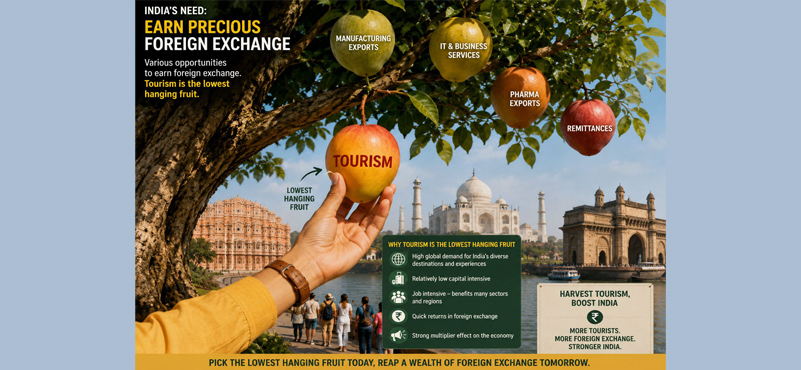
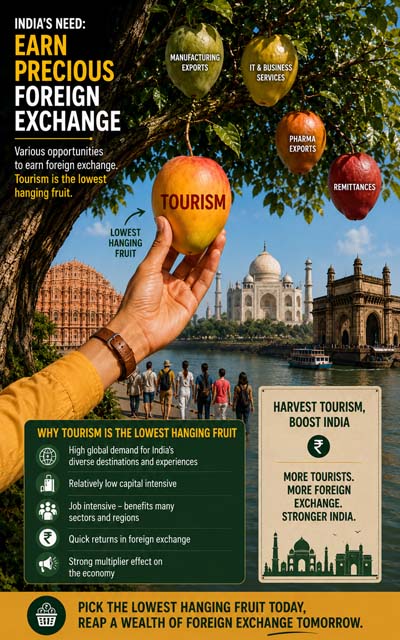 This has become a crying need. Also, important at the same time, is our ability to earn more foreign exchange. Saving is one thing, earning more is another. One big area where we have comparatively low hanging fruit ability to earn almost like tomorrow, and earn well is through foreign or inbound tourism into India. We have repeatedly stressed how infrastructure has improved in many parts of the country and remains relatively underutilized. As the old saying goes, every crisis presents an opportunity. So does this one. That we look up to tourism again. An activity that is said to retain over 90% of the foreign tourist spend within our own country.
For instance, take the Buddhist circuit. We’ve been talking about it for years. Major improvements have happened. There are standard branded hotels now in many of these tourist circuits, including cities, relating to Buddhism, with decent airport infrastructure, where aircrafts can land directly. Similarly, there can be another dozen pockets that can be identified, catering to other interests, almost a quick fix in the present situation.
And a quick fix doesn’t mean unsatisfactory, unfinished, incomplete, ad hoc. No, because the elements are all there. Quick fix does not imply any compromise. It only means working with speed on known, identified, tangibles that are available with us and doing a quick plan to promote specific markets. No packages need to be developed, just awareness, just awareness that we are there, we are open and we are ready to welcome you.
How much India has changed in the last ten years, that story is yet to be told. That for tourism, especially, we are not the developed world yet, but we have ensured considerable ease and comfort in travel, during the last decade. That India of today is considerably more enjoyable, not just the sights and sounds, but also the experience.
 For years we have talked about the importance of earning foreign exchange through tourism. Not much has been achieved. Ironically, in the last ten years, when all big and rapid infrastructure changes were taking place, as the present government has stepped up airport infrastructure, no specific promotion of tourism has been undertaken. Even despite the fact that PM Modi has been the single biggest votary of tourism ever since independence. An irony that remains inexplicable, difficult to comprehend.
Interestingly enough, an interesting coincidence, or a tryst with luck and fate, we are presently in the midst of the traditional slack season, as we have witnessed the annual calendar of activity over years, though the lean part has narrowed. We are now in the month of May with June, July, August and September to follow – at least these months are relatively low occupancy months in the plains in the north and also in many of our metros. Chennai, for instance, or New Delhi, would have adequate room availability over the summer months. These are traditionally lean months, and a good time to, to initiate this renewed thrust on inbound. You will recall, these months are captured domestically by the hills and resorts and not directed towards Agra, Jaipur, Jodhpur, Bhopal, Andhra and even mostly Kerala as well.
So, there is a fair amount of, shall we say, opportunity available between where Indians would like to go as domestic traffic and where foreigners would prefer to visit. Like the Buddhist circuit, that we identified, is not the number leading destination of the Indian domestic in the summer months. So, there is that capacity available. Is it too hot for tourists? Only they will know better. All we need to share is the weather chart, the likely temperature, which in today’s world, is easily available on every mobile phone. It is not an excuse. Travelers know or they find out before they travel. Awareness is the critical issue. Promotion, nothing else.
What would be a prescription that works best? Identify a dozen hot spots that should be marketed, promote the attractions around each gateway. If feasible, as an additional carrot, revise the charter policy and create a window of next 4 months, to fly charters direct into these identified entry gateways. Not necessary, though, the present capacity will also work. As it is, Indian airlines are reducing their flights, and should welcome any new promotion that can generate more traffic for them. Charters are not necessarily cheap, price them high, ensuring quality tourism comes our way. The government can do this well by pricing their permits accordingly, best to leave the detailing to the experts in the field. Charters as only distinct from scheduled services.
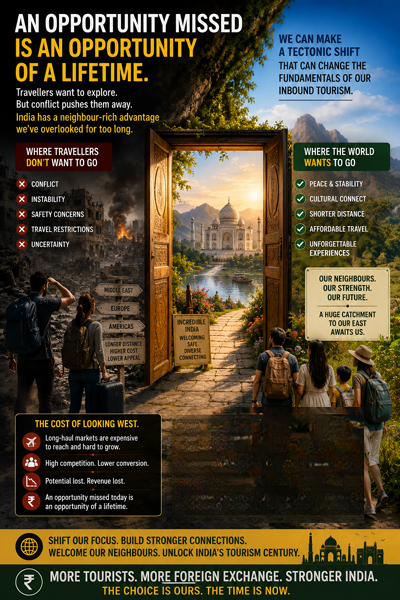
So, while tourism is the low hanging fruit, there are sub-sets within tourism that are even lower hanging. Short haul destinations, especially within South Asia and across the East. Buddhism is the easiest tap to open, as seeking pilgrimages during times of stress is a way of life. Also, for the diplomats to answer better, a good time to open doors and windows to Chinese tourism. Remember, there is new found connectivity in recent years – right through to Australia, Indonesia, Vietnam and so much more. And the plan should be, not just sightsee, not just keep harping upon culture and heritage, but equally on having decent fun, enjoying the night life in our metro cities, of which there is plenty now. As I write this column, I can already visualize dozens of Aussie tourists enjoying Indian beers that we should be promoting to them.
All the above also fits in suitably in the Prime Minister’s vision of Look East, also to build relationships in the neighborhood. It will further build two way traffic as Indians may also begin to opt for close-by international locations, as an extension of their domestic holidays.
If not now even, then when? This is the crucial moment when tourism can perform a perfect rescue act, and this can stay on longer, as our industry expands. While it is time for restraint, to curb buying gold, to curb unnecessary expenditure in foreign exchange, to save on oil and gas consumption, to defer travel overseas, it is also time to promote inbound tourism, again, mindfully and responsibly.
ABOUT THE AUTHOR
 Navin Berry, Editor, CS Conversations, over five decades has edited publications like CityScan, India Debates and Travel Trends Today. He is the founder of SATTE, India’s first inbound tourism mart, biggest in Asia.
Blogs at: https://www.csconversations.in/nb-blogs