From a Nation under a blazing sky to a Republic growing thirsty
India Enters the Furnace
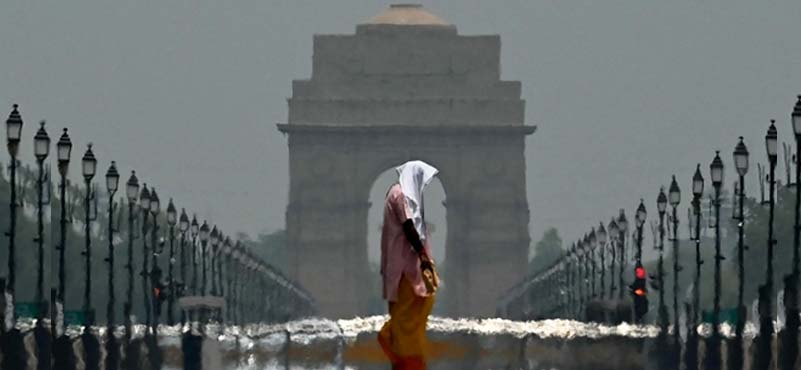
May in India was once understood as a difficult month. It is now increasingly experienced as a national test. The summer of 2026 has arrived early, fiercely, and with a sense of forewarning. Across the plains, plateaus, and coasts, temperatures have climbed sharply even before the calendar reaches its hottest stretch. In several states, the mercury has already crossed 40°C in April, while parts of Maharashtra, Andhra Pradesh and Gujarat have reported heat-wave like conditions.
The India Meteorological Department (IMD) has repeatedly noted a rising trend in the frequency of heat-waves across the “heat core zone” covering Northern plains and Central India. That phrase may sound technical, but its consequences are deeply human: exhausted workers, delayed construction, higher electricity bills, strained hospitals, wilting crops, and daily life reorganised around shade and survival.
A deeper national trend sits behind the headlines. According to the Ministry of Earth Sciences, India’s average temperature has risen by around 0.7°C between 1901 and 2018. In climate terms, that is no minor shift. It changes rainfall behaviour, increases the probability of extremes, and turns once-manageable summers into punishing ones.
Schools alter timings. Families stock water. Delivery riders begin earlier. Office-goers study traffic and weather apps before stepping out. In homes across India, the first conversation of the morning is no longer about plans—but about heat.
Summer is no longer merely weather. It has become infrastructure, economics, and public health.
Heat-wave Nation – When Temperature Becomes a Threat
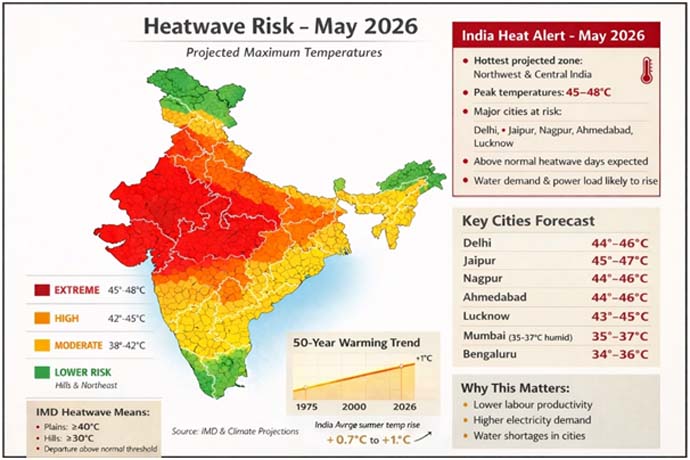
India has always known heat. What is changing is its duration, frequency, and intensity. Scientists and official agencies increasingly describe heat-waves not as isolated anomalies but as recurring stress events. IMD-linked research notes that the duration of heat-waves in India has increased over recent decades, while broader studies show the 21st century has seen more sustained and severe episodes.
This matters because the real danger is not a single hot afternoon. It is the accumulation of stress over days and nights. When nights remain warm, the human body loses precious recovery time. Recent reporting from Mumbai highlighted expert concern over hot, humid nights that deny relief even after sunset.
For outdoor workers, this can be brutal. A mason on a roof, a traffic constable at a junction, a vendor beside a griddle, a farmer in a field, a courier on a motorcycle—each faces heat not as inconvenience but occupational hazard.
If one imagines the past fifty years as a slow incline rather than dramatic spikes, the picture becomes clearer. Each year may differ, but the baseline rises. A hotter baseline means yesterday’s extreme becomes tomorrow’s normal.
The economy also pays. Heat reduces labour productivity, increases cooling demand, stresses transmission networks, and raises costs for industry. When temperatures surge across multiple states simultaneously, the strain becomes national.
The danger, then, is not merely how high the mercury climbs—but how long the body, the city, and the economy must endure it.
The Thirsty Republic – India’s Water Anxiety
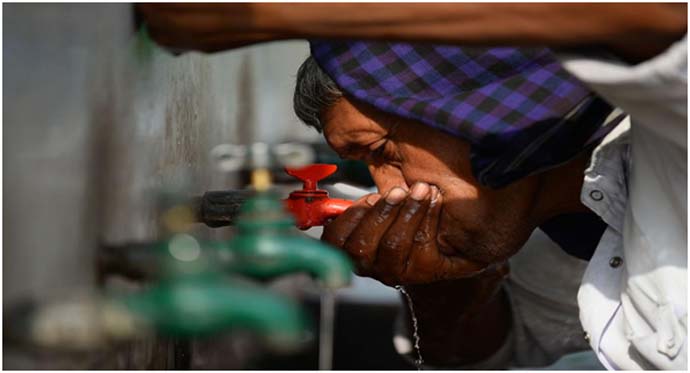
Heat alone is hardship. Heat combined with water stress becomes crisis.
Across India, summer increasingly reveals a difficult truth: many regions remain one weak monsoon away from anxiety. Reservoir levels are watched with the tension once reserved for election results. Tankers become lifelines. Groundwater tables continue to face pressure in many urban and agrarian belts. Climate variability and poor management often meet in the same season.
Cities such as Bengaluru, Chennai and Hyderabad have each, in different years, offered warnings about what happens when growth outruns water planning: tanker dependence, falling lakes, neighbourhood disparities, and emergency restrictions.
But scarcity is not only about nature. It is also about leakage, pricing, storage, recycling, encroachment, and delayed governance. A city can lose vast quantities through broken pipes while residents queue with buckets.
The burden is unequal. A premium apartment complex may summon private supply. An informal settlement may wait hours for a municipal line. A family with storage tanks plans ahead. A one-room household cannot.
Water has therefore become more than a utility issue. It is now a question of dignity, public order, urban planning, and social fairness. India does not lack rainfall in absolute terms; it struggles with when it falls, where it falls, and how little of it is stored intelligently.
A thirsty republic cannot be sustained by emergency tankers forever.
Urban Chaos – When Cities Cannot Cope
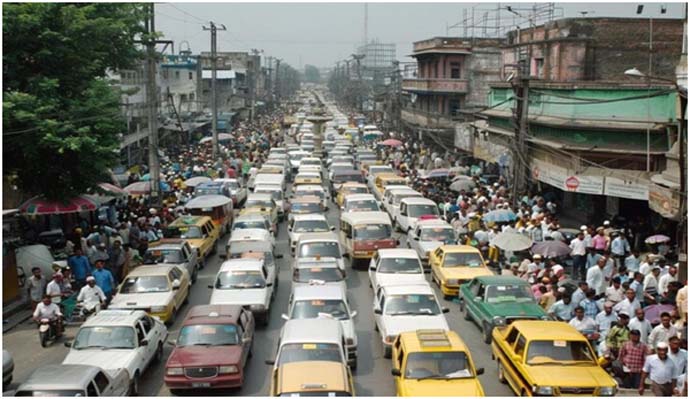
Every Indian summer exposes a truth that glossy brochures and ribbon-cuttings often conceal: many of our cities are operating beyond design capacity. Roads built for another era carry millions more vehicles. Water systems planned for smaller populations strain under expansion. Power grids must cool far denser skylines. Public spaces shrink just as citizens need them most.
Heat amplifies every urban weakness. Traffic snarls become harsher when commuters sit in metal cabins under 42°C sun. Garbage deteriorates faster. Construction dust thickens the air. Pavements become hostile to pedestrians. Public transport platforms feel more crowded and less forgiving.
India’s urban population has risen rapidly over the past decades, with the World Bank estimating that more than one-third of Indians now live in urban areas, a share expected to grow steadily. That demographic shift has often outpaced infrastructure renewal.
The result is a cycle of seasonal stress:
- Summer: heat, water demand, power peaks.
- Monsoon: flooding, potholes, drainage failures.
- Winter: pollution, respiratory distress in many Northern cities.
The cumulative effect is distinctly visible in major cities.
- Mumbai battle land scarcity and transport overload.
- Pune wrestles with rapid expansion and traffic stress.
- Ahmedabad has pioneered heat action planning but still faces rising climate pressures.
- Kolkata combines humidity, density and ageing infrastructure.
Every summer reveals what city planning forgot.
Delhi – Capital at Boiling Point
New Delhi is not merely a metropolis. It is the seat of the Union government, diplomatic nerve centre, media capital, and symbolic showcase of modern India. Yet each summer, the capital confronts the same elemental adversary: heat.
Delhi routinely records some of the most punishing temperatures among major world capitals during late spring and early summer. Dry winds sweep in from the northwest. Heat radiates from roads, glass towers and concrete colonies. Green cover, though significant in parts, is unevenly distributed. Vast built surfaces create an urban heat island effect that can keep nights warmer than surrounding rural zones.
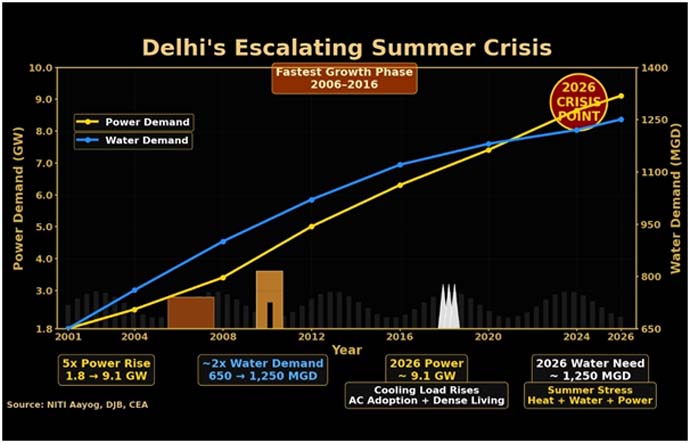
The paradox is striking. In the city where national policy is drafted, climate stress is not theoretical. It is immediate and visible.
- Ministries discuss sustainability while air-conditioners hum at full load.
- Diplomats commute through traffic slowed by heat and dust.
- Street vendors improvise shade beside corridors of power.
- Government workers monitor advisories while ordinary citizens monitor water timings.
Delhi’s peak electricity demand has repeatedly touched record levels during severe summers as cooling needs rise sharply. Utilities prepare each year for intense pressure on supply systems.
What happens in Delhi matters nationally because it shapes perception. If the capital struggles with heat management, citizens naturally ask what hope remains for smaller municipalities with fewer resources.
The capital of power often feels powerless before heat.
Water, Air & Mobility – Delhi’s Daily Battle
Delhi’s summer challenge is not one crisis but three interconnected ones: water, air, and movement.
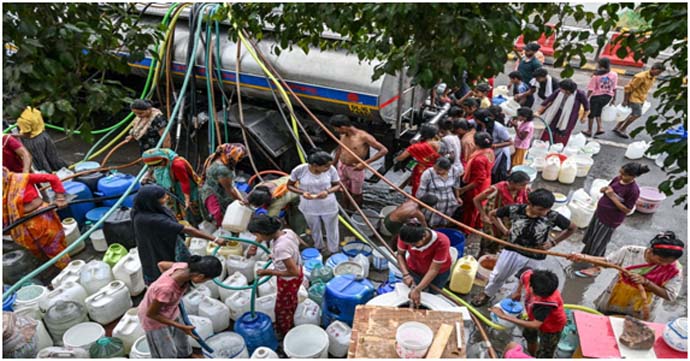
1. Water: The Seasonal Nerve Point. Delhi depends significantly on river systems and supplies linked to neighbouring states. This makes water not only an engineering question but an intergovernmental one. In hot months, reduced flows, rising demand, leakages, and neighbourhood inequalities sharpen tensions.
Some localities receive regular supply. Others rely on storage tanks, pumps, or private tankers. In lower-income settlements, water collection can consume hours of labour each week.
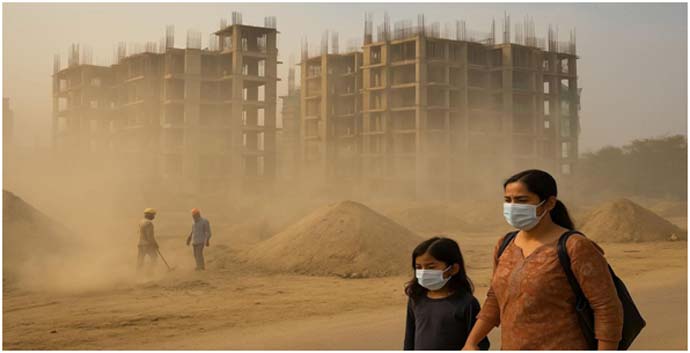
2. Air: A Year-Round Burden. Winter smog dominates headlines, but summer does not mean clean air by default. Dust, construction activity, vehicular emissions, and ground-level ozone episodes continue to affect breathing conditions. Hotter temperatures can worsen ozone formation in urban atmospheres.
3. Mobility: Endurance by Commute. Delhi has one of the world’s most significant urban transit systems in the Delhi Metro—a major civic success that has transformed movement patterns. Yet the sheer scale of the metropolitan region means roads remain crowded, buses stretched, and last-mile travel inconsistent.
For millions, the workday includes:
- Walking in high heat to bus stops.
- Waiting on exposed roadsides.
- Riding packed buses or feeder services.
- Navigating congested arterial roads.
- Returning home through dust and evening heat.
In Delhi, even movement can become a form of endurance.
Politics in the Heat – Governance Under Stress
Summer has a way of stripping politics to essentials. Ideology recedes. Slogans fade. Citizens ask simpler questions:
- Will the tap run?
- Will the power stay on?
- Will the road move?
- Can children step outside safely?
The capital’s layered governance structure has long complicated urban management. Responsibilities are divided among the Union government, the Government of NCT of Delhi, municipal bodies, development agencies, police, and neighbouring state authorities.
In ordinary months, this can be bureaucratic. In summer, it can become consequential.
When shortages emerge, blame often travels faster than relief.
- Water disputes can widen into inter-state arguments.
- Power concerns trigger anxieties over preparedness.
- Air quality debates return to enforcement failures.
- Traffic paralysis raises questions of planning discipline.
- Encroachment and illegal construction expose weak oversight.
This is not unique to Delhi. Across India, climate pressure is becoming a governance test. Cities that once treated summer as a seasonal inconvenience must now treat it as a strategic management challenge.
The electorate increasingly judges governments not only by promises made, but by systems maintained. A repaired transformer, a shaded bus stop, a functioning drain, a predictable water schedule—these are now acts of political credibility.
Heat strips politics to essentials: who can deliver relief?
Human Cost – The Unequal Summer
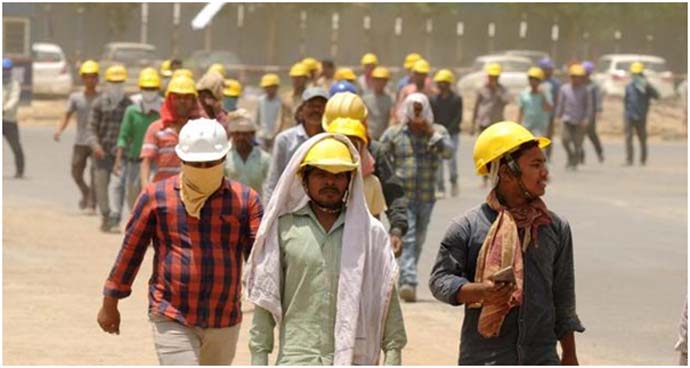
Summer is often described in averages: average temperature, average rainfall deficit, average humidity. But suffering is never average. It is distributed unequally.
The professional in an air-conditioned office, commuting in a cooled car, experiences heat differently from the worker laying asphalt at noon. The family in a shaded apartment tower experiences water scarcity differently from the household waiting with plastic containers for a tanker.
Those who bear the harshest burden often include:
- Construction labourers.
- Street vendors.
- Security guards.
- Delivery riders.
- Drivers and transport workers.
- Sanitation staff.
- Elderly people living alone.
- Children in poorly ventilated schools.
- Women managing household water shortages.
For them, summer is not a headline. It is a daily negotiation with exhaustion.
Health systems also absorb the strain: dehydration, heat exhaustion, aggravated respiratory illness, cardiovascular stress, and reduced sleep during hot nights. The World Health Organization has repeatedly warned that extreme heat is among the fastest-growing climate-related health risks globally.
There is also a hidden economic cost. Missed workdays, lower productivity, spoiled food, higher electricity bills, transport delays, and medical expenses combine into a silent tax on the vulnerable.
Summer is the most democratic season in theory, and the most unequal in practice.
Beyond Survival – How India Can Adapt
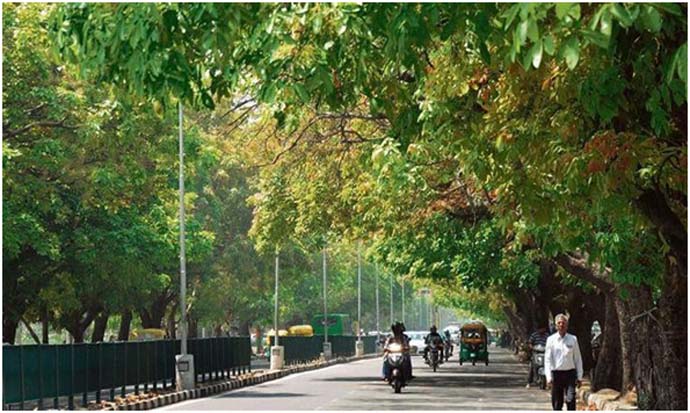
India cannot abolish summer. It can, however, become smarter in facing it. The question before policymakers is whether the nation will continue reacting to each hot season as emergency—or begin designing for it as certainty.
Across the world, climate-resilient cities are investing in cooling corridors, shaded streets, reflective roofs, urban forests, water recycling, smarter grids, and early warning systems. India need not invent every solution, but it must scale those that fit its realities.
India-Wide Priorities
- Heat Action Plans in every major city and district.
- Rainwater Harvesting with enforcement, not tokenism.
- Urban Lake and Wetland Revival.
- Cool Roof Programmes for low-income housing.
- Reliable Public Transport to reduce heat-heavy commutes.
- Smart Power Networks for peak demand management.
- Public Cooling Shelters in dense urban zones.
- Data-led Local Forecasting and alerts.
What Delhi Can Lead On
As the national capital, New Delhi can set standards for the country:
- Shaded pedestrian routes.
- Dust suppression at construction sites.
- Electric buses and cleaner fleets.
- Treated wastewater reuse.
- Integrated command systems across agencies.
- Heat-resilient schools and clinics.
- Water loss reduction through pipe modernisation.
The deeper challenge is cultural as much as technical. India’s growth story has long celebrated speed, scale, and ambition. It must now also celebrate maintenance, efficiency, shade, water discipline, and breathable streets.
Because the climate of the future will reward nations that prepare quietly more than those that boast loudly. India cannot negotiate with summer. It can only prepare for it.
And if the capital leads, the country may yet endure smarter than it suffers.
ABOUT THE AUTHOR

Lt Gen Rajeev Chaudhry (Retd) is a social observer and writes on contemporary national and international issues, strategic implications of infrastructure development towards national power, geo-moral dimension of international relations and leadership nuances in changing social construct.