Introduction
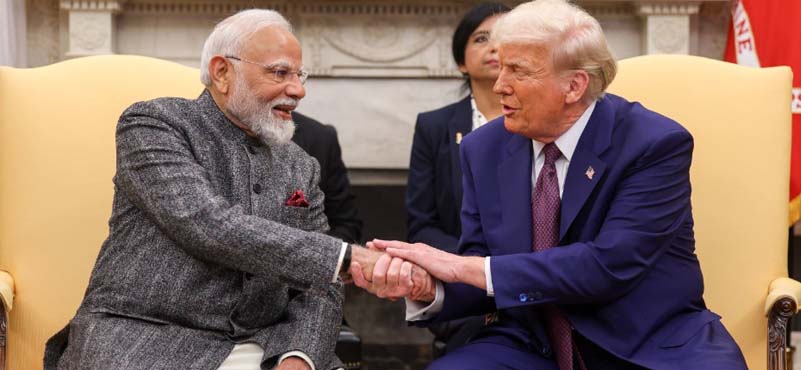
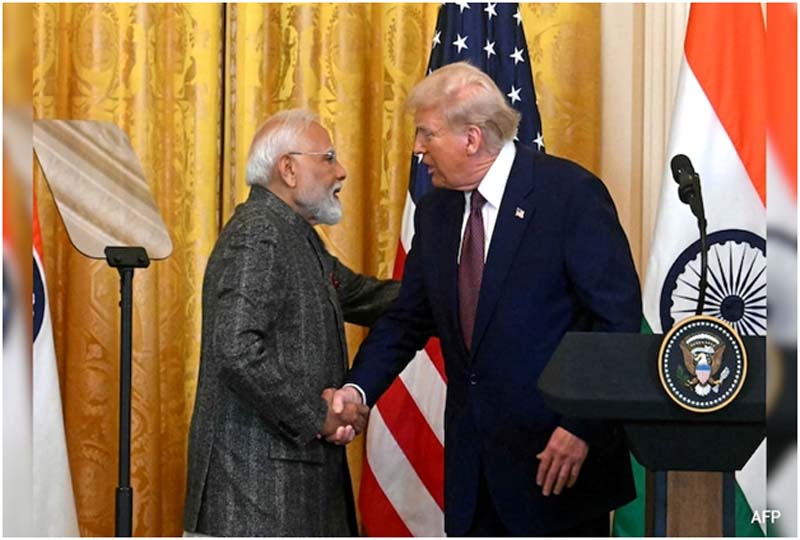
On 02 February the US President Donald Trump announced the Indo-US trade deal through a message on Truth Social where he said an agreement had been reached after a phone call with Prime Minister Narendra Modi.
“Out of friendship and respect for Prime Minister Modi and, as per his request, effective immediately, we agreed to a trade deal between the United States and India, whereby the United States will charge a reduced reciprocal tariff, lowering it from 25 per cent to 18 per cent,” he said.
“They will likewise move forward to reduce their tariffs and non-tariff barriers against the United States, to zero. The Prime Minister also committed to ‘Buy American’, at a much higher level, in addition to over $500 billion of US energy, technology, agricultural, coal and many other products,” he added.
He also wrote that Prime Minister Modi has also agreed to “stop buying Russian oil”, which meant that the total tariff now stood at 18 per cent, a White House official told US media.
President Trump’s post was welcomed by Prime Minister Modi, who said on X that it was a “wonderful announcement” and that “when two large economies and the world’s largest democracies work together, it benefits our people and unlocks immense opportunities for mutually beneficial cooperation”.
The deal will see the US lower tariffs from 50 per cent to 18 per cent on made-in-India items like jewelry and textiles. In return, India will reportedly reduce its tariffs on US goods to zero from an average tariff rate of 17 per cent.
Indo – US Trade
What is significant about India–US trade is its depth and resilience. It rests on structural complementarity, with India exporting high-value services, pharmaceuticals and engineering goods, while importing advanced technology, capital equipment, energy and defence equipment from the US.
The centrality of services trade, particularly in information technology and knowledge-based sectors, creates durable linkages that extend beyond conventional merchandise exchanges. The trade of over $ 200 billion including services enables India to maintain a surplus while integrating into the US advanced technology value chains.
While, India–China trade is asymmetric, dominated by imports of manufactured goods and intermediates and resulting in persistent deficits and strategic vulnerability. Trade with the European Union is diversified but regulation-intensive, shaped by stringent standards and prolonged negotiations.
Thus, Indo-US trade uniquely combines economic complementarity, technological upgrading and geopolitical convergence, making it one of India’s most strategically consequential bilateral trade relationship.
While the US has wielded tariffs as economic weapons for over two centuries, using them to protect domestic industries, fund government operations, and coerce foreign nations into compliance.
The fact is that the US discovered it lacked decisive leverage while imposing the tariffs on India: hence de-escalation became necessary. The tariffs were unsustainable and the outcome underscores the resilience of Indo–US trade, which ultimately compelled pragmatism even when politics temporarily overwhelmed economics.
India’s restraint in negotiations with the US was underpinned by a parallel strategy unfolding away from the spotlight. This led the Commerce Minister Piyush Goyal to state at the Berlin Global Dialogue in Germany; ‘We are talking to the US, but we do not do deals in a hurry and we do not do deals with deadlines or with a gun to our head.”
Over the past few months, New Delhi has signed five trade agreements with major partners, expanding market access for Indian goods and services even as US talks stalled.
The most consequential being the signing of the trade deal with the EU which was negotiated over several years. By gaining preferential access to large markets outside the US, India reduced its vulnerability to American tariff pressure and exporters gained alternative pathways. In fact, deepening of economic ties to navigate the era of great power politics is what Canadian Prime Minister Mark Carney spoke of at Davos and what India has demonstrated.
Also, since his arrival in January, the US Ambassador to India Sergio Gor has managed to reset the tone. He seems to have recognized that the tariff rate for India that was the highest in the world (alongside Brazil’s) was both unsustainable and an obstacle to progress relations in any other area. He therefore, focused on removing it.
The deal prompted India’s Finance Minister Nirmala Sitharaman in an interview with PTI to say that “our exports will pick up now, that is my expectation… along with having found new markets where they will continue to operate,” “It is a good augury for them (exporters)”.
For India, expanded access to the US market strengthens export competitiveness, supports manufacturing and embeds the country more firmly in resilient global supply chains. For the US, deeper trade with India diversifies sourcing, opens a high-growth market for energy, defence and advanced manufacturing and reinforces a trusted Indo-Pacific partner.
Reactions
Veteran US trade negotiator Wendy Cutler, Senior Vice-President at Asia-focused think-tank Asia Society Policy Institute (ASPI), stated that “the announcement is certainly a relief to our Indian partners, who have faced some of the highest tariff rates of any partner,”
“It will help clear the pathway for the US and India to work cooperatively on other pressing matters concerning critical minerals, technology cooperation and supply chain resiliency,” she said. While Dr Aparna Pande, a Research Fellow for the Washington-based think-tank Hudson Institute has stated that ‘the India-US strategic partnership has collapsed and will not recover’. She pointed to India’s omission from key policy documents released in recent weeks.
The Trump administration’s National Defence Strategy does not reference India at all, while the more encompassing National Security Strategy makes only a passing mention of the nation that was not long ago seen as key to countering China.
“The relationship lacks strategic underpinnings despite ongoing commerce and military-to-military ties,” Dr Pande said, noting that the trust that sustained the partnership for over 35 years had evaporated.
She has also predicted complications arising from scrutiny of the deal by the Indian Parliament and from the bureaucratic insistence on a detailed, written agreement.
Prime Minister “Modi’s public message focused on tariffs, without mentioning the US$500 billion purchase commitment or dropping Russian oil, suggests that the government is balancing domestic political pressure with the need to release formal texts,” she said.
The maths did not add up either, she said. India’s purchases will not be limited to the US; it will buy oil and gas from the United Arab Emirates, engage with Europe, and sign FTAs with multiple countries, creating potential clashes with existing commitments and necessitating escape clauses.
In another geopolitical dimension, Mr Trump tied the deal to his attempt to broker peace in the Russia-Ukraine war, saying India’s agreement to stop buying Russian oil “will help end the war in Ukraine”.
Analysis
The newly announced trade deal between the US and India promises commercial relief but more needs to be done to heal the rupture in bilateral ties. Analysts in the US pronounced the US-India deal as lacking strategic depth.
The deal is transactional, not transformational, said Danny Russel, a former senior US State Department official who served in the Obama administration. “It stabilizes the relationship, but it doesn’t rebuild strategic confidence is what he stated. He went on to state that “Trump’s approach has taught India – and many US partners – that today’s Washington is unreliable. The rational response isn’t closer alignment, it is hedging and reducing exposure to US pressure”.
It remains to be seen if the trade deal will serve to resurrect the Quad, between the US, Japan, Australia and India, which failed to hold a leader-level meet in 2025 amid US-India tensions.
“The Quad is not dead, but its pulse is weak in the absence of confidence in the US or a shared set of objectives among all four countries,” said Danny Russel.
The biggest achievement between India and the US since the 2000s had been a deepening relationship. Because of all that has happened in recent months, including trade tensions and the US praising Pakistan post operation Sindoor the relationship that cut across party lines has plummeted.
A lot of people put in a lot of work over recent decades to ensure that third-country relationships to which either side objected did not affect U S -India relations; namely, India’s relationships with Iran and Russia, to which Washington often objected, and America’s relations with Pakistan. In light of this the American decision to impose a 25 percent oil penalty tied to third-country choices was the perverse foreign policy impact of the Trump’s administration’s recent choices that set a bad precedent that will linger, even if it is now rolled back in this new tariff deal.
It was obvious that imposing an unprecedented 25 percent “Russian oil tariff” would only damage relations, since the US had no realistic chance of persuading India to sever its relations with Moscow.
The massive 50% tariffs imposed by the US, and their subsequent rollback under a different framing, can therefore be best understood as a mix of transactional trade politics and face-saving recalibration.
The fact is that the trade dispute, resulting in increased tariffs intersected with issues regarding strategic autonomy and shifting geopolitical expectations. Non-trade irritants included India’s friendship with Russia and its neutrality on Ukraine as well as its purchase of Russian crude oil. The tariffs thus functioned less as an economic correction to trade ‘reciprocity’ and more of a tool of diplomatic coercion. These difficult dynamics further complicated the trade dispute and Indo- US relations.
Conclusion
The leader-level commitment and de-escalation are important signals. Till a formal treaty is signed it implies freezing further tariff escalation while technical details are finalized. The outcome rather than a process is significant. There is no doubt that the agreement has compressed months of back-channel negotiations and the market reaction has been more than welcoming.
While the precise contours of the agreement remain indistinct and its legal architecture has yet to be formally articulated, the exchange between the two leaders may have eclipsed bureaucratic procedure but it has not diminished the strategic significance of the moment. Until concrete terms are revealed, businesses and policymakers have the advantage of navigating the uncertainty in US – India trade relations under the veneer of restored goodwill.
The episode demonstrates that tariffs were used as a weapon rather than a sustainable policy tool, and their removal reflects recognition of mutual dependence framed as a diplomatic victory as India was neither strategically dependent on US trade nor willing to concede core policy autonomy. It also exposed a US weakness in dealing with a confident and more self-reliant India which demonstrated that it is capable of resisting unilateral pressure while standing up for its national interests.
The fact is that trust in a relationship is more difficult to build than to lose and while confidence has been restored the ceiling of trust needs to be raised.
ABOUT THE AUTHOR
 Maj Gen VK Singh, VSM was commissioned into The Scinde Horse in Dec 1983. The officer has commanded an Independent Recce Sqn in the desert sector, and has the distinction of being the first Armoured Corps Officer to command an Assam Rifles Battalion in Counter Insurgency Operations in Manipur and Nagaland, as well as the first General Cadre Officer to command a Strategic Forces Brigade. He then commanded 12 Infantry Division (RAPID) in Western Sector. The General is a fourth generation army officer.
 Major General Jagatbir Singh was commissioned into 18 Cavalry in December 1981. During his 38 years of service in the Army he has held various command, staff and instructional appointments and served in varied terrains in the country. He has served in a United Nations Peace Keeping Mission as a Military Observer in Iraq and Kuwait. He has been an instructor to Indian Military Academy and the Defence Services Staff College, Wellington. He is a prolific writer in defence & national security and adept at public speaking.