“Follow-up on the IndiGo Crisis: In weak defence of the DGCA”
As the IndiGo crisis unfolded, the culpability of the Indian aviation regulator, DGCA has come under intense scrutiny. When public anger mounts, the airline protagonists at the front-end feel the maximum heat. However, it is but natural that the wrath also gets directed towards the Govt agencies. The outcry is that while one made it happen, the other allowed it to transpire.
So, the exam question is: Can the DGCA be held accountable for the failings of a business entity?
I wish the answer was a simple ‘yes or no’ and not based on emotive passions that are currently ruling the sky.
At a very fundamental level, a profession regulated by law is a regulated profession. It implies that a body designated by the Govt is given the authority to frame laws for practice of that profession. An automatic corollary is that violation of any laws, as laid down by the regulator, is legally punishable to the degree specified or arrived at by the court.
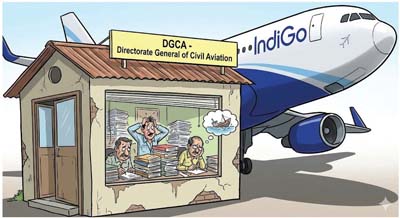 In case of Indian aviation, the office of the Director General of Civil Aviation (DGCA) is the regulatory authority which works directly under the aegis of the Ministry of Civil Aviation (MoCA). Civil flying in Indian skies for all airlines and other operators is governed by DGCA regulations.
DGCA itself takes inputs from the International Civil Aviation Organization (ICAO) which is a UN agency which sets global standards for safe, secure and efficient flying.
Besides that, there exists a significant industry organization, called the International Air Transport Association (IATA). This group promotes cooperation between civil operators and enables sharing of best practices worldwide.
The job of the aviation regulator is not limited to framing of laws and policy alone. Compliance monitoring and law enforcement through regular audits, inspections and sample checks is also very much part of their activity sphere.
Licensing of airlines, airports, aircrew and other aviation personnel, besides maintaining records and documentation is another important tasking for them. Plus, flight safety issues and public grievances are also part of their scope and processed through them.
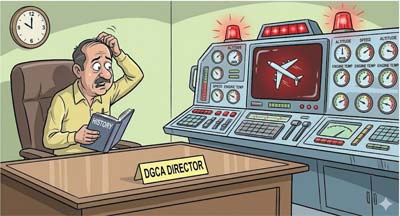 The remit of the DGCA is vast and critical due to the nature of the profession. They are practically the nerve centre of aviation activity in the country. Every day, thousands of people taking to the skies, take ‘safety of flight’ for granted. They have an unspoken belief that someone out there is doing his job ethically and conscientiously.
Indian aviation is big, with a dozen (big and small) airlines, flying close to 200 million+ passengers annually through approximately 130 airports. Incidentally, 50 more airports are in the pipeline, with an overall 7% growth rate in domestic capacity. It is indeed a tall order for the regulator to undertake all the mandated tasks diligently within the ambit of extensive & strict legislation.
It should be noted from open-source info that the DGCA, which is sanctioned for over 1600 vacancies at various levels, is currently manned with approximately only one third of that figure. Simply put, they are grossly understaffed.
One also openly wonders, if the functionaries have the right level of aviation knowledge and skills to undertake the expected tasks professionally? Have they been adequately trained to a level where they are able to separate the wheat from the chaff? To be able to pick out, what is critical rather than the mundane.
 Although, not wanting to make a wild co-relation and a misattribution of individual capability, I cannot hold myself from pointing out a stark fact: The current Director General of the DGCA is a B.A (Honours) in History. He was earlier an Addl Secy in the Ministry of Agriculture and Farmer’s Welfare.
I guess a medical professional should ideally be heading a multi-speciality hospital. Similarly, would it not be better that a person with an aviation background is made in charge of this extremely important post? Aviation is far too technical and far too serious to be managed by a general-duty bureaucrat. However capable he may be, he would be totally at sea while looking at the skies.
I am reminded of a seminar conducted by the GoI on defence offsets many years back. Malaysia was represented by a young lady, who was their Minister of Offsets. As it turned out, she was a PhD in Offsets from Oxford and extremely knowledgeable in her domain. To think that a country with probably an offset budget of less than 5% of ours, was appointing such a highly qualified person to fulfil the requirement of ‘a right person for the right job’.
It is imperative that a watchdog organization like the DGCA must be focused, agile, alert and equipped with a very strong instinct of spotting potential safety issues. To reach that evolved stage, organized training and research is a must. Institutional capability is not built in a day, and institutional knowledge must not be lost if some members leave as per natural progression in life.
Plenty of charges of bribery, corruption and giving unfair concessions are being directed against the DGCA on social media. There is even an anonymous letter that has been circulated, trying to whistle blow the internal struggles within IndiGo. Conspiracy theories of a foreign hand to time the whole affair with Putin’s visit are also doing the rounds.
How true or untrue these are, is a matter of speculation in the absence of concrete evidence. The government is ordering a high-level inquiry into the crisis. However, my knowledge about bureaucracies worldwide, tells me a thing or two about internal revelations in such efforts.
Coming to the airline in the news, IndiGo has almost 2/3rd market share in the Indian skies. That is huge and makes them a strategic national resource in terms of contribution and vulnerability. And it is not their fault that they are in that position.
The reality is that any big player will always try to influence govt policies to its advantage. Don’t blame them for it, for it is simply business. It happens all the time all over the world. In the US, they use a fancy word for it called, ‘lobbying’. It is also understandable that bigger players have bigger voices. The matter of concern is whether regulatory agencies acted unfairly, unethically or unsafely in accommodating their concerns.
IndiGo is a low-cost airline. Such establishments work on the principle of ‘Look after the pennies and the pounds will take care of themselves.’ Towards that end, they cut corners and costs at every possible opportunity. It is an existential requirement for them, because their model is built around extremely low per-capita profit margins, albeit with higher numbers.
Low cost is also achieved by reducing cost of hiring in all departments. If the FDTL demands a certain number of flying hours in a week, they will try to plan so that each pilot delivers as close as possible to that figure. They are stingy and miserly without being apologetic about it.
They tend to stretch the mandates of the regulatory bodies to the ultimate limits while remaining just compliant. That state may be far from industry best practices, but then that is the risk they are willing to take.
Coming back to our original poser, could the DGCA have averted it by intervening in time? Let us leave aside all the speculative hypothesis for the time being. After that, my take is that in their current state of staffing and tasking, they just don’t have the bandwidth to do a deeper level of monitoring that we are expecting of them. So, the answer is-No!
As the crisis comes to a temporary close, I am visualizing no earth-shattering developments. A few heads will probably roll at IndiGo and DGCA, the company will be penalized fiduciarily, a few process changes for enhanced monitoring will be introduced and then it may be business as usual.
What I am wishing though is, that we should treat this crisis as a blessing in disguise. Meaning, a terrible but non-catastrophic event spurring us to make major changes in our outlook. With this happening, we are getting away with only cancellations, widespread disgruntlement and nothing more serious.
The Indian aviation is poised to leap, is an inevitability. That something akin or worse does not happen again, requires a full revamp of the regulatory organization to convert them into a vibrant, research-based, global leader in their domain.
An organisation which is not apologetic or on the defensive, but which is genuinely respected and even feared by potential errant operators. So that they are led and manned by the best in the field. So that, oversight means supervision and not omission.
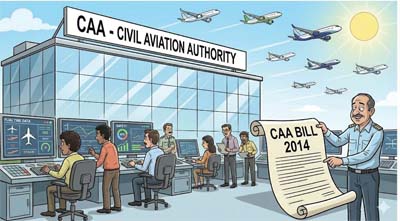
This call for a full structural revamp is nothing new. *Incidentally in 2012, looking at the growth trajectory of aviation in the country, the Govt (read MOCA) ordered a major study for drafting a bill for creation of a CAA (Civil Aviation Authority). This study was led by a very qualified and reputed ICAO consultant Dr Ludwig Weber. This Authority was set to replace the DGCA.
This new organisation aimed to provide greater autonomy, enhanced funding, modern infrastructure, appropriate manning and improved administration (including removal of recruitment woes) to the aviation safety regulator. After going through the standard parliamentary procedures, the bill was approved by the Union cabinet in Feb 2014.
For reasons best known to the Govt, the bill never transformed into formal legislation and remains on the backburner for over a decade. Hopefully, the IndiGo crisis will now provide the desired impetus to shake off the dust from the Bill, review it if required, and see it through without delay.
As the Billboard reads, “URGENTLY REQUIRED: A regulator who fits the bill!”
ABOUT THE AUTHOR
 Air Vice Marshal Rajeev Hora is a Qualified Flying Instructor and an Experimental Test Pilot with over 3800 flying hours on multiple types of aircraft. His last appointment was as AOC HQ MAO at Mumbai. Previously held appointments are AOC Adv HQ WAC (Jaipur), Comdt Aircraft and Systems Testing Establishment (ASTE), Deputy Comdt AFA, AOC AFS Bidar and Deputy Technical Manager (Air) in the Acquisition Wing of MoD. He has earlier commanded a Jaguar squadron and was also the Team Leader of the IAF’s Hawk Aircraft Project Team in the UK.