Kautilya’s Sane Logic of a Stable Neighbourhood
Viksit Bharat is a destination whose course is well set, but what complicates it is the landscape around it. The mismatch is what makes the coming decade tricky. For India, the case for a stable neighbourhood is not a modern invention. It sits at the heart of the oldest strategic thinking produced on this subcontinent. Kautilya’s view of the region was blunt and unsentimental: a state’s first ring of security is shaped by the conduct and condition of the powers that surround it. No empire, no matter how strong internally, could remain secure if instability or hostile influence took root in its immediate vicinity. His “mandala” idea wasn’t a philosophical flourish; it was a survival manual. A neighbour slipping into disorder, or falling under another power’s grip, was treated as an early alarm, not a distant development.
The logic remains unchanged today. India cannot build long-term power or economic weight while ringed by states drifting into conflict, radicalisation or external control. Stability around India is not charity, diplomacy or goodwill. It is strategic insurance. When the circle outside is steady, India can concentrate its energy on growth, innovation and deterrence. When the circle fractures, India spends its time putting out fires it did not start. Nothing has made Kautilya more relevant than the neighbourhood India faces now.
The Shift in Regional Tectonic Plates
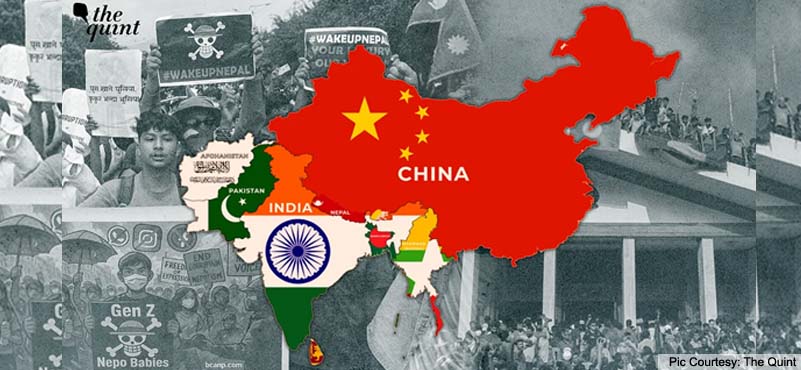
India is hemmed in today by a turbulent neighbourhood. Cross-border terrorism, illegal migration, drugs and arms smuggling, the dark web, and regional instabilities engulf it. The shift has been slow in parts, violent in others, but unmistakable everywhere. In the last three years, nearly every country around India has moved into some form of political erosion, internal fracture, ideological extremism, economic crisis, or been exploited by external leverage. These aren’t scattered disturbances. They form a tightening arc of instability, with India facing the all-around brunt in the internal security domain. Ironically, the shift of the tectonic plates has reduced India’s influence in the region.
Pakistan: A State Exhausted by Its Own Contradictions
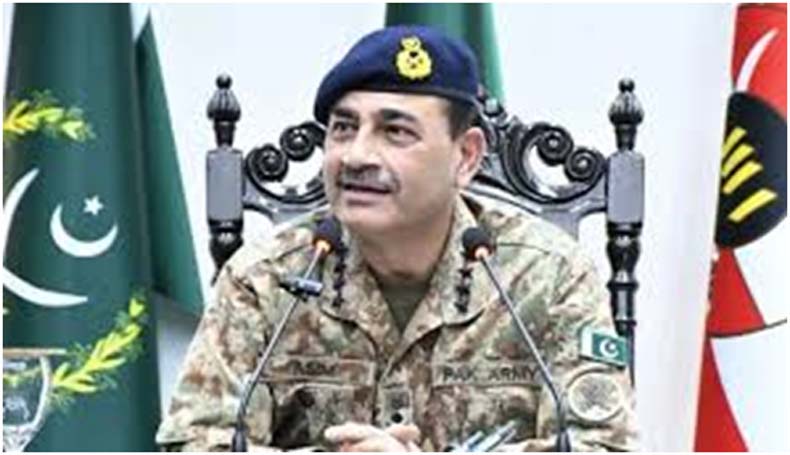
Pakistan looks like it’s perpetually one shock away from the edge. The only consistency is the rise of the military with sweeping powers. The economy is barely staying above water; the political system doesn’t function unless the military wills it; and the space for extremist groups, some old, some newly reassembled, has widened. People often describe Pakistan’s instability as cyclical. What feels different now is the erosion of the centre. The institutions that once gave the state its coherence, be it civil service, judiciary, or even parts of the military, seem unable to keep pace with the disorder.
For India, this is a strategic headache that never really goes away. A Pakistan bogged down in its own crises may lack the appetite for major confrontation, but weak states generate a different set of risks. Border management becomes harder. Radical groups slip across lines that are otherwise heavily fenced. Arms and narcotics networks find openings. And there’s always the uncomfortable knowledge that a nuclear weapons state with poor governance has a longer tail of risk than most countries like to admit.
It doesn’t matter how strong India’s economy is; if Pakistan keeps fraying, India burns time and political energy simply managing proximity. Islamist radicalism is no longer a proxy tool in Pakistan; it is a permanent institution and the cultural character of the nation. The Pakistan Army is the preserver of this ideology and the one which calls the shots. Their target, being India, remains central.
Bangladesh: The Chameleon Act
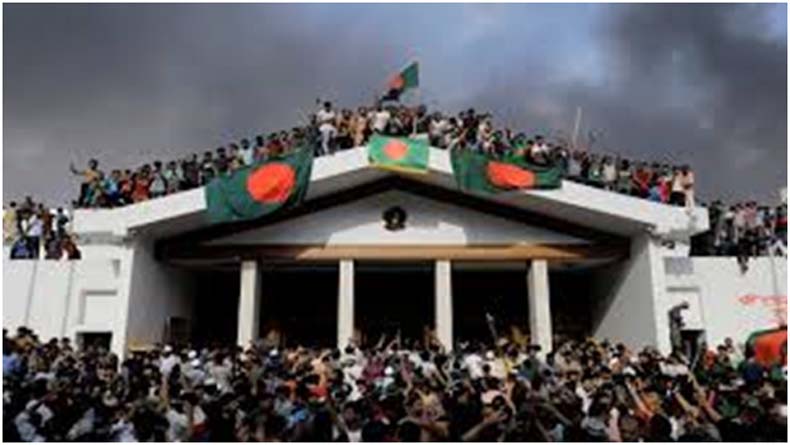
The collapse of the Hasina era was not just a political transition. It ripped open space long contested by Islamist networks and foreign handlers. The 2024 revolt did not simply result in a regime change and a puppet caretaker; it exposed how deeply Jamaat-e-Islami networks and Gulf-funded madrassa chains had penetrated society, aided and abetted by Pakistan ISI. A country that once fought its own Islamists with courage now finds itself hostage to them. Elections have grown contentious. Opposition space has narrowed. And the economic model, earlier dependent on garments, remittances, and concessional financing, has begun to feel its limits. Inflation over the last two years has hit household budgets hard.
Bangladesh’s China bonhomie and distancing from India adds another dimension. Bangladesh’s invitation to China for the Teesta project alters more than a riverbank. It reshapes the security calculus of eastern India. Any external presence near the Siliguri corridor, military or civilian, creates national security challenges. When that external actor is China, the asymmetry shifts from a challenge to a red line.
India’s impact as a turbulent neighbour has been immediate. Border districts on the Indian side saw the effects almost immediately by way of illegal crossings, extremist chatter bouncing across digital channels, and a familiar mix of propaganda and intimidation drifting into vulnerable pockets. What Dhaka loses in control, India gains in complications, and the scale of refugees tells its own story. None of this is episodic. It reflects a deeper shift in Bangladesh’s political core. India’s Northeast’s economic prospects are tied to a stable transit through Bangladesh. Bangladesh’s stability and proximity impact India’s energy cooperation, border economies, and the larger Bay of Bengal regional play.
Myanmar: Collapse Spilling Across the Border

Across the eastern frontier, Myanmar’s civil war has reached a point where the state exists only on paper. Militias, ethnic armies and freelance fighters run the show. For India, this isn’t someone else’s civil conflict; it is a live security threat spilling into Manipur, Nagaland and Mizoram. Refugees, weapons and narcotics cross freely because the other side of the border has no authority left to stop anything. Drone strikes on insurgent camps may remove one problem at a time, but they do nothing to halt the structural collapse next door.
China has found increasing space in this chaos, backing different groups and gaining influence. India’s entire “Act East” vision was predicated on Myanmar serving as a land bridge. That bridge now resembles a fault line. This is the kind of geopolitical complication that economic planning cannot simply wish away.
Sri Lanka’s Stability Instability Paradox
Sri Lanka is quieter on the surface, but the turbulence hasn’t gone away. The economic crash didn’t end with the IMF paperwork; people are still paying inflated prices, shortages return whenever the government stumbles, and the political class is split between survival mode and election manoeuvring. Beijing hasn’t stepped back either. It’s recalibrated with fewer flashy announcements, more silent leverage through ports, infrastructure development, energy projects, and debt renegotiations that keep Colombo tethered. The Indian Ocean routes around the island have seen more unusual vessel movement this year, and that alone tells its own story. For India, the risk isn’t a dramatic collapse; it’s illegal migration spikes, intelligence footprints in the Tamil belt, and the economic drag that pushes Colombo to lean harder on whichever external actor writes the next cheque.
Nepal: Government by Rotation, Policy by Interruption
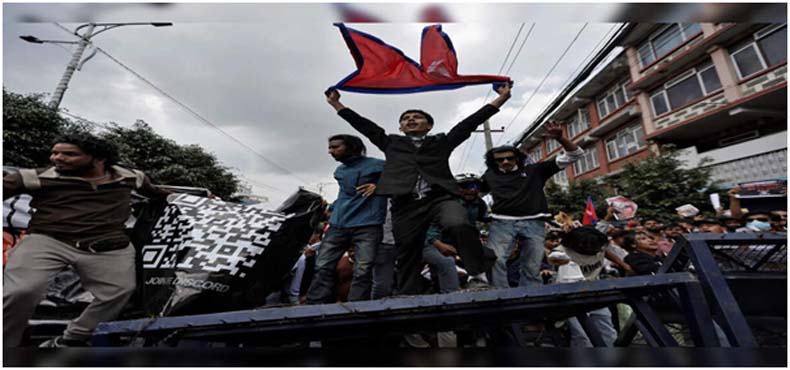
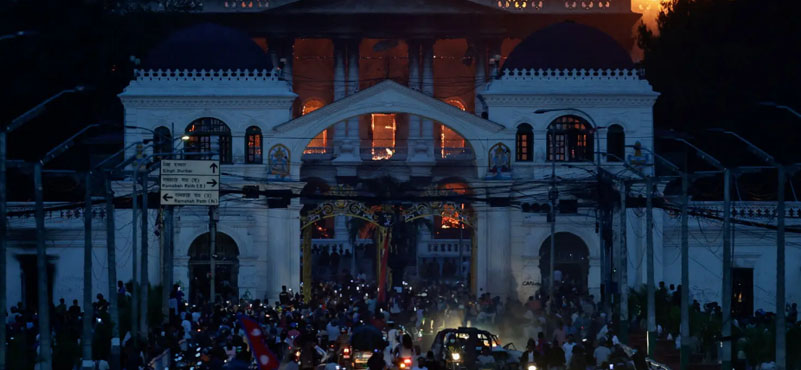
Nepal’s relationship with India is a paradox bound by history and culture, yet fractured by realpolitik. Nepal is in a phase of political churn, with shifting coalitions and a weak administrative grip. Economic strain and expanding Chinese influence, including BRI, are shaping Kathmandu’s choices far more than before, and the Terai belt is seeing irregular movement that complicates India’s border management. The country is caught in a cycle where coalitions change before any policy can mature. Prime ministers rotate; parties split; alliances realign almost entirely on personal equations. The economic base, viz tourism, remittances, and hydropower, has potential, but none of it is fully realised because every government operates within a narrow window before the next reshuffle.
This political churn has allowed external actors to nudge domestic positions in ways that would be less likely in a more stable environment. China has built influence through infrastructure promises and party-level ties. The United States has pushed development and governance programmes. India is treading a balancing rope with caution, but is concerned about losing its influence. If Nepal becomes unpredictable, project delays, shifting regulatory signals, and ever-changing interlocutors. A country rising toward developed status prefers clarity in its periphery. Nepal offers the opposite: constant low-level uncertainty.
Bhutan Under Pressure
Bhutan remains steady but is under quiet pressure with economic stress, youth outmigration, and slow-moving boundary talks with China. The India–Bhutan partnership is intact, though it now needs closer attention as the region around Thimphu becomes less predictable.
China Is Filling Every Gap India Leaves Open
While South Asia burns, China is working with cold consistency. Beijing’s debt diplomacy engulfs the regions, creating dependencies and distancing neighbours from India. It’s Sun Tzu’s strategy of weakening an adversary by a steady rewiring of regional incentives in Beijing’s favour. India now faces a neighbourhood where China is embedded in the decision-making space of governments once naturally aligned with New Delhi. Influence lost quietly is far harder to recover. Bangladesh’s move to bring Chinese state-linked companies into the Teesta project has shifted a routine water-sharing matter into a strategic geopolitical fault line in the eastern subcontinent.
The Spillover Is Already Inside India’s Borders
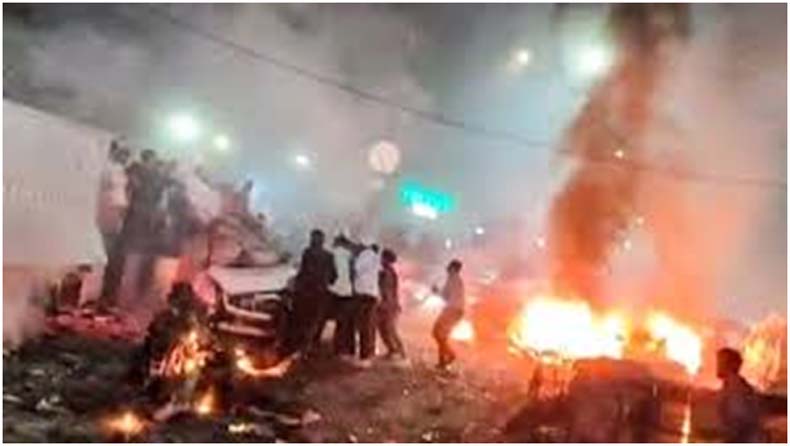
The blast near Red Fort in November saw the evolution of hybrid white collar internal security threats where ideology, technology, and social media fuse into an institutionalised subversion. The investigation triggered a map of ideological penetration far more worrying than the device that exploded. The operational chain ran from handlers in Pakistan, through crypto-funded intermediaries in Bangladesh, handlers in Turkey, and into the lives of young, credentialed Indians sitting in research labs, IT parks, hospitals and university networks. These weren’t fringe individuals. They were insiders; people with legitimate access, clean records, and the ability to toggle between their day jobs and encrypted channels without detection. Its roots lay in digital mobilisation, ideological penetration, and institutional subversion.
India Needs a Strategic Focus and Enduring Vision
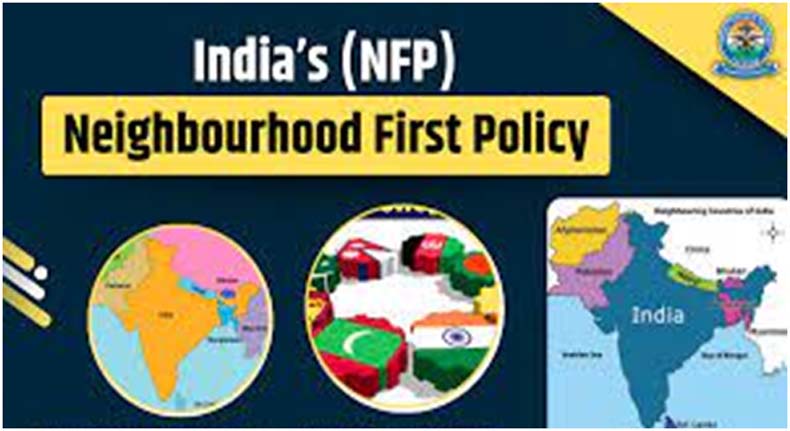
A border fence means little when the battlefield is encrypted, and societies are under attack. The threat enters through ideas first, corrupts the mind next, and logistics later. The implosion is more dangerous than the explosion. India cannot stabilise this environment with airstrikes, fast-track arrests and one-off diplomatic statements.
India must recognise this threat and take concrete actions to secure its neighbourhood. Influence is earned by constant engagement, not nostalgia.
- Use Force Precisely, Diplomacy Consistently: India’s diplomacy must operate on longer timelines. Neighbours need predictable financing, energy stability, and trade access more than they need political advice. India must calibrate its influence carefully. South Asian states react sharply to perceived interference. Quiet, sustained engagement, especially through infrastructure, training, and connectivity, tends to work better than overt political signalling. Predictability builds trust; inconsistency breeds opportunism. The need is not just to counter Chinese and Pakistani influence in the region, but to gain sustained trust and mutual respect through a strategic bonding. India must deepen regional integration through SAARC, SAGAR and BIMTEC, thereby integrating the region before its disintegration.
- Treat the Borders as Strategic Terrain: India has to deal with China in the neighbourhood without theatrics. Beijing isn’t retreating; if anything, it will play harder in places where India has limited room to manoeuvre. India’s response must be deliberate and grounded in economic reliability rather than speed. The eastern frontier needs the same seriousness as the western one. Saturated surveillance, integrated command centres, and real-time coordination between intelligence and policing are no longer optional. It requires a multidomain deterrence. India also needs to strengthen maritime dominance in the Indian Ocean.
- Northeast must be developed not as an appendage but as a core economic zone. The more robust the Northeast becomes internally, the less exposed India is to disorder in Bangladesh and Myanmar. The region requires greater integration and strategic focus.
- Clean India’s Internal Spaces Before Radical Penetration: Radical penetration is happening through universities, “civil-society” networks, litigation groups, madrassas, funding channels, media cells and social-media creators. Oversight cannot be symbolic. The state must map, audit, and harden these spaces before they calcify into parallel influence structures. The need is also to secure internal resilience through governance, economic parity, technology exploitation and social cohesion. This would deny external players the space to exploit the faultlines.
- Build a Region-Wide Crisis Nerve Centre: South Asia’s breakdown must be tracked as a single ecosystem, not country by country. India needs a central outlook that monitors insurgent flows, political collapses, refugee surges, water conflicts, and foreign interference as interconnected phenomena. The need is strategic focus and pre-emptive actions rather than a myopic, siloed outlook and reactive disposition.
The Region Won’t Deny but will Shape India’s Rise

India can pursue its Viksit Bharat goals even if the neighbourhood keeps deteriorating. But the path becomes narrower, the cost higher, and the need for disciplined statecraft more intense. A rising power surrounded by unstable states doesn’t collapse; it simply spends more energy balancing its external environment.
The neighbourhood may not be India’s choosing, but it will shape India’s rise, whether Delhi likes it or not. Development is a domestic project; stability, unfortunately, is regional. The two run on parallel tracks. If India wants to reach its goal first, it cannot ignore the widening cracks in the second.
ABOUT THE AUTHOR
 Lieutenant General A B Shivane, is the former Strike Corps Commander and Director General of Mechanised Forces. As a scholar warrior, he has authored over 200 publications on national security and matters defence, besides four books and is an internationally renowned keynote speaker. The General was a Consultant to the Ministry of Defence (Ordnance Factory Board) post-superannuation. He was the Distinguished Fellow and held COAS Chair of Excellence at the Centre for Land Warfare Studies 2021 2022. He is also the Senior Advisor Board Member to several organisations and Think Tanks.