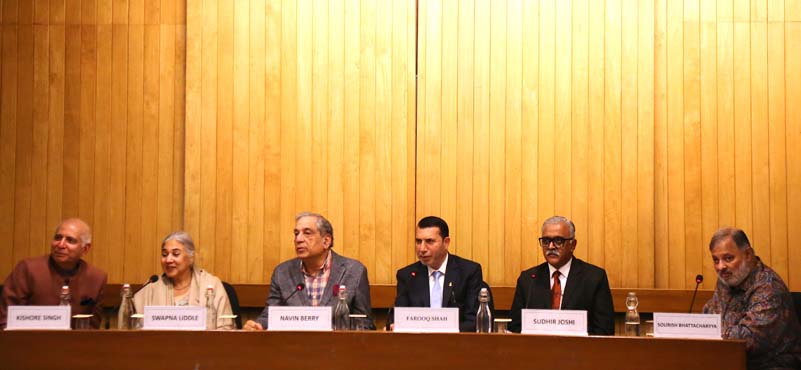
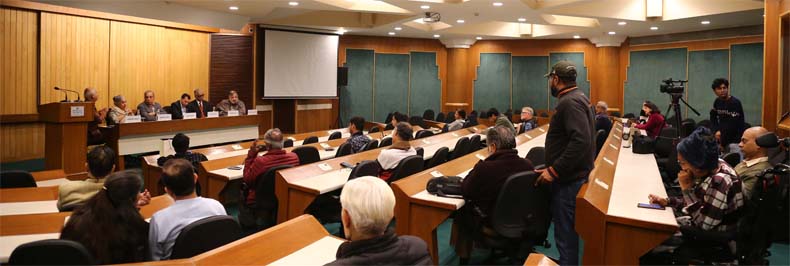
IN this roundtable discussion held under the auspices of India Habitat Centre, we bring together experts who collectively know the city’s tourism product like the back of their hand. Joining the discussion are Swapna Liddle, historian, art curator, heritage seeker and conservationist; Kishore Singh, columnist, specialist on art and museums, curator; Sourish Bhattacharya, food writer, columnist; Sudhir Joshi, founder, Walkathon Tours, and Navin Berry, editor, Destination India and moderator. Joining the roundtable, a special guest was Farooq Shah, MLA, Gulmarg and former secretary tourism, J&K Government. Presented here are the highlights of the discussion.
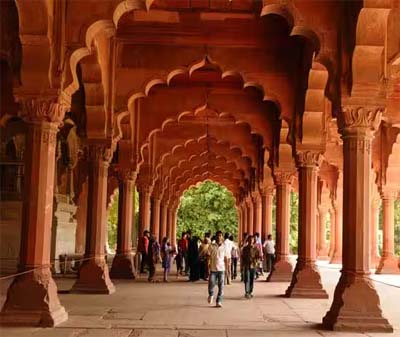
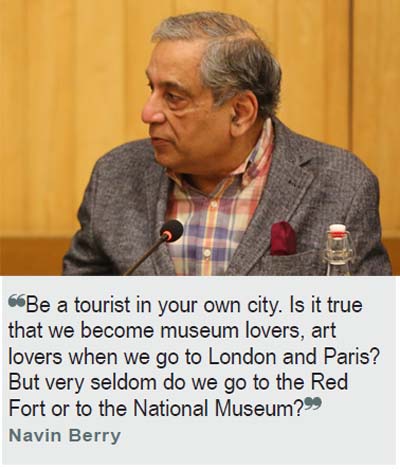 Navin Berry: Be a tourist in your own city. It’s an interesting subject because I think citizens do not take to visiting their own city as avidly as we imagine they should? Is it true that we become museum lovers, art lovers when we go to London and Paris? But very seldom do we go to the Red Fort or to the National Museum?
What is there to do in Delhi? Is there enough? Or we are just talking about something which doesn’t exist. In my view, Delhi must be one of the most endowed cities in the world. It has so much of history, so much of culture, so much of modern experiences. So, Sourish, to start from the most important subject in our lives, how much food is there in the city?
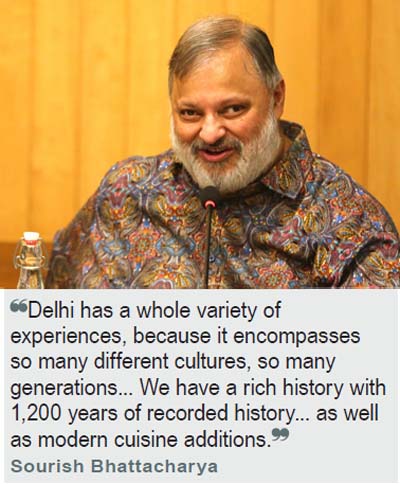
Sourish Bhattacharya: Delhi has a whole variety of experiences, because it encompasses so many different cultures, so many generations. We have a rich history with 1,200 years of recorded history. I think Amir Khusrow wrote about the ‘samosas’ way back in 1200 AD. There is a lot of cuisine heritage in the city as well as modern cuisine additions.
Delhi has a multiplicity of cultures. We have restaurants like Madras Coffee House in CP, there’s Chidambaram’s. And they have got Kashmiri food available. Now there are so many people giving great Kashmiri food. We have a whole new culture of Eastern UP cuisine, of Bihar cuisine, which is there in Zakir Nagar, Shaheen Bagh…..you get the best chapli kebabs from Shaheen Bagh. So, look at momos, so much so these momos have become the favourite dish of Delhi. You go to any street corner, you’ll have momos. At the moment you’ve got tandoori momos, they’re selling like hotcakes.
 Navin Berry: Swapna, if you could actually walk us through a few experiences which you think can be a lead for the Delhiite to take on.
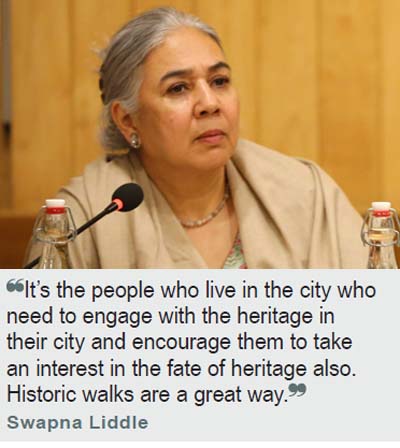
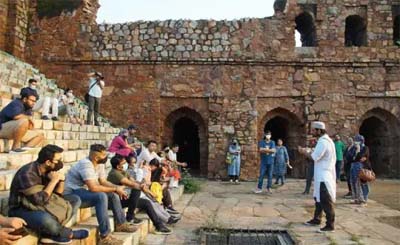
Swapna Liddle: Historic walks are a great way of exploring the city. And I also discovered early on, that walks were a great way to involve the people of the city with the monuments that we had, because we felt that tourists are well and good, but tourists don’t have a long-term stay. It’s the people who live in the city who need to engage with the heritage in their city and encourage them to take an interest in the fate of heritage also.
I continue to do walks. And I’m really glad to see that now there are so many organizations involved. There are young people who are making careers out of doing this.
Navin Berry: Can you take us through, let’s say, your three most favourite walks?
Swapna Liddle: So, my number one favourite must be Qutb Minar, it’s a spectacular monument. However, I do recommend that please look at it in a nuanced manner. It’s a very complex site, it needs unpacking. When I wrote my book several years ago, 14 Historic Walks of Delhi, that was the number one on that, because I felt that it was very important to explain that walk properly. Another one is Humayun’s Tomb.
It’s the finest tomb, with a museum next to it. Also next to Qutub Minar is the Mehrauli Archaeological Park which I really love – it has a lot of problems but I love it.
Navin Berry: Over a period of time do you find that the number of Delhiites wanting to take such walks, has that increased?
Swapna Liddle: I think the majority of walks that are done are done on weekends and most of the people who join in are people who live in this city. So that’s the biggest market. I think for all heritage products, shall we say, the city is a captive market. There are so many people here who are interested in them.
Navin Berry: Kishore, can I ask you to share with us a little bit of the world of museums and art galleries. What kind of experience do they provide? Why should one visit an art gallery, to just see, or learn?
Kishore Singh: The first thing I will do is to make a quick observation, Navin. When Swapna says, she does her groups and tours, et cetera, and they’re fabulous people who join these groups, and they’re curious and inquisitive, and they want to learn more about the city. I’m afraid my experience in taking tours through museums, et cetera, has been quite the opposite.
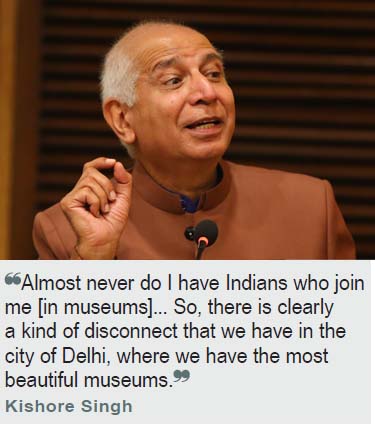
 Almost never, never, never do I have Indians who join me, unless I’ve done an appreciation course, and I’m taking my fellows or my students through. It’s always and always been for foreign visitors. So, there is clearly a kind of disconnect that we have in the city of Delhi, where we have the most beautiful museums, we have the most beautiful art galleries, we have wonderful art, but art that is being celebrated only on the page one of our newspapers, unfortunately. So, we say, oh, Hussain sold for 118 crores. But nobody describes that painting. Nobody tells you a little more about it. So culturally, we remain agnostic as far as these discoveries go, which is a pity.
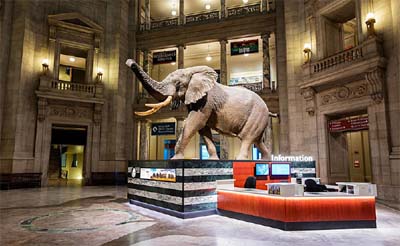
But in terms of what is available in the city, oh, my god. She mentions Humayun’s Tomb. Look at the museum that has come up with it. What a fabulous new museum. I can bet that 99.9 % of our city doesn’t even know that it exists. That’s the point. We don’t know. A jewel of a museum, the Amar Nath Sehgal Private Collection. Nobody knows about it. You’ve got to go to the Museo Camera. What a fabulous place. We have the National Museum where we celebrate India today in a certain manner.
But why does no one go to visit the dancing girl of Mohenjo Daro? Or look at the seals from Harappa, et cetera? These are part of our national heritage somewhere. So, I think we have failed to tell our stories somewhere. And who is going to live through these stories? One can do this on a private basis with a group of people, 10 people, 20 people, in a room like this. But how do we do the stories for the larger city? Why do our people not love our city enough? I think there is a question there.
I think if people want to see them, there are also the pressures of traffic, of travel, of pollution. The most beautiful winters when we used to go out, to so many of these monuments, et cetera, and picnic outside, is now an impossibility.
 Navin Berry: My other question to you was, when I go to an art gallery, I’m not just seeing, as you said, a Hussain or somebody. Who’s there to tell me that there may be a story behind it?
Kishore Singh: I think there are trained people who do tell you stories. The issue is that, see, a museum is one space and a gallery is another space. A gallery is usually what is called the white cube. So, this whole hushed atmosphere, very quiet. People who come in to visit don’t very often have the confidence or the courage to ask you about works of art. For example, when we used to post on Instagram and bring in people into the rooms, there was no standing room available. So, the curiosity is there, that you need to spread the word.
Navin Berry: So, the curiosity to come, or also to appreciate the story?
Kishore Singh: The appreciation has to begin with somebody. First transit beyond says, this is what Hussain is about. This is what his journey is about. This is what his work is about. Okay, let me tell you what this painting represents. And once I’ve told you those five things to look at in a painting, your life will change because you will start looking at old works of art with a certain eye. Nobody’s cracking that code.
Navin Berry: What about art on the city of Delhi? How and where does that work?
Kishore Singh: I think we’re fortunate. There are galleries that are opening up. Collections are being acquired. Museums have it all. We just have to go and discover it. We talk about our great civilization and sculpture. How many people go to the National Museum? I’m saying it again. Look at those sculptures. Why don’t we do it? Why is that curiosity lacking?
Navin Berry: So, I think probably, Sourish can answer. They’re probably more interested in where new restaurants open and the new shopping buys. And if I’m going to a museum, is there a great restaurant next to it?
Sourish Bhattacharya: What I feel is that museums can become livelier by integrating multiple experiences. The British Museum, for instance, has some of the finest restaurants there. I just thought not in the posh sense of the word, but very nice. You can just hang around, eat, talk. We need to make our museums more multi -sensory. There is a lot of curiosity. Another thing, you mentioned the word Instagram, today that is the medium of communications and attracting more people. I have realized one thing, Delhiites love to hang out in malls, watch movies, and then go out to eat.
 Navin Berry: So maybe we should have small museums in the malls?
Kishore Singh: Well, we have a museum in a mall, too. The Kiran Nadar Museum is in fact in a mall. But once again, you have to struggle to bring people in. And I mean, it’s going to be the largest art museum in the country. A stupendous thing when it opens in 2027. Again, we may be on both sides of that conversation, but Yuge Yugeen Bharat National Museum in New Delhi, in the North and South Blocks is opening up a massive space in terms of art. It will be the world’s largest museum with a fabulous collection.
Navin Berry: So maybe that will instill some new awareness of India.
Kishore Singh: I don’t know why this hesitancy. I mean, we celebrate New Delhi the way we celebrate Rome. Monument for monument we have, as much if not more, than they do. They package it so well, we don’t have it.
Navin Berry: Tell me, in your former company, you had put up this new experience at the Red Fort. What was the experience then?
Kishore Singh: So the thing that was very, very interesting, the first time at Red Fort when we put up our exhibitions over there, we had people who came in and look at original art.
It was part of their ticketed package. So, they came in, so they were seeing original works of art for the very first time ever. So, you know, it was, they’d come to look at history, they’d come to look at monuments, but suddenly they’re seeing the nine national artists who are your national treasures. It becomes a discovery. Even if one in a thousand retains an image or a memory, it tells you how to relook at maybe, design, maybe your shop windows, maybe your street fronts. It’s also part of the aesthetics of the city.
 Navin Berry: Sudhir, can I come to you now? You are a master of Shahjahanabad and Old Delhi, Chandhi Chowk. You’re a pioneer in conducting tours. I’ll start by asking, what is your experience? Are Delhiites also coming to be tourists in their own city, or is it only foreigners?
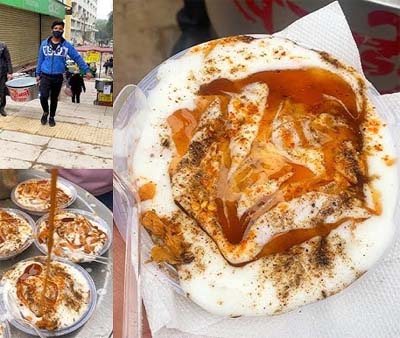
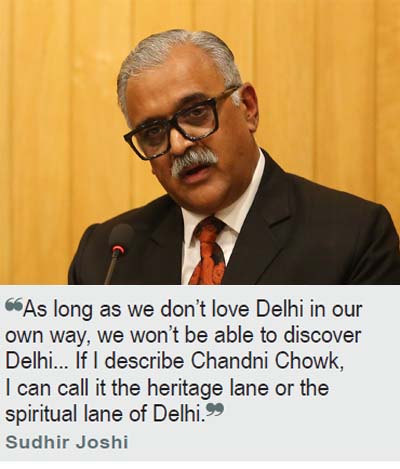
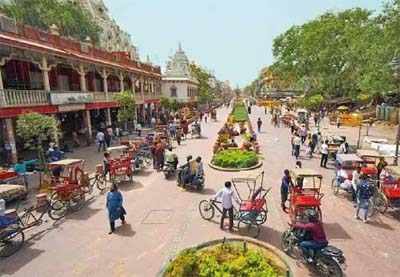
Sudhir Joshi: So, how do we describe Delhi? My background was always inbound tourism. Foreigners are coming, but what about our own citizens? As long as we don’t love Delhi in our own way, we won’t be able to discover Delhi. There is so much in Delhi. Now I will say that Delhi is the capital of India. There are some old and some new parts of Delhi, and all have their own stories. Be it Sitaram Bazaar or Chandni Chowk’s Dahi Bhalla, or the Daulat ki Chaat. Or be it Sis Ganj ki Gurbani or Jama Masjid’s Azaami.
When we are standing in the corner of Chandni Chowk, the first thing you see is Digambar Jain Temple, which is also known as a mystical temple. Then next to it, it seems that it is the Gauri Shankar temple. If we move a little further, then Sis Ganj Gurudwara. Next to it is the Shahi Sunehri Masjid. If you go a little straight from there is the Central Baptist Church.
If you go further ahead from there, you will find the Shiv Mandir in your Katra Neel. And if you go ahead, you will find the Fatehpuri Mosque. So, if I describe Chandni Chowk, I can call it the heritage lane or the spiritual lane of Delhi. Because on the same lane, you will find all the religions. And all of them are moving together in a very good way. There is food, there is shopping for weddings.
When you are in Chandini Chowk, you get kachori, samosas, jalebi, Nataraj’s dahi -bhalle. If you go ahead, you get Gyani’s falooda and rabri. My interpretation about the street food, I normally say that we are going to share with you our local delicacies, when taking our tours around.
 When we talk about the local delicacies, the concept of Chandni Chowk was not to stand outside and eat food. They used to call all the food vendors to their homes. That too on Saturdays and Sundays, specially. And they used to serve food to the ladies in the house. Gradually, those recipes came on the streets. Just pick up your own bag, take your camera, hold the metro and enjoy the delicacies of Purani Dilli.
Navin Berry: How much of this can one do on his own, or do you need a guide? Has anything happened further, like you’ve got what you call the audio tapes with you which can escort you through.
Sudhir Joshi: Audio guides are only available in the museums or maybe at the moment. Not on the street walks. You can explore on your own or even take any of the many walks available, experienced people. You don’t actually need a tour guide even though I am talking about reducing my own business. But if you need an exact or the authentic experience of Old Delhi or Shahjahanabad, you have to take the services of a knowledgeable walk leader, who can take you to the lanes and the bylanes of Old Delhi, and can make you understand the history of the streets and their names.
Navin Berry: Over your experience in the last 3 -4 decades, are Delhites coming more to experience Chandini Chowk? Are they still foreigners?
Sudhir Joshi: I’m very happy that after COVID, the demand from local Delhiites has grown, they want to explore. Like last week I received a call from a young lady and she just called me up and she said that I’m born and brought up in Old Delhi, in Sitaram Bazaar. But when I was in 9th class, I moved out from Sitaram Bazaar. Now I’m staying in Gurgaon. I just want to explore my old city.
 Local Delhiites, now they are aware and thanks to the social media, thanks to the food bloggers, thanks to the storytellers, and thanks to the various stakeholders who are giving information on walks on social media. And because of them, our domestic demand is increasing among our local Delhiites.
Navin Berry: If you look at Delhi, question to both of you, what would be the single biggest catchment area which you think Delhiites can start exploring with? Of course, it will depend a lot on the interest of the individual. But what would you do?
Kishore Singh: I think as we are getting more and more distanced from our own city and our own culture, I have to say this. We worry about hygiene. We worry about going into the old part of the city. We worry about dust. We worry about touts, perhaps, even now that they are foreigners. We’ve become foreigners in our own city somewhere. Where are our discoveries of our own city?
Navin Berry: Al this talk in the last few days of the revival of Shahjahanabad and a new agency has been appointed to take up the cleaning and restoring of the sidewalks, is something happening on the ground?
Sudhir Joshi: This is all optical illusions. A lot of funds have been given by the government or the different agencies. But unfortunately, what we need for Shahjahanabad is proper management. Now from 9 AM to 9 PM, automobiles and auto rickshaws are not allowed. But unauthorized rickshaws, there’s now thousands on the Chandni Chowk Road.
 Swapna Liddle: I would say that one thing that we really lack, which could potentially connect Delhi people to their city, is a city museum. I’m amazed that Delhi doesn’t have a city museum. Even small towns have a city museum. When you hear the story of Delhi, when you learn the story of Delhi, there is no city museum.
We encourage people to come to Qutub Minar. They know about it. Are we telling them there is a historic village next to the Qutb Minar? The Mehrauli village? Are we diverting some of that traffic to the village? Let’s encourage them to see the heritage which is around them. We don’t do anything to do that. And that’s when we could have stayed for a few days in Delhi. That’s when local communities will benefit from their business, it’s not through monument tickets that we are going to push our tourism. It has to come through with the people who live around, they should feel the some positive impact in their lives also. That’s when they will cooperate in your effort to maintain monuments. The other thing I wanted to say was there are apps now. So, a lot of them are not tourist guides, they’re not audio guides, but there are apps, and I’ve worked on a couple of them. They are all on the e-commerce app store.
Shahjahanabad, I very much agree that there has to be a concerted vision for its development and for its revival, shall we say, not redevelopment. The revival of Shahjahanabad’s heritage must involve experts, not just bureaucrats and politicians.
Navin Berry: Sourish, can you share, a cluster or a zone where you can feel, you can have an exhaustive culinary experience. Give me your favorite.
 Sourish Bhattacharya: Chittaranjan Park, my favorite from my childhood. Then Bengali Market, which unfortunately is going down.
Navin Berry: I come now to Mr. Shah? We are talking about Delhiites exploring Delhi. Srinagar is a very rich city historically, culturally. How much does an average local Srinagar resident explore the city? So that could be a starting point to see how different we are, is there lethargy in Delhi or is it nationwide?
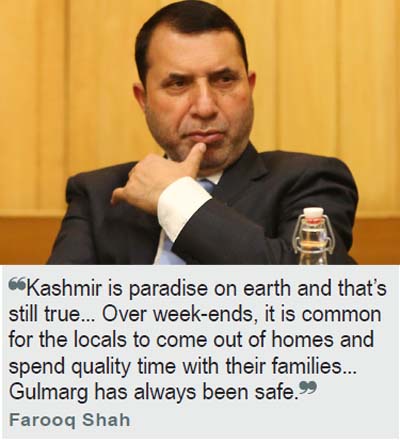
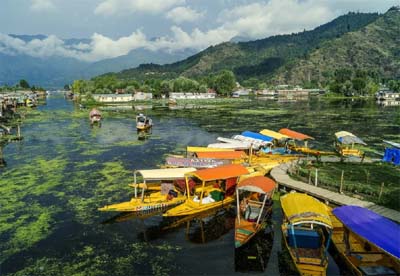
Farooq Shah: Kashmir is paradise on earth and that’s still true. And this place is only 1 hour 15 minutes from here. Heritage and our heritage walks are beautiful. I believe we are the best in the country as a golfing destination. The shopping is fantastic. Kashmir is a much-visited destination. For locals, most of the sightseeing venues are also playground, especially for the young ones. Over week-ends, it is common for the locals to come out of homes and spend quality time with their families.
Navin Berry: It appears that we all obviously view and believe that there is so much to see and do in Delhi. And as Kishore said very well vehemently, we tend to become foreigners around us, also because of the size of the city. and the problems of commuting. But having said that, how do we create some awareness or some basic momentum for the locals to feel inspired to go? Is it something like Swapna said, a city museum, some newness.
Kishore Singh: So clearly, if we choose to, we can create occasions, we are very happy to be tourists in our own city. And these discoveries are led, if you just look at Jahan-e-Khusrau festival, for example. You couldn’t find elbow room at the festival. People bought tickets to be part of it. It was a new event, it was well publicized, it was well put together. Jashn-e-Rekhta sells out months in advance. So, there is obvious hunger. Now, having said that, we also have to look at various economic divides, etc.
 There are people who go to India Gate and experience India Gate for its greenness and openness. They’re escaping from certain cloistered neighborhoods to come in. So, what does it even mean when we’re talking about being tourists in our own city? What social levels are we talking about? What is the constituency we’re addressing somewhere? I think within that, however, creating, communicating, and putting information out creates a secure moment.
When Anish Kapoor comes in, the NGMA is flooded with visitors. A regular artist doesn’t get that, because he’s not being publicized, or she’s not being publicized. So, I think that is a very, very important area that gets missed.
Navin Berry: Swapna, when you talk about heritage walks, many of us, we mean good to consider. We don’t think Delhi is a city for walkers. It’s a pain to think of taking a walk. Forget the pollution, which of course is a nuisance, but even on non -polluting roads, taking a walk, we’re not just a walkers’ city.
Swapna Liddle: I’ve been walking the city for a long, long time. I still do. I still take public transport. Apart from the heritage walks. As far as I’m concerned, particularly, because I’m leading Delhi people through it, I said, let’s go to the littered streets. Let’s go to the broken pavements because you are citizens of Delhi. Separately, then, maybe you will raise your voice to get them fixed. So, I think that for me, that is also important. You need to see it. If we combine our energies, I think we can do quite a lot there.
Navin Berry: Anything Sudhir from you in terms of cleanliness, Chandni Chowk does evoke some reluctance on my part. I mean, will I have a good experience? Will I be able to walk through these gullies carefully? I belong to the gullies of Chandni Chowk, but I shudder to think, do I want to go and see how bad or good it will be?
 Sudhir Joshi: In Old Delhi, when we are going to take a walk, we have to go with an open mind. So, when we are taking our guests to the Old Delhi area, please don’t come with a predetermined mind. I tell you this only, go with the flow. Delhi will give you surprises. Keep walking with it and you will keep enjoying it. And till you don’t have an expert walking leader to take you to the lanes and the bylanes of Old Delhi, of course you have some fear in your mind that I am entering this lane, there could be some problem. So, an experienced walk leader is essential for the, not for Old Delhi, I am talking for the entire Delhi.
One of my favorite walks is called History, Alcohol and Craft. We have to create the circuits, small circuits where we don’t have to worry about commuting. History is Old Fort. Alcohol is the Bhairav temple. And just opposite, is the Craft Museum. That is one circuit.
Navin Berry: How do you publicize them?
Sudhir Joshi: Through colleges, through institutes and through government channels also. We are already associated with Delhi Tourism also, but we have to create more awareness, for sure.
Navin Berry: Shah sahb, it is winter in Kashmir now, any tips you want to give us, so that we book our tickets when we go home?
Farooq Shah: So far as Gulmarg is concerned, it has been rated as one of the most affordable ski destinations in the world. It will start from 15 January. Once there is a snowfall. And now, Gulmarg has some, as compared to European ski resorts, the quality of the experience is really the best in the world. And the mountain is connected by the world’s highest and one of the longest cable cars. We added this year some more skiing lifts also. The infrastructure is at its best.
We now have star hotels that are affordable. I can say that as compared to Europe, the expenditure will be one-tenth what we have been spending in Europe.
Navin Berry: What about mid -level accommodation? I mean, you have got Khyber where you spend a lakh a day.
Farooq Shah: There are also mid-level hotels. But they do charge 5000-6000 rupees per night.
Navin Berry: There will be one question on everybody’s mind which you must address and share with us. How about the safety and security for us to go this winter.
Farooq Shah: Always quite safe. Gulmarg has always been safe. Many foreigners are coming presently from Malaysia, from Taiwan and Southeast Asia and other countries. I can say that Gulmarg is as safe as any other destination you are planning to visit this winter.