
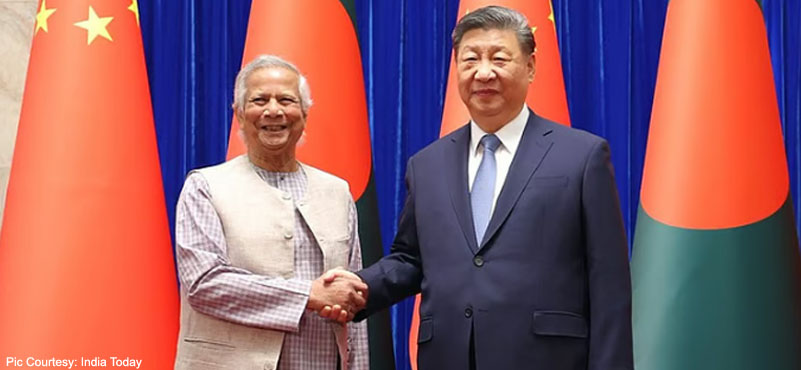
Bangladesh’s China Tilt: Testing the Limits of Its India Partnership
Overview
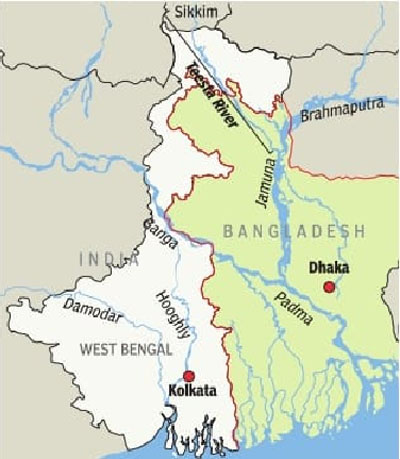
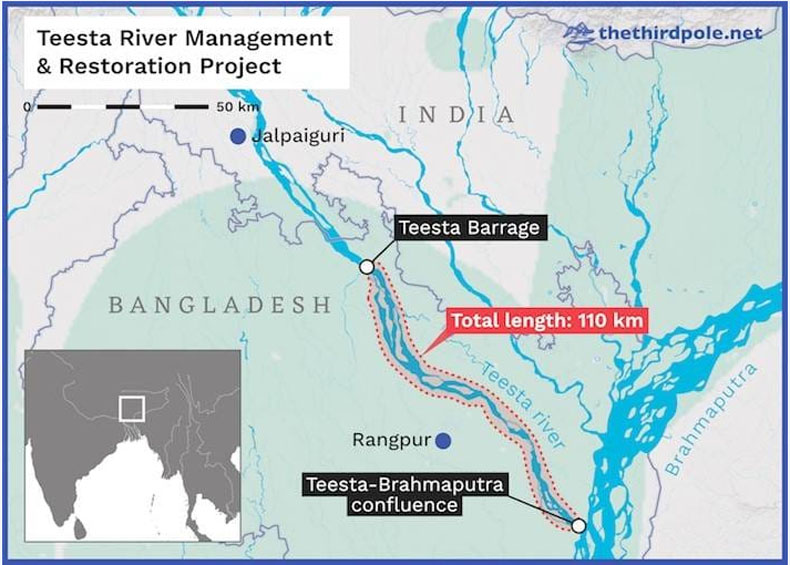
Bangladesh’s move to bring Chinese state-linked companies into the Teesta project has shifted a routine water-sharing matter into a strategic geopolitical fault line in the eastern subcontinent. The proposed construction zone is far too close to the Siliguri Corridor, which connects India’s Northeast to the rest of the country.
In that narrow belt, geography is not a backdrop but a strategic concern. Any foreign technical footprint, especially one aligned with Beijing’s strategic power play, inevitably steps on India’s security redlines. For New Delhi, this is not a distant or debatable concern. It directly impacts the security of its transit routes, the stability of its northeastern states, and the broader strategic concern along a corridor that relates to national security.
What makes Dhaka’s move harder to justify is the fact that Bangladesh has long been aware of this sensitivity, which India treats as non-negotiable. It understands that the presence of any external actor in its vicinity, even under the guise of a development project, immediately reshapes India’s risk calculus. The recent thaw in India-Bangladesh relationship and its warming ties with Pakistan and China are an indication of this misadventure as its hedging strategy.
Chinese involvement in hydro-engineering and terrain-surveying near Siliguri is not a routine infrastructure engagement. It provides Beijing with access to sensitive topography, data on movement corridors, logistical nodes, and future influence over water flows, none of which align with India’s core security interests.
Siliguri Corridor: Not Just a Chokepoint, But a Strategic Organ
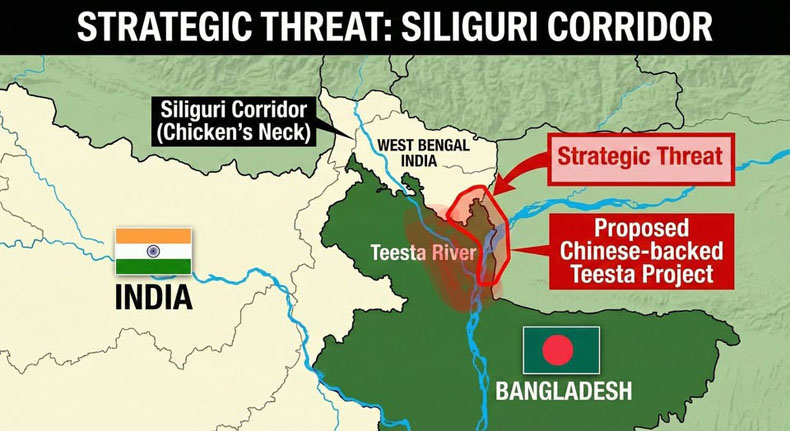
The Siliguri Corridor remains India’s narrowest vulnerability, a thin passage linking the Northeast to the rest of the country while sitting under the gaze of Nepal, Bhutan, Bangladesh and the Chinese position in the Chumbi Valley. The stretch of approximately 200 km with a width varying from 27 to 60 km is aptly called the ’Chicken’s Neck’. It feeds eight states, sustains military logistics, and anchors the Indo-Bhutan frontier. Its vulnerability has shaped Indian defence thinking for six decades. The Doklam crisis already demonstrated that earlier warnings of a possible Chinese push through this flank cannot be dismissed. The border remains porous with narcotics, smuggling, and counterfeit activities rampant.
The illegal migration from Bangladesh has resulted in demographic changes along with the spread of radical forces and institutions. The activities of insurgent groups like the KLO and ULFA add another dimension to internal security. In the hills, the Gorkhaland question continues without closure. The GTA, conceived as a compromise arrangement after two rounds of agitation, never acquired real authority, and political tinkering by the state government left the administrative structure fragmented.
Any external presence near this zone, military or civilian, creates asymmetry. When that external actor is China, the asymmetry shifts from concern to a red line.
 Dhaka’s Strategic Misread
Bangladesh appears to be operating under four flawed assumptions:
- That India’s patience with its neighbours is elastic.
- That Chinese projects in sensitive areas can remain “apolitical.”
- That balancing India and China is feasible without geographic depth or economic buffers.
- A strategy to pressure India by courting China, aimed at the repatriation of Sheikh Hasina.
These assumptions have repeatedly been disproven across the region—Sri Lanka, Maldives, Nepal, and Myanmar offer ample warning. Bangladesh’s geography makes the margin for miscalculation even thinner.
A Region Under Strain: Why the Moment Matters
The move comes at a time when the wider neighbourhood is already unstable. Pakistan is wrestling with economic contraction and political breakdown, yet an intensifying proxy war. Myanmar’s civil conflict has erased any notion of a stable frontier. Nepal’s political cycle goes through alignments with little warning. Sri Lanka, though calmer, is still exposed to deep structural fragilities. In this environment, India is looking for stability along borders, not fresh vulnerabilities for external actors. Against that backdrop, Dhaka’s decision to bring Beijing into a strategically sensitive zone lands at a moment when New Delhi’s appetite for ambiguity is minimal.
India’s Reading: A Structural Line, Not Routine Diplomacy
For India, the concern is rooted in geography, not sentiment. No state can remain indifferent to a rival’s presence near the sole land artery connecting eight of its northeastern states. New Delhi has spent the past decade supporting Bangladesh across multiple sectors and has refrained from pressure tactics even during tense phases. But the logic of security does not bend to political comfort.
The Teesta proposal crosses a boundary beyond the water project as it sets a precedent wherein Chinese-linked entities gain access to India’s geographical vulnerabilities.
Policy Responses India Must Consider
1. Communicate an Unambiguous Diplomatic Position
India must communicate privately and formally that Chinese activity in the Teesta basin constitutes a core security concern. Clarity does not equate to hostility; it prevents miscalculation. A precise articulation of red lines helps Dhaka reassess its own cost–benefit calculus.
2. Offer a Credible, Accelerated Counter-Proposal
India’s original Teesta stabilisation plan was delayed, creating a vacuum that China exploited. New Delhi should return with a faster, better-financed, and technically superior alternative, ensuring transparent revenue models and shared management mechanisms. Bangladesh cannot ignore an offer that surpasses Chinese terms.
3. Strengthen the Corridor without Publicity
India should quietly expand redundancy: alternative road-rail connectors through Assam and Bihar, hardened logistics infrastructure, enhanced surveillance coverage, and deeper cooperation with Bhutan on monitoring activities across the Doklam-Sikkim sector. Militarily, the posture around the Siliguri corridor must be wargamed and loopholes plugged for all contingencies. The ISR architecture in the area must be persistent and multi-tiered to preempt any misadventure proactively. These measures address vulnerability regardless of developments in Bangladesh.
4. Calibrate Economic Levers
New Delhi’s economic weight, whether through transit routes, power supply, or cross-border trade, gives it the leverage that can be applied judiciously. Small shifts, rather than headline-level measures, are often enough to signal that the stakes are higher than routine diplomacy while avoiding the appearance of coercion.
5. Engage Multiple Political Constituencies in Bangladesh
Long-term stability in the relationship requires engagement that goes beyond the government of the day. India must cultivate institutional and societal channels that understand the strategic limits of Chinese involvement in Bangladesh’s northern regions.
6. Adapt to the Post-Hasina Bangladesh
India needs a fresh look at its ‘Neighbourhood First’ policy, which is shrinking its strategic space. India must be aligned with the geopolitical and security realities of its neighbours and attune its diplomacy to manage the changes favourably. Bangladesh’s regime change and the subsequent deterioration of its relations with India impinge on its security interests and bring the Chinese and Pakistani influence to the fore. Creating strategic cushions now reduces the risks that would otherwise accumulate around the Corridor.
Conclusion
Bangladesh’s invitation to China for the Teesta project alters more than a riverbank. It reshapes the security calculus of eastern India. It is not an economic dimension; it is a strategic inflexion point. What appears on paper as a development proposal carries direct consequences for the only land bridge tying the Northeast to the rest of the country. The Siliguri stretch is too sensitive for India to entertain ambiguity. Even a small Chinese presence near that corridor alters the risk calculus.
Dhaka still has space to reassess its choices and create stability in its neighbourhood. India must show diplomatic acumen to hasten this choice and build a stronger relationship with Bangladesh, which respects mutual security concerns and benefits national interests.
With the neighbourhood already unsettled, New Delhi cannot look away from that possibility. The decision on whether this region moves toward stability or deeper strategic tension now rests squarely with Dhaka.
ABOUT THE AUTHOR
 Lieutenant General A B Shivane, is the former Strike Corps Commander and Director General of Mechanised Forces. As a scholar warrior, he has authored over 200 publications on national security and matters defence, besides four books and is an internationally renowned keynote speaker. The General was a Consultant to the Ministry of Defence (Ordnance Factory Board) post-superannuation. He was the Distinguished Fellow and held COAS Chair of Excellence at the Centre for Land Warfare Studies 2021 2022. He is also the Senior Advisor Board Member to several organisations and Think Tanks.