“History never repeats itself, but it does often rhyme.” Mark Twain
The war between the United States (codenamed “Epic Fury”) and Israel (codenamed “Roaring Lion”) on February 28, 2026, against Iran marks one of the most consequential escalations in West Asian geopolitics since the 2003 Iraq War. It needs no clairvoyance to perceive that, unlike previous tit-for-tat skirmishes, this operation marked a paradigm shift from “active deterrence” to “regime decapitation”.
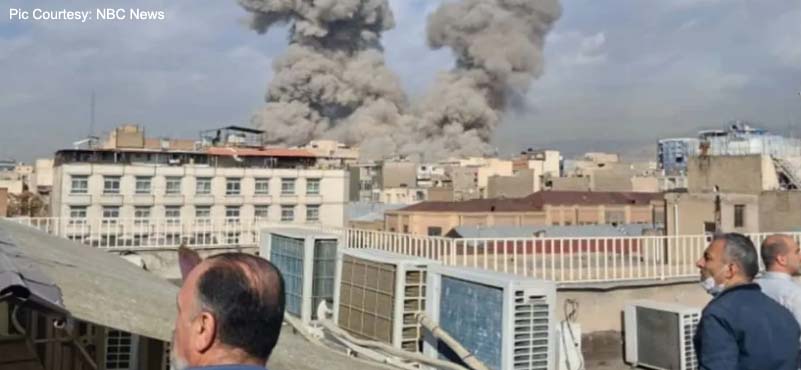
What began as a limited precision strike campaign rapidly evolved into a multi-domain confrontation involving missile warfare, cyber operations, maritime disruption in the Persian Gulf, and proxy mobilisations across Lebanon, Iraq, Syria and Yemen. As of early March 2026, the conflict appears to be in a fragile, high-intensity but geographically contained phase. US carrier strike groups remain deployed in the Arabian Sea and Eastern Mediterranean; Israel continues targeted strikes against Iranian military infrastructure and allied militias; Iran has retaliated through missile salvos, drone swarms, and asymmetric pressure via regional proxies. Oil markets remain volatile, shipping insurance costs have spiked, and global markets are in risk-off mode.
The death of one is a tragedy; the death of millions a statistic, or so goes a quote often misattributed to Joseph Stalin. The killing of Iran’s Supreme Leader Ayatollah Ali Khamenei during the initial wave of precision strikes has dramatically altered the internal political trajectory of Iran, injecting uncertainty into both the conflict’s duration, the region’s long-term stability, global energy security and economic stability.
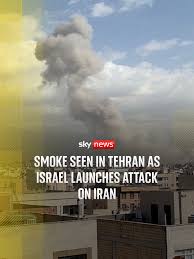 The Trigger: Escalation Dynamics
The issue was never whether Iran qualified as an enemy or a danger. A regime committed to financing terrorism and casting America as the embodiment of global evil was bound to see the USA either as a direct adversary or as a target to undermine through weapons development and proxy militias. Nor was there much doubt about America’s ability to dismantle Iran’s offensive capacity. Even Pat Buchanan—often cited as one of America’s leading isolationists—once conceded that the United States could neutralise Iran “in an afternoon.”
The immediate trigger appears to have been a combination of three factors:
- Intelligence of Imminent Nuclear Breakout: Reports that Iran had enriched uranium to weapons-grade levels and was within weeks of assembling a deliverable device.
- Missile/Drone Attack on Israeli Territory: A large-scale attack allegedly coordinated by Iran or its proxies that overwhelmed parts of Israel’s missile defence architecture.
- US Personnel Casualties: A strike on US assets or bases in Iraq or the Gulf that resulted in American casualties.
For decades, Iran has called America “the Great Satan”. Months of prior US military buildup in the region preceded the strikes, indicating premeditated planning rather than a purely reactive operation. Israel, long committed to preventing a nuclear-armed Iran under its “Begin Doctrine,” initiated Operation Roaring Lion to degrade Iran’s nuclear and missile infrastructure. For, as Carl von Clausewitz said, “War is a continuation of politics by other means”.
The United States followed with Operation Epic Fury, targeting command-and-control nodes, IRGC facilities, naval bases, and cyber infrastructure. The absence of any ‘smoking gun’ makes us wonder, “Is the juice worth the squeeze”, as they say in Texas, USA. The killing of Khamenei transformed what might have remained a limited pre-emptive strike into a war with regime-level implications.
Trump said that the goal of this operation is to destroy Iran’s offensive capabilities and its “ability to project power beyond its borders”.
Extensive and Systematic Devastation -Strategic and Geopolitical Repercussions
Military Strategy. The spiralling Middle East war underscores three key trends. First, multi-domain warfare: the integration of cyber operations, satellite disruption, AI-enabled targeting, and drone swarms. Second, missile-defence saturation: even advanced systems such as Iron Dome, David’s Sling, and US Aegis were strained by high-volume, low-cost drones. Third, asymmetric escalation: Iran expands the conflict through proxies in Lebanon (Hezbollah), Yemen (Houthis), and Iraq while avoiding full conventional war.
Strategically, the US and Israel seek to prevent Iranian nuclear weaponisation, degrade IRGC offensive capabilities, and reinforce deterrence, including toward China and Russia, demonstrating unequivocally that actions have consequences. Iran aims to preserve regime survival, maintain nuclear latency, and demonstrate that attacks on it impose systemic costs.
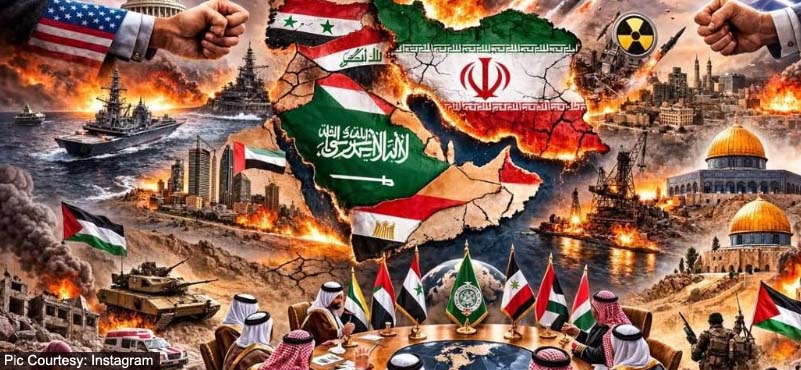
Diplomatic Fallout. The diplomatic environment is sharply polarised. The USA retains support from some NATO allies but faces European criticism over energy security risks. Israel receives quiet backing from certain Arab states wary of Iranian expansionism. Russia condemns US actions and may deepen arms transfers to Iran. China calls for a ceasefire, positioning itself as a mediator while protecting oil flows. Gulf states balance fear of Iranian retaliation against concern over regional escalation. The UN Security Council remains paralysed by veto politics. The conflict accelerates bloc formation: an informal US–Israel–Gulf alignment versus a Russia–China–Iran axis – a worsening global landscape, isn’t it?
Khamenei Killing and Regime Change – Dissonance and Discord
The death of Supreme Leader Ali Khamenei is historically significant. This decapitation strike has pushed Iran into a leadership vacuum at the apex of its theocratic hierarchy and sharply raised the probability that this will not remain a “limited” confrontation and could acquire terrifying proportions across the region.
With IRGC Ascendancy, the Revolutionary Guard may consolidate power, leading to a more militarised state. Public Unrest will lead to economic hardship, war fatigue, and generational dissatisfaction. External imposition is unlikely unless ground invasion occurs, which neither the US nor Israel currently seeks. While Iran’s political system has historically demonstrated resilience, the decapitation of the Supreme Leader is an unprecedented shock.
Global Economic Repercussions
Energy Markets. Oil prices spike above $120 per barrel due to threats to the Strait of Hormuz, LNG prices surge, and insurance premiums for Gulf shipping skyrocket.
Global Markets. Equities decline, Gold and US Treasuries rally, and emerging markets experience capital outflows. Supply chain disruptions in petrochemicals and fertilisers, and increased freight costs, mar development prospects.
Strategic Straits: Small Passages, Big Stakes
In my writings and speeches over the years, I have repeatedly demonstrated that the proximity of the Strait of Hormuz to the UAE, Dubai, Saudi Arabia, and Qatar, along with the potential for conflict escalation to Yemen and the Strait of Bab El-Mandeb, creates a geoeconomic dependency asymmetry, particularly for Asian growth markets in general and India in particular. The fallout from this escalation impacts not only the immediate area but also intensifies power rivalry, proxy conflicts, and economic dependencies, imperilling global stability. Important global choke points are the Suez Canal (Egypt), Panama Canal, Bab El-Mandeb, Malacca Strait, and Turkish Straits. Alternatives, such as Saudi Arabia’s East-West pipeline or the UAE’s Fujairah terminal, are grossly inadequate to handle the entire load. Risks posed by mines, drones, or naval tensions could increase shipping costs, disrupt insurance markets, and decelerate global trade. India relies on this region for 60 % of its crude oil imports.
Impact on Dubai – How Crippling?
Dubai’s model is deeply open and externally integrated—an advantage in normal times, but a vulnerability during shocks. Growth depends on FDI, portfolio inflows, real estate investment, wealth migration, and tourism liquidity. If regional tensions escalate (e.g., Iran–Gulf conflict, Hormuz disruptions), investors could reprice Gulf risk, delay FDI, cut allocations, and rotate into ultra-safe assets (U.S. Treasuries, gold, CHF). Even without direct UAE involvement, regional risk perception can spread. Dubai’s edge has long been “relative stability”; if the entire Gulf is viewed as unstable, that premium narrows. Still, the UAE has demonstrated rapid crisis recovery (2008, COVID-19), maintains strong legal and business infrastructure, and practices pragmatic diplomacy—suggesting volatility would likely be cyclical, not structural.
The Dirham’s USD peg anchors inflation and limits currency speculation. Backed by substantial reserves and oil-linked fiscal buffers (via Abu Dhabi), the UAE is unlikely to face devaluation or sovereign panic unless oil infrastructure is physically hit and Hormuz closes for a prolonged period—an extreme scenario.
As a regional financial hub, tighter sanctions, higher compliance costs, and surging shipping insurance, especially through Hormuz, could slow trade and hit Jebel Ali, logistics, and re-exports. Yet diversification across tourism, aviation, finance, tech, and real estate reduces single-channel risk.
Dubai has become a refuge for Russian capital, Indian HNWIs, African elites, Chinese entrepreneurs, crypto wealth, and family offices. Its appeal rests on stability, zero income tax, strong property rights, credible regulation, and neutrality—underpinned by Abu Dhabi’s oil wealth. Compared to Lebanon, Turkey, Egypt, or Pakistan, the UAE remains highly stable. However, Dubai’s safe-haven status is confidence-driven; chronic, military instability would erode that narrative.
Bracing for Impact- India’s Strategy
In the aftermath of the February 2026 USA/Israel–Iran war, markets have turned risk-averse. Oil prices are surging on supply concerns, global equities are volatile, gold and the US dollar are strengthening as safe havens, and emerging markets are seeing FII outflows. For India, a qualitative escalation in West Asia threatens its energy security, remittances, and trade — just as the economy had hit the ‘Goldilocks Zone’: inflation at historic lows, a narrowing current account deficit, and accelerating GDP growth. Higher crude prices mean rising import bills, renewed inflation risks, pressure on the rupee, and stress on corporate margins, particularly in energy-intensive sectors. Even fundamentally strong companies are witnessing sharp price swings. Many investors ask: if the businesses are solid, why are portfolios unstable? Geopolitical shocks raise risk premiums across markets. In the short term, sentiment can override fundamentals—and investing without valuation discipline heightens vulnerability during crises. War doesn’t just shift borders; it disrupts oil, currencies, and liquidity—and ultimately earnings, valuations, and market direction.
In such a fraught scenario of regional security dynamics, energy price volatility, remittance compression, export market disruption, currency pressure, and the state of play in the relationship between India and the Middle Eastern States, India must rework its policy imperatives. But it must act decisively where it can. William Shakespeare wrote eloquently in his play Julius Caesar (Act I, Scene II), “The fault, dear Brutus, is not in our stars, but in ourselves, that we are underlings”. While perceptions differ and assessments vary, this necessitates a transformed mindset, changed diplomatic manoeuvres, and modified perceptions.
India is uniquely exposed due to energy dependence and trade linkages. If Brent/similar crude sustains above 80 $, post US–Israel strikes on Iran, this would stoke inflation, widen CAD and reduce growth versus the current baseline.
Inflation
India now imports about 88% of its crude oil, so even moderate price spikes quickly feed into fuel and transport costs. A $ 10-per-barrel increase typically adds 0.2–0.4 percentage points to the CPI, with a larger impact on the WPI via fuel, chemicals, and freight. If crude stays at or above $80 instead of the low $70s, headline inflation would likely remain in the upper half of the RBI’s 2–6% band for longer, with second-round pressures on core inflation through logistics and manufactured goods. A disruption of the Strait of Hormuz could push prices to $90–100, materially raising inflation risks and potentially forcing tighter monetary policy.
Oil accounts for roughly 25% of India’s total imports, so higher prices directly widen the trade deficit. A sustained $10 per barrel rise can increase the current account deficit (CAD) by about 0.3 percentage points of GDP, adding $13–14 billion to net oil imports. If crude averages $80–90 instead of the low $70s, FY26 CAD could widen from 1.2–1.3% of GDP to around 1.5–1.6%, increasing pressure on the rupee. With a prolonged supply shock with prices above $90, the CAD could reach 2% of GDP unless offset by weaker non-oil imports or strong services exports and remittances.
Growth – Changing Perspectives, Cognisable Dilemmas
Higher oil prices act like a tax on net importers, squeezing household incomes and raising costs for transport, aviation, chemicals, fertilisers and manufacturing. If oil stays just above $80 for a limited period, the growth impact should be manageable with some pressure on consumption and corporate margins, especially if the government cushions pump prices or duties.
Should prices rise toward $90–100 due to prolonged disruptions near the Strait of Hormuz, the hit would be sharper: weaker discretionary spending and investment, tighter monetary policy if inflation rises, and higher fiscal costs if subsidies or excise cuts are used. This could trim real GDP growth by a few tenths of a percentage point, with energy-intensive sectors and small firms most hit.
Policy-wise, oil above $80 complicates inflation and widens the current account deficit, but does not, by itself, trigger a macro crisis. The real risk lies in a sustained supply disruption that pushes prices toward $100, forcing tough trade-offs among inflation control, growth, and fiscal discipline. The government would then need to balance shielding consumers, protecting capital and social spending, and maintaining fiscal credibility. India has some buffers — strategic petroleum reserves, alternative pipelines bypassing Hormuz, and diversified sourcing from Russia, Africa and the Americas. These would, however, soften, not eliminate, a severe shock.
Dynamics and Dialectics of Development -Sectoral Impact
Sector-specific effects are likely to differ widely, but more than 30 publicly listed Indian firms are confronting heightened geopolitical uncertainty as tensions between Iran, Israel and the United States put key shipping lanes through the Strait of Hormuz at risk. The exposure cuts across infrastructure, aviation, energy, logistics and consumer industries, with crude price swings and potential trade disruptions emerging as major stress points for India Inc. This is by no means insignificant, is it?
In Oil and Gas, refiners, such as Reliance and ONGC could see short-term gains in refining margins due to price volatility; however, they remain exposed to risks related to crude supply disruptions. Public sector oil marketing companies (OMCs) are likely to experience continued volatility as fluctuations in crude prices and potential policy interventions affect their profitability. Aviation, automobiles, and logistics companies are likely to face margin pressures as higher aviation turbine fuel (ATF) and fuel costs increase operating expenses. These elevated costs may also dampen discretionary demand, particularly in the automobile segment. Similarly, FMCG and manufacturing companies could experience margin compression because rising input costs erode profitability unless they pass on higher costs to consumers. In the fertilisers and chemicals sector, elevated feedstock and naphtha prices are expected to increase agricultural input costs, which have downstream implications for farm economics and food prices.
Domestic defence companies may, however, benefit from accelerated procurement cycles and stronger export demand amid heightened geopolitical tensions. IT, pharmaceutical, and speciality chemicals companies are likely to be impacted more indirectly, primarily through global risk-off sentiment, currency volatility, and potential demand moderation in key overseas markets. Shipping and logistics firms could face higher freight rates and insurance premiums, particularly if tanker routes are disrupted, leading to increased operational uncertainty.
From a macroeconomic and market perspective, any escalation, such as tanker attacks or blockades, would likely push up shipping and insurance costs across a range of commodities. This could fuel import-led inflation and undermine export competitiveness. Sectors with significant exposure to the Gulf region, including construction, EPC, IT, and financial services, may face project delays and uncertainty over remittances. Exports to West Asia and remittance inflows from the diaspora could weaken if the conflict intensifies or spreads further. Equity markets may see corrections amid heightened risk aversion, with foreign institutional investor (FII) outflows potentially intensifying. In such an environment, defensive sectors such as pharmaceuticals, IT, and FMCG are likely to outperform cyclical sectors, as investors gravitate toward relatively stable earnings profiles.
Lexicon of Change – Strategic Implications for India
India’s interests include energy security, the safety of 8+ million Indian expatriates in Gulf countries, the stability of sea lanes, and balanced relations with the US, Israel, and Iran. India has historically maintained strategic autonomy and balanced diplomacy.
India’s Stand – Bridging the Chasm
India’s response has been cautious and consistent: it has voiced deep concern, urged restraint, reaffirmed respect for sovereignty and civilian safety, and called for dialogue. This follows India’s standard West Asia approach—avoid taking sides, uphold international law, seek negotiated outcomes, and protect national interests.
Going forward, India’s position should rest on six pillars:
- Strategic autonomy – Stay out of rival blocs. Maintain ties with the US and Israel while preserving channels with Iran, given its importance for energy and connectivity (including Chabahar and access to Central Asia).
- Energy security – Diversify crude sources, tap strategic reserves, explore non-Hormuz routes, and secure long-term contracts with suppliers across Russia, Latin America, and Africa.
- Diaspora and trade protection – Prioritise evacuation readiness, consular coordination, and maritime security to safeguard Indian workers and shipping routes in the Gulf.
- De-escalation and humanitarian norms – Publicly support an immediate ceasefire, humanitarian access, and a return to diplomacy on Iran’s nuclear and regional role—without endorsing unilateral regime-change wars.
- Domestic macro-stability – Use targeted fuel-tax adjustments, calibrated RBI communication, and clear market guidance to manage inflation and prevent panic.
- Long-term strategy – Accelerate energy transition, strengthen maritime and defence capabilities, and deepen partnerships with like-minded middle powers for a stable, multipolar Gulf order.
In sum, India should combine principled non-alignment with firm protection of its economic and security interests. Calibrated neutrality backed by active diplomacy remains the most pragmatic course.
Syntax of Transformation
The spectre of prophecy is often invoked in moments of upheaval, and references to Nostradamus’s vision of a “third Antichrist” rising from the Middle East have resurfaced amid the February 2026 US–Israel–Iran war. Yet beyond symbolism, the conflict represents a decisive geopolitical rupture in West Asia. Triggered by escalating nuclear tensions, targeted strikes, and hardened security doctrines, what began as a confrontation over deterrence and regional influence has morphed into a multi-layered crisis with profound global repercussions. The killing of Iran’s Supreme Leader, Ayatollah Ali Khamenei, marks a historic inflexion point for the Islamic Republic. Such an event could trigger factional struggles within Iran’s political and clerical establishment, potentially empowering the Revolutionary Guard or reformist elements. However, regime collapse is far from certain. External aggression often consolidates nationalist sentiment, and the leadership vacuum could just as easily harden the state’s ideological posture, intensify repression, or provoke prolonged instability rather than systemic transformation. The trajectory will depend on how Iran’s institutions manage succession and whether external pressure escalates or subsides.
At the international level, the war deepens bloc politics, reminiscent of a renewed Cold War. The USA and Israel have signalled a willingness to normalise pre-emptive military action against perceived existential threats, while rival powers such as Russia and China may leverage the crisis to expand influence, challenge Western dominance, and reshape diplomatic alignments. Energy insecurity has re-emerged as a central global concern, with oil and gas markets reacting sharply to disruptions in the Persian Gulf and the Strait of Hormuz. Shipping routes, insurance premiums, and supply chains face heightened risks, amplifying volatility in already fragile global markets.
For India, the immediate fallout is predominantly economic but strategically significant. As a major energy importer, India is vulnerable to spikes in crude oil prices, which can widen the current account deficit, fuel inflation, strain public finances, and pressure the rupee. Market volatility may deter foreign investment and complicate fiscal planning. Beyond economics, India must consider the safety of its large diaspora in West Asia, the security of sea lanes, and the implications for its defence and diplomatic partnerships. Adroitly balancing ties with Israel, maintaining working relations with Iran, and preserving strategic cooperation with the USA will require calibrated diplomacy rooted in strategic autonomy. The conflict also tests India’s long-term energy diversification strategy, including investments in renewables, strategic petroleum reserves, and alternative suppliers. It may accelerate India’s push for resilient supply chains and multipolar engagement while reinforcing the need for crisis management mechanisms in the Indian Ocean Region. Ultimately, the conflict’s broader consequences hinge on whether it remains a contained confrontation or expands into a wider regional war involving proxy groups across Lebanon, Syria, Iraq, and Yemen. The inflexion of time transcends the Middle East, influencing global power balances, energy markets, maritime security, and the evolving norms of international conduct.
Critical questions remain unresolved: Can a fragile Israel–Iran truce, if brokered, endure? Are U.S. and Israeli strategic objectives fully aligned, or could divergences emerge? Will Iran recalibrate or accelerate its nuclear ambitions? Can oil markets stabilise amid uncertainty? Will a more extreme regime rise from the chaos? Will instability plague Iran? Is there political space for renewed diplomacy, or has deterrence overtaken dialogue as the primary instrument of policy? These are difficult questions, to which there are no easy answers. At this cataclysmic juncture, the path forward is fraught with uncertainty, and the choices made by regional and global actors will shape not only West Asia’s future but the contours of the international order itself. We watch warily.
ABOUT THE AUTHOR
 Dr. Manoranjan Sharma, Chief Economist, Infomerics Ratings is a globally acclaimed scholar. With a brilliant academic record, he has over 350 publications and six books. His views have been published in Associated Press, New York; Dow Jones, New York; International Herald Tribune, New York; Wall Street Journal, New York.