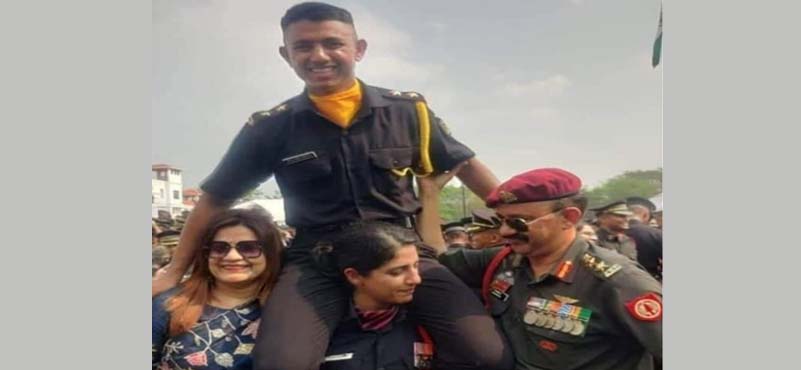
Through a powerful image of a sister in uniform lifting her newly commissioned brother, the article reflects on pride, sacrifice, evolving roles, and conscious choice.
The Moment That Becomes a Legacy
Some photographs capture joy. Some capture achievement. And once in a rare while, a photograph captures inheritance. A young officer, freshly commissioned, is lifted high in celebration—not by friends or course-mates, but by his sister, herself in uniform. To one side stands their father Col Sanjay Washington, a decorated soldier whose quiet bearing reflects years of service. Beside him, the mother smiles—her pride shaped by sacrifice, patience, and resilience. This is not merely a family celebrating success. It is a family witnessing continuity.
In that single frame, the past, present, and future of service converge. The father represents lived experience, the sister embodies the present commitment, and the young officer symbolizes the future. The mother, often unseen in such narratives, anchors them all. This is the essence of “Legacy in Uniform.”
The Cost, The Courage, The Continuum
In many Indian military families, service is not just a career—it is a way of life. Children grow up in cantonments where discipline is routine, where stories of courage replace folklore, and where the uniform is not distant—it is personal. Values are not formally taught; they are absorbed:
- The dignity of routine.
- The meaning of responsibility.
- The quiet acceptance of hardship.
For such families, joining the Armed Forces is rarely an impulsive decision. It is shaped over years of exposure, observation, and inspiration. Yet, it is important to acknowledge:
This is not a universal reality across all military households. It is a symbolic representation of certain families where tradition evolves into a shared ethos of service. Legacy here is not compulsion. It is conviction carried forward.
A Sister, A Soldier, A Symbol of Change
The image of a sister lifting her brother carries a deeper symbolism—it reflects the changing face of military legacy in India. Traditionally, such narratives were linear: father to son. Today, they are inclusive and evolving. The sister in uniform represents:
- Experience earned through her own journey.
- Strength shaped by training and service.
- Equality in responsibility and honour.
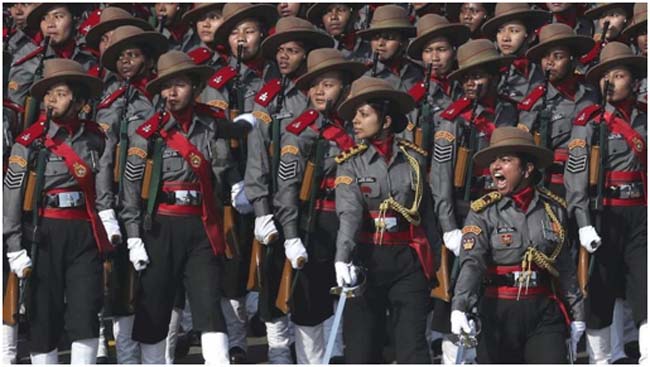
She is not standing behind her brother, nor merely celebrating him. She is welcoming him into a life she already understands. This moment quietly challenges old assumptions. It tells us that legacy is no longer defined by hierarchy or gender, but by shared commitment. In lifting her brother, she is not just celebrating his success—she is affirming his entry into a responsibility she already carries.
The Father: Where Legacy Begins Quietly
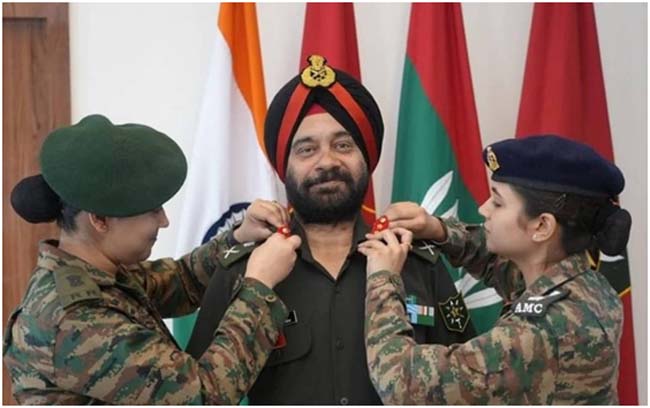
For a father serving in Armed Forces, such moments are deeply personal. A soldier himself, he has lived the realities that his children are now stepping into. His pride is unmistakable—but measured. Soldiers are trained to contain emotion, and that discipline reflects even in moments of joy. What he witnesses here is rare:
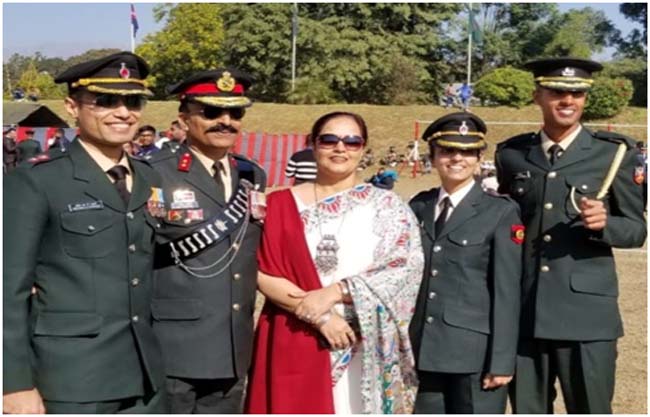
- Not one, but two daughters in uniform.
- Not aspiration, but achievement.
- Not hope, but continuity fulfilled.
And yet, beneath this pride lies a silent understanding. Every soldier-parent knows that service carries risk. To see one child choose it is significant. To see more than one is both a matter of honour and a renewed acceptance of uncertainty. Legacy, therefore, is not just pride passed on. It is also courage to let the next generation walk the same path.
The Mother: Silent Architect of Strength
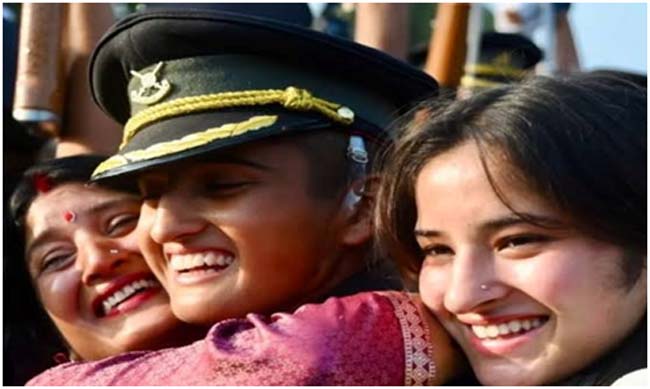
Often missing from formal narratives, yet central to every story of service, is the mother. She does not wear rank. She does not command troops.
But she sustains the very foundation on which such legacies are built. Her life is shaped by:
- Frequent relocations.
- Long separations.
- The responsibility of holding the family together.
In similar stories, she supports not one, but two children into uniform. Her pride is layered—with joy, relief, and an understanding of what lies ahead. Every uniform carries a story stitched at home—and it is often the mother who weaves it together.
Stories That Go Beyond One Family
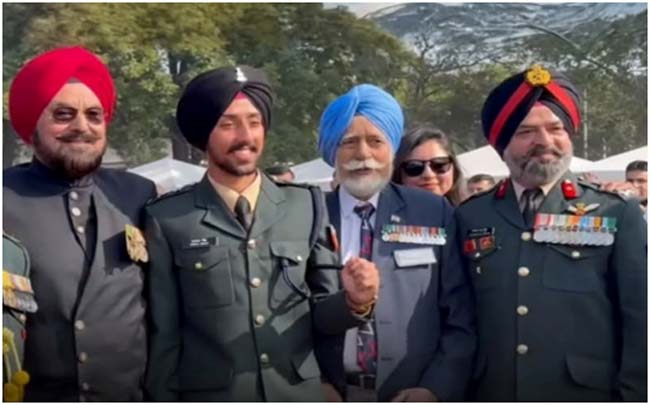
The story in this image is powerful—but not singular. India has witnessed extraordinary examples of military legacy:
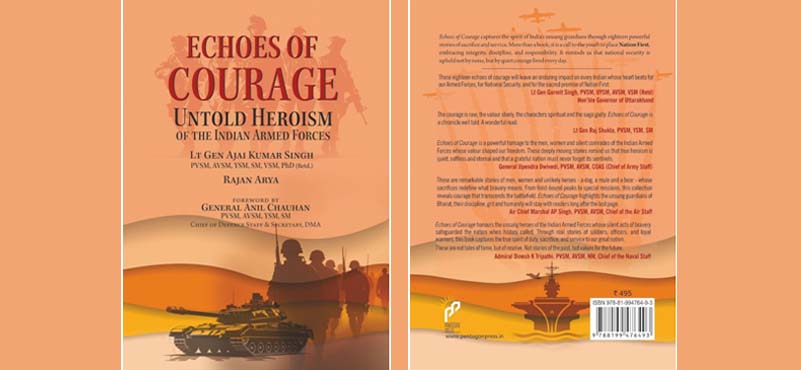
- Lt Gen Ajai Singh represents a rare lineage of five generations in service, each shaped by different eras yet united by a shared commitment.
- Brig Vinod Dutta comes from a family that has produced 19 officers and holds a Limca Book of Records for having the highest number of officers serving in the Indian Armed Forces.
These are not coincidences. They are outcomes of environments where:
- Service is respected deeply.
- Discipline is lived daily.
- The uniform is understood intimately.
Such families contribute not just individuals, but an enduring ethos of Continuity and Character.
Why Legacy Endures
Legacy in uniform continues not because it is expected—but because it is experienced. Young individuals growing up in such environments develop:
- Familiarity with military life.
- Respect for its values.
- Emotional connection to service.
They do not romanticize the uniform—they understand it. At the same time, modern India has brought a crucial shift:
- Legacy is no longer binding.
- Children are free to choose their own paths.
And yet, many still choose service. That choice—made with full awareness—is what makes legacy meaningful.
Beyond Profession: When Service Becomes Identity
Identity is the most visible part of military legacy. Behind every photograph of celebration lies a quieter, more enduring reality—one that rarely finds its way into public memory. Service is not defined by parades or ceremonies. It is lived in:
- Departures before dawn.
- Phone calls that are brief and often delayed.
- Festivals marked by absence rather than togetherness.
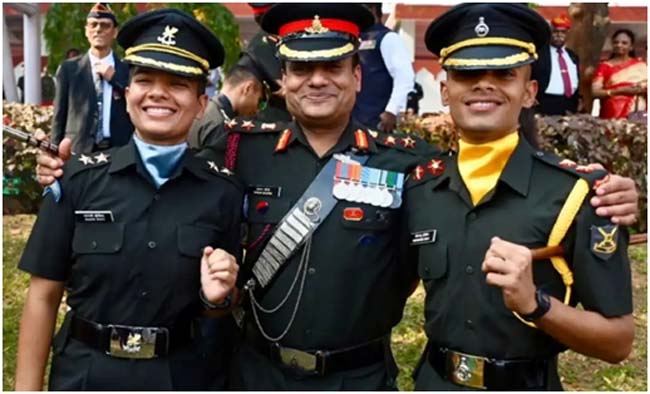
For families where more than one member serves, this reality does not divide—it multiplies. A mother waits for two updates instead of one. A father carries pride balanced carefully with concern. Siblings understand distance not as exception, but as routine.
And yet, there is no sense of complaint. Because in such homes, sacrifice is not extraordinary—it is accepted as part of duty. Legacy, therefore, is not merely the passing down of honour. It is the repeated acceptance of its cost.
Emotional Architecture of a Fauji Family
Military families are built differently. Not visibly—but fundamentally. They function on a delicate equilibrium:
- Strength without display.
- Emotion without indulgence.
- Attachment without dependency.
Children grow up learning adaptability early:
- New schools, new cities, new friendships.
- The ability to say goodbye without hesitation.
- The discipline to carry on without disruption.
Parents evolve into quiet pillars:
- Offering stability amid constant change.
- Shielding anxiety behind composure.
- Allowing their children to choose service, even when they understand its risks fully.
Over time, the family itself becomes a unit of resilience. In legacy families, this resilience is not accidental. It is cultivated, observed, and internalised across generations.
The sister who lifted her brother in that defining moment is part of this structure. She embodies both its strength and its continuity. And the brother she lifted will, in time, come to understand what truly supports him—not just family, but the values that precede him.
Legacy in a Changing India: Choice Over Expectation
One of the most significant transformations in modern India is the evolution of legacy itself. It is no longer a path dictated by family tradition. It is a choice made with awareness. Children of military families today grow up with:
- Access to diverse careers.
- Exposure to global opportunities.
- The freedom to define their own journeys.
And yet, many still choose the uniform. Not because they must—but because they want to. This distinction is crucial. The sister in our story chose her path despite knowing its demands.
Her brother followed—not under expectation, but through conviction. This is what makes legacy relevant today: It is not inherited blindly. It is embraced consciously.
Final Reflection
Some inherit wealth. Some inherit name. And some inherit a calling. In families like these, the uniform is not merely worn—it is understood.
Not simply respected—it is lived. Legacy in uniform is not about how many serve. It is about why they serve—and how that purpose endures.
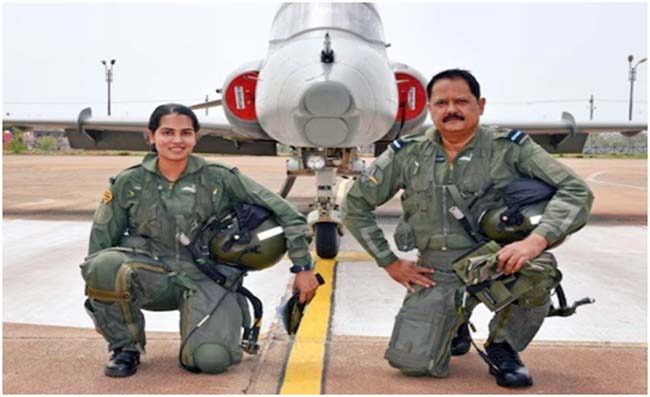
In that single moment, a family did not just celebrate a commissioning— they reaffirmed a covenant with the nation.
(Author’s Note: The examples quoted in the article, remarkable as they are, do not claim to represent the entirety of India’s armed forces. They are symbolic—glimpses into a deeper and quieter tradition that exists across countless families, where service is not an isolated choice but a shared legacy. Many such stories remain undocumented, lived with humility rather than recorded for recognition.)
ABOUT THE AUTHOR
Lt Gen Rajeev Chaudhry (Retd) is a social observer and writes on contemporary national and international issues, strategic implications of infrastructure development towards national power, geo-moral dimension of international relations and leadership nuances in changing social construct.