Introduction: The New Strategic Paradigm
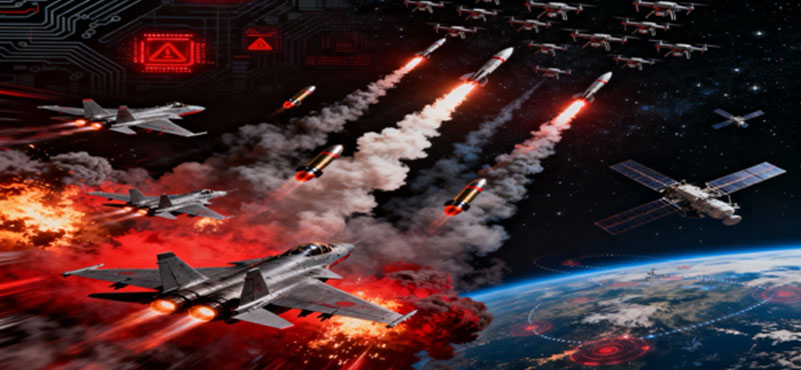
The wars of the twenty-first century are increasingly being shaped by the trajectory of missiles, the persistence of rockets, and the saturation of drones rather than conventional manned aircraft alone. From the frozen plains of Eastern Europe to the scorched deserts of West Asia, modern conflicts have fundamentally demonstrated that the ability to detect, track, and intercept incoming projectiles is no longer just a technical niche—it is the central pillar of national security.
In recent years, fighting across West Asia has particularly highlighted the existential importance of missile defence. Massive, multi-vector barrages consisting of thousands of rockets, low-flying cruise missiles, and suicide drones have tested the world’s most sophisticated defensive systems to their breaking point. These conflicts have tested Israeli innovations like the Iron Dome and Arrow series as also the American Terminal High Altitude Area Defence (THAAD) and the venerable MIM-104 Patriot.
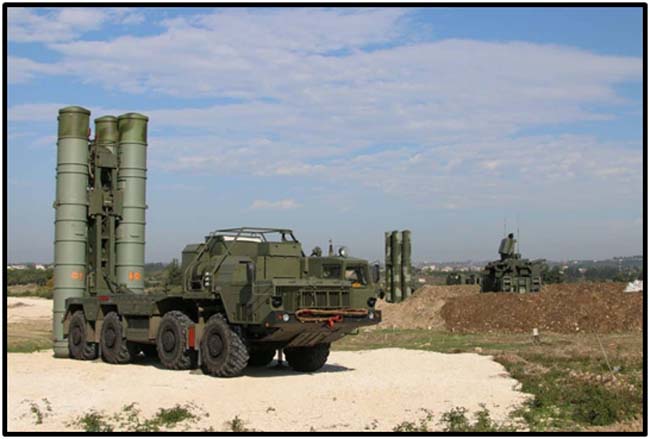
Simultaneously, the Indo-Pacific region is witnessing a parallel arms race. Operation SINDOOR (May 2025) validated India’s layered air defence architecture. Managed by the Akashteer digital “brain,” the system integrated the long-range S-400 for strategic deterrence with Akash and MRSAM for medium-range threats. Crucially, India utilized a “low-high” cost-mix, employing L-70 guns and Schilka units to neutralize 600+ drones, preserving expensive missiles. This network-centric approach ensured a 360-degree shield, successfully protecting critical infrastructure through automated threat prioritization and real-time coordination. The emerging picture of 21st-century combat is clear: warfare is increasingly defined by the kinetic and electronic contest between offensive saturation and defensive shields.
The Layered Air Defence
To understand the complexity of modern shields, one must understand the “Layered Architecture.” No single system can provide a silver bullet against all threats. Instead, military planners use a tiered approach, where different systems intercept threats at specific altitudes, ranges, and phases of flight. Typically, a comprehensive missile defence network includes:
- Long-Range Interceptors (Exo- atmospheric): These are the high-altitude sentinels. They are designed to destroy Medium and Intermediate-Range Ballistic Missiles at very high altitudes, often in space, during their mid-course phase.
- Medium-Range Air Defence (MRAD): These systems are the workhorses of the network. They target manoeuvring fighter aircraft, subsonic and supersonic cruise missiles, and tactical ballistic missiles as they re-enter the atmosphere.
- Short-Range and Point Defence Systems: Acting as the final line of defence, they protect high-value targets—such as cities, airbases, and nuclear plants—from incoming rockets, artillery shells, and small drone swarms.
Countries that successfully integrate all three layers create a synergistic multi-tier shield. If a threat leaks through the long-range outer layer, the medium and short-range layers stand ready to neutralize it. This redundancy significantly reduces vulnerability to complex, multi-modal aerial threats.
Israel’s Iron Dome: A Revolutionary Solution to Asymmetric Threats
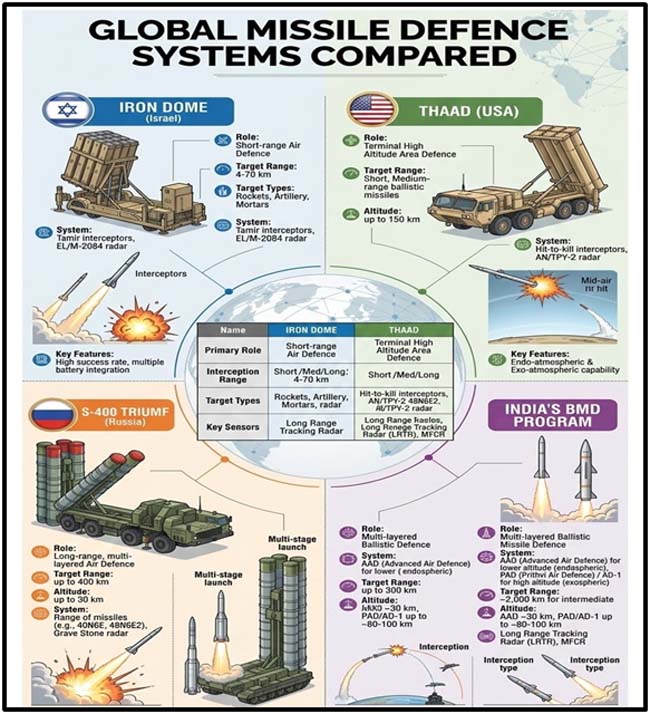
Among modern air defence systems, Israel’s Iron Dome is perhaps the most globally recognized. Developed by Rafael Advanced Defence Systems and Israel Aerospace Industries after years of relentless rocket fire from non-state actors in Gaza and Lebanon, the system became operational in 2011. Since then, it has rewritten the rules of urban protection.
How Iron Dome Operates
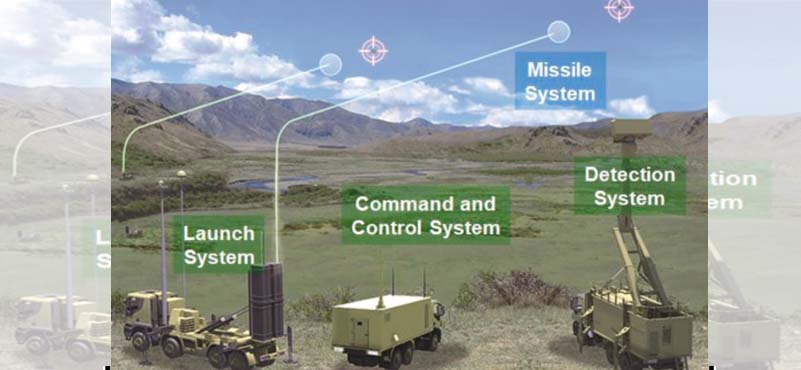
Iron Dome is a masterpiece of selective logic. It consists of three primary components:
- Detection Radar (EL/M-2084): A Multi-Mission Radar that detects incoming projectiles and tracks their path.
- Battle Management & Control: The “brain” of the system. In milliseconds, it calculates the predicted point of impact of the projectile.
- Tamir Interceptor Missiles: Highly manoeuvrable missiles equipped with electro-optic sensors.
One of the most remarkable features of Iron Dome is its Economic Selective Interception. If the system calculates that a rocket is headed for an unpopulated field or the sea, it ignores it. It only fires a Tamir interceptor (costing roughly $40,000–$50,000) if a “populated or protected” zone is at risk. This preserves ammunition and lowers the overall cost of the conflict. Israel claims interception rates exceeding 85–90% under typical operational conditions.
Performance and Limitations in Recent Conflict
Though the Iron Dome has demonstrated an ability to intercept dozens of rockets simultaneously, however, recent large-scale conflicts have revealed its Achilles’ heel – Saturation. When an adversary launches hundreds or thousands of rockets in a single coordinated salvo, the “interception capacity” of the missile battery can be stretched. When the data surge between the radar and the command centre exceeds a threshold, the system chokes. The launchers in turn are “left blind,” awaiting strike orders. In such a situation, some projectiles will inevitably slip through. This has led to an ongoing “numbers game” between the offensive rockets and the capacity of the defensive interceptor.
THAAD: The High-Altitude Kinetic Guardian
While Iron Dome handles short-range threats, the United States developed THAAD to counter more lethal ballistic missiles. THAAD is designed to intercept missiles during the terminal phase of their flight—the moment they begin their descent back towards the target.
Key Features and Kinetic Impact
Unlike traditional systems that use explosive blast-fragmentation warheads, THAAD employs “Hit-to-Kill” technology. The interceptor collides directly with the incoming missile, using nothing but pure kinetic energy to pulverize the threat. This is particularly effective against missiles carrying unconventional warheads, as the high-speed collision ensures the destruction of the payload.
A typical THAAD battery is a massive logistical undertaking, including:
- AN/TPY-2 Radar: One of the world’s most powerful mobile X-band radars, capable of seeing deep into enemy territory.
- Mobile Launchers: Usually truck-mounted for rapid redeployment.
- Command & Control, Battle Mgt and Communication Units: These integrate THAAD with other systems like the Aegis (sea-based) or Patriot (land-based). They collect information, analyse threats, assign interceptors and communicate orders to missile batteries and radars in real time.
Global Strategic Deployment
THAAD is more than a weapon; it is a diplomatic tool. Its deployment in South Korea (to counter North Korean threats), Guam, and the United Arab Emirates has shifted regional power dynamics. In the Gulf, THAAD has been integrated into a broader network to protect energy infrastructure from hostile ballistic missiles.
Patriot: The Global Backbone of Air Defence
The MIM-104 Patriot remains the most prolific and combat-proven air defence system in the Western world. Originally designed in the 1960s and 70s as an anti-aircraft system to counter Soviet bombers, the Patriot has undergone continuous evolution. Its modern versions, such as the PAC-3, developed by Lockheed Martin, are dedicated missile interceptors.
The Patriot’s longevity is due to its adaptability. It has seen service in the Gulf War, the Iraq War, Saudi-Yemen border conflicts, and most recently, the high-intensity war in Ukraine. Despite its age, its ability to integrate with satellite data and modern radars makes it a formidable opponent for cruise missiles. However, the system is notoriously complex to operate and requires a massive logistics tail, making it a “strategic” rather than a “tactical” asset.
India’s Strategic Shield: The Rise of Sudarshan Chakra
India’s security environment is arguably the most complex in the world. Facing a “two-front” threat from adversaries possessing diverse missile and drone inventories, India has transitioned from purchasing off-the-shelf systems to building a comprehensive, indigenous National Air Defence Architecture.
Operation SINDOOR (May 2025): A Watershed Moment
The effectiveness of India’s modernized, multi-layered Air Defence was put to the ultimate test during Operation SINDOOR in May 2025. This conflict served as a major validation of the “Shield and Sword” philosophy.
- Massive Drone Interception: The most significant takeaway was the thwarting of a massive drone offensive. Over 600 drones and loitering munitions were neutralized. India used a clever “cost-mix” strategy: instead of using million-dollar S-400 missiles on $20,000 drones, they utilized upgraded L-70 anti-aircraft guns and Schilka Air Defence gun systems.
- The Role of Akash Teer: This was the debut of the Akash Teer system—an automated, digitized “brain” that networked every radar and gun in the theatre. It allowed for a real-time “Composite Air Situation Picture,” preventing friendly fire and ensuring that the most appropriate weapon was used for each specific threat.
- Indigenous Success: The Akash missile system demonstrated stellar performance, proving that Indian-made hardware could hold its own against high-speed intruding aircraft and large unmanned aerial vehicles.
Mission Sudarshan Chakra: The AI-Enabled Future
Announced by Prime Minister Sh. Narendra Modi on August 15, 2025, Mission Sudarshan Chakra is India’s decade-long plan for an AI-driven Integrated Air Defence System (IADS).
- Layered Integration: It combines the long-range S-400 Triumf (re-christened Sudarshan Chakra in India) and the upcoming Project Kusha (indigenous long-range and short-range) surface to air missiles.
- The AI Advantage: Sudarshan Chakra isn’t just about missiles, it uses AI to fuse data from satellites, Airborne Warning & Control Systems, and ground radars to detect stealth aircraft and hypersonic threats.
- Strategic Deterrence: By creating a “no-fly zone” over critical infrastructure, India has significantly raised the cost of aggression for any regional adversary.
The Cost-Asymmetry Dilemma: A Strategic Crisis
One of the most pressing challenges in modern air defence is the economic imbalance. This is the “interceptor vs. threat” cost ratio.
- A “Grad” rocket or a “Shahed”-style drone might cost between $500 and $20,000.
- A single interceptor missile (Tamir, Patriot, or S-400) can cost anywhere between $50,000 and $3 million.
In a war of attrition, an adversary can bankrupt a defender simply by launching cheap “junk” projectiles to deplete the latter’s inventory of expensive interceptors. This strategic dilemma has forced a pivot toward new, low-cost-per-shot technologies.
The Next Frontier: Lasers, AI, and Hypersonics
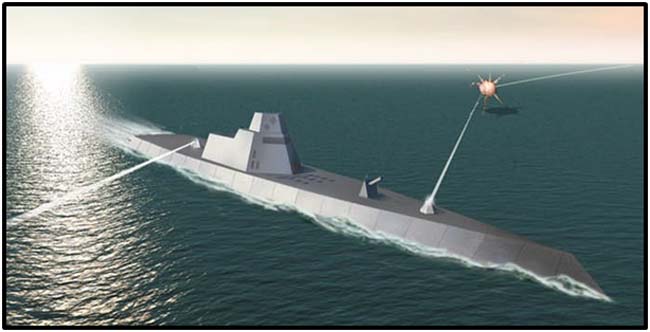
Directed Energy Weapons. Israel’s Iron Beam represents the future. By using a high-energy laser to “cook” an incoming rocket or drone until it explodes, the cost per shot drops to essentially the price of the electricity used. Lasers offer an “Infinite Magazine,” provided there is a stable power supply. While limited by atmospheric conditions (dust, rain, and fog), they are the primary solution to the cost-asymmetry problem.
The Hypersonic Threat. The emergence of Hypersonic Glide Vehicles like the Russian Avangard or Chinese DF-17 has thrown a wrench into traditional air defence. These weapons travel at speeds exceeding Mach 5 and can manoeuvre mid-flight. Traditional ballistic missile interceptors, which rely on predictable parabolic paths, struggle to track them. The next decade will see a race to develop space-based sensors and “hyper-velocity” interceptors to counter this threat.
Artificial Intelligence and Swarm Defence. The future of air defence is too fast for human reaction times. AI is now being used to manage “Swarm vs. Swarm” combat. In this scenario, an AI-driven command centre would deploy its own defensive drone swarms to collide with incoming offensive swarms, creating a dynamic, cloud-based shield that evolves in real-time.
Conclusion: The New Arms Race in the Sky
The conflicts of the past decade have fundamentally altered the calculus of war. Missile and drone technology have democratized precision strike capabilities, allowing even non-state actors to threaten sovereign nations. In response, air defence systems have moved from the periphery of military strategy to the very centre.
As the airspace becomes increasingly contested, a nation’s ability to defend itself from above is as important as its offensive capabilities. Whether it’s Iron Dome shielding cities, Patriot neutralizing hypersonic missiles, or Arrow-3 shooting threats in space — the race for aerial supremacy is being decided not just in the skies, but in radar control rooms and missile launchers worldwide. Looking ahead, next-generation technologies – including lasers, high-powered microwaves, and smarter kinetic interceptors – are shaping a more cost-efficient and adaptable defence grid. As stealth jets, drones, and hypersonics become more prevalent, nations must continue evolving their layered defence approach.
For countries like India, the lesson of Operation SINDOOR and the promise of Sudarshan Chakra is clear: Strategic Autonomy requires Defensive Sovereignty. No nation can be truly secure if it relies on a single layer of protection or exclusively on foreign technology. The future battlefield will be a complex web of missiles, lasers, AI, and space-based sensors. In this era of high-speed, long-range precision weapons, the contest between the offensive missile and the defensive shield has become the defining military competition of our time.
The shield is no longer just a piece of armour; it is a sentient, networked, and multi-layered digital canopy that determines whether a nation stands or falls.
ABOUT THE AUTHOR
 Lt Gen Tarun Chawla, was commissioned into the Regiment of Artillery in Jun 1984. He has served with the United Nations Mission in Liberia and has been an instructor at the College of Defence Management at Secunderabad. The officer has commanded an Artillery Brigade in the LC Sector in J&K, and an Artillery Division as part of Army’s Western Command. He was the Director General Financial Planning, prior to assuming the role of Director General of Artillery.